CPT code 21011: Excision of soft tissue tumor of the face
CPT code 21011: Official descriptor and procedure overview CPT code 21011, as pu...

Last Updated: Oct 8, 2026
S0137 is the HCPCS Level II code for didanosine (ddi), 25 mg.
Let Pabau's smart automation suggest the right codes, reduce claim denials, and keep your practice compliant—effortlessly.
Automate repetitive tasks and focus on what matters most—your patients.
Reduce coding errors and ensure compliance with the latest regulations.
Clean claims, fewer denials, and faster reimbursements.
Powerful insights and reporting to help your practice thrive.
HIPAA compliant SOC 2 certified GDPR-compliant Trusted by 4,000+ clinics worldwide

HCPCS Code S0137 covers didanosine (ddI) 25 mg, an NRTI antiretroviral used in HIV treatment regimens.
S-series codes are not covered by Medicare Part B. Medicaid and commercial acceptance varies by state and plan.
No HCPCS code exists for the other didanosine strengths, which are billed through NDC-based methods instead.
Claims need documented medical necessity, an HIV diagnosis such as ICD-10 B20 or Z21, and the prescription record.
Practice management software like Pabau applies payer-specific S-code rules when the claim is created.
HCPCS Code S0137 is a Level II temporary national code representing didanosine (ddI), 25 mg. It reports the dispensing or administration of that antiretroviral to a patient.
The code belongs to the HCPCS S-series, which runs from S0012 through S9999. These temporary codes sit within CMS’s HCPCS Level II framework, and AHIP administers them for Medicaid and private payers.
S-codes sit outside the CMS-maintained permanent national code set, so Medicare does not recognize or reimburse them. Coverage is decided at the payer level. Billers have to confirm acceptance before submitting a claim carrying S0137.
S0137 didanosine refers specifically to the 25 mg strength formulation of didanosine, a nucleoside analogue reverse transcriptase inhibitor. The drug incorporates into viral DNA and terminates chain elongation, which blocks HIV replication.
It has been FDA-approved for HIV treatment since 1991, and it still appears in some regimens where other agents cause treatment-limiting toxicities.
The 25 mg strength is the only didanosine formulation with its own HCPCS code. No S-code exists for the 50 mg, 100 mg, 150 mg or 200 mg strengths.
The codes either side of S0137 belong to unrelated drugs, S0136 to clozapine and S0138 to finasteride. Where a payer needs a different didanosine strength reported, it reaches the claim through NDC-based methods rather than a second S-code.
Medicare Part B does not cover HCPCS S-series codes. CMS applies that across the whole series rather than code by code, so no S-code is a valid Medicare claim code. Submitting S0137 to a Medicare fee-for-service plan produces an automatic denial.
Running insurance eligibility verification before the claim is built catches Medicare patients ahead of submission. That check costs a minute and saves a denial that cannot be appealed on its merits.
Medicaid coverage varies by state program. Many state Medicaid plans do accept S-codes, particularly for HIV drugs the state formulary supports. Coverage is not universal, though, and some states use J-codes or NDC-based billing for antiretrovirals instead. Check the state Medicaid billing manual before assuming coverage.
S0137 reimbursement rates are not set by a CMS fee schedule, because Medicare does not cover S-codes. Each accepting payer prices the drug individually. The basis is usually average wholesale price (AWP), wholesale acquisition cost (WAC), or a negotiated contract rate.
AWP figures move with the market, and the antiretroviral market has changed a great deal since didanosine launched. Verify any amount you find in a static reference against the payer’s current fee schedule or contract. Medicaid often pays a percentage of WAC, or a rebate-adjusted rate that differs by state.
Before billing S0137, call the payer’s provider line or check the online portal to confirm the current allowable amount for didanosine 25 mg. AWP-based reimbursement can shift quarterly, and submitting at an outdated rate may trigger a recoupment request after payment.
Billing S0137 correctly comes down to matching the claim form to what each accepting payer expects. The claims management software a practice uses should support HCPCS Level II S-code entry on the CMS-1500 form. Manual entry carries the highest risk of unit-quantity errors, a common denial trigger for drug-administration codes.
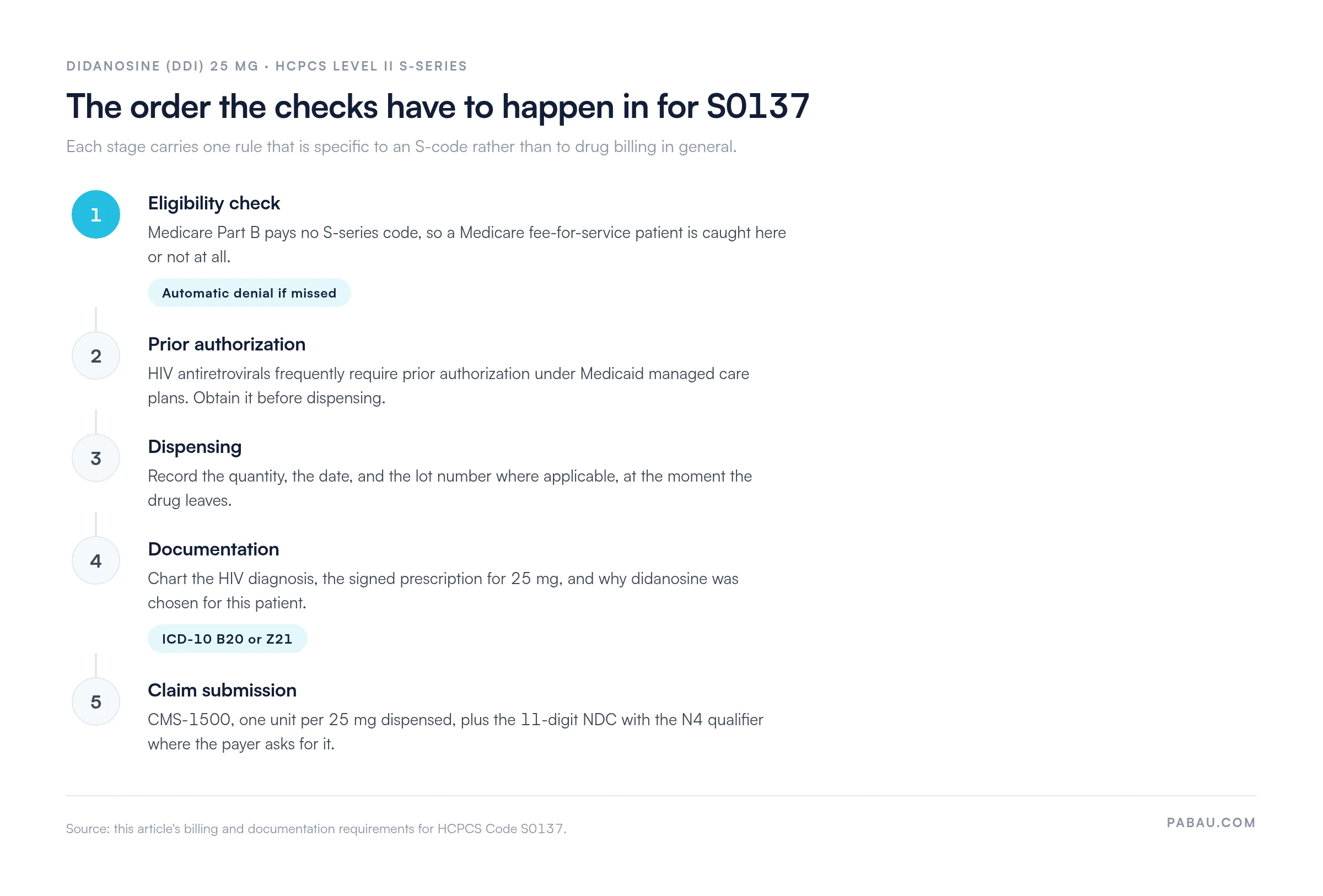
Those checks only work in one order, because each one decides whether the next is worth doing. The sequence runs from eligibility check through to claim submission.
Every S0137 claim has to be supported by a documented clinical record. Missing or vague documentation is the leading cause of post-payment audits and recoupments on antiretroviral drug claims.
Building these steps into the clinical workflow, rather than leaving them to the billing stage, keeps the record complete while the visit is still open. Records also have to be kept for the payer’s audit window, which runs to six years at the federal level.
Every claim for S0137 must carry at least one ICD-10-CM diagnosis code establishing medical necessity. Didanosine is an HIV antiretroviral, so those codes almost always describe HIV disease or an HIV-related condition. An unsupported diagnosis code can trigger denial and, under payer audit, recoupment.
ICD-10-CM guidelines tell coders to sequence B20 as the principal diagnosis when a patient is seen for an HIV-related condition. Z21 applies only while the patient is asymptomatic. Confirm HIV status with the treating clinician before submission, since miscoding it can cause payer disputes and reportable compliance findings.
Didanosine is one of several antiretrovirals with an HCPCS S-series code. Adjacency in the code set means nothing clinically, though, so a biller cannot reason from one S-code to its neighbor.
Our HCPCS codes hub groups the codes by family, and the AAPC HCPCS Level II lookup confirms a specific descriptor.
When a patient’s regimen switches from oral didanosine to a long-acting injectable, the applicable J-code replaces S0137 on the claim. The two series are not interchangeable, and payer coverage logic differs sharply between them.
S-series codes and J-codes both report drugs on professional and facility claims. They differ in who maintains them, who covers them, and how reimbursement is set. Knowing the distinction prevents coding errors when a practice’s formulary holds both.
For a practice billing both S0137 and J-coded injectable antiretrovirals, staff training on the distinction prevents one costly habit. That habit is submitting an S-code to Medicare and waiting for a payment that never arrives.
The Integrated Outpatient Code Editor (IOCE) is CMS’s claim-editing tool for hospital outpatient claims under the Outpatient Prospective Payment System (OPPS). It validates codes, assigns status indicators, and flags discrepancies before a claim is adjudicated.
For S0137 the consequence is short. Medicare does not cover S-series codes, so the IOCE flags the line on a Medicare outpatient claim as non-covered, and the claim generates no reimbursement.
On non-Medicare outpatient claims, processing depends on the payer’s own code editor configuration. Some commercial payers and Medicaid managed care organizations run IOCE-equivalent tools with different status indicators for S-codes. Confirm with each payer that their editor recognizes S0137 before submitting facility-based outpatient claims.
Run a test claim for S0137 with each new Medicaid or commercial payer before activating the code in your billing workflow. A test remittance confirms whether the payer’s code editor accepts the S-code and at what allowable amount, saving costly retroactive corrections.
In most practices, S-code knowledge lives in one biller’s head or in a shared spreadsheet. They remember which state Medicaid plan takes S0137 and which one wants the NDC, and the rest gets rechecked by phone. When that person is on leave, claims either sit in a queue or go out wrong.
Practice management software like Pabau stores those rules against the payer instead. A claim line picks up the payer’s S-code policy, the NDC requirement, and the prior authorization flag as the claim is built. Your biller sees the requirement before the claim leaves, not on the remittance three weeks later.
Denials land back in the same system. Pabau tracks denial reasons by code. A run of rejections on S0137 from one plan then reads as a pattern, not as a handful of separate write-offs. That is the difference between fixing a payer setup once and absorbing the same denial every month.

Pabau’s claims management tools store payer-specific rules, capture NDC requirements, and submit clean claims for HCPCS S-codes. Your billers stop rechecking the same payer policy by phone.

S0137 pays only where the payer has agreed to accept the S-series. That makes eligibility, not submission, the point where the outcome is decided.
Practices that treat the payer check as part of dispensing rarely see these claims come back. Practices that treat it as a billing task absorb the denials instead, and by then the drug has already left the shelf.
S-codes buy a precise drug descriptor at the cost of universal coverage, and that trade-off is not going to change. Keeping each payer’s policy current is what makes the descriptor worth using. Book a demo to see how Pabau keeps S-code policy, NDC requirements and denial history in one place.

Need a framework for reducing claim denials on drug codes? Denial management in healthcare covers strategies for identifying root causes and fixing upstream coding errors.
Want to see where HCPCS fits in the billing lifecycle? What is revenue cycle management explains the process from eligibility check to payment posting.
Running billing compliance for an HIV or specialty drug program? Medical billing compliance sets out the record-keeping that holds up during a payer audit.
Want fewer claims coming back at all? Clean claim submission explains what a payer needs on the claim line the first time.
HCPCS Code S0137 bills for didanosine (ddI), 25 mg, an antiretroviral NRTI. It covers the drug dispensed or administered as part of an HIV or AIDS treatment regimen. It is a temporary HCPCS Level II S-code, accepted by Medicaid programs and commercial payers that recognize the S-series.
No. Medicare Part B does not cover any HCPCS S-series codes, including S0137. Medicare does not recognize S-codes as valid claim codes, so submission to Medicare fee-for-service results in automatic denial. Patients with Medicare coverage for antiretrovirals may reach the drug under a Part D pharmacy benefit. That coverage is not billed using HCPCS S-codes.
S0137 is a temporary national HCPCS Level II code, not a permanent one. Temporary S-series codes are maintained by AHIP rather than CMS, which is why Medicare does not cover them. Their active status can change in annual HCPCS updates, so verify against the current CMS annual release file each year.
No. S0137 is the only HCPCS code for didanosine, and it describes the 25 mg strength. The codes either side of it cover unrelated drugs, S0136 for clozapine and S0138 for finasteride. Other strengths reach the claim through NDC-based billing rather than through a second S-code.
Medicaid programs in many states and most commercial payers accept S-series codes such as S0137. Acceptance is not universal. Some state Medicaid programs use NDC-based billing or J-codes for antiretrovirals instead. Always verify with the payer or the state billing manual before submitting an S-code claim.
Five records support an S0137 claim. The chart must confirm the HIV diagnosis behind B20 or Z21 co-billing. A licensed prescriber must have signed a prescription for didanosine 25 mg. The dispensing record must note the quantity and the date. Clinical notes must establish medical necessity, and any prior authorization number must be retained. Medicaid payers may also require the NDC on the claim form.
S-codes are temporary national codes maintained by AHIP, and Medicare does not cover them. J-codes are permanent national codes maintained by CMS, and Medicare Part B generally covers them. They typically apply to injectable or infusible drugs, reimbursed at ASP plus 6% under Medicare. S-codes apply to oral specialty drugs and are reimbursed at AWP, WAC, or a payer contract rate where accepted.