CCSD code H4430: Examination of rectum under anaesthetic
CCSD code H4430 pays for the examination alone CCSD code H4430 is the UK private...

Last Updated: Oct 20, 2026
L0120 is the HCPCS Level II code for cervical, flexible, non-adjustable, prefabricated, off-the-shelf (foam collar).
Let Pabau's smart automation suggest the right codes, reduce claim denials, and keep your practice compliant—effortlessly.
Automate repetitive tasks and focus on what matters most—your patients.
Reduce coding errors and ensure compliance with the latest regulations.
Clean claims, fewer denials, and faster reimbursements.
Powerful insights and reporting to help your practice thrive.
HIPAA compliant SOC 2 certified GDPR-compliant Trusted by 4,000+ clinics worldwide

HCPCS Code L0120 describes a cervical, flexible, non-adjustable, prefabricated, off-the-shelf foam collar billed under the Medicare DMEPOS benefit.
PDAC approval is required for Medicare reimbursement, so verify the product on the PDAC database before you dispense it.
Every L0120 claim carries NU, RR or UE, and the wrong modifier is a leading cause of denial.
Medicare applies a five-year reasonable useful lifetime, so any earlier replacement needs documented justification.
Practice management software like Pabau keeps the order, the modifier and the proof of delivery on one claim file.
L0120 falls under HCPCS Level II L-codes, the category covering orthotic and prosthetic devices billed as durable medical equipment.
The foam collar it describes is prefabricated and available off the shelf, so it needs no custom fitting or fabrication. That classification matters for billing, because off-the-shelf orthotics carry different documentation and coding rules than custom-fabricated devices.
Physicians order the L0120 collar for neck injuries, post-surgical cervical support, whiplash, and degenerative cervical conditions. The clinical goal is temporary immobilization or pain relief rather than structural correction.
Medicare reimbursement for the foam collar is set through the DMEPOS fee schedule, which the Centers for Medicare and Medicaid Services (CMS) updates annually. Payment rates vary by MAC jurisdiction and locality. They are adjusted each year using the Consumer Price Index for All Urban Consumers.
The table below reflects the general payment structure for L0120 under the 2026 fee schedule. Always confirm current rates on the CMS DMEPOS fee schedule before submitting claims, because allowable amounts differ by locality.
Medicare pays 80% of the fee schedule amount once the beneficiary’s annual deductible is met, and the beneficiary covers the remaining 20% coinsurance. Suppliers in Medicare’s competitive bidding program may see different rates depending on their contract area. Check your own MAC’s schedule before billing.
Download the current DMEPOS fee schedule from CMS at the start of each calendar year. Rates take effect on January 1, so set a reminder and verify L0120 before you process any January claims. Late verification is a quiet source of billing shortfalls.
Medicare covers L0120 under the DMEPOS benefit when the device is medically necessary and properly documented. Coverage sits under the local coverage determinations issued by each MAC, so eligibility criteria vary by jurisdiction. The requirements below apply broadly across Medicare’s DMEPOS policies for cervical orthoses.
Medicare requires that a cervical orthosis be ordered by a treating physician, with the patient’s record supporting clinical need. Common supporting diagnoses include acute cervical strain, whiplash injury, post-surgical cervical stabilization, and degenerative cervical disc disease with radiculopathy.
Check that the wording in the encounter note maps to current ICD-10-CM diagnosis codes before the claim is built.
CMS sets a reasonable useful lifetime (RUL) for orthotics under the DMEPOS benefit. Cervical orthoses take the standard five-year lifetime, measured from the date of issue, under 42 CFR §414.210(f). CMS applies the same five-year figure in RAC review topic 0174.
Medicare will not cover a replacement L0120 inside that window without justification. The supplier has to document that the original device was lost, stolen, or damaged beyond repair, or that the beneficiary’s clinical condition changed materially.
Support every replacement request with a new physician order, a written explanation of the reason, and the supporting clinical notes. Replacement claims inside the RUL without that paperwork are a standing target in Medicare audits and OIG reviews.
The Pricing, Data Analysis and Coding (PDAC) contractor, operated by Palmetto GBA, verifies which products may be billed under a given HCPCS code. For L0120, Medicare requires that the foam collar dispensed be a PDAC-approved product. A collar the PDAC has not coded to L0120 will be denied, however closely it resembles one that has.
Billing L0120 correctly comes down to three things. Select the right modifier, pair the claim with a valid diagnosis code, and submit through a DMEPOS-enrolled supplier account. An error at any of those steps can trigger an automatic denial or a post-payment audit.
Every L0120 claim submitted to Medicare must carry one of three DMEPOS modifiers. The modifier tells the MAC whether the item was purchased new, rented, or supplied as used equipment. Missing and incorrect modifiers are among the most frequent causes of L0120 denials.
L0120 is one of several L-codes covering cervical orthoses under the DMEPOS benefit. Choosing the wrong code for the device dispensed is a billing error with audit consequences. The table below sets out the codes most often confused with L0120.
Billing L0130 when only an off-the-shelf foam collar was dispensed is upcoding. Billing L0120 when a custom-molded thermoplastic collar was supplied is downcoding. Both carry audit risk, so match the code to the device that was actually handed over and recorded in the file.
L0120 extends beyond Medicare. Medicaid, commercial insurers, and workers’ compensation programs each handle the foam collar differently, and none of their rules are interchangeable with Medicare’s.
State Medicaid programs may or may not cover L0120, and their criteria vary widely. Some states adopt Medicare’s DMEPOS coverage policies by reference, while others run separate fee schedules and prior-authorization requirements.
Check your state program’s DMEPOS policy before dispensing. PDAC approval is a Medicare requirement and does not carry over to Medicaid claims automatically.
Commercial payers accept HCPCS Level II codes including L0120, but coverage criteria, prior-authorization rules, and fee schedule rates are plan-specific.
Many plans require pre-authorization for DME before dispensing, so submit a verification of benefits request first. Keep the encounter note, the diagnosis codes, and the device details consistent across every document the payer sees.
Workers’ compensation payers generally accept HCPCS Level II codes, but they operate under state fee schedules that are independent of Medicare rates. Prior authorization is common.
Some programs also require the device to be dispensed through the employer’s preferred supplier network. Confirm the plan’s requirements and billing address before you submit.
L0120 is a simple code that produces a predictable set of denials. Most of them come from a step skipped before submission rather than from the coding itself. Good denial management starts with knowing which check would have caught each one. The sequence below maps six checkpoints to the denial each one clears.
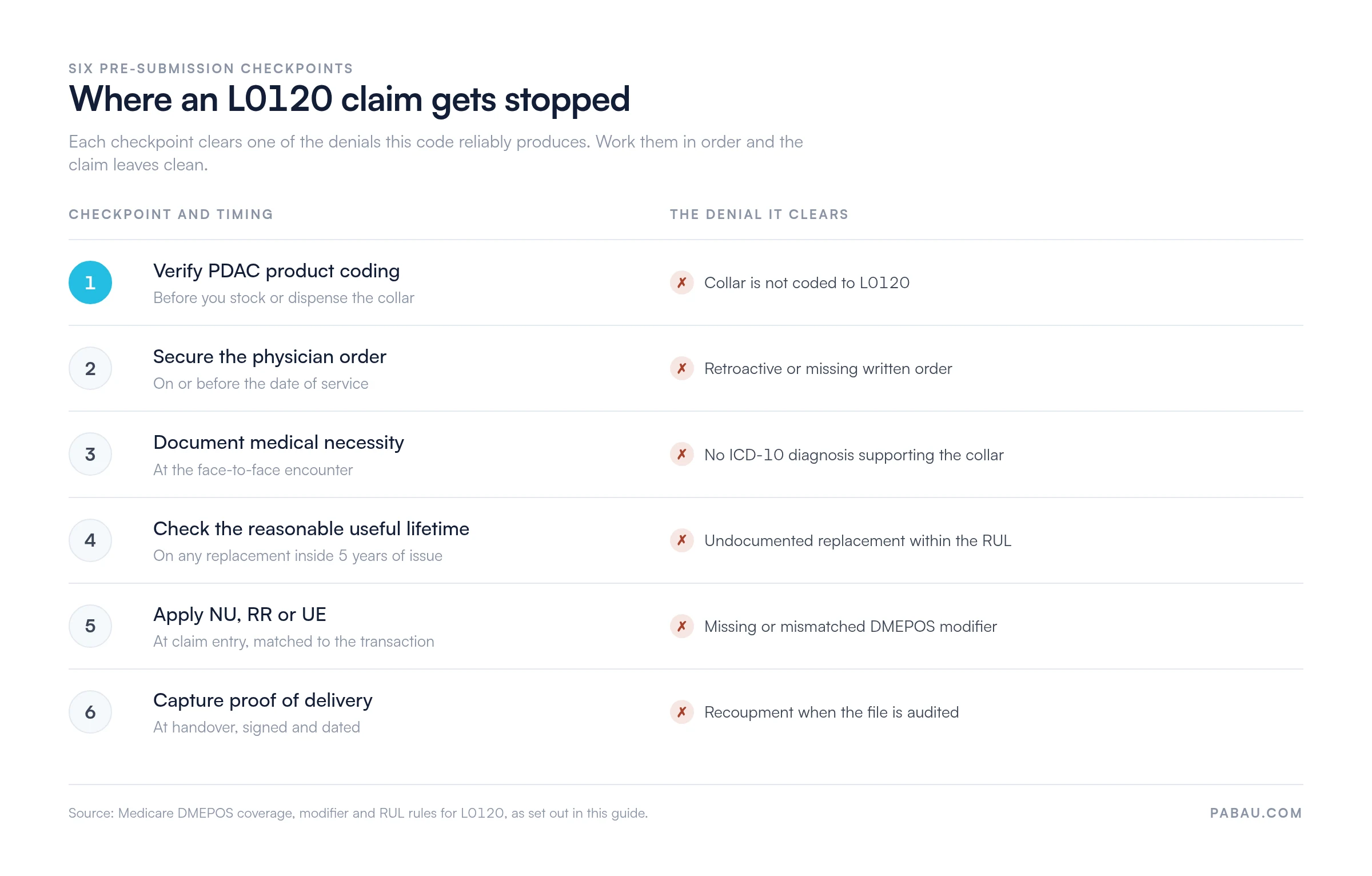
Building a pre-submission checklist into your billing workflow removes most of these denials. Run each L0120 claim against the six items above before it leaves your system. Record the result against the claim, so the answer is still there when an audit arrives.
Run a quarterly audit on the L0120 claims you submitted in the prior 90 days. Check each file for PDAC approval and modifier accuracy. Then confirm a signed delivery record and an order dated on or before the date of service. Fifteen minutes per file removes most of your audit exposure.
Most DMEPOS suppliers hold the pieces of an L0120 claim in separate places. The physician order sits in a fax folder, the PDAC verification in a supplier spreadsheet, and the signed delivery slip in a filing cabinet. When a MAC asks for that file two years later, someone rebuilds it by hand.
Practice management software like Pabau keeps those records against the patient instead of against a folder. The order, the encounter note carrying the diagnosis, the device dispensed, and the delivery confirmation all sit on one timeline.
That record feeds audit-ready claims management software, so the claim is built from the file rather than from memory.
The result is a shorter check before submission. Rather than chasing four documents across three systems, a biller confirms them in one place while the claim is still editable. That is where L0120 denials are cheapest to catch.

Pabau’s claims management software tracks physician orders, proof of delivery, modifier selection, and claim status from a single dashboard. Billing teams can see what is missing before a claim is submitted.

L0120 pays reliably when the file behind it is complete. The collar has to be PDAC-coded, the order has to predate the handover, and the modifier has to match what actually happened. None of those checks is difficult on its own. They fail because suppliers run them after submission rather than before it.
The trade-off worth remembering is time. A four-item check before the claim leaves costs minutes per file. Rebuilding the same documentation for a post-payment audit two years later costs days, and by then the money has usually been spent.
Put the check into your submission workflow rather than into your appeals process. Book a demo to see how Pabau keeps DMEPOS orders, delivery records, and claim status in one place.

Need a broader foundation in DMEPOS billing? What is medical billing explains the revenue cycle that HCPCS claims sit inside.
Want fewer claims coming back at all? Clean claim sets out what a payer needs to see on first submission.
Billing other Medicare items? Medicare billing walks through enrollment, coverage rules and the submission process.
Tightening your audit exposure? Medical billing compliance covers the documentation standards that survive a post-payment review.
HCPCS Code L0120 is the billing code for a cervical, flexible, non-adjustable, prefabricated, off-the-shelf foam collar. DMEPOS suppliers use it to bill Medicare and other payers for dispensing that collar. Typical patients have neck injuries, whiplash, post-surgical cervical conditions, or degenerative disc disease needing temporary cervical support.
Yes. Medicare covers L0120 under the DMEPOS benefit when the collar is medically necessary and carries current PDAC approval. A treating physician must order it after a face-to-face encounter. Coverage sits under MAC-specific local coverage determinations, so check your own MAC’s policy before submitting claims.
Three modifiers apply: NU for a new item purchase, RR for a rental, and UE for used equipment. NU covers the great majority of foam collar claims, and rentals are rare. Every L0120 Medicare claim must carry one of the three or the MAC will reject it.
PDAC approval confirms that a specific foam collar has been coded to L0120 by the Pricing, Data Analysis and Coding contractor, which Palmetto GBA operates. Medicare reimburses suppliers only for products on the current approved list for that code. Verify each product model on the PDAC database before dispensing.
L0120 covers a flexible, non-adjustable, prefabricated off-the-shelf foam collar that needs no custom fitting. L0130 covers a flexible thermoplastic collar molded to the individual patient, which makes it a custom-fitted device at a different rate. Billing L0130 for an off-the-shelf foam collar is upcoding.
Cervical orthoses take the standard five-year reasonable useful lifetime under 42 CFR 414.210(f), measured from the date of issue. Medicare will not cover a replacement L0120 inside that period without justification. The original must have been lost, stolen, or damaged beyond repair, or the patient’s condition must have changed materially. Document the justification and obtain a new physician order.
Yes. Most commercial insurers and workers’ compensation programs accept HCPCS Level II codes including L0120. Coverage criteria, prior-authorization rules, and rates vary by plan and by state. Verify benefits before dispensing, and remember that PDAC approval is a Medicare requirement that does not apply automatically to private payers.