

CCSD code G5100: Bypass of duodenum billing guide
CCSD code G5100 bills a bypass that leaves the duodenum in place CCSD code G5100...

Last Updated: Oct 16, 2026
K0823 is the HCPCS Level II code for power wheelchair, group 2 standard, captains chair, patient weight capacity up to and including 300 pounds.
A power wheelchair claim is one of the most closely scrutinized bills in DME billing: high-value, paid as a capped rental, and an easy target for denial if the seat type or the paperwork is even slightly off. HCPCS code K0823, the group 2 standard captains chair, sits right in the middle of that scrutiny.
Claims fail for predictable reasons: billing the wrong seat variant instead of K0823, a missing face-to-face evaluation or incomplete Certificate of Medical Necessity, or a rental claim submitted without prior authorization already on file. K0823 is also easy to confuse with its sibling codes, which cover different seating options entirely.
Let Pabau's smart automation suggest the right codes, reduce claim denials, and keep your practice compliant—effortlessly.
Automate repetitive tasks and focus on what matters most—your patients.
Reduce coding errors and ensure compliance with the latest regulations.
Clean claims, fewer denials, and faster reimbursements.
Powerful insights and reporting to help your practice thrive.
HIPAA compliant SOC 2 certified GDPR-compliant Trusted by 4,000+ clinics worldwide

HCPCS code K0823 describes a power wheelchair, group 2 standard captains chair, with patient weight capacity up to and including 300 lbs
K0823 is on the CMS DMEPOS mandatory prior authorization list, meaning prior auth must be secured before the device is supplied
Missing or incomplete Certificate of Medical Necessity (CMN) and face-to-face evaluation documentation are the most common K0823 claim denial triggers
Practice management software like Pabau connects clinical documentation directly to billing workflows, helping DME suppliers and allied health providers move face-to-face notes straight through to claim submission without manual handoffs
HCPCS code K0823 is the billing code for a power wheelchair, group 2 standard captains chair, with patient weight capacity up to and including 300 lbs. Specifically, it sits within the HCPCS Level II K-code range (K0813-K0899) reserved for power mobility devices billed under the Medicare DMEPOS benefit.
Group 2 power wheelchairs serve patients who cannot self-propel a manual wheelchair and need a power mobility device to complete mobility-related activities of daily living (MRADLs) within the home.
The “standard captains chair” designation describes the seating system. It sets K0823 apart from codes that specify a single power option, tilt, recline, or alternative seating, such as K0835.
Medicare reimburses K0823 as a capped rental item for the first 13 months, after which ownership transfers to the beneficiary. However, power wheelchairs use a different capped-rental formula than most DME.
CMS pays 15% of the average purchase price per month for months 1-3, then 6% of the average purchase price per month for months 4-13. Standard capped-rental equipment instead uses a 10%/7.5% split.
Fee schedule amounts vary by Medicare Administrative Contractor (MAC) locality. Additionally, geographic price indices adjust them further. Always verify current rates using the CMS DMEPOS Fee Schedule or your MAC’s published fee schedule file. The figures below reflect the general 2026 payment structure; confirm your MAC-specific allowable before billing.
For HCPCS code verification and code range lookups, the AAPC HCPCS code range tool provides a searchable index. Additionally, MAC websites (CGS, Noridian, Palmetto GBA) publish locality-specific fee schedule tables that reflect the allowable amounts for your region.
The applicable Local Coverage Determination (LCD) governs coverage for K0823, typically LCD L33789 for Power Mobility Devices, published by the relevant MAC. Therefore, the claim must meet all of the following requirements before Medicare covers it.
Coverage indicators and non-covered scenarios vary by MAC. Always cross-reference the specific LCD in effect for your jurisdiction before submitting. As a result.
An inventory management tool ties each dispensed item to a patient and a billing code, ending stockroom guesswork.
Incomplete documentation is the single most common audit risk in power wheelchair billing. Your team must collect and retain the clinical records and forms required for a K0823 claim before delivery, not assemble them after a denial.
For higher-tier requests within this code family, such as single power option or Group 3 devices, LCD L33789 requires a specialty evaluation from a qualified professional.
K0823 itself does not carry this specialty-evaluation requirement, but suppliers who also bill for those higher-tier codes should route both evaluations into the same file before submitting the CMN.
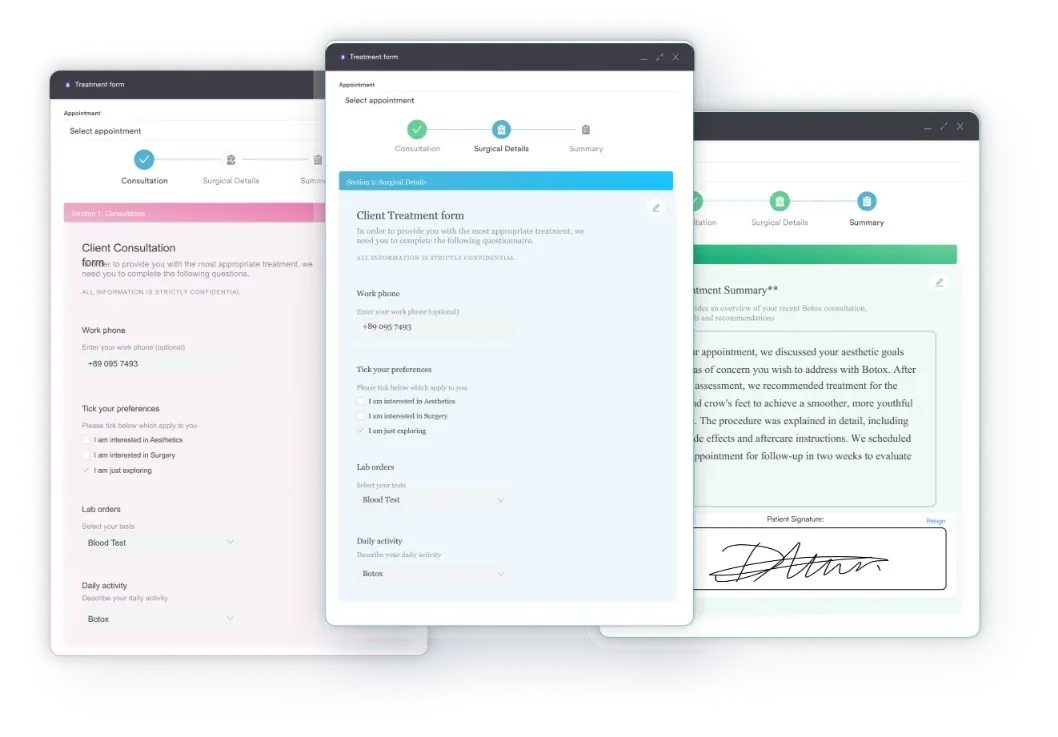
The digital intake forms and documentation workflows in Pabau allow providers contributing to the clinical record to centralize patient notes, evaluation findings, and signed forms in one place, reducing the documentation assembly delays that often trigger denials.
K0823 is on the CMS DMEPOS mandatory prior authorization required list. Prior authorization is not optional and cannot be waived. Submitting a K0823 claim without an approved prior authorization will result in automatic denial.
The PA process works as follows. Confirm current HIPAA-compliant handling requirements for authorization documentation with your MAC before submission, as requirements can vary by jurisdiction.
CMS updates the DMEPOS Required Prior Authorization List regularly, so check the current list on the CMS website and your MAC’s prior authorization page before submitting. If you need to confirm that a specific power wheelchair model correctly maps to K0823, CGS Medicare’s PDAC coding verification lookup tool cross-references manufacturer model numbers against approved HCPCS codes.
Flag K0823 claims in your billing queue the moment a face-to-face evaluation is scheduled, not after it is completed. Starting the prior authorization checklist at the evaluation stage gives your team time to gather documentation, flag missing items, and submit the PA request before delivery is expected. Last-minute PA submissions are the leading cause of delayed device supply for power wheelchair claims.
Modifier selection on K0823 claims directly affects whether the claim processes correctly and at what rate. Applying the wrong rental-month modifier, or omitting a required modifier, is a routine denial cause. The table below covers the most commonly used HCPCS modifiers for K0823.
Modifier logic doesn’t carry across benefit categories. Orthotic and prosthetic management billed under CPT code 97763, for example, follows an entirely different modifier set. Always verify modifier guidance against your MAC’s DMEPOS billing instructions.
Documentation sometimes has to travel with the claim instead of waiting in the file for an audit request. Modifier 22 on a CPT code 23073 claim is submitted with the operative note narrative that justifies the added complexity.
Selecting the wrong code within the Group 2 power wheelchair range is a common error. The table below compares K0823 with adjacent codes to support accurate code selection. For a full searchable list, see the PGM Billing HCPCS lookup tool.

Pabau connects clinical evaluations, digital forms, and billing workflows so your team has every document ready before claim submission, not after a denial.

No competing reference page covers the end-to-end K0823 billing workflow in one place. This is the sequence DME suppliers and billing teams should follow from first patient contact through claim processing. Relevant practice management features appear alongside each step.
Centralizing these steps in a patient records platform that timestamps each document stage greatly reduces the documentation scramble that follows a claim denial or audit request. Pabau’s claims management software supports this end-to-end trail from clinical note to billing submission.
K0823 claims carry high value, and Medicare frequently audits them. The errors below account for the majority of preventable denials. Working through them in order before submission is faster than managing the appeals process after the fact.
K0823 claims fail most often not because the patient lacks medical need, but because the documentation trail breaks down somewhere between the evaluation and the claim. Missing CMN fields, wrong rental modifiers, and skipped prior authorization steps are all preventable with a consistent workflow.
Pabau’s practice management platform helps DME-adjacent providers centralize clinical records, coordinate digital forms, and connect evaluation documentation directly to billing queues, so the same breakdown doesn’t repeat on the next claim. To see how Pabau handles clinical documentation and billing workflows, book a demo.

Billing another DMEPOS orthotic item? L2050 covers hip-knee-ankle-foot orthosis billing, coverage criteria, and documentation requirements.
Working through another capped-rental DME code? E0745 covers neuromuscular stimulator billing, prior authorization, and modifiers.
Handling a spinal orthosis claim too? L0464 covers TLSO billing requirements and documentation.
HCPCS code K0823 is the Medicare billing code for a power wheelchair, group 2 standard captains chair, with a patient weight capacity of up to and including 300 pounds. It is a HCPCS Level II K-code used for DMEPOS claims submitted to Medicare by enrolled DME suppliers.
Yes. K0823 is on the CMS DMEPOS mandatory prior authorization required list. Prior authorization must be obtained from the beneficiary’s MAC and the affirmation letter must be on file before the device is supplied and before the claim is submitted.
K0823 covers a standard Group 2 captains chair power wheelchair with no added power option. K0835 covers a Group 2 standard power wheelchair with a single power option, either tilt or recline, but with a sling or solid seat/back rather than a captains chair. The captains-chair equivalent with a single power option is K0836, not K0835. Use K0835 only when a single power option is clinically indicated and documented in the face-to-face evaluation and CMN.
K0823 claims require the RR modifier (rental) combined with the appropriate month modifier: KH for month 1, KI for months 2-3, and KJ for months 4-13. The KX modifier is also required on every claim to attest that coverage criteria and documentation requirements have been met. Verify modifier guidance with your MAC before submission.
A Group 2 power wheelchair is a power mobility device tier defined by CMS for beneficiaries who cannot self-propel a manual chair and require a powered device for mobility-related activities of daily living within the home. Group 2 devices meet specific performance standards and carry higher reimbursement than Group 1 but require additional clinical documentation to justify the group classification over a less complex device.
Yes. CMS includes K0823 on its DMEPOS prior authorization required list. The PA requirement applies nationally, though the submission process and timelines are administered by each MAC. Always confirm against the current CMS list, as the required items are updated periodically.
No. Under ACA Section 3136, standard power wheelchairs including K0823 lost the lump-sum purchase option and must be billed as a 13-month capped rental. Ownership transfers to the beneficiary automatically after the rental period, with no separate purchase claim required.



