CCSD code H4430: Examination of rectum under anaesthetic
CCSD code H4430 pays for the examination alone CCSD code H4430 is the UK private...

Last Updated: Oct 20, 2026
K0801 is the HCPCS Level II code for power operated vehicle, group 1 heavy duty, patient weight capacity 301 to 450 pounds.
That weight band is the whole reason the code exists, and Medicare treats it as a hard threshold rather than a clinical estimate. Payment turns on two details, the documented weight and a prior authorization affirmed before delivery.
Let Pabau's smart automation suggest the right codes, reduce claim denials, and keep your practice compliant—effortlessly.
Automate repetitive tasks and focus on what matters most—your patients.
Reduce coding errors and ensure compliance with the latest regulations.
Clean claims, fewer denials, and faster reimbursements.
Powerful insights and reporting to help your practice thrive.
HIPAA compliant SOC 2 certified GDPR-compliant Trusted by 4,000+ clinics worldwide

HCPCS code K0801 describes a group 1 heavy duty power operated vehicle for patients weighing 301 to 450 pounds.
Medicare pays only when a face-to-face exam documents that the patient cannot manage at home with a cane, walker, or manual wheelchair.
Prior authorization has to be affirmed before the device is delivered, and the reference number belongs on the claim.
The KX modifier attests that the documentation already meets the Local Coverage Determination criteria, so it goes on last, never first.
Practice management software like Pabau pre-fills the claim from the patient record and blocks submission until the required fields are complete.
K0801 is a Level II HCPCS code for a power operated vehicle, group 1 heavy duty. The Centers for Medicare and Medicaid Services (CMS) maintains Level II.
The system covers items and supplies the five-digit CPT set does not reach. K-series codes sit in the durable medical equipment (DME) family that Medicare covers under Part B.
Power operated vehicles are scooters. They steer from a tiller and carry a captain’s seat. The group 1 build suits reasonably even surfaces, indoors and out.
Power wheelchairs are a separate range with joystick control and their own coverage rules, so the two are never interchangeable on a claim.
Within the POV range, weight is the sorting mechanism. Here is how K0801 sits against its closest neighbors.
K0801 is active for 2026. Choosing it over K0800 means the file has to show a documented weight above 300 pounds, taken at the time of the order.
Payers read that number as an eligibility threshold, so an estimate in a progress note will not hold up under review.
There is no single national figure for K0801. Medicare pays it from the DMEPOS fee schedule, which CMS updates annually and adjusts by locality.
The DMEPOS fee schedule files carry the allowed amounts. Pull the current file for your jurisdiction at the time of billing, not last year’s rate.
One caveat sits on top of all of this. Suppliers working inside a competitive bidding area may be paid a contract amount instead of the published rate.
Check the current CMS competitive bidding rules for your area before you quote a patient a figure.
Medicare covers K0801 under the Local Coverage Determination (LCD) for power mobility devices, published by each Medicare Administrative Contractor.
The test is not the diagnosis on its own. It is whether the patient can still manage inside the home without the scooter. These are the thresholds the LCD sets.
Confirm all five before the device is ordered. A coverage problem caught at the order stage costs a phone call. Caught after delivery, it costs the price of the scooter.
K0801 sits inside the DMEPOS prior authorization program, and CMS applies that requirement for power mobility devices nationwide.
The supplier needs an affirmative decision before the device goes out. Deliver first and the claim will not be paid, no matter how good the clinical file is.
Waiting on an authorization decision is the most common reason a POV claim misses first-pass payment. Tie the delivery date to the affirmation, not to the order date, and that delay stops turning into a write-off.
Store your K0801 prior authorization reference numbers in the same system you submit claims from. A mismatch between the authorized payer ID and the billing NPI denies the claim, even when the clinical documentation is perfect.
Six stages stand between the referral and the remittance, and they only work in one order. The sequence below is worth pinning up next to the intake desk.
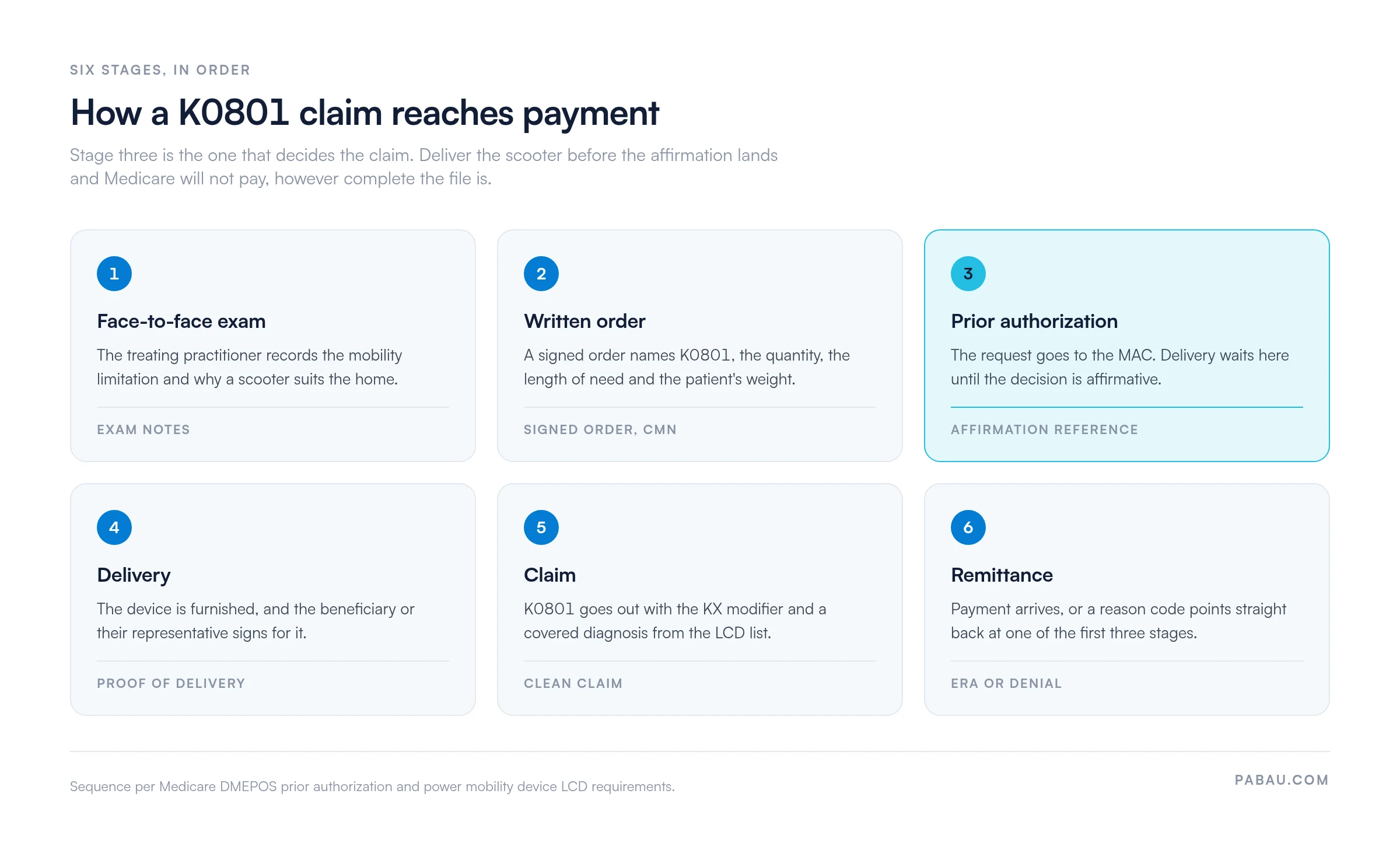
Stages one and two belong to the referring practice, so they are the part a supplier cannot control. Chase them early. A written order that omits the weight or the length of need goes back for a signature. That alone can add a week before the authorization request is sent.
Stages four to six belong to the billing team, and this is where claims management software earns its keep. It lifts the code, the diagnosis, and the patient details onto the claim form. The biller reviews a claim instead of retyping one.
Most K0801 denials can be caught in the 90 seconds before a claim goes out. Work down this list every time:
That list is the difference between a paid claim and a 45-day round trip. It is also the practical definition of a clean claim for DME. The claim arrives complete, and the payer has no follow-up question.
CMS and the applicable MAC LCD set the documentation standard for K0801. All six items below belong in the beneficiary’s file before the claim is submitted, not gathered afterward when the payer asks.
Structured intake forms help here, because a field that has to be filled cannot be skipped. Scanned paper is fine for the audit, but it will not tell you on Tuesday that a signature is missing.
The ICD-10-CM code on a K0801 claim has to appear on the covered list in your MAC’s power mobility LCD. The codes below turn up often in those policies.
Check the current LCD for the submitting MAC before you file, because the lists are revised.
A covered code is the start, not the finish. Take E11.65 as an example. On its own, the code says little about mobility. The notes have to connect the neuropathy to the walking distance the patient lost. Reviewers read the narrative, then the code.
Appending KX to a K0801 line tells the MAC that the documentation meeting the LCD criteria is already on file. Send it while the exam notes are still outstanding and you have made a false attestation.
That opens the door to overpayment recovery and False Claims Act exposure. The rest of the set is more routine.
GA and GZ are worth separating in your head, because they carry opposite consequences. Say coverage looks doubtful and you hold a signed ABN. The line goes out with GA, and the patient can be billed. Skip the ABN and it goes out with GZ, and the write-off is yours.
Modifiers are only half the setup. Confirm that the model you are furnishing is coding-verified for K0801, using the PDAC product coding verification guidance from CGS Medicare.
Check the device’s PDAC verification status before you bill K0801. The Pricing, Data Analysis and Coding (PDAC) contractor confirms which manufacturer models meet each HCPCS code definition. Furnishing a model without verification for K0801 is grounds for denial, even when the clinical file is complete.
K0801 denials cluster around the same handful of process failures, and almost all of them are visible before the claim goes out. Read the reason code on the remittance against the standard denial codes.
Within a minute you can usually tell whether the problem was coverage, documentation, or timing.
Patterns matter more than individual claims here. If two of these show up repeatedly, the fix belongs upstream in the intake process, not in the appeals queue.
Picking the right POV code means matching the device group and the documented weight at the same time. Group 1 and group 2 both run across the same three weight bands, and K0812 sits outside the grid entirely.
Group 2 devices (K0806 to K0808) offer more than the group 1 build, such as better seating and stronger outdoor performance. K0812 is the not otherwise classified code, so it carries no group or weight rating. It covers a POV that fits none of the listed categories.
In outpatient DME, most bariatric POV orders land on K0801 or K0807. The deciding factor is the device’s feature set, since the weight band is identical. Record the group and the capacity alongside the code on the order. A biller can then confirm the selection without reopening the clinical record.
Most DME billing teams work across three places at once. The exam notes arrive with the referral, the authorization reference sits in an email, and the claim gets typed fresh into the clearinghouse. Each retype is another chance to drop the weight, the modifier, or the reference number.
Pabau closes that distance by building the claim from the patient record. The code and the diagnosis attached to the service land on the charge line. Built-in ICD-10-CM and HCPCS lookup libraries let a biller confirm a covered diagnosis without leaving the form.
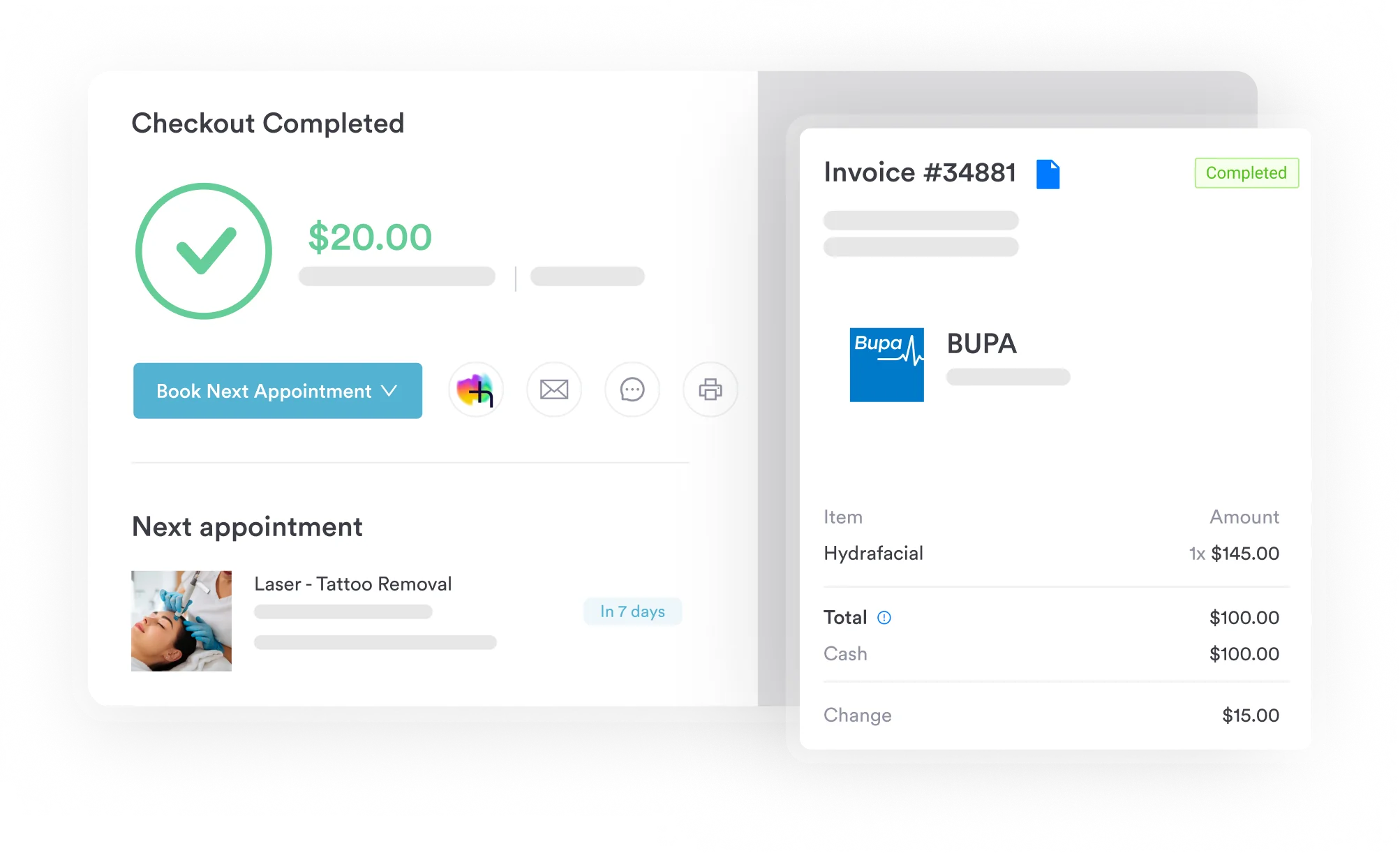
Required fields are validated before the send button unlocks, so an incomplete claim never reaches the payer. US suppliers submit through Claim.MD, with eligibility checks, claim status tracking, and remittance posting in the same screen.
Your team chases fewer claims, and the ones that do come back land against the record that created them.

Pabau builds the claim from the patient record, checks that every required field is filled, and submits it through your clearinghouse. Your billing team retypes less and chases fewer rejections.

K0801 is a simple code wrapped in a strict process. Document the weight, write the face-to-face notes so they explain why a scooter works at home, and wait for the affirmation before delivery. Suppliers who hold that order get paid on the first pass. The ones who improvise end up funding the device for a while.
The handoff between the clinical file and the claim form is where the money leaks. That is the point where a weight, a modifier, or an authorization reference quietly goes missing.
Pabau’s claims management software pulls those details straight from the patient record instead. Book a demo to see how a DME claim comes together inside it.

Need a system for working denials rather than re-sending them? Denial management in healthcare covers how to categorize denials and build an appeals workflow that holds.
Want the full picture of how a claim reaches a payer? Medical billing fundamentals walks through each step of the cycle, including the DME-specific ones.
Tightening up your compliance program? Medical billing compliance sets out the audit triggers and documentation standards that apply to DMEPOS suppliers.
Checking coverage before the equipment ships? Insurance eligibility verification explains how to confirm benefits and plan rules before an order is placed.
Looking at the whole revenue cycle, not one claim? Revenue cycle management shows how orders, claims, and payments connect from end to end.
No. The test is whether a cane, walker, or manual wheelchair still covers the patient’s mobility-related activities of daily living at home. Someone who takes a few safe steps can still qualify if those activities remain out of reach.
No. Coverage for a power operated vehicle assumes the beneficiary can steer the tiller safely without help. A patient who lacks the strength, vision, or judgment to do that is normally assessed for a power wheelchair instead.
Yes. The power mobility LCD expects adequate access between rooms, space to maneuver, and floor surfaces the device can cross. Record that assessment with the order, because a scooter that cannot be used indoors fails the home use criterion.
The supplier corrects the documentation and resubmits the request before the device is delivered. A non-affirm is a decision on the paperwork rather than a permanent denial. Delivering anyway means the claim is denied, so repair the file first and send it back.