CPT Code 44960: Appendectomy for ruptured appendix
CPT Code 44960: official descriptor and quick reference CPT Code 44960 is define...

Last Updated: Oct 20, 2026
K0053 is the HCPCS Level II code for elevating footrests, articulating (telescoping), each.
For a durable medical equipment (DME) supplier, the rest of the money sits in the paperwork around the code.
The physician order, the transaction modifier, and a note explaining why plain footrests will not do. Get those right and K0053 rarely comes back.
Let Pabau's smart automation suggest the right codes, reduce claim denials, and keep your practice compliant—effortlessly.
Automate repetitive tasks and focus on what matters most—your patients.
Reduce coding errors and ensure compliance with the latest regulations.
Clean claims, fewer denials, and faster reimbursements.
Powerful insights and reporting to help your practice thrive.
HIPAA compliant SOC 2 certified GDPR-compliant Trusted by 4,000+ clinics worldwide

HCPCS code K0053 covers elevating footrests, articulating (telescoping), each, so you bill two units for a pair.
K0052 is not the non-articulating version of K0053. It covers swingaway, detachable footrests, replacement only, each.
Medicare pays K0053 only when the record shows why standard footrests fall short for this patient.
Match the modifier to the transaction. NU covers a new purchase, RR covers rental, and UE covers used equipment.
Most K0053 denials trace back to how orders arrive from prescribers, not to the claim form itself.
The official descriptor reads elevating footrests, articulating (telescoping), each. Articulating means the footrest pivots, so the leg angle changes with it.
Telescoping means the hanger extends, so the footplate meets the patient’s heel instead of hanging short. A footrest that only lifts, without pivoting or extending, does not meet this descriptor.
Here is how the quantity works in practice. A patient takes delivery of two new articulating footrests on a wheelchair Medicare already covers. You bill one line, K0053 with modifier NU, and enter 2 in the units field. Enter 1 instead and the second footrest goes unpaid, and fixing it means a corrected claim.
Articulating footrests handle leg length differences and post-surgical positioning. They are not the same as a plain footplate under K0040, and they are not the swingaway, detachable footrests replaced under K0052. Code selection follows the product you delivered, not the clinical goal behind it.
K0053 sits in the K-series of HCPCS Level II codes, which CMS maintains for wheelchair options and accessories. The series runs from K0001 to K0195. None of it appears in the AMA’s CPT book, because these codes exist only in HCPCS Level II for suppliers billing Medicare and other payers.
Medicare pays K0053 under the durable medical equipment, prosthetics, orthotics and supplies (DMEPOS) benefit when three conditions hold.
The item is medically necessary, the treating physician ordered it, and an enrolled DMEPOS supplier provided it. Coverage is never automatic. Your DME MAC measures the claim against its Local Coverage Determination (LCD) for wheelchair options and accessories.
Check eligibility before the footrest leaves the warehouse. A patient can hold Medicare Part B and still lack an active DMEPOS benefit, or sit below an unmet deductible. A two-minute check on the payer portal beats a dispute after delivery.
Five points have to be visible in the chart before a K0053 claim is defensible. Four of them come from the prescriber. The last one is the supplier’s job.
Two contractors handle DMEPOS claims today. Noridian covers Jurisdictions A and D. CGS covers Jurisdictions B and C, and both contractors publish their own guidance on wheelchair accessories. So read the LCD for your jurisdiction rather than the code descriptor alone.
Incomplete documentation is where most K0053 claims fail. DME MACs run post-payment audits on wheelchair accessory codes, and a missing signature or an undated order can cost the whole payment.
DMEPOS rules run tighter than most Medicare benefit categories, because the item is ordered, supplied, and billed apart from the patient’s visit.
Keep all of it for at least seven years. Audit requests on wheelchair accessories often reach back across several submission cycles, and the supplier file is the only place a reviewer looks.
There is no single national figure for K0053. Medicare pays it from the DMEPOS fee schedule, which CMS updates every January, and the allowable is adjusted by locality. Suppliers in high-cost areas such as New York, California, or Alaska see more than rural localities do.
So pull the locality rate for the patient’s address before you submit, not the national average. Billing the average when a higher locality rate applies leaves legitimate reimbursement behind.
Third-party code sites often run a cycle behind. The CMS DMEPOS fee schedule file is published each January and is the only authoritative source for allowable amounts.
A K0053 claim does not start where an office-visit claim starts. It begins with the physician order, and the supplier submits it rather than the prescriber.
The sequence below runs in order, and a skipped step usually surfaces later as a denial:
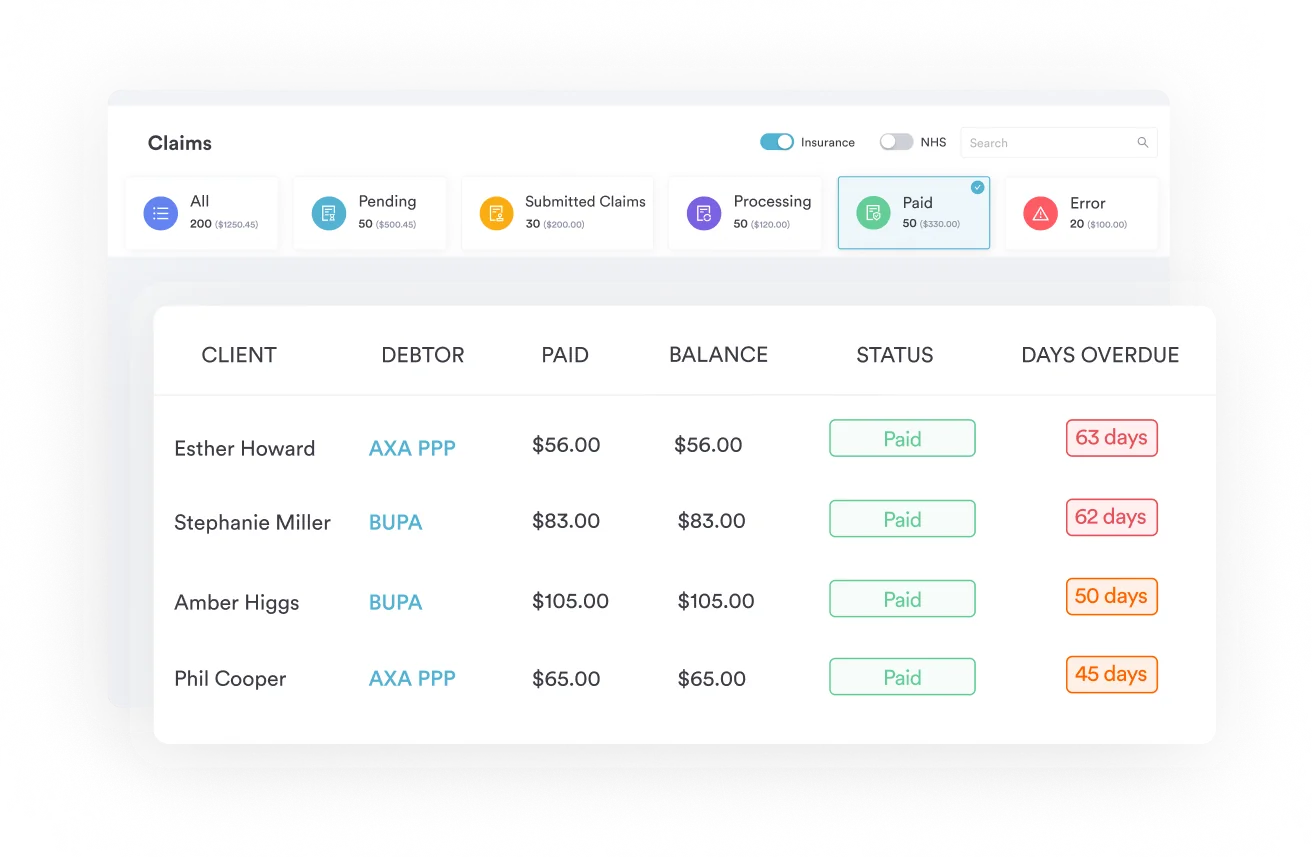
Suppliers who run this list before submission stop most K0053 denials at the desk. The check costs a minute of someone’s time. An appeal costs a great deal more.
Modifiers are not optional on a DMEPOS claim. They tell the payer whether the item was sold new, rented, or supplied used, and the claim gets judged on that answer.
Check your DME MAC’s billing article on wheelchair options and accessories for the KX rule in your jurisdiction. Some LCDs treat KX as the attestation that every coverage criterion is met. Submit without it where it is required and the claim rejects rather than denies, so there is nothing to appeal.
Review your DME MAC’s billing article for wheelchair options and accessories each January. CMS updates modifier requirements alongside the annual fee schedule, and a rule change can push otherwise clean K0053 claims into rejection without warning.
This is where K0053 gets miscoded most often. The codes around it look like a tidy ladder of elevating footrests, and they are not.
A keyword search on the AAPC HCPCS code lookup helps when several footrest descriptors read alike, but the descriptors below settle it.
Read the K0052 descriptor again, because it does not say elevating. It covers swingaway, detachable footrests, replacement only, each.
A swingaway footrest pivots out of the way so the patient can transfer. Elevation and articulation are not part of it, and the replacement-only wording limits the code to a part supplied against an existing wheelchair. A high mount flip-up footrest also clears the way for transfers, but it pivots upward and bills under HCPCS code K0037.
K0053 sits on the other side of that line. It is the complete elevating footrest, articulating and telescoping, billed one unit per footrest. So the question at delivery is a plain one.
What does the item you handed over do? The routing below follows the same logic.
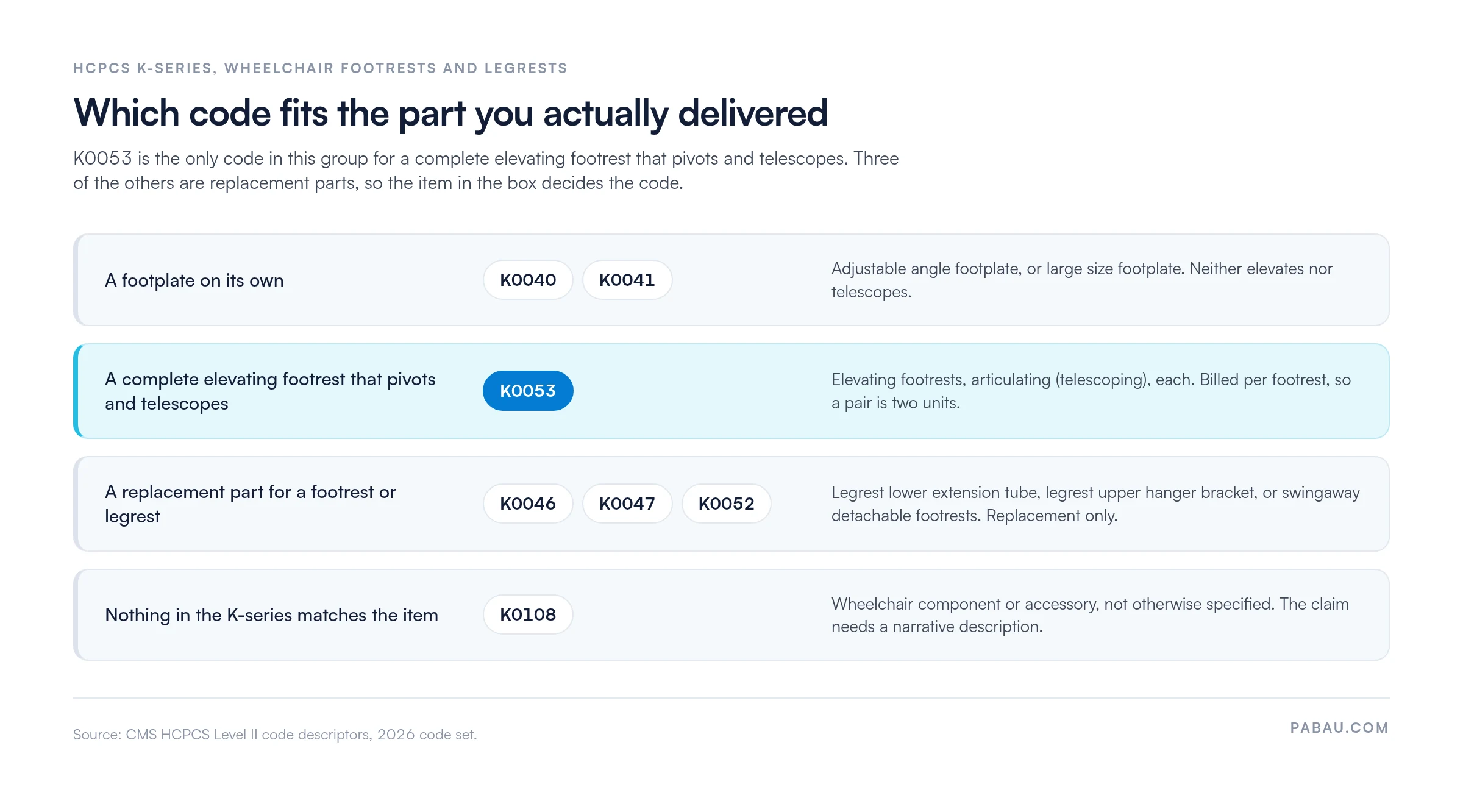
K0046 and K0047 belong to elevating legrests rather than footrests, and both are replacement parts. K0046 is the lower extension tube. K0047 is the upper hanger bracket. Neither one covers a complete legrest assembly.
K0108 is the fallback, and reviewers read it that way. Reach for it only when no specific K-code describes the item, and send a narrative description with the claim.
Suppliers who use K0108 to avoid a coding decision tend to get the file requested. Where the item belongs to another part of the series, our reference on HCPCS codes for suppliers is the place to look.
Denials on this code repeat themselves. Each pattern below has its root cause in a process rather than on the claim form, which is why the same fix keeps working. Sound denial management starts with knowing what triggers the rejection before the claim goes out.
Track denials by reason code on the remittance and the pattern shows up fast. A run of CO-50 rejections on K0053 says the documentation workflow is broken, not that one biller slipped. CO-50 is the medical necessity code, and the repair almost always sits in how orders arrive from prescribers.
Holding a clean-claim standard for K0053 means the pre-submission check above runs every time. Units, modifier, documentation, and authorization all get verified before the claim leaves the billing queue.
Most suppliers keep the order in one system, the delivery receipt in another, and the claim in a third. When an audit letter arrives, someone spends an afternoon rebuilding a single patient’s file.
Practice management software like Pabau removes that hunt, because the patient record and the claim sit in the same place.
Pabau’s claims software for suppliers keeps the physician order, the face-to-face note, and the signed proof of delivery together. They all sit on the record the claim was built from, attached at the point of care instead of weeks later. So the evidence behind a K0053 line is one click from the claim itself.
Reporting closes the loop. You can read denials grouped by code and by reason. A run of K0053 rejections then reads as one fixable pattern, not 30 separate problems. Repair the intake step once, and next month’s claims go out clean.

Pabau holds physician orders, proof of delivery, and medical necessity records on the claim they support. So a K0053 problem gets caught before submission, not at audit.

K0053 is a short line on a claim with a narrow definition behind it. The footrest either elevates and articulates, or it does not. The record either explains why this patient needs that, or it does not. Medicare pays the claims that answer both questions.
So treat the code as the last decision, not the first. Confirm the product classification, get the order right, count the footrests, and pick the modifier that matches the transaction. Suppliers who fix the intake step stop reworking claims one at a time.
Want to see that running in one system? Book a demo and we will show how Pabau keeps K0053 orders, delivery proof, and denial reasons on a single patient record.

New to the DMEPOS side of billing? Medical billing explained walks through the claim from creation to payment posting.
Want fewer claims coming back at all? What makes a clean claim sets out the checks that get a claim paid first time.
Unsure what the codes on a remittance mean? Electronic remittance advice explains how payers report adjustments and denials.
Bracing for a DMEPOS audit? Medical billing compliance covers the records and controls reviewers ask to see.
Checking coverage before delivery? Insurance eligibility verification shows how to confirm benefits before the item ships.
K0052 covers swingaway, detachable footrests, replacement only, each. That footrest swings clear for transfers and does not elevate or telescope. K0053 covers a complete elevating footrest that articulates and telescopes. The item’s mechanism decides the code, not the patient’s clinical goal.
Check the manufacturer’s PDAC coding verification. PDAC is the Pricing, Data Analysis and Coding contractor, and its product classification list shows which HCPCS code a specific model was verified under. Where no verification exists, keep the manufacturer’s written specification in the supplier file.
Have the patient sign an Advance Beneficiary Notice of Noncoverage before delivery, then bill K0053 with modifier GA. The notice tells the patient Medicare is likely to deny the item and that they accept the cost. Deliver first and the supplier holds the bill.
Repairs are covered on equipment the patient owns. The labor is billed with K0739 in 15-minute units, and the replacement part carries its own code. Rented equipment works differently, since the supplier stays responsible for maintenance during the rental period.
Many mirror Medicare’s coverage criteria, but none of them have to. Read the plan’s own DME policy for prior authorization, quantity limits, and modifier rules before delivery. Medicaid programs vary by state too, so verify per payer rather than per code.