CCSD code H4430: Examination of rectum under anaesthetic
CCSD code H4430 pays for the examination alone CCSD code H4430 is the UK private...

Last Updated: Oct 20, 2026
K0017 is the HCPCS Level II code for detachable, adjustable height armrest, base, replacement only, each.
HCPCS code K0017 bills a detachable, adjustable height armrest base on a covered wheelchair. It applies when you replace a worn or broken base, never when you supply the first one. That "replacement only" wording in the descriptor is a coverage condition, and it drives most K0017 denials.
An initial armrest issue belongs to E0973, or it sits inside the chair's base allowance. Billers and suppliers feel the difference fast, because a wrong code here costs the rework and the payment.
This page covers the descriptor, the coverage test, the modifiers, 2026 payment, and a pre-submission checklist.
Let Pabau's smart automation suggest the right codes, reduce claim denials, and keep your practice compliant—effortlessly.
Automate repetitive tasks and focus on what matters most—your patients.
Reduce coding errors and ensure compliance with the latest regulations.
Clean claims, fewer denials, and faster reimbursements.
Powerful insights and reporting to help your practice thrive.
HIPAA compliant SOC 2 certified GDPR-compliant Trusted by 4,000+ clinics worldwide

HCPCS code K0017 covers a detachable, adjustable height armrest base, replacement only, each, under Medicare Part B.
Replacement is a coverage condition, so an initial armrest issue bills E0973 or comes bundled into the chair allowance.
Coverage runs through LCD L33792, which sets a two-part test on arm height and daily wheelchair use.
Modifier RB marks a part replaced during a repair, while RA covers replacing the whole item.
Practice management software like Pabau tracks HCPCS codes on each order and flags incomplete required fields before submission.
The official long descriptor reads Detachable, adjustable height armrest, base, replacement only, each. CMS maintains it in the HCPCS Level II code set, under the K-series for wheelchair accessories.
Each phrase in that string takes an option off the table.
One line in that table decides more claims than the rest. K0017 pays for the base, and no other part of the arm. So before you assign it, put hands on the part and name the component in the order.
Start with the component, not the product name. K0017 is the base, K0018 is the upper portion, and K0019 is the arm pad.
If the arm has no height adjustment, K0015 is your code, and it is not limited to replacements. Fixed adjustable-height arms supplied as a pair go to K0020 instead.
Read the chain below from the top, because two questions have to resolve before K0017 is even in play.
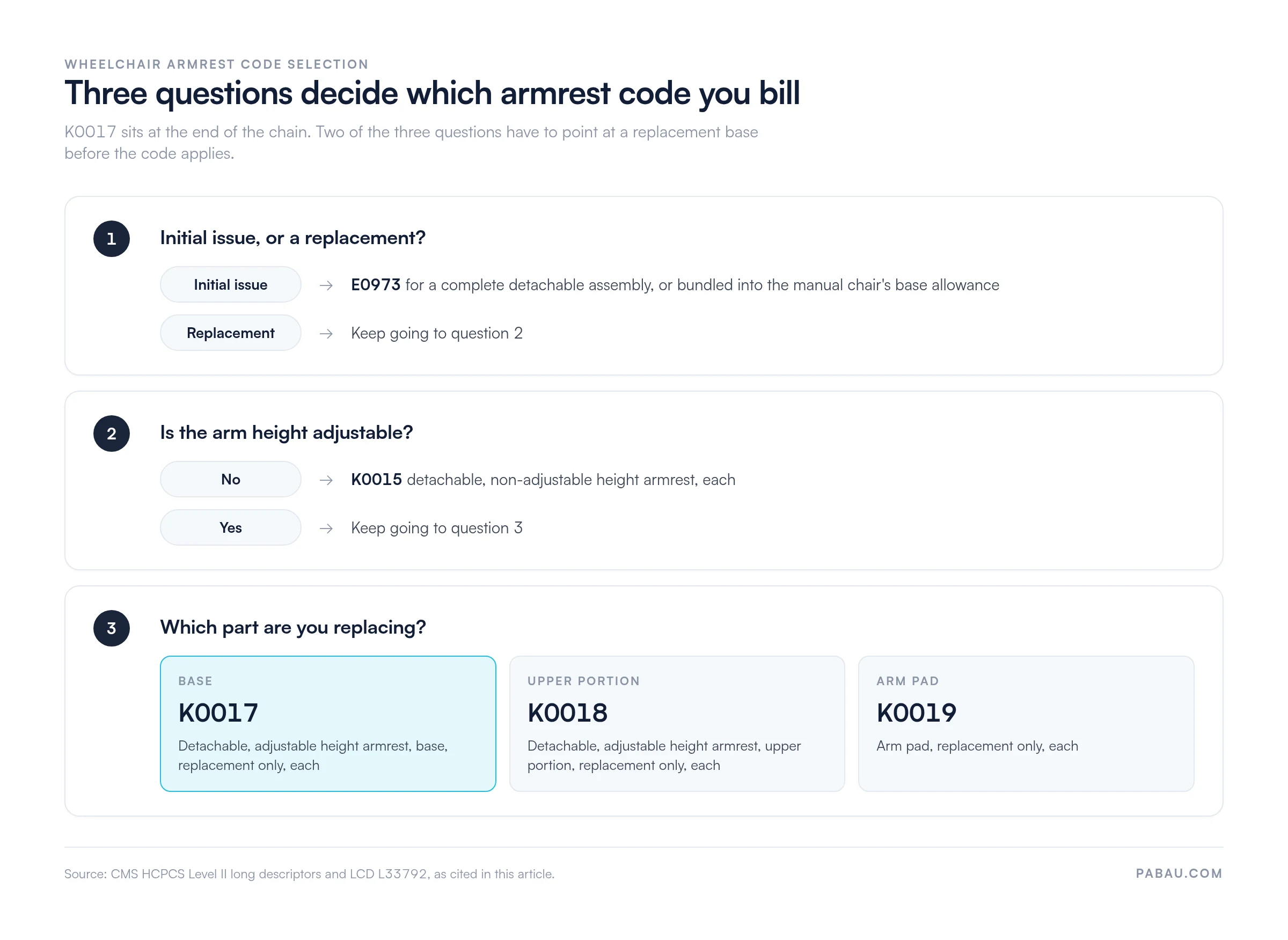
These parts look alike on a shelf, which is how the wrong code gets picked. When a product could reasonably fall under two codes, ask the PDAC contractor for a coding verification.
A PDAC letter names the code for that manufacturer and model, and it holds up under audit. You can also work back through the wider HCPCS code library to see where the K-series sits.
Picking the code is the easy half. Coverage comes from LCD L33792, Wheelchair Options and Accessories, applied by your DME MAC. It does not treat an adjustable-height arm as automatically reasonable and necessary.
Two conditions have to hold, and both belong in the file before delivery.
Neither condition is met by simply saying so. A note reading “patient requires adjustable arms” fails the first condition. It never says what height the patient needs, or why a fixed arm misses it. For the second, record the daily hours as the clinician described them.
On top of that test, the general conditions for any wheelchair accessory still apply:
K0017 never covers the first armrest on a chair. The initial-issue code is E0973, which describes a complete detachable, adjustable height armrest assembly. It is an E-code, so the whole K-series is the wrong place to look.
For a manual wheelchair, the arms often are not separately payable at all, because the base allowance already includes them. Billing K0017 in either scenario misuses the replacement-only designation, and that is the pattern reviewers look for.
Run the eligibility check before the part ships, not after. Confirm active Part B coverage. Check the base wheelchair is on file as a covered item. Then confirm no Part A stay is running. Checking early costs a few minutes. Finding out from a denial costs staff time, rework, and sometimes the payment itself.
Coding it right is only half the job. Reviewers deny replacement-part claims on paperwork far more often than on coding. So build the file as if someone will read it in three years, because they might. Six documents do most of the work.
Keep all of it for at least seven years. Audits open long after payment. A document missing at that point means repaying the claim, even when the part was clinically appropriate. A shared checklist inside software for DME billers catches a missing proof of delivery before submission, not after a denial.
With the file in order, the modifier is next. RB is the one most K0017 lines need, because it marks a part replaced during a repair.
A failed armrest base is exactly that. RA is its counterpart, used when you replace an entire item rather than one component.
Appending KX says the coverage criteria are met and documented in your file. That is a statement on a federal claim, so it carries weight beyond the payment. Check the two-part LCD test and the order date before it goes on the line.
The path is short, and each step leaves something the next one needs. Walk it once in this order and the failure points stand out.
Step four trips up more claims than the rest. A wrong place of service sends an otherwise clean line to manual review, so confirm it against your MAC’s instructions.
Units matter here too. K0017 is billed each. A left and right replacement in one episode goes on two lines, not one line with a quantity of two. Some MACs accept quantity billing for this code, so check yours before you combine them.
No single figure answers this. CMS publishes an allowed amount for K0017 in the DMEPOS fee schedule. Your DME MAC then applies state and locality pricing. So the number that matters is the one for the patient’s service area, on the date of service.
Competitive bidding is not part of that math right now. Contracts under the DMEPOS Competitive Bidding Program expired on January 1, 2024, and CMS has not awarded new ones since.
Until it does, payment follows the fee schedule amount, updated for the consumer price index, rather than a contract rate.
Pull the current figure from the CMS DMEPOS fee schedule files, or from your DME MAC’s own lookup tool. The Physician Fee Schedule search tool will not help you here, because it does not carry K-codes.
Rates also change mid-year on occasion, so check at the time of billing rather than working from a saved spreadsheet.
The rules above collapse into seven yes-or-no answers. Work through them while the order is open, because each one is cheap now and expensive after a denial.
Seven answers take one pass. They get you closer to a clean claim than checking after the remittance arrives.
All of this is easy on one order and hard on fifty. Most DME billing runs across two systems that never speak to each other. The order and the clinical note live in one, and the claim gets keyed into the other. Nobody notices the missing proof of delivery until the reason code turns up.
Practice management software like Pabau keeps the order, the note, and the claim on one record. You attach the HCPCS code to the item as you dispense it. The claim screen then shows which required fields are still empty. Payer, provider, and billing detail sit together, so the file is ready when a reviewer asks for it.
Claims then go out electronically, and the remittance posts back against the same record. Your team can see which lines paid, which paid in part, and which need a second look. You stop rebuilding the story from three screens.

Pabau tracks the HCPCS code on every DME order and flags incomplete required fields before the claim reaches the payer. See how that fits your billing team.

K0017 is a narrow code, and the narrowness is the whole story. Confirm you are replacing a base. Confirm the height requirement and the two hours a day. Then bill it, with RB on the line.
Suppliers with the lowest denial rates are rarely the fastest at appeals. They are the ones whose file was complete on the day the order was written. The claim never had to come back.
Tracking codes and documents across a book of DME orders is where most billing teams slow down. Book a demo to see how Pabau keeps the code, the note, and the claim on one record.

Need a structured approach to DME claim documentation? Medical billing compliance covers the documentation standards and audit-readiness practices that apply across DME and other claim types.
Seeing the same denials come back? Denial management in healthcare explains how to find root causes, build an appeals workflow, and lift first-pass payment rates.
Want the full billing cycle, from order to payment? Revenue cycle management shows how each step connects and where DME suppliers lose reimbursement.
Checking coverage before the part ships? Insurance eligibility verification walks the checks that catch inactive Part B and secondary payers early.
Building a charge capture process? Superbill explains how a structured charge sheet validates codes and modifiers before submission.
Only a DMEPOS supplier enrolled with Medicare can bill it, using an active supplier number. A practice without that enrollment cannot submit the claim, even with a valid order in the file. Review the supplier standards at 42 CFR 424.57 before you dispense.
No fixed interval applies. Coverage follows documented wear, damage, or a change in the patient’s condition. The note has to say what happened to the old base. A second replacement inside a short window invites review, so record the reason at the time rather than at appeal.
Yes, provided the chair itself would meet Medicare coverage criteria. Replacement parts for patient-owned equipment are payable, but your file has to establish that the base chair qualifies. Keep the purchase record and the current medical necessity note together.
Rarely, since a new chair arrives with its arms. If both land on one claim, expect a review, and be ready to show the replacement served an existing chair.