CPT Code 62284: Injection procedure for myelography
CPT Code 62284: official descriptor and procedure overview The American Medical ...

Last Updated: Oct 19, 2026
K0002 is the HCPCS Level II code for a standard hemi (low seat) wheelchair with fixed full-length arms and swing-away detachable footrests. The lower seat lets a patient with hemiplegia or hemiparesis propel the chair with one foot.
Medicare covers it as a 13-month capped rental under the Manual Wheelchair Bases LCD (L33788). A claim needs a face-to-face exam, a signed detailed written order and the KX modifier.
Let Pabau's smart automation suggest the right codes, reduce claim denials, and keep your practice compliant—effortlessly.
Automate repetitive tasks and focus on what matters most—your patients.
Reduce coding errors and ensure compliance with the latest regulations.
Clean claims, fewer denials, and faster reimbursements.
Powerful insights and reporting to help your practice thrive.
HIPAA compliant SOC 2 certified GDPR-compliant Trusted by 4,000+ clinics worldwide

HCPCS Code K0002 covers the standard hemi (low seat) wheelchair. Its lower seat-to-floor height is the one specification that separates it from the K0001 standard wheelchair.
Every Medicare K0002 claim that meets coverage criteria needs the KX modifier. Leaving it off is the most common single cause of denial.
The treating physician’s face-to-face exam and a signed detailed written order must both be on file before a supplier bills K0002 to Medicare.
Claims management software like Pabau tracks modifier requirements and documentation status on each DME claim, so errors are caught before the payer sees them.
HCPCS Code K0002 is the billing code for a standard hemi wheelchair.
This manual wheelchair frame has a lower seat-to-floor height (17.5 inches or less). The patient can reach the floor with one foot to propel it. It belongs to the K-series of HCPCS Level II codes. The Centers for Medicare and Medicaid Services (CMS) maintains that series for durable medical equipment, prosthetics, orthotics, and supplies (DMEPOS).
The “hemi” designation describes a clinical need. It applies to patients with hemiplegia, hemiparesis, or significant leg-length discrepancy who can’t use a standard-height frame effectively. If the physician’s notes don’t describe this functional limitation, the code won’t hold up at audit.
The HCPCS descriptor for K0002 is “Wheelchair, standard hemi (low seat), fixed full length arms, swing away detachable footrests.” A standard wheelchair with the same fixed full-length arms falls under HCPCS Code E1130. The Pricing, Data Analysis and Coding Contractor (PDAC) verifies whether a specific product meets K0002 coding criteria. Confirm PDAC verification before billing to avoid upcoding disputes.
Accessories (cushions, elevating leg rests, anti-tip devices) are billed separately under their own HCPCS codes and are never bundled into K0002. Billing an accessory as part of K0002 is a bundling error that triggers recoupment.
The K0001-K0004 series separates manual wheelchairs by seat height and frame weight class. Seat-to-floor height is the primary differentiator between K0001 and K0002. Weight class separates K0002 from K0003 and K0004. Getting this wrong is the most common upcoding pattern CMS auditors flag in manual wheelchair claims.
Decision rule: If the patient needs a lower seat height to propel by foot, K0002 is correct. If the patient needs a lighter frame but not a lower seat, look to K0003 or K0004 instead. Billing K0003 when only the seat height is documented as a clinical need is upcoding.
Medicare coverage for HCPCS Code K0002 is governed by CMS’s HCPCS Level II coding framework and Local Coverage Determination LCD L33788 (Manual Wheelchair Bases). The applicable Medicare Administrative Contractor (MAC) maintains that LCD. The patient must meet every criterion below at the same time.
LCD L33788 sets the specific documentation language MACs expect. Suppliers in Competitive Bidding Areas (CBAs) face additional pricing constraints but not different coverage criteria. Check the applicable MAC’s LCD version before each claim cycle, because coverage article updates happen independently of the annual HCPCS code update.
Documentation failures drive more K0002 denials than any other single factor. Wheelchair codes are among the most audited in DMEPOS billing. Every element below must be in the supplier’s file before the claim is submitted.
CMS requires suppliers to retain all K0002 documentation for a minimum of seven years. DME audits under the Comprehensive Error Rate Testing (CERT) program frequently target wheelchair claims. Missing any single element above typically results in full recoupment.
The dates matter as much as the documents. The sequence below shows the order the records have to exist in, from the first exam to the last rental month.
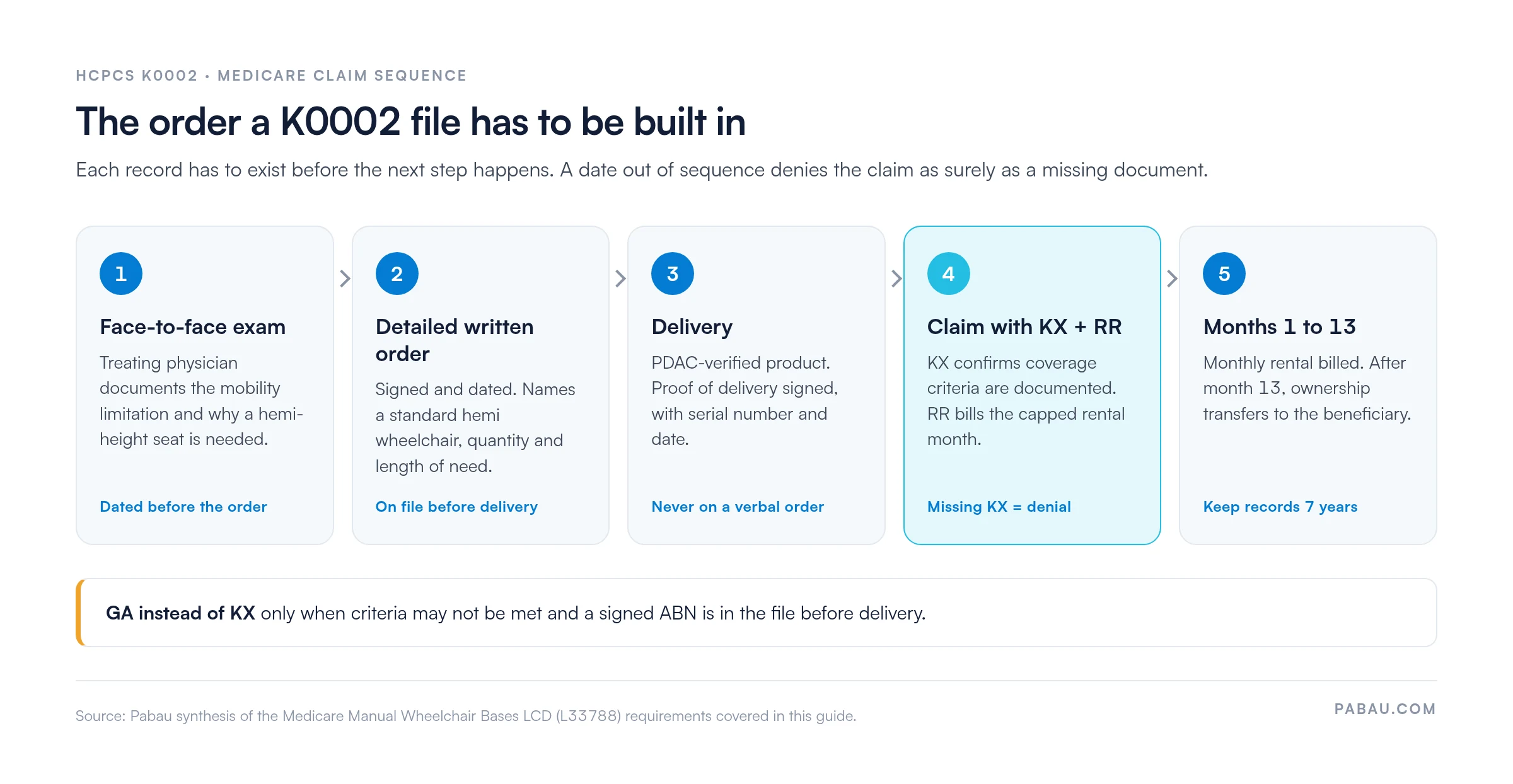
A CMN is not universally required for K0002, but some MACs and commercial payers request one. Where it’s required, it travels with the detailed written order as part of the DMEPOS documentation package. The physician completes the clinical sections, and the supplier completes the supplier sections.
The physician’s signature on the CMN doesn’t substitute for the face-to-face examination notes. Auditors routinely deny a CMN submitted without supporting chart notes. Check the Medicare Coverage Database and your MAC’s LCD to confirm whether your jurisdiction needs one.
Modifiers on K0002 claims tell the payer whether coverage criteria are met, whether an ABN was issued, and whether the item is rented or purchased. Omitting the KX modifier when criteria are documented is the single most common preventable K0002 denial. The table below covers the full modifier set used with this code.
Incorrect modifier usage on DME claims carries False Claims Act exposure in addition to recoupment. Train billing staff to confirm modifier selection against the LCD criteria checklist before submission.
Run a modifier audit before any K0002 claim goes to Medicare. Confirm KX is present when criteria are documented and RR is applied for rental months 1 to 13. Then check that no GA modifier appears without a signed ABN in the supplier file. That 60-second check prevents the most common denial pattern on this code.
K0002 does not currently require prior authorization under the Medicare manual wheelchair prior authorization program. That program targets higher-complexity power wheelchairs and manual wheelchairs at the K0005 level and above. Standard manual wheelchair codes, including K0002, fall outside its mandatory scope under current CMS parameters. The program expands periodically, so verify the current scope with your MAC.
Medicaid prior authorization for K0002 varies significantly by state. Some state programs require PA for any wheelchair, while others apply a dollar threshold or clinical complexity screen. Before delivery, verify the state Medicaid program’s DME prior authorization policy. Checking insurance eligibility when the order comes in, not at delivery, prevents the most expensive authorization denials.
Commercial payers set their own PA requirements independently of Medicare. Most commercial payers do require PA for wheelchair equipment. Confirm coverage and authorization requirements with each commercial payer before delivery, and document the authorization number in the supplier file.
Medicare reimburses K0002 under the 13-month capped rental model. The supplier bills a monthly rental fee for months 1 through 13. After month 13, ownership transfers to the beneficiary at no additional cost, and Medicare stops payment. Maintenance and servicing after the transfer follow a separate billing pathway.
Reimbursement rates for K0002 vary by geographic region and by whether the supplier is in a Competitive Bidding Area (CBA). Rates also change annually with the CMS DMEPOS fee schedule update. Because of that variation, no fixed dollar amount published here would be accurate for all claims.
Check the CMS DMEPOS fee schedule for the current allowed amount in your region. Do it before you estimate patient cost-sharing or project claim revenue.
In CBAs, contract suppliers must accept the bid rate as payment in full. Non-contract suppliers in CBAs can’t bill Medicare for K0002 unless a specific non-contract exception applies. Suppliers operating across multiple CBAs should verify their contract status in each area separately.
K0002 is a top DME audit target, and the denial patterns below account for most K0002 claim failures. A pre-submission checklist built against them stops most of these denials before the claim leaves the supplier.
For specific denial reason codes and how to respond to each, the DME denial code reference maps CARC reason codes to corrective action steps. Tracking denials by reason code across your K0002 volume shows which documentation failures repeat, so you can fix the intake process behind them.
Medicaid coverage for K0002 is not uniform across states. Each state Medicaid agency maintains its own DME fee schedule, coverage criteria, and prior authorization requirements. Some states mirror Medicare LCD L33788 closely. Others apply different functional criteria, lower reimbursement rates, or restrict coverage to specific patient populations (e.g. pediatric-only or acute-care post-discharge).
Always get the current state-specific DME billing guide before billing K0002 to Medicaid. Applying Medicare criteria to Medicaid claims is a common error that produces both denials and overpayment exposure.
Commercial payers add more variation. Some follow Medicare coverage criteria as a baseline, while others apply proprietary medical necessity criteria that may be stricter. A few use alternative HCPCS codes or require the supplier to map K0002 to an internal product code.
Review each payer’s DME coverage policy, and call the payer’s provider relations line when documentation requirements are unclear. A clean K0002 claim needs payer-specific documentation checks, not just Medicare LCD compliance.
For commercial claims, also confirm whether the payer requires a Certificate of Medical Necessity, and if so which form version. Some commercial payers accept the Medicare CMN format, while others require proprietary forms. Submitting the wrong form is a correctable denial, but it wastes processing time.
Build a payer-specific documentation matrix for your top 10 K0002 payers. Cover the required CMN format, the PA requirement, the face-to-face documentation standard and the preferred modifier set. Update it quarterly. One shared reference cuts pre-submission errors and speeds up appeals on the rare claim that denies despite full compliance.
On many DME billing teams, K0002 requirements are tracked by hand. The face-to-face notes sit in one system and the signed order in another. The modifier choice depends on whoever builds the claim that day.
Practice management software like Pabau keeps the documentation and the claim together. Pabau’s claims software for DME suppliers tracks documentation status and modifier requirements on each claim. Your billing team can see whether the exam notes, order and ABN are on file before anyone hits submit.
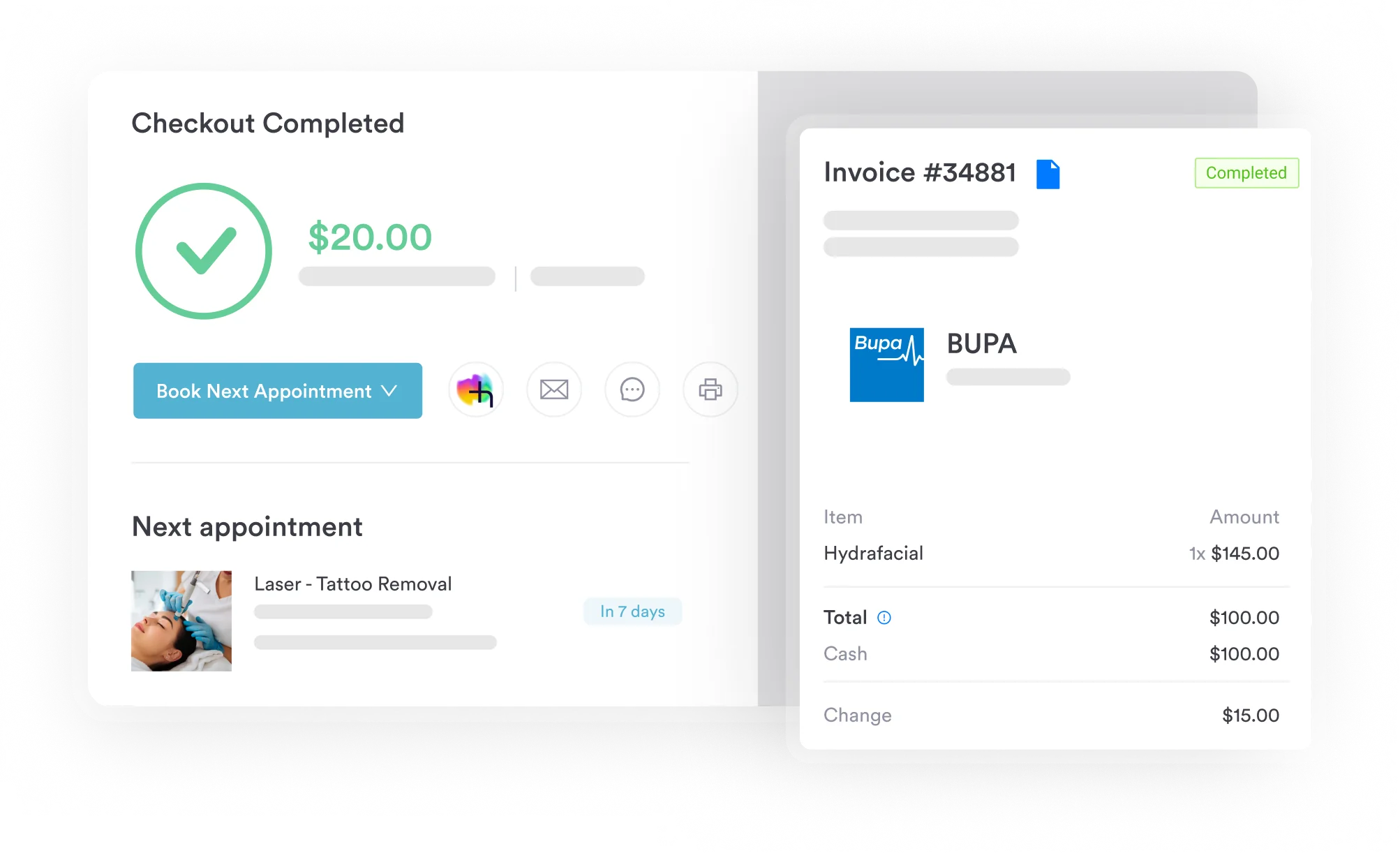
The result is fewer denials that trace back to paperwork. Your team also spends less time appealing claims that should have paid the first time.

Pabau’s claims management software tracks documentation status, modifier requirements, and submission records across your DMEPOS claims, so nothing falls through before you hit send.

K0002 claims are won or lost in the physician’s notes. If the chart doesn’t say why the patient needs a hemi-height seat, no modifier or order form will rescue the claim at audit.
So start upstream. Give ordering physicians a face-to-face template that asks for the seat-height need, and hold delivery until the signed order is in the file. Then treat KX as a default on K0002 claims that someone has to justify removing.
The trade-off is a slower intake on each order. That time comes back as claims that pay on first submission. Book a demo to see how Pabau keeps DME documentation and modifiers in step on every wheelchair claim.

Billing a lighter frame instead? HCPCS Code K0003 covers the lightweight wheelchair and what it takes to justify the weight-class step up.
Is the patient an active, daily user? HCPCS Code K0004 covers the high-strength lightweight wheelchair and its documentation requirements.
Need to understand how DME claim denials map to correction actions? Denial codes in medical billing covers CARC reason codes and the corrective steps for each denial type.
Want to verify your documentation meets clean claim standards before submission? Clean claim requirements outlines the field-level completeness criteria that prevent front-end rejections.
Looking for a broader billing compliance framework? What is revenue cycle management explains the end-to-end process from order intake through payment posting for DME suppliers.
HCPCS Code K0002 is the billing code for a standard hemi wheelchair, a manual wheelchair with a seat-to-floor height of 17.5 inches or less. It’s used when a patient needs a lower seat to propel the chair with one foot. Typical reasons are hemiplegia, hemiparesis, or a similar condition that rules out standard two-handed propulsion.
K0001 is the standard wheelchair with a standard seat-to-floor height. K0002 is the standard hemi (low-seat) wheelchair, with a seat-to-floor height of 17.5 inches or less. Both are standard-weight frames. The only clinical distinction is seat height, and the physician’s notes must document it as medically necessary to justify K0002 over K0001.
Yes, Medicare covers K0002 when the patient meets every LCD L33788 criterion. That means a documented mobility limitation, failure of lesser mobility aids, a face-to-face exam by the treating physician, and a valid detailed written order. The notes must also show medical necessity for a hemi-height seat specifically. The KX modifier on the claim confirms that all criteria are met and documented.
The KX modifier is required on every Medicare K0002 claim where coverage criteria are documented. The RR modifier is required for capped rental claims (months 1 to 13). If an Advance Beneficiary Notice was issued because criteria may not be met, add GA instead of KX. GY applies when the item is non-covered, and GZ when it’s expected to be denied. NU and UE signal new or used equipment on purchase claims.
You need a face-to-face exam note from the treating physician that documents the hemi-height need. You also need a detailed written order naming the hemi wheelchair and seat height, and a functional assessment supporting medical necessity. Add a diagnosis code linking the condition to the equipment, plus a signed delivery record. Some MACs also require a Certificate of Medical Necessity, so check with yours.
The most common reasons are a missing KX modifier and face-to-face notes that never mention the hemi-height need. Others include an order that says only “wheelchair” without the hemi designation, delivery before the order was signed, and non-accredited supplier status. A pre-submission checklist aligned to LCD L33788 prevents each of these.
No. K0002 does not currently fall within the mandatory Medicare prior authorization program for complex rehabilitative manual wheelchairs, which targets K0005 and above. Prior authorization rules still vary by Medicaid program and commercial payer, so verify each payer’s policy before delivery. CMS expands the program periodically, so confirm the current scope with your MAC.
There’s no single rate. The allowed amount for K0002 varies by geographic region and by whether the supplier is in a Competitive Bidding Area. Rates also change annually with the CMS DMEPOS fee schedule update. Check the current fee schedule for your supplier location and claim date rather than relying on a published figure that may be out of date.