CPT Code 62284: Injection procedure for myelography
CPT Code 62284: official descriptor and procedure overview The American Medical ...

Last Updated: Oct 19, 2026
A4431 is the HCPCS Level II code for ostomy pouch, urinary; with barrier attached, with faucet-type tap with valve (1 piece), each. It describes a one-piece urostomy pouch with the skin barrier built in and a drain tap at the base, billed per pouch.
Medicare covers it under the prosthetic device benefit for a permanent urinary ostomy. LCD L33828 sets the usual maximum at 20 pouches a month, and the barrier is never billed on a separate line.
Let Pabau's smart automation suggest the right codes, reduce claim denials, and keep your practice compliant—effortlessly.
Automate repetitive tasks and focus on what matters most—your patients.
Reduce coding errors and ensure compliance with the latest regulations.
Clean claims, fewer denials, and faster reimbursements.
Powerful insights and reporting to help your practice thrive.
HIPAA compliant SOC 2 certified GDPR-compliant Trusted by 4,000+ clinics worldwide

HCPCS code A4431 covers a one-piece urinary ostomy pouch with an attached skin barrier and a faucet-type drain tap, billed per pouch.
The attached barrier is neither extended wear nor convex, which separates A4431 from A4428, A4429 and A4430.
Medicare pays for A4431 under the prosthetic device benefit, and LCD L33828 sets the usual maximum at 20 pouches per month.
The barrier is built into the pouch, so billing a separate flanged skin barrier for the same appliance is incorrect coding.
Practice management software like Pabau keeps the order, diagnosis and delivery records on one patient file, so review requests are quicker to answer.
HCPCS code A4431 is the Level II code for a one-piece urinary ostomy pouch with a skin barrier attached and a faucet-type tap with valve. It sits in the ostomy pouches and supplies range, A4361 to A4438, within the A-series of medical and surgical supplies.
The official long descriptor reads: Ostomy pouch, urinary; with barrier attached, with faucet-type tap with valve (1 piece), each.
Each part of that descriptor narrows the product. “Urinary” means the pouch collects urine from a urostomy, such as an ileal conduit. “Barrier attached” means the adhesive wafer that seals to the skin is built into the pouch. The faucet-type tap is a small spigot at the base that the patient opens to drain it.
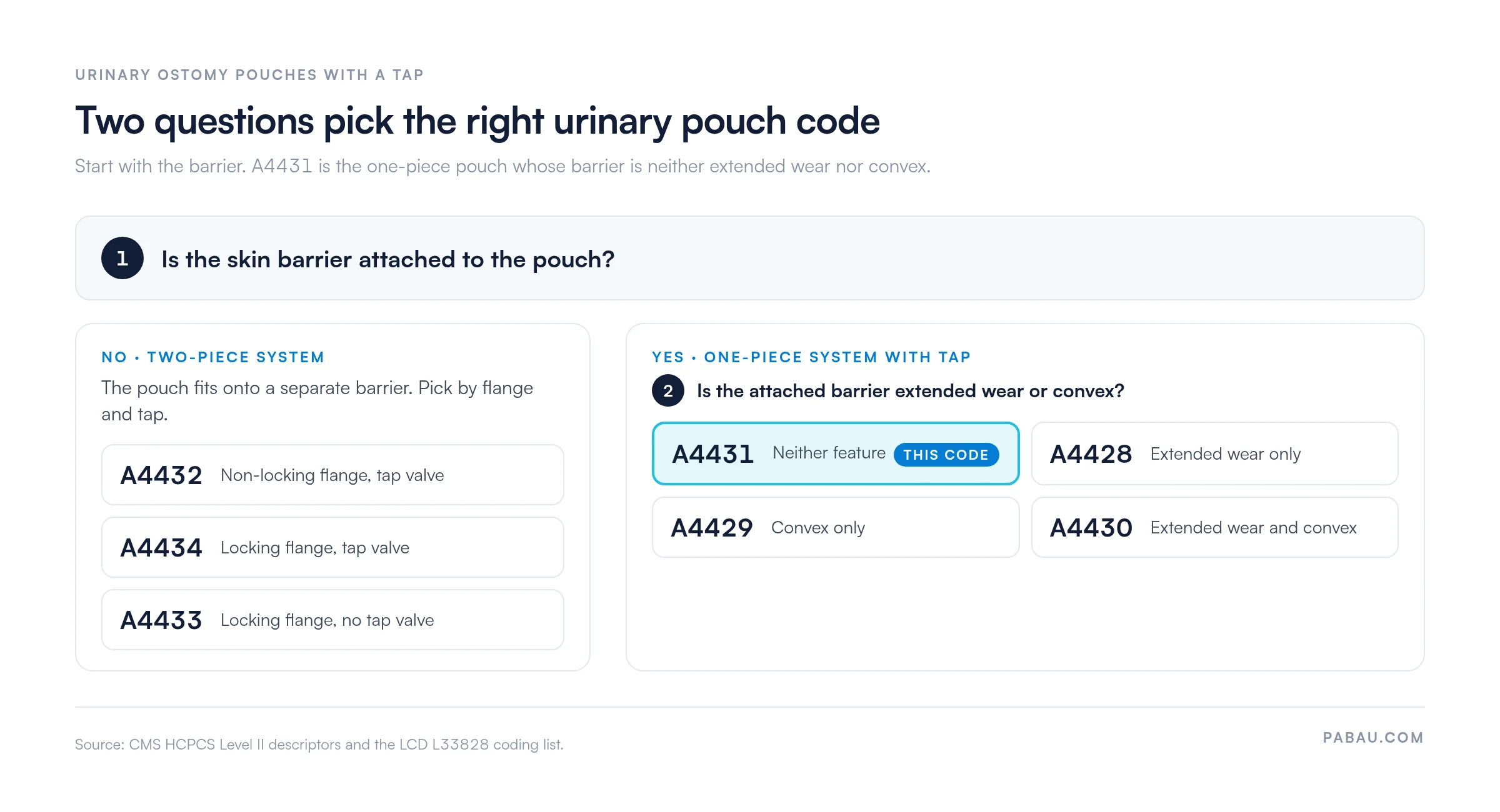
The features the descriptor leaves out matter just as much. A4431 has no extended wear barrier and no built-in convexity. A one-piece urinary pouch with either feature is coded as A4428, A4429 or A4430 instead.
One unit is one pouch. The patient removes the whole appliance at each change, and the supplier bills no separate barrier for it.
The table below summarizes the administrative data for A4431, taken from the CMS HCPCS Level II code set and the Medicare ostomy supplies policy.
The benefit category trips people up. Ostomy supplies are processed by the DME MACs and priced on the DMEPOS fee schedule. The statutory benefit is still the prosthetic device benefit, because the pouching system takes over the bladder’s job of holding urine.
A4431 is paid from the Medicare DMEPOS fee schedule. It carries no relative value units, so a physician fee schedule lookup will not show a rate for it. Check the current quarter in the CMS DMEPOS fee schedule files before quoting a figure.
Allowed amounts are published by state, with separate rural and non-rural columns. The beneficiary’s permanent residence decides which amount applies, not the supplier’s billing address.
Three payment facts about A4431 hold steady from year to year:
Medicaid works on its own terms. Each state program sets coverage, quantity limits and payment rates for ostomy supplies, and commercial plans publish their own policies.
Six urinary pouch codes sit close enough to A4431 to get picked by mistake. The descriptors below come from the CMS HCPCS Level II file and the coding list in LCD L33828.
Two questions settle most code choices. Is the barrier part of the pouch? If it is not, the pouch is two-piece and belongs to A4432, A4433 or A4434.
If the barrier is attached, is it extended wear or convex? Either feature moves the claim to A4428, A4429 or A4430. Two products can look alike on a packing list and still carry different codes, so read the manufacturer’s coding statement before the first claim.
Medicare covers A4431 when the beneficiary has a surgically created stoma that diverts urine and the condition is permanent. Coverage is defined by LCD L33828 and its companion policy article A52487.
Permanent has a specific meaning here. It describes a condition of long and indefinite duration, judged from the treating practitioner’s records. It does not require a finding that the condition can never improve.
Core coverage criteria for an A4431 claim:
The LCD ties quantity to the type of ostomy, its location and construction, and the skin around the stoma. Units above the usual maximum are denied as not reasonable and necessary when the record does not explain them.
Every A4431 claim rests on records a DME MAC reviewer can read without asking follow-up questions. The file needs six elements:
Urinary pouches ship on a cycle, and the refill rules are where an otherwise clean A4431 claim comes apart.
Supplies delivered without a documented refill request are denied as not reasonable and necessary. That denial is hard to argue, because the missing record belongs to the supplier.
Billing A4431 cleanly means matching the product, the patient and the paperwork before the claim leaves your system. The steps below follow standard DME MAC workflow under Medicare Part B.
Policy article A52487 lists the ICD-10-CM codes that support medical necessity for ostomy supplies. Most of them describe bowel diversions. Two describe a urinary diversion, and those are the ones an A4431 line carries. Ileostomy and colostomy status, Z93.2 and Z93.3, support a drainable pouch instead, billed on a one-piece system as HCPCS code A4435.
The underlying condition does not belong on the A4431 line by itself. Bladder cancer is absent from the covered list, so sending C67.9 alone invites a medical-necessity denial.
Before each monthly A4431 submission, check four points. The standard written order is on file with a quantity. The units billed are 20 or fewer. The refill contact and the affirmative response are both logged. Z93.6 or Z43.6 sits on the claim.
A4431 claims fail for a short list of reasons. Working through them before submission costs far less than appealing afterward.
Redeterminations on A4431 turn on paperwork rather than clinical argument. A complete order, a covered diagnosis and a logged refill request settle most of them without reaching a qualified independent contractor.
Schedule a records review for every urostomy account once a year. Continued medical need is the quiet failure point on long-running supply claims, because pouches keep shipping long after anyone last opened the file.
Most suppliers keep the pieces of an A4431 claim in different places. The order arrives by fax and lands in a shared drive. Delivery receipts sit in the shipping system, and refill calls get noted wherever the caller had a window open.
Practice management software like Pabau holds those records on one patient file. The signed order, the intake forms, the treatment notes and the diagnosis attach to the same record. Pulling a year of documentation for a review request becomes one search instead of three systems.
On the billing side, Pabau’s claims management software stores insurer and policy details on the patient record and tracks each claim through to payment. A denied pouch claim surfaces while the refill cycle is still fresh, so the fix goes out before the next shipment.

Pabau brings patient records, digital forms and claims tracking into one system. Each A4431 order has its documentation ready before a review request arrives.

A4431 rewards suppliers who settle the product question at intake. The pouch must be one piece, with a drain tap and an attached barrier that is neither extended wear nor convex. Confirm that once per account, and check it again whenever the patient’s product changes.
After that, the monthly work is documentation. A current order, a covered diagnosis and a logged refill request cost far less to keep than a redetermination costs to win.
Book a demo to see how Pabau keeps orders, diagnoses and delivery records together for every ostomy supply account.

Billing the extended wear version? A4428 covers the one-piece urinary pouch with an extended wear barrier and the same tap valve.
Is the patient on a two-piece system? A4432 covers the urinary pouch with a tap that pushes onto a separate non-locking barrier.
Need the locking two-piece pouch without a tap? A4433 walks through coverage, refills and denials for that urinary pouch.
Billing the accessories alongside the pouch? A4404 covers the ostomy ring, which carries its own monthly maximum.
Need the code for a support belt? A4367 sets out the coverage test for an ostomy belt, limited to one per month.
A4431 bills a one-piece urinary ostomy pouch with the skin barrier attached and a faucet-type tap with valve. One unit is one pouch. The attached barrier is neither extended wear nor convex, and it is never billed on a separate line.
Yes. Medicare covers A4431 under the prosthetic device benefit when the beneficiary has a permanent urinary ostomy. LCD L33828 sets the usual maximum at 20 pouches per month. A standard written order and a covered diagnosis such as Z93.6 must support the claim.
Both are one-piece urinary pouches with an attached barrier and a faucet-type tap. A4428 has an extended wear barrier, while the A4431 barrier is not extended wear. If the barrier has built-in convexity, the code is A4429 or A4430 instead.
No. A4431 is a one-piece system, so the barrier is part of the pouch. Flanged skin barrier codes such as A4414 belong to two-piece systems, where the pouch attaches to a separate wafer. Accessories such as an ostomy ring are billed under their own codes.
The usual maximum in LCD L33828 is 20 pouches per month. Higher quantities can be paid when the medical record explains why the beneficiary needs more. Without that explanation, the extra units are denied as not reasonable and necessary.