CPT Code 62284: Injection procedure for myelography
CPT Code 62284: official descriptor and procedure overview The American Medical ...

Last Updated: Oct 19, 2026
Q4165 is the HCPCS Level II code for keramatrix or kerasorb, per square centimeter (add-on, list separately in addition to primary procedure).
HCPCS Code Q4165 covers Keramatrix and Kerasorb, keratin-based skin substitutes made from sheep's wool protein, billed per square centimeter of wound area. From January 1, 2026, Medicare pays it as an incident-to supply at a flat national rate of about $127 per square centimeter. Most Q4165 billing errors come from confusing it with adjacent Q4xxx codes, miscounting wound units, or missing the documentation a payer requires.
Let Pabau's smart automation suggest the right codes, reduce claim denials, and keep your practice compliant—effortlessly.
Automate repetitive tasks and focus on what matters most—your patients.
Reduce coding errors and ensure compliance with the latest regulations.
Clean claims, fewer denials, and faster reimbursements.
Powerful insights and reporting to help your practice thrive.
HIPAA compliant SOC 2 certified GDPR-compliant Trusted by 4,000+ clinics worldwide

HCPCS Code Q4165 covers two products only: Keramatrix and Kerasorb skin substitutes, not the broader Q4xxx series
Units are reported per square centimeter of wound area measured at the time of application, rounded up to the nearest whole unit
From January 1, 2026, Medicare pays Q4165 as an incident-to supply at a flat rate of about $127 per sq cm
Medicare coverage needs a covered diagnosis and full documentation at each application, judged by your MAC’s LCD or case by case
Medicare pays only the product applied, so discarded units are never billed and JW/JZ modifiers no longer go on Q4165 lines
Practice management software like Pabau keeps wound measurements, product details, and prior auth status on the record that feeds the claim
HCPCS Code Q4165 is the official HCPCS Level II code for “Keramatrix or Kerasorb, per square centimeter.” Both products are keratin-based skin substitutes applied topically to chronic wounds to support tissue regeneration. The descriptor covers both product names under a single billable code, so a coder billing either Keramatrix or Kerasorb uses Q4165 on the claim.
Q-codes are temporary HCPCS Level II codes maintained by the Centers for Medicare and Medicaid Services. New and revised drug and biological codes are decided through a quarterly application review, and CMS has held no public meetings for them since 2020. CMS can also retire or reassign a Q-code. Verify the code remains active in the current year’s CMS HCPCS file before billing.
Units for HCPCS Code Q4165 equal the wound surface area in square centimeters at the time of application. Measure wound length and width in centimeters, multiply to get area, and round up to the nearest whole square centimeter. That figure is the billed quantity on the claim.
A worked example: a wound measuring 3.2 cm x 2.7 cm gives an area of 8.64 sq cm. Round up to 9. Bill Q4165 with a quantity of 9 units.
Keramatrix and Kerasorb are keratin-based wound products made from purified keratin protein sourced from sheep’s wool. They support chronic wound healing by providing a resorbable scaffold for cellular ingrowth. Keramatrix is cleared by the FDA through the 510(k) pathway rather than licensed as a biologic. That status places Q4165 in the incident-to supply group CMS created for 2026 payment.
When ordering or applying either product, verify the lot number and package size in the clinical record. CMS and MAC audits have flagged missing lot documentation as a compliance risk for skin substitute claims.
Medicare coverage for HCPCS Code Q4165 depends on your Medicare Administrative Contractor (MAC). The skin substitute Local Coverage Determinations (LCDs) planned for January 1, 2026 were withdrawn in December 2025. Novitas, First Coast, and CGS keep their older skin substitute LCDs. Palmetto GBA, NGS, WPS, and Noridian have none, so they judge each claim on whether it is reasonable and necessary.
Under the older LCDs, conventional wound care must have been tried and failed before the skin substitute is applied. The wound must also meet minimum duration and severity criteria. Case-by-case reviewers look for the same evidence in the record, so document it either way.
Claims submitted for wound types outside LCD coverage are denied automatically. Common non-covered uses include acute traumatic wounds without underlying chronic disease, cosmetic skin procedures, and burns not meeting clinical criteria. Wounds that have not first received adequate conventional wound care are also denied. Where your MAC has an LCD, it defines “adequate conventional care” in its own terms. Review that LCD, or your MAC’s reasonable-and-necessary guidance, before the first application.
Medicare pays HCPCS Code Q4165 at a flat national rate of about $127.14 to $127.28 per square centimeter in 2026. The CY2026 Physician Fee Schedule and OPPS final rules reclassified skin substitutes that are not licensed as biologics as incident-to supplies. Keramatrix, a 510(k)-cleared product, falls in that group from January 1, 2026.
The flat rate replaced product-specific Average Sales Price (ASP) pricing, and manufacturers no longer report ASP data for these products. CMS set the rate for the full calendar year, so it does not change quarterly. The same rate applies in the physician office, the hospital outpatient department, and the ambulatory surgical center. Verify your local rate using the CMS Physician Fee Schedule lookup tool.
Commercial payers including Blue Cross Blue Shield plans set their own payment rates, which may differ significantly from the Medicare flat rate. Review each payer’s fee schedule or contact the payer directly for Q4165 contracted rates. Load each contracted rate into your fee schedule separately, because a commercial Q4165 line will not follow the Medicare figure.
Load the 2026 Q4165 rate into your fee schedule once, not every quarter. The flat incident-to supply rate holds for the full calendar year, so the old January, April, July, and October ASP checks no longer apply. Recheck when CMS publishes the CY2027 rules, because CMS intends to propose separate rates for each FDA regulatory category.
Every Q4165 claim needs a supporting ICD-10-CM diagnosis code that maps to a covered wound type. In Novitas, First Coast, and CGS jurisdictions, a code missing from the LCD’s covered-diagnosis list triggers a denial. The table below lists the most commonly linked codes for each covered wound category.
Where your MAC has an LCD, verify the specific ICD-10 codes on its covered-diagnosis list, not just the broad category. Codes missing from that list trigger denial even when the wound is clinically appropriate. Where the MAC has no LCD, code to the highest specificity the documentation supports, including site, laterality, and severity.
Modifier requirements for HCPCS Code Q4165 changed on January 1, 2026, when Medicare began paying the product as an incident-to supply. The payer, the patient’s hospice status, and wound laterality now decide which modifiers apply. Confirm modifier guidance with your MAC and each commercial payer before billing.
The JW/JZ modifier pair applies to separately payable drugs and biologicals from single-dose containers. CMS guidance states the pair is not appropriate on incident-to supplies, and Q4165 has been one on Medicare claims since January 1, 2026. Bill only the square centimeters applied to the wound. Medicare does not pay for discarded skin substitute product under any circumstance. A commercial payer may keep its own waste-reporting rule, so check its policy before you drop the modifiers from its claims.
Prior authorization for HCPCS Code Q4165 is not universally required, and the rules vary by payer and MAC jurisdiction. Check PA for the patient’s primary payer as part of eligibility verification, before the first application appointment.
Q4165 and Q4166 are adjacent HCPCS codes covering different wound matrix products. Using Q4166 when Q4165 is correct, or vice versa, results in an automatic product-code mismatch denial. The differentiator is simple: the product applied determines the code.
Both codes are per-square-centimeter skin substitutes, making them easy to confuse when billing from product logs or charge capture. The safest approach is to link the charge code directly to the product name in the clinical record. The coder then never has to infer which code applies. For other products in the Q4xxx series, check the current CMS HCPCS file, which lists each product under its own code.
Truskin is one of those neighboring products, billed under Q4167 at one unit per square centimeter applied. It pairs with a CPT application code from the same 15271-15278 series.
Missing or incomplete documentation is the most common root cause of Q4165 denials on audit. Documentation rules for skin substitute codes are among the strictest in outpatient wound care. Every clinical note for a Q4165 application date must include all of the following elements to survive MAC review.
Charge capture should hold every field above before the claim is created, so the coder never reopens the chart to finish a Q4165 line.
Skin substitute claims have appeared repeatedly on OIG Work Plan audits as Medicare spending on the category climbed. Q4165 denials follow a predictable pattern, and the same triggers appear across practices and MACs. The table below pairs each trigger with the step that prevents it.
When a Q4165 claim is denied, read the Claim Adjustment Reason Code (CARC) on the electronic remittance advice before appealing. The CARC pinpoints the denial category and directs the correct corrective action. Track denial patterns across Q4165 claims over a rolling 90-day period. That surfaces systemic documentation or coding errors instead of treating each denial as isolated. The medical billing denial codes reference explains what each common CARC value means and how to correct it.
Use this pre-submission checklist before releasing any Q4165 claim. Each item maps to a denial trigger, and missing any one gives the payer grounds to reject the claim.
The four stages below show where each checklist item sits on the path from coverage check to payment.
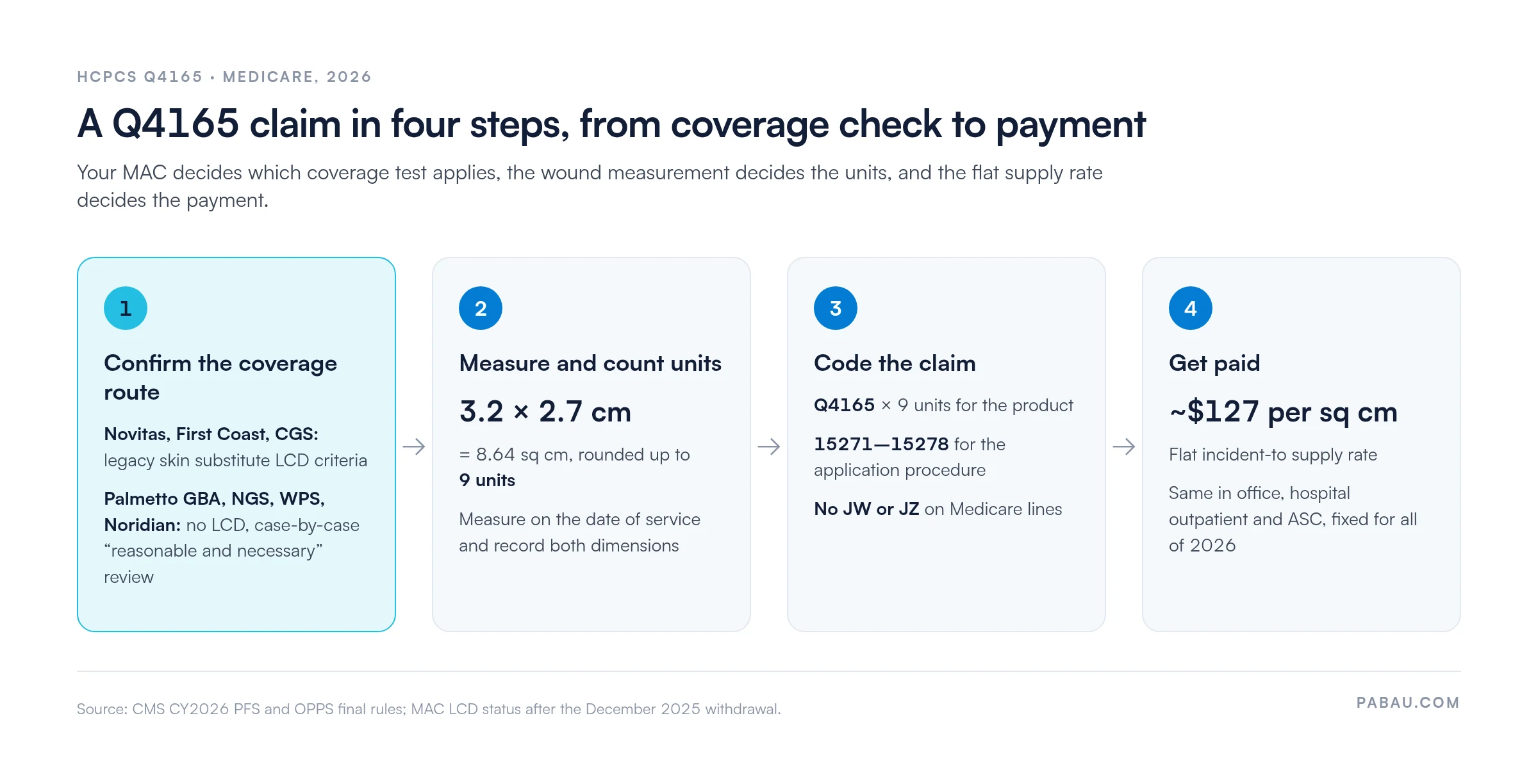
The application procedure bills on its own line. CPT code 15271 covers the first 25 sq cm on the trunk, arms, or legs, while foot wounds use 15275. Build this checklist into charge capture so errors are caught before the claim leaves the practice.
Build a Q4165-specific charge capture rule in your practice management system. Require wound length, width, product lot number, and any laterality modifier before the charge can be saved. This turns the checklist into a system gate rather than a manual step, and it creates an audit trail that survives a MAC pre-payment review.
Most Q4165 denials start in the chart. The wound measurement sits in one note, the lot number on a packing slip, and the prior auth reference in an inbox. A coder then rebuilds the claim line from all three sources.
Practice management software like Pabau keeps those details on the patient record. Treatment notes, wound photos, and product lot details are captured at the appointment itself. Its claims software built for practices then pulls that record data into a pre-filled claim, submitted and tracked through Claim.MD.
The coder reviews one complete record instead of chasing three, and remittances post back against the same claim. On a code that attracts close audit attention, that shortens the path from application to payment.

Pabau keeps wound measurements, lot details, and photos on one patient record. It pulls them into a pre-filled claim, so Q4165 lines reach the payer complete.

HCPCS Code Q4165 now pays a flat supply rate, so the 2026 margin sits in the units you can prove. Every square centimeter billed needs a matching measurement in the note, and trimmed product is never paid. Before the first application, check whether your MAC still works from an LCD, because that decides which criteria the record has to meet.
Update your fee schedule and charge rules once for the year, drop JW/JZ from Medicare lines, and hold every claim until the record is complete. The trade-off is a slower charge entry step in exchange for fewer appeals. Book a demo to see how Pabau keeps Q4165 wound documentation and claims on one record.

Need to understand how clearinghouse submission works for HCPCS claims? Medical claims clearinghouse guide explains how claims route from practice to payer and where Q-code claims most often stall.
Want to reduce claim rejections across your billing workflow? Medical billing overview covers the end-to-end process and where skin substitute claims fit within it.
Looking for the denial code definitions behind your Q4165 rejections? Denial codes in medical billing maps CARC values to actionable corrections for wound care coders.
HCPCS Code Q4165 is a temporary HCPCS Level II code covering Keramatrix and Kerasorb skin substitutes, billed per square centimeter of wound area applied. CMS decides these codes through its quarterly drug and biological application review, with no public meeting since 2020. Q4165 identifies these two keratin-based wound products for reimbursement under Medicare and many commercial payers.
Traditional Medicare fee-for-service does not currently require prior authorization for Q4165. Medicare Advantage plans set their own PA requirements, and many require it for any skin substitute. Always verify the specific patient’s plan before the first application, as MA plan requirements differ from traditional Medicare and from each other.
The most common Q4165 denial reasons are a missing prior authorization and a diagnosis code not on the MAC LCD covered list. Units calculated from package size rather than wound area also cause denials. So do billed units that include discarded product, and documentation missing a wound photo or lot number.
Medicare pays Q4165 at a flat national rate of about $127.14 to $127.28 per square centimeter in 2026, before local adjustment. CMS reclassified non-BLA skin substitutes as incident-to supplies from January 1, 2026. The same rate applies in the physician office, hospital outpatient, and ASC settings, and it holds for the full year.