CPT Code 62284: Injection procedure for myelography
CPT Code 62284: official descriptor and procedure overview The American Medical ...

Last Updated: Oct 19, 2026
A4458 is the HCPCS Level II code for enema bag with tubing, reusable. It describes a gravity enema system, and Medicare treats it as statutorily non-covered. LCD L36267 denies it as "no benefit," so no diagnosis, order, or KX modifier makes the claim payable.
Report A4458 to Medicare with the GY modifier and tell the patient they'll pay for the bag. If the device is a manual pump transanal irrigation system, bill A4459 instead.
Let Pabau's smart automation suggest the right codes, reduce claim denials, and keep your practice compliant—effortlessly.
Automate repetitive tasks and focus on what matters most—your patients.
Reduce coding errors and ensure compliance with the latest regulations.
Clean claims, fewer denials, and faster reimbursements.
Powerful insights and reporting to help your practice thrive.
HIPAA compliant SOC 2 certified GDPR-compliant Trusted by 4,000+ clinics worldwide

HCPCS code A4458 describes a reusable enema bag with tubing, a gravity enema system separate from A4457 (replacement tube) and A4459 (transanal irrigation system).
Medicare denies A4458 as statutorily non-covered under LCD L36267, so no diagnosis, order, or KX modifier can make the claim payable.
Bill A4458 to Medicare with the GY modifier. The patient pays for the device, and no ABN is required for a statutorily excluded item.
The April 1, 2025 LCD revision extended conditional coverage to A4459 only. For a Medicare-payable bowel management system, bill A4459 with the A4453 catheter.
HCPCS code A4458 is the Level II supply code for a reusable enema bag with tubing. The official CMS descriptor reads: Enema bag with tubing, reusable.
LCD L36267 classes it as a gravity enema system, which delivers fluid by gravity rather than through a pump. Medicare denies it as statutorily non-covered, so you bill it with the GY modifier and the patient pays.
The word “reusable” sets the limit on what the code describes. A4458 covers a bag-and-tubing set built for repeated use, so it doesn’t fit a single-use kit. CMS maintains Level II codes like A4458, as its HCPCS Level II overview explains.
A4458 doesn’t describe any of these items:
Medicare denies every A4458 claim because gravity enema systems fall outside any Medicare benefit category. LCD L36267, the Bowel Management Devices policy, states that gravity enema systems coded A4458 “will be denied as statutorily non-covered, no benefit.”
A statutory exclusion works differently from a medical-necessity denial. A “not reasonable and necessary” denial can sometimes be reversed with better documentation. A no-benefit denial can’t, because the law never included the device in what Medicare pays for.
That’s why the usual coverage checklist doesn’t apply to A4458. A covered ICD-10 diagnosis, a written order, and the KX modifier leave the outcome unchanged. The claim is still denied.
Much of the confusion traces back to the April 1, 2025 revision of LCD L36267. Before it, the LCD denied both gravity and manual pump enema systems, A4458 and A4459, as statutorily non-covered.
Revision R11, a non-discretionary update under the 21st Century Cures Act, removed A4459 from that denial language. A4458 stayed in it. Transanal irrigation systems are now covered under the Prosthetic Devices benefit when the criteria in Policy Article A54516 are met.
If the patient needs a bowel management device Medicare can pay for, the conversation is about A4459, not A4458. Checking the patient’s other coverage at intake also shows whether a Medicaid or commercial plan might pay for the bag instead.
When an A4458 claim goes to Medicare, report it with the GY modifier. GY tells the payer the item is statutorily excluded or doesn’t meet the definition of any Medicare benefit.
GY doesn’t turn the claim into a paid one. It produces a denial that states the correct reason, which a secondary payer may ask to see before it considers the item. Medicare’s mandatory claim submission rule doesn’t cover statutorily excluded items. File the claim when the patient asks for one, usually so a supplemental plan has the Medicare denial it needs.
No ABN is required for A4458. The ABN requirement covers items Medicare may deny as not reasonable and necessary, and a statutorily excluded item sits outside that rule.
The patient is still financially responsible for the full cost. Tell them in writing before you dispense, so the bill doesn’t arrive as a surprise. CMS allows a voluntary ABN for this purpose, though it isn’t mandatory.
Because Medicare won’t pay for A4458, the paperwork protects the patient, the secondary payer, and your own audit trail. Keep these records in the supplier file:
Carrying the device description and order date from the chart onto the claim keeps these records lined up with what you bill.
Medicare pays nothing for A4458, so there’s no Medicare allowed amount to bill against. What the practice collects depends on the patient’s other coverage, or on the price it charges the patient directly.
Reviewing the electronic remittance advice for each claim confirms the GY denial posted with the right reason. Check it before you bill the secondary payer or the patient.
Three adjacent HCPCS codes cover enema and bowel irrigation supplies, and they differ by what goes out to the patient. The choice matters because A4458 has no Medicare benefit, while A4459 can be covered when the policy criteria are met.
The most frequent mix-up is between A4457 and A4458. If the supplier dispenses the bag and the tubing together, A4458 is correct. If only a replacement tube goes out, A4457 applies. The decision below maps each device to its code and its Medicare outcome.
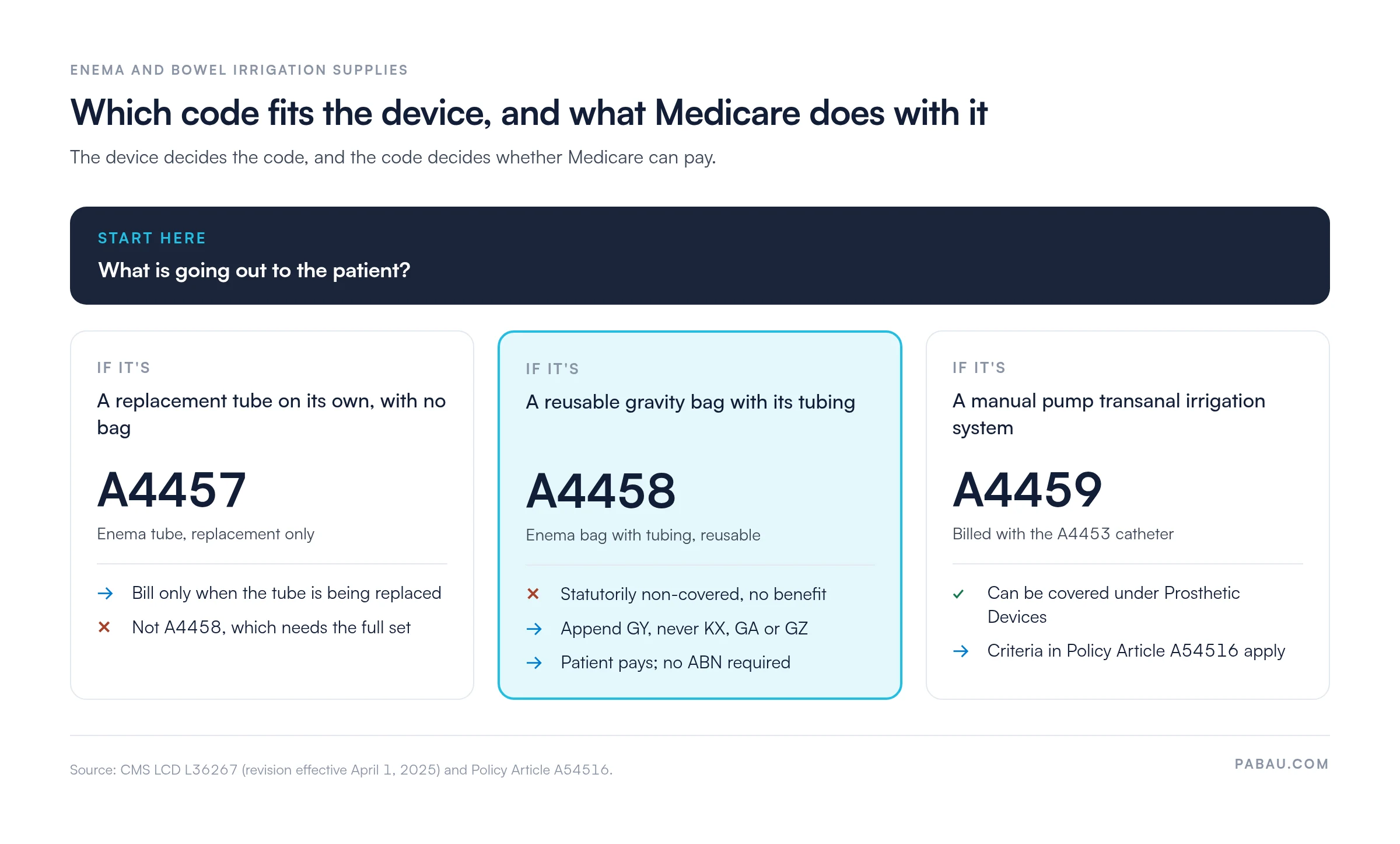
The costlier mistake is billing A4458 for a transanal irrigation system. That sends a potentially covered A4459 claim to Medicare as a no-benefit item. The denial codes on the remittance show which of these errors caused a rejection.
A4458 errors follow a pattern, and most come from treating the bag like a covered DME supply. Tracking them by root cause shows which ones keep coming back.
Before any A4458 claim goes out, run three checks. Confirm the device is a reusable gravity bag, not a transanal irrigation system or a replacement tube. Confirm GY has replaced any KX, GA, or GZ. Then confirm the patient signed a written notice that they’ll pay for the item.
Adding those checks to your pre-submission checklist keeps the same errors off the next claim.
A4458 billing goes wrong when a team handles a no-benefit item like a covered one. Getting it right takes three steps: a claim that carries GY, a patient who knows the cost, and a code that matches the device.
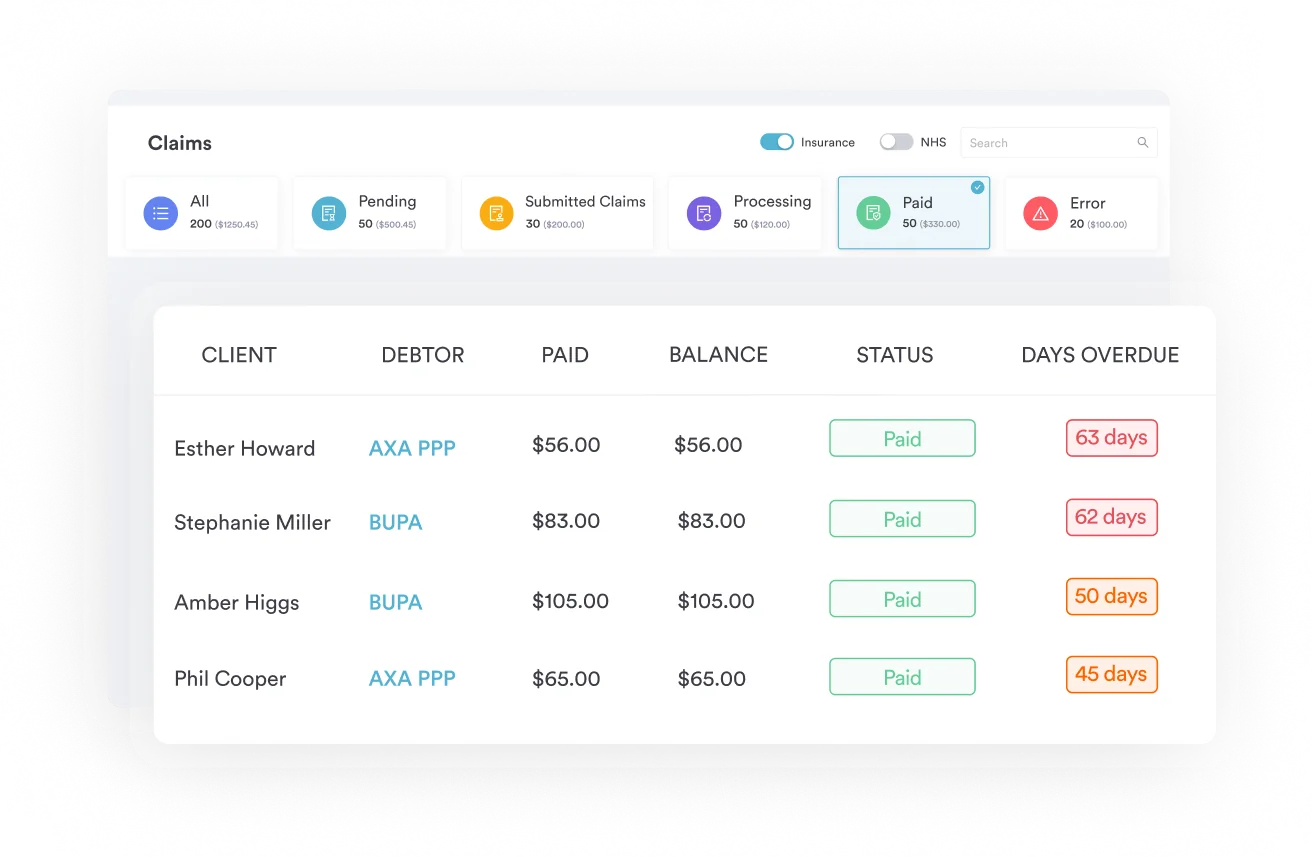
Practice management software like Pabau checks the fields insurers require and blocks a claim from going out if something is missing or invalid. Its claims management software then shows where each submitted claim sits, so billers see the GY denial post before they invoice the patient.

Pabau’s claims management software checks the fields insurers require and blocks incomplete claims before they go out. A status dashboard tracks every claim already submitted.

A4458 is one of the few HCPCS supply codes where the Medicare answer is settled before the claim is written. Medicare won’t pay for a gravity enema bag under any diagnosis. The work shifts to coding it with GY and telling the patient about the cost up front.
When a patient needs a device Medicare can cover, that’s a transanal irrigation system billed as A4459 with A4453. Pabau keeps the order, the financial notice, and the claim in one patient record. Book a demo to see how Pabau keeps no-benefit supply claims coded right and patients informed before they pay.

Need to understand the full medical billing cycle? What is medical billing walks through the end-to-end workflow from patient encounter through payment posting.
Seeing repeated claim rejections? Denial management in healthcare covers how to categorize, track, and resolve CARC-coded denials systematically.
Want to reduce coding errors before claims leave the system? Clean claim submission outlines the pre-submission checks that prevent the most common HCPCS billing defects.
Billing the covered alternative? HCPCS code A4459 explains the transanal irrigation system descriptor, the A4453 catheter pairing, and its coverage criteria.
Need to confirm the GY denial posted? Electronic remittance advice shows how to read an ERA line by line, including the denial reason codes.
HCPCS code A4458 is the Level II supply code for a reusable enema bag with tubing, a gravity enema system. It’s distinct from A4457, a replacement enema tube, and A4459, a manual transanal irrigation system.
No. LCD L36267 denies A4458 as statutorily non-covered with no benefit, so Medicare won’t pay for it under any diagnosis. A written order, a covered diagnosis, or a KX modifier doesn’t change that outcome.
A4457 is a replacement enema tube, with or without adapter, and has no bag. A4458 is the full reusable bag with tubing. Bill A4457 when only the tube is replaced, and A4458 when the whole set is dispensed.
Keep the order naming a reusable enema bag with tubing, a signed notice that the patient will pay, and a dispensing record. Add the Medicare remittance showing the GY denial if a secondary payer will be billed.
Use the GY modifier on any A4458 claim sent to Medicare, because it marks the item as statutorily excluded. KX, GA, and GZ don’t apply, since they relate to policy criteria or medical-necessity denials.
Medicare requires neither for A4458. An ABN isn’t required for a statutorily excluded item, though you can give one voluntarily. Medicaid and commercial plans set their own rules, so check with the patient’s plan.
Use A4459 for a manual transanal irrigation system, billed together with the A4453 rectal catheter. The April 1, 2025 revision of LCD L36267 removed A4459 from the non-coverage language, so it can be covered when the policy criteria are met.