CPT code 36468: Injection sclerotherapy of telangiectasia billing guide
CPT code 36468 covers spider veins on a limb or the trunk CPT code 36468 reports...

Last Updated: Nov 13, 2026
J7508 is the HCPCS Level II code for tacrolimus, extended release (Astagraf XL), oral, 0.1 mg. One billing unit equals 0.1 mg dispensed, so a single 5 mg capsule is 50 units.
Medicare Part B covers it, through the DME MAC, for transplant recipients who had Part A when the transplant took place. Immediate-release tacrolimus bills as J7507 instead, and Envarsus XR as J7503.
Let Pabau's smart automation suggest the right codes, reduce claim denials, and keep your practice compliant—effortlessly.
Automate repetitive tasks and focus on what matters most—your patients.
Reduce coding errors and ensure compliance with the latest regulations.
Clean claims, fewer denials, and faster reimbursements.
Powerful insights and reporting to help your practice thrive.
HIPAA compliant SOC 2 certified GDPR-compliant Trusted by 4,000+ clinics worldwide

HCPCS code J7508 describes tacrolimus, extended release (Astagraf XL), oral, 0.1 mg, so one unit equals 0.1 mg dispensed.
Medicare Part B covers J7508 when the patient had Part A at the time of the transplant, with claims sent to the DME MAC.
J7508 is for Astagraf XL only. Immediate-release tacrolimus bills as J7507, and Envarsus XR bills as J7503.
KX goes on a Medicare line only when the transplant date is on file and the A52474 conditions are met.
Pabau’s claims management software pre-fills claims from the patient record and tracks each one to payment, so unit and NDC errors surface early.
HCPCS code J7508 is the Level II code for tacrolimus, extended release (Astagraf XL), oral, 0.1 mg. CMS maintains the HCPCS Level II code set, which covers drugs and supplies that CPT codes don’t describe. One billing unit equals 0.1 mg of tacrolimus dispensed.
Tacrolimus, first developed as FK506, is a calcineurin inhibitor. It suppresses the T-cell response that drives rejection after a solid organ transplant. Astagraf XL, made by Astellas, is the once-daily extended-release capsule the code names.
J7508 sits in the J7500 to J7599 range for immunosuppressive drugs. Keep this quick reference beside the dispensing record when you build the claim.
J7508 covers Astagraf XL dispensed as maintenance therapy to prevent organ rejection. Its FDA label approves it for prophylaxis of organ rejection in kidney transplant recipients. Claims for other organs face closer medical necessity review.
The label also carries a boxed warning about increased mortality in female liver transplant patients. These products fall outside J7508, and billing one of them under it is a costly mistake:
Check the dispensed product against the current CMS HCPCS descriptors at the time of service, because descriptors can change each year.
The most common error in tacrolimus billing is matching the code to the drug instead of the product. Three oral tacrolimus codes exist, and each has its own billing unit. Oral cyclosporine, a different calcineurin inhibitor, adds a code billers often mix up with them.
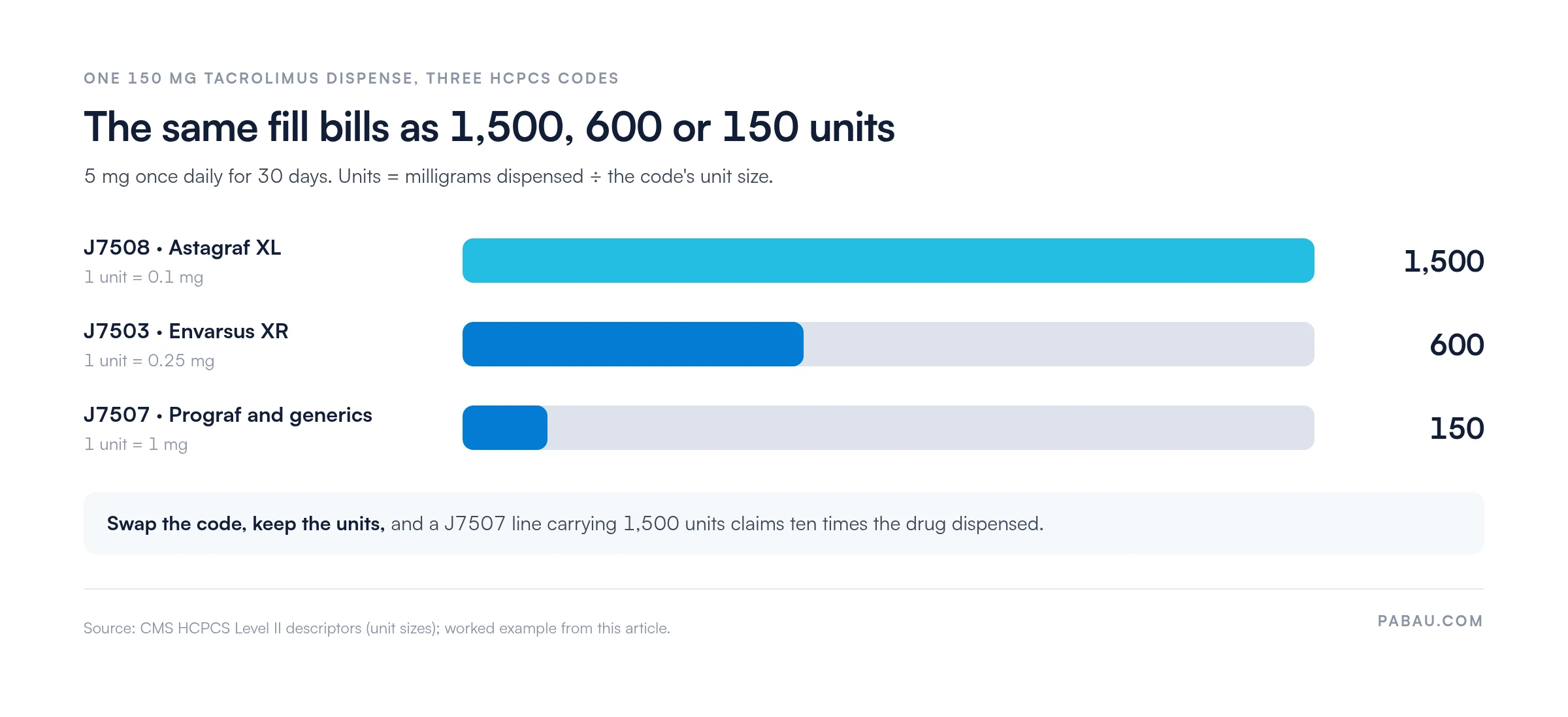
Units are where a wrong code does the most damage. The same 5 mg daily dose is 50 units under J7508, 5 units under J7507 and 20 units under J7503. Over a 30-day fill, that one dispense turns into three very different unit counts.
When a patient moves from IV tacrolimus (J7525) after surgery to oral maintenance, switch codes at that point. Report J7508 only once the patient is on Astagraf XL, not on immediate-release capsules.
Medicare Part B, not Part D, covers HCPCS code J7508 for qualifying transplant recipients. The patient must have been enrolled in Part A at the time of the transplant, and in Part B when the drug is dispensed. A transplant that predates Part A enrollment falls outside this benefit, and Part D may cover the drug instead.
The Consolidated Appropriations Act, 2021 added a Part B immunosuppressive drug benefit that started in January 2023. It lets some kidney recipients keep drug coverage after their other Medicare coverage ends 36 months post-transplant. Confirm current eligibility with the applicable Medicare Administrative Contractor (MAC).
Part B oral immunosuppressives are billed to the DME MAC by a pharmacy enrolled as a DMEPOS supplier. The DME MACs’ Immunosuppressive Drugs LCD (L33824) and its policy article A52474 set the coverage rules. A refill can now cover up to a 90-day supply.
When a patient has both Medicare and commercial coverage, coordinate carefully. Billing J7508 under Part D when Part B is the correct primary payer triggers a coordination-of-benefits denial. It can also become a billing compliance issue.
A J7508 claim passes through five stages before anyone gets paid. Knowing who touches it at each one tells you where an error usually starts.
Commercial plans and Medicaid set their own formats, so check each payer’s billing guide before the first claim goes out.
Billing HCPCS code J7508 correctly comes down to six elements on every claim. Get them right once and each refill claim follows the same pattern.
Take a kidney recipient on Astagraf XL 5 mg once daily, with a transplant that Medicare Part A covered. A 30-day fill of 5 mg capsules is 150 mg, so the line reads J7508 × 1,500 units.
The diagnosis is Z94.0, and the NDC comes off the 5 mg package in hand. With the transplant date on file, the line takes KX. One unit of Q0511 covers the supplying fee for the period.
Payers auditing J7508 claims look for a consistent set of records. A missing piece here is the second most common denial pathway after a missing NDC.
Keep a transplant billing file for each patient, with the transplant summary, current orders and dispense records. It speeds up audit responses. A superbill that captures the NDC, units and diagnosis codes at the point of service makes that file easy to build.
Prior authorization for immunosuppressants follows a split pattern between Medicare and commercial payers. Mixing up the two rules is how a clean dispense turns into a denial.
Medicare Part B: It generally does not require prior authorization for tacrolimus for a qualifying transplant recipient. The diagnosis codes, the KX criteria and the chart documentation do that job instead.
Commercial payers: Most commercial plans require PA for immunosuppressants before the first dispense. Typical criteria include a documented transplant, the transplant specialist’s attestation and the center’s dosing protocol. Dispensing before PA is on file leads to a retroactive denial that is hard to overturn.
Medicaid: State programs vary. Many require PA for an initial period, commonly 12 months, with annual renewal. Some states exempt transplant immunosuppressants under fee-for-service, while managed Medicaid plans usually require PA.
Build a PA tracker specifically for immunosuppressant dispenses. Flag each J7508 patient with their PA expiration date, and set an automated reminder 30 days before renewal. A lapsed PA on a long-term transplant patient is a preventable revenue loss.
Run through these six checks on every J7508 claim, refills included. Each one maps to a denial reason further down.
J7508 denials cluster around six root causes. The table maps each one to the Claim Adjustment Reason Code (CARC) payers most often return and the action that resolves it. For the wider code sets, see our guide to denial codes.
Good denial management for J7508 tracks each denial by root cause, not only by CARC. A month of tagged denials often points to one workflow step, such as an NDC skipped at the point of dispense.
Most repeat denials trace to habits rather than one-off slips. These are the ones worth retraining:
Medicare Part B reimburses J7508 under the Average Sales Price (ASP) methodology, per 0.1 mg unit. The payment rate is ASP plus 6%, or ASP plus 4.3% under mandatory sequestration. CMS updates ASP rates quarterly, so pull the current rate from the CMS Physician Fee Schedule and ASP Drug Pricing files.
Commercial reimbursement for J7508 is contract-specific. Many commercial plans pay at AWP minus a discount, which can differ a lot from the Medicare ASP rate. Model your Astagraf XL reimbursement by payer and flag contracts that approach or fall below acquisition cost.
Medicaid requires the 11-digit NDC on every J7508 claim. Report it in 5-4-2 format, taken from the package dispensed, not from a drug database. The NDC quantity must use the unit of measure as dispensed, typically “each” for capsules.
As an example, Astagraf XL 0.5 mg capsules carry NDC 00469-0647-73. A 30-capsule dispense of that strength is 15 mg, so it bills as 150 units of J7508. Each strength and pack size has its own NDC, so copy it from the package in hand.
CMS publishes a quarterly crosswalk file that maps NDCs to HCPCS codes. The AAPC HCPCS code lookup and the PGM Billing HCPCS tool can help confirm your NDC maps to J7508. When a Prograf or Envarsus XR NDC lands on a J7508 line, it shows up as a formulation mismatch denial.
The safest place to capture the NDC is the dispense itself. By the time a biller reviews the claim, the package has usually left the pharmacy.
Run a quarterly audit of your J7508 NDC-to-HCPCS crosswalk. Pull every J7508 claim from the past 90 days and verify that the NDC reported maps to J7508 in the current CMS crosswalk file. NDCs that have migrated to a new HCPCS code will cause silent denials if the crosswalk update was missed.
In many transplant practices, J7508 claims are still checked by hand. A biller confirms the product, recounts units and copies the NDC from the dispensing record. Because tacrolimus is lifelong, one slip can repeat on every refill.
Pabau, the practice management platform we build, keeps patient records, prescribing notes and claims in one system. Its claims management software pre-fills the claim from the patient record and checks required fields before it can be sent. In the US, claims go out through Claim.MD, with eligibility checks and remittance posting built in.
Each claim’s status and denial reason sit on the same record as the patient’s orders. A recurring unit or NDC error shows up after one refill instead of six, so staff spend less time on resubmissions.

Pabau pre-fills claims from the patient record, checks required fields before submission and tracks each claim to payment. Denial reasons for every refill sit in one place.

J7508 rewards a practice that treats it as a product code rather than a drug code. Confirm Astagraf XL on the label, count in 0.1 mg units and send the claim to the DME MAC. Those three habits remove most of the denials on this page.
The trade-off is upfront work. Building the transplant file and KX evidence takes time on the first claim, but tacrolimus is lifelong. Every refill after that reuses the same file.
Book a demo to see how Pabau tracks your J7508 claims from dispense to payment.

Need a denial management framework for specialty drug claims? Denial management in healthcare covers the end-to-end process for tracking, appealing and preventing claim denials across J-code billing.
Billing the immediate-release version instead? HCPCS code J7507 explains Prograf and generic tacrolimus billing at 1 mg per unit.
Managing a patient on sirolimus too? HCPCS code J7520 covers oral sirolimus, another immunosuppressant billed to the DME MAC.
Want to understand the broader billing compliance picture? Medical billing compliance outlines documentation standards, NDC reporting rules and audit readiness for specialty practices.
Looking to improve your overall revenue cycle? What is revenue cycle management explains how to structure billing workflows from eligibility through final payment posting.
No. The Astagraf XL label warns that it is not interchangeable or substitutable with other tacrolimus products, because switching has caused medication errors. A switch needs a new prescription and closer trough monitoring, and the claim moves to J7507.
CPT code 80197 reports a quantitative tacrolimus drug assay. The lab bills it on its own claim, separately from the J7508 dispense.
Yes. Policy article A52474 covers one unit of Q0511 for the first covered immunosuppressive drug dispensed in a 30-day or 90-day period. A second pharmacy in the same period doesn’t get a second unit.
Coverage lasts as long as the patient stays eligible for Medicare. When Medicare is based only on kidney failure, it ends 36 months after the transplant. The Part B immunosuppressive drug benefit can then continue drug coverage for eligible patients.