

HCPCS code E0198: Water pressure pad billing guide
HCPCS code E0198 is a water pad for a standard mattress HCPCS code E0198 is the ...

Last Updated: Oct 13, 2026
J7525 is the HCPCS Level II code for tacrolimus, parenteral, 5 mg.
Denials on this code rarely trace back to code selection. They come from unit miscalculation, a missing NDC, or ICD-10 pairings that fail to support medical necessity. Those are medical billing mechanics rather than coding decisions.
Let Pabau's smart automation suggest the right codes, reduce claim denials, and keep your practice compliant—effortlessly.
Automate repetitive tasks and focus on what matters most—your patients.
Reduce coding errors and ensure compliance with the latest regulations.
Clean claims, fewer denials, and faster reimbursements.
Powerful insights and reporting to help your practice thrive.
HIPAA compliant SOC 2 certified GDPR-compliant Trusted by 4,000+ clinics worldwide

HCPCS Code J7525 covers tacrolimus, parenteral, 5 mg, an intravenous immunosuppressant billed at one unit per 5 mg administered.
J7525 is distinct from J7521, which covers tacrolimus oral granules at 0.1 mg per unit. Route and unit size differ, so the two codes are not interchangeable.
Many payers require the NDC alongside J7525, and a missing NDC is one of the most common denial triggers for this code.
The JA and JB route modifiers do not apply to J7525, because the code is already parenteral-specific.
Pabau’s claims management software links drug administration records to J-code billing in one workflow, which cuts manual lookup and transcription errors.
HCPCS Code J7525 is the Level II code for tacrolimus, parenteral, 5 mg. It falls under the J-code category, which covers drugs administered by routes other than oral.
The code is maintained by CMS’s HCPCS Level II system. It applies when tacrolimus is delivered intravenously in a hospital outpatient department, infusion center, or physician office.
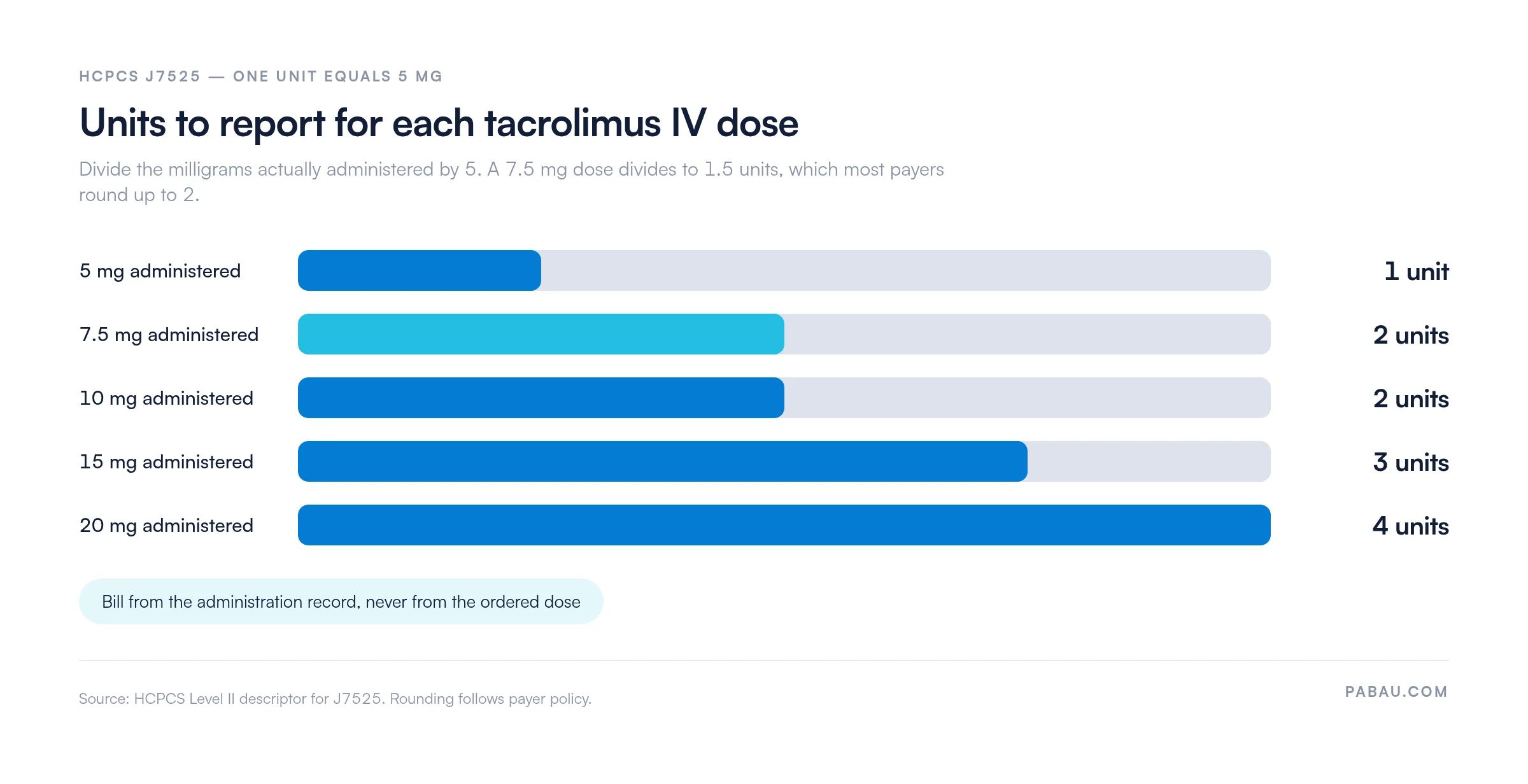
Each unit reported under J7525 represents exactly 5 mg of tacrolimus administered. Reporting 1 unit for a 10 mg dose instead of 2 units is a common underbilling mistake. The claim pays short, and no edit on the remittance points to the cause.
Every unit-based J-code carries its own divisor in its descriptor. J1556 counts in 500 mg increments and J7189 counts in micrograms, so the divisor has to be read rather than assumed. The chart below converts the tacrolimus doses you will see most often.
Tacrolimus, sold under brand names including Prograf and Envarsus XR, is a calcineurin inhibitor used to prevent organ rejection after solid organ transplantation.
It works by suppressing the T-cell responses that would otherwise attack the transplanted organ. The FDA approves it for kidney, liver, and heart transplantation, with off-label use in lung and other solid organ transplants.
The intravenous form covered by J7525 is usually reserved for the early post-transplant period, when a patient cannot tolerate oral administration. It is also used during acute rejection episodes that call for rapid immunosuppression.
Once the patient is stable enough for oral intake, prescribers generally transition to oral tacrolimus. Billing staff should confirm from clinical documentation whether IV or oral administration occurred before selecting the J-code.
Two HCPCS codes cover tacrolimus, and selecting the wrong one is a straightforward but damaging error. The route of administration and the billing unit differ between them. Verify the administration record before billing.
Both codes can apply on the same date of service if the patient moved from IV to oral tacrolimus within one encounter. Separate documentation has to support each administration event. Check your payer’s bundling rules before submitting both on the same claim.
Four variables decide whether a J7525 claim pays on first pass. They are the dose administered, the unit count, the place of service, and the payer’s modifier and NDC requirements. Submitting a clean claim first time matters here, because rework on a drug claim costs more staff time than the upfront verification.
Track the dose administered against the dose ordered on every J7525 claim. When nursing staff document a partial infusion, the billed units must reflect what was given rather than what was prescribed. Billing from the order instead of the administration record is an audit liability and a common denial trigger.
Medicare Part B reimburses J7525 under the Average Sales Price (ASP) methodology. CMS sets the payment rate at ASP plus 6% for physician office and outpatient settings.
Because ASP is recalculated quarterly, the reimbursement rate for J7525 changes four times per year. Verify the current quarter’s rate before estimating reimbursement or setting patient cost-share expectations.
The CMS Physician Fee Schedule lookup tool provides the most current published rates. Search by J7525 to retrieve the national non-facility and facility payment amounts. Then apply the geographic adjustment factor for your Medicare Administrative Contractor (MAC) jurisdiction.
Reviewing your electronic remittance advice after each submission is the fastest way to catch rate discrepancies before they compound across claims. Store the quarterly CMS ASP file alongside your billing reference materials, and update it at the start of each new quarter.
Payers use the submitted ICD-10 diagnosis codes to confirm medical necessity for J7525. The Z94 transplant status codes are the primary anchors. Depending on the clinical context, a T86 rejection code or a complication code may also apply.
Submitting J7525 with only a non-specific or unrelated diagnosis triggers medical-necessity denials, even when the administration is clinically appropriate.
Sequence the primary diagnosis first. If the patient has an active rejection episode, list the T86 code before the transplant status code. The clinical record should support whichever code leads. Verify against the current ICD-10-CM tabular list, since instructional notes and sequencing guidance are updated annually.
Most payers, including Medicare, require the 11-digit National Drug Code (NDC) on J-code drug claims. The NDC identifies the labeler, the product, and the package size of the drug administered. For tacrolimus parenteral, multiple NDCs exist depending on manufacturer and concentration.
The NDC crosswalk maps each NDC to its corresponding HCPCS code. CMS publishes a quarterly NDC crosswalk file alongside the ASP pricing file. Use the CMS crosswalk file as the authoritative source. Manufacturer NDCs change with production runs, and the file reflects which ones are currently active for J7525 billing.
Insufficient documentation is why J7525 claims clear initial submission and then fail on post-payment audit. Payers expect a clear chain from the prescriber’s order through administration to billing. Good billing compliance practice means building that chain before the drug reaches the infusion pump.
Using integrated prescription management inside your practice software closes the distance between the prescriber’s order and the billing record.
Practices running scheduled infusions get the same benefit from IV therapy software that stores the administration log next to the claim. When both live in one system, auditors get a timestamped trail without anyone assembling paper records.

Coverage for J7525 varies meaningfully by payer type. Medicare Part B generally covers immunosuppressant drugs for post-transplant patients under specific conditions. Medicaid and commercial plans each have their own coverage determinations.
Running insurance eligibility verification before each administration session protects against denials and patient billing disputes.
Medicare’s 36-month immunosuppressant rule is narrower than it looks. It limits coverage only for kidney transplant patients whose Medicare eligibility came from end-stage renal disease alone. Coverage continues past 36 months when the patient also qualifies by age or by disability.
Since 2023, patients who would otherwise lose eligibility at 36 months have another route. They can enroll in the Part B immunosuppressive drug benefit, which pays for immunosuppressant drugs only. Establish which of these three situations applies during the eligibility check, because the answer decides who pays for the infusion.
J7525 has a narrow profile with predictable error patterns. Knowing them in advance keeps denial rates low and reduces the rework burden. Sound denial management starts before the claim is submitted, not after the remittance arrives.
Build a J7525 pre-bill checklist into your infusion billing workflow. Confirm the dose from the administration record, then capture the NDC in 11-digit format. Verify the ICD-10 transplant status code, and check prior authorization where the payer requires it. Running those four fields before submission prevents most denials on this code.
Specialty drug billing like J7525 involves several data handoffs. The prescriber’s order, the administration record, the NDC from the dispensed vial, and the claim itself all carry the same figures forward. Each handoff is a place where a figure can be lost or mistyped.
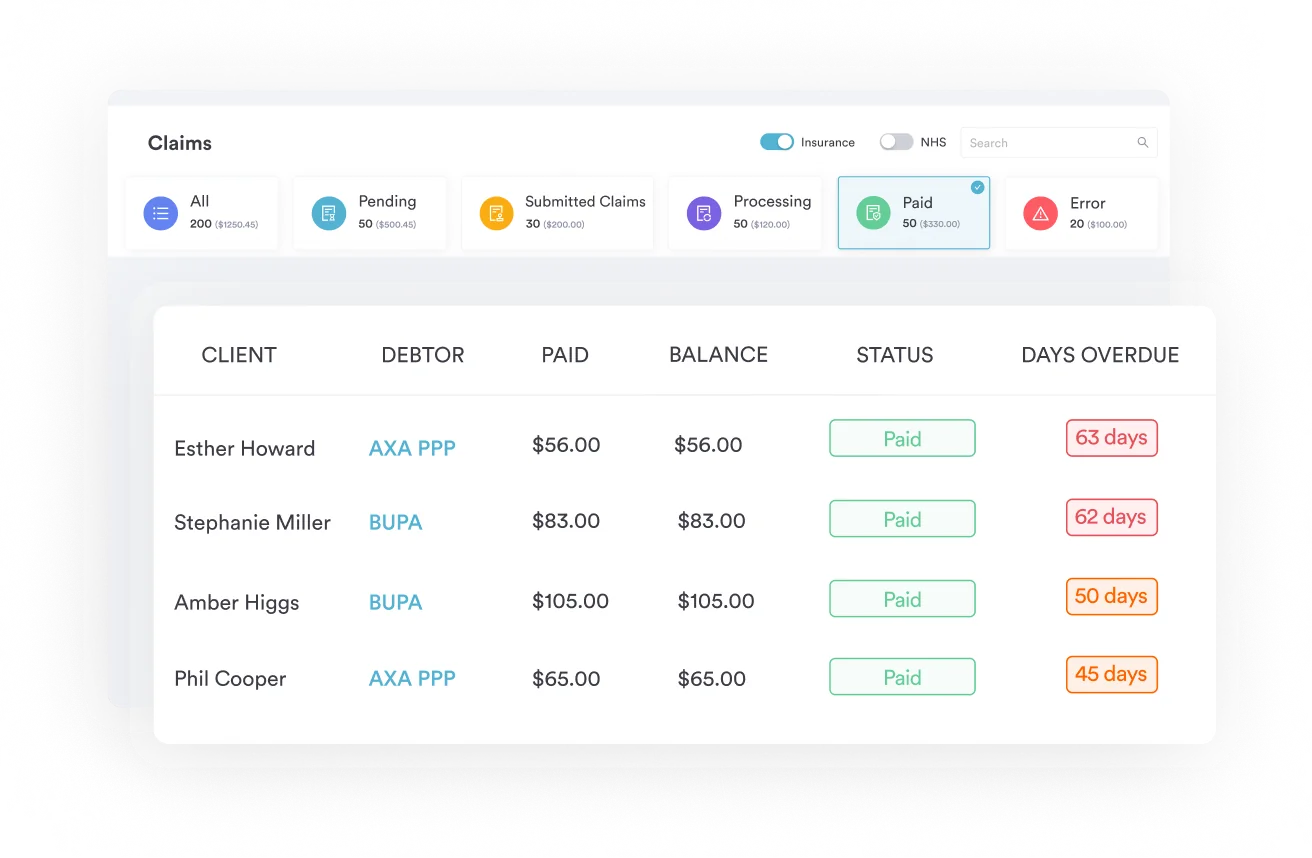
Practice management software like Pabau closes those handoffs. Its claims management tools carry the administered dose, NDC, and diagnosis codes from the clinical record into the billing queue without manual re-entry. The Claim.MD integration then submits the finished claim electronically, so nobody retypes a J-code line.
Infusion centers and transplant programs running recurring J7525 administrations gain the most, because the documentation burden lands on every single claim. The same timestamped log is what HIPAA compliance and a payer audit both ask for.

Pabau lets you document drug administrations and link them straight to billing codes. Claims for your transplant and infusion patients leave with the right units and NDC already attached.

J7525 rewards process more than knowledge. The code itself takes a minute to learn. The unit math, the NDC capture, and the ICD-10 pairing take a workflow that runs before anyone opens the claim.
The trade-off worth remembering is where each check is cheapest. Confirming a dose at the infusion chair costs a minute. Finding the same error in a remittance costs the staff time twice over, once to diagnose it and once to resubmit.
Book a demo to see how Pabau links drug administration records to J-code billing for transplant and infusion teams.

Billing another factor product per unit? J7187 covers Humate-P, and it needs the same unit conversion and NDC discipline as J7525.
Chasing the crosswalk for a deleted J-code? J3487 explains where the code went and which replacement to bill in its place.
Billing an injectable with a payer-specific unit? J3470 walks through hyaluronidase billing and how payers read the dose on the claim.
Working on another parenteral drug code? J0132 covers acetylcysteine injection, from unit calculation to the ICD-10 codes that support it.
Billing a device supplied under a J-code? J7301 sets out the Skyla billing rules, including the CPT and ICD-10 pairings.
HCPCS Code J7525 is the billing code for tacrolimus, parenteral, 5 mg. It covers the intravenous immunosuppressant used to prevent organ rejection in transplant patients. The code is a Level II HCPCS J-code, billed at one unit per 5 mg administered, and CMS maintains it in the annual code set.
Medicare reimburses J7525 at ASP plus 6% under Part B, and the rate changes quarterly. Check the current CMS ASP Drug Pricing File or the Physician Fee Schedule lookup tool. Both give the rate for the current quarter, which you then adjust for your MAC jurisdiction.
J7525 covers tacrolimus administered parenterally, billed at one unit per 5 mg. J7521 covers tacrolimus oral granules, billed per 0.1 mg. The two codes are not interchangeable, and the administration record determines which one applies.
Yes, Medicare Part B generally covers J7525 for post-transplant immunosuppression. The 36-month limit applies only to kidney transplant patients whose Medicare eligibility came from end-stage renal disease alone. Coverage continues past 36 months for patients who also qualify by age or by disability. It also continues for those enrolled in the Part B immunosuppressive drug benefit, which pays for immunosuppressants only.
Yes. Most payers, including Medicare, require the 11-digit NDC in loop 2410 of the 837P electronic claim or in box 24A of the CMS-1500 form. Include the unit qualifier, which is ML for injectable tacrolimus, along with the quantity dispensed. A missing NDC is one of the most common denial triggers for J7525.
The primary codes are Z94.0 for kidney transplant status, Z94.1 for heart, and Z94.4 for liver. If the patient has active rejection, sequence the matching T86 code first. Use T86.11 for kidney, T86.21 for heart, and T86.41 for liver.
No. JA and JB exist to distinguish the route when a single HCPCS code covers more than one, and J7525 is already parenteral-specific. On single-dose drug claims the modifiers that do come up are JW and JZ. JW reports a discarded amount, and JZ attests that none was discarded.



