CPT code 36468: Injection sclerotherapy of telangiectasia billing guide
CPT code 36468 covers spider veins on a limb or the trunk CPT code 36468 reports...

Last Updated: Nov 13, 2026
J7520 is the HCPCS Level II code for sirolimus, oral, 1 mg. It covers sirolimus tablets and oral solution, billed at one unit per milligram dispensed.
Medicare pays for it under the Part B immunosuppressive drug benefit, but only after a Medicare-covered organ transplant. Pharmacies and suppliers send the claim to a DME MAC with a transplant diagnosis such as Z94.0.
Let Pabau's smart automation suggest the right codes, reduce claim denials, and keep your practice compliant—effortlessly.
Automate repetitive tasks and focus on what matters most—your patients.
Reduce coding errors and ensure compliance with the latest regulations.
Clean claims, fewer denials, and faster reimbursements.
Powerful insights and reporting to help your practice thrive.
HIPAA compliant SOC 2 certified GDPR-compliant Trusted by 4,000+ clinics worldwide

HCPCS code J7520 is sirolimus, oral, 1 mg, so you bill one unit for every milligram of tablets or oral solution dispensed.
Medicare pays it under Part B only after a Medicare-covered organ transplant, with Part A in place on the transplant date.
A transplant diagnosis such as Z94.0, T86.11 or Z48.22 has to be on the claim, or the drug falls outside the benefit.
Pharmacies and suppliers bill the DME MAC, and the October 2026 Medicare payment limit is $0.609 per 1 mg unit.
Cyclosporine never belongs on J7520. Oral cyclosporine is J7502 or J7515, and the injection is J7516.
HCPCS code J7520 is the Level II code for sirolimus, oral, 1 mg. Medicare reimburses it through the immunosuppressive drug benefit, which CMS limits to patients with a Medicare-covered organ transplant in Policy Article A52474. Sirolimus is an mTOR inhibitor, sold first as Rapamune and now mostly as generic tablets and oral solution.
J7520 describes oral sirolimus only. The injectable and topical forms of the drug have no place on it.
The payment limit comes from the CMS Medicare Part B payment limit file effective October 1, 2026. It changes every quarter, so check the current file before you quote a figure to a patient.
Units on J7520 follow the dose in milligrams, never the tablet count. A bottle of 1 mg tablets gives one unit per tablet, which makes counting tablets look safe. Switch the patient to 2 mg tablets and the count doubles.
Here’s how three common dispenses work out:
Run the first example through the October 2026 limit and the allowed amount is 180 × $0.609, or $109.62. Medicare pays 80% of that after the Part B deductible, and the patient owes $21.92 in coinsurance.
Keep each dispense to a 90-day supply or less. The DME MAC coverage policy L33824 moved the limit from 30 to 90 days for dates of service from January 1, 2025.
Policy Article A52474 sets five criteria, and the claim fails if any one of them is missing:
Kidney recipients whose Medicare came from end-stage renal disease alone lose it 36 months after a successful transplant. Since January 1, 2023, they can keep paying for Part B only to cover these drugs. CMS calls this the Part B immunosuppressive drug benefit, or Part B-ID.
Sirolimus is FDA-approved to prevent rejection after a kidney transplant in patients aged 13 and over. Its label also covers lymphangioleiomyomatosis (LAM), a rare lung disease. A LAM patient with no transplant has no claim under this benefit, so check their Part D plan instead.
Off-label transplant use is no longer an automatic denial. Since April 2025, L33824 also covers FDA-approved drugs the DME MAC judges reasonable and necessary against rejection. Keep the prescriber’s rationale on file, because that judgment is made claim by claim.
A52474 accepts 64 ICD-10-CM diagnostic codes, and every other diagnosis is treated as not supporting the drug. They fall into three families: Z94 transplant status, T86 transplant complications and Z48.2 aftercare. Sirolimus is labeled for kidney transplants, so these are the codes you’ll reach for first:
Code what the prescriber documented. If the note says the graft is stable, Z94.0 is the right code, and a failing graft takes T86.12. Reaching for T86.11 to make a claim look stronger only invites a review.
The transplant practice writes the order, but the pharmacy or supplier usually sends the Medicare claim. Both sides have to hold the same facts. The checks below are the ones that decide whether the claim pays.
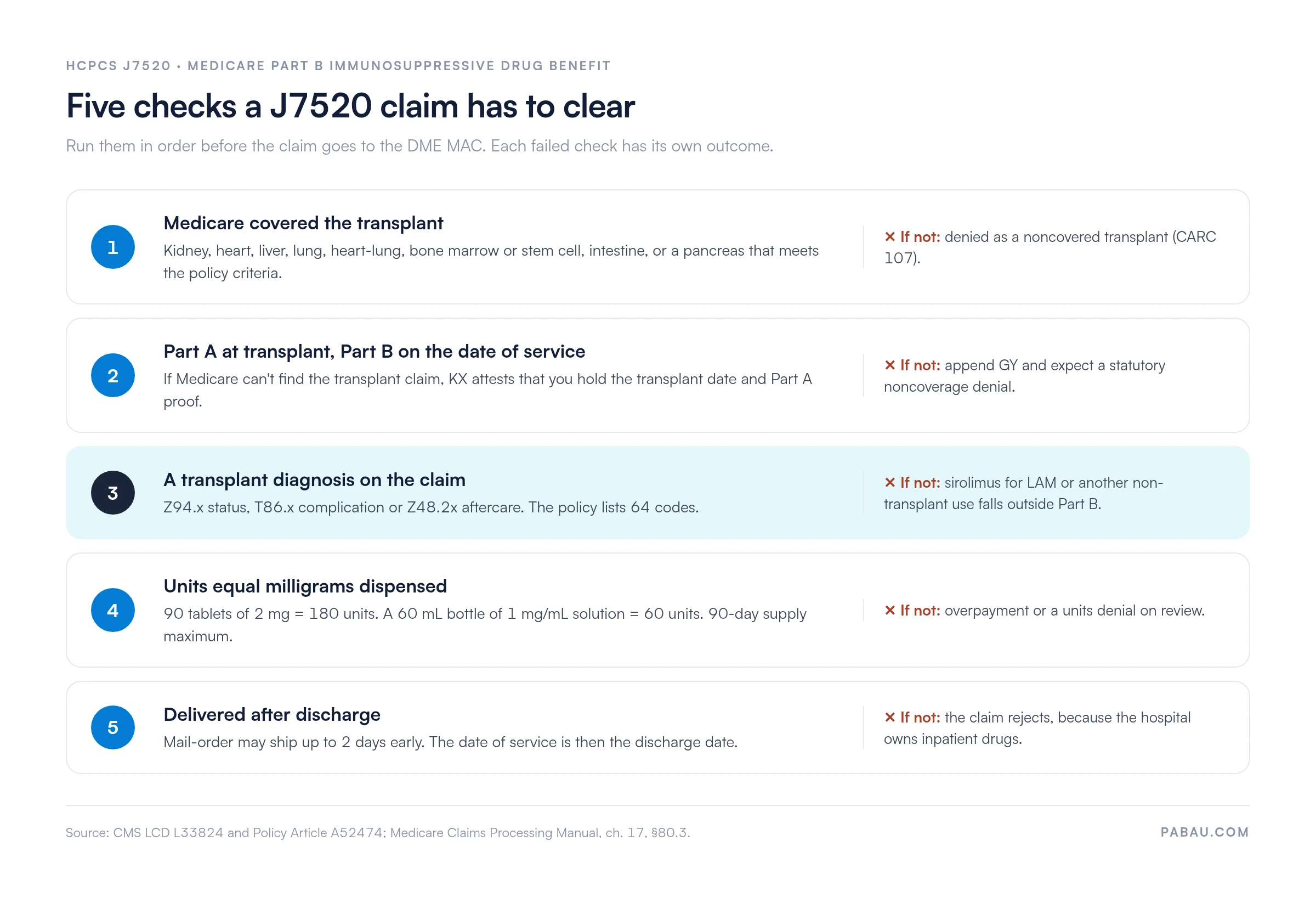
KX is optional, according to chapter 17 of the Medicare Claims Processing Manual. It matters most when Medicare has no record of the transplant claim, for example after a Medicare Advantage-paid transplant. Supply fees go on the same claim as the drug and are denied with it.
Hospital discharges need one more check. A mail-order supplier may ship up to two days before discharge, but the date of service then becomes the discharge date. Ship earlier, or bill before discharge, and the claim rejects, because the hospital owns inpatient drugs.
Commercial plans and Medicaid often want the NDC alongside J7520 on an 837P or CMS-1500. Many commercial plans skip J7520 altogether and run oral sirolimus through the pharmacy benefit, where the NDC is the only drug identifier.
When a payer does want the NDC on a professional claim, the format is fixed:
A worked example: Zydus sirolimus 1 mg, 100 tablets, carries package NDC 65841-772-01. In 11-digit form that’s 65841077201, reported as N465841077201 UN100. The HCPCS line still reads J7520 × 100 units.
Take the NDC from the package you dispensed, not from a saved template. Generic labelers change often, and a stale NDC is one of the quickest ways to get a drug line rejected.
The immunosuppressive drug codes sit in the J7500 to J7599 range, and several share drugs, routes or unit sizes. These are the neighbors that cause the most trouble, with payment limits from the same October 2026 file:
Two mix-ups come up again and again. The first is billing cyclosporine on J7520. Cyclosporine has its own codes (J7502, J7515, J7516). No 10 mg cyclosporine code exists.
The second is treating sirolimus and everolimus as interchangeable. Both are mTOR inhibitors, but everolimus has its own code, J7527, with a 0.25 mg unit. Swap them and both the drug and the unit count are wrong.
The patient’s ESRD Medicare is ending. What happens to their sirolimus? Coverage stops 36 months after a successful kidney transplant unless they enroll in Part B-ID. Flag the date three months ahead, so the switch happens before the next refill.
The patient is in a Medicare Advantage plan. The plan pays, not the DME MAC, and its own pharmacy and authorization rules apply. If they later return to Original Medicare, the plan’s payment for the transplant still meets the coverage criterion.
The prescriber wants to bill J7520 directly. The LCD allows a treating practitioner to bill only when they meet enrollment and state rules for dispensing. If they don’t, the dispensing pharmacy bills.
The facts a J7520 claim depends on start in the transplant practice. When the transplant date, the organ, Part A status and the dose sit in different notes, the pharmacy calls and waits.
Pabau, the practice management and EHR platform we build, keeps those details on one patient record. The transplant history, prescriptions and diagnoses sit side by side, so your team can answer a supplier’s request for the transplant date in one look.
Practices can also switch on a patient portal where patients see their prescriptions and request refills, which keeps their supply on schedule.
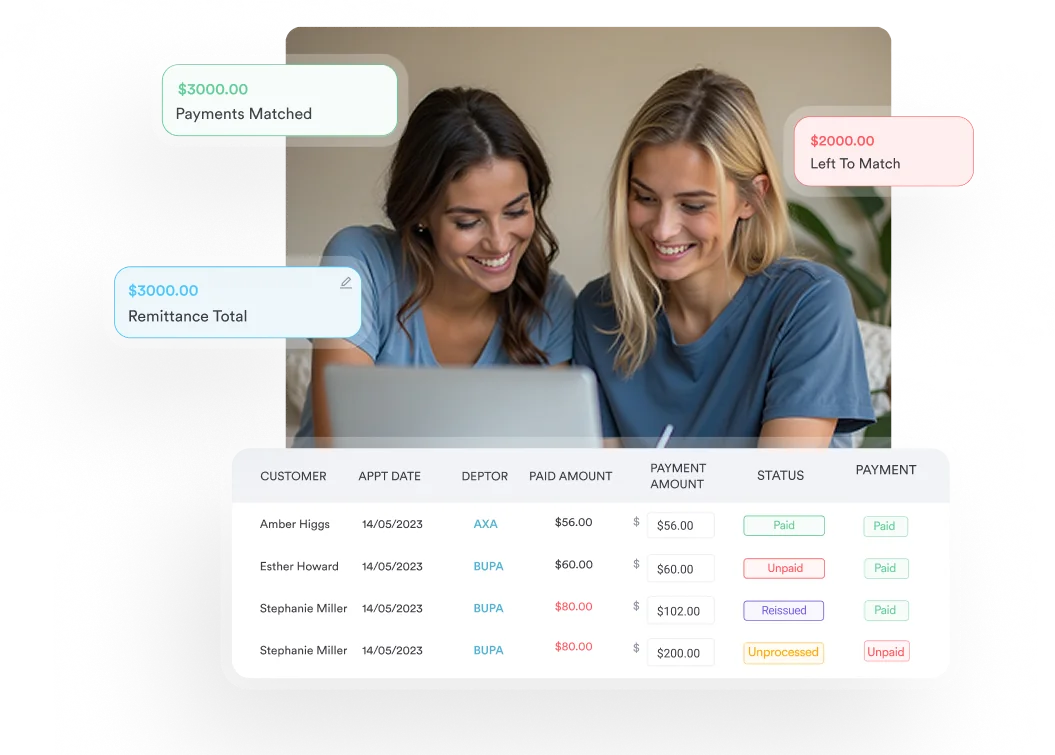
When your practice bills a plan itself, Pabau’s claims management software sends CMS-1500 and 837P claims through Claim.MD. It checks eligibility first, then posts the remittance when it comes back.

Pabau keeps the transplant date, diagnosis and prescription on one patient record, so pharmacies get what they need for a J7520 claim. Your team stops chasing notes.

J7520 comes down to three facts. It is oral sirolimus, billed a milligram per unit, for Medicare-covered transplant patients. Each one maps to a denial when it’s missing.
If you change one habit, make it sending the transplant date with every new sirolimus order. It protects the KX attestation, settles the coverage question and saves the pharmacy a phone call. Count milligrams, never tablets, and recheck the payment limit each quarter.
Book a demo to see how Pabau keeps transplant histories, prescriptions and claims on one record for your practice.

Want claims to pay on the first pass? What is a clean claim breaks down the fields payers check before they process a claim.
Seeing the same denial codes every month? Denial codes in medical billing maps common CARC and RARC codes to their fixes.
Billing oral tacrolimus as well? HCPCS code J7507 covers immediate-release tacrolimus and its units.
Need to understand how claims reach the payer? Medical claims clearinghouse guide explains how 837P files are checked before submission.
Building a denial prevention routine? Denial management in healthcare sets out a process for tracking and reworking denials.
Generic sirolimus tablets and oral solution use J7520, the same code as the Rapamune brand. The NDC on the package tells the payer which product was dispensed, while J7520 sets the billing unit.
No. Fyarro, a protein-bound sirolimus injection used to treat a rare tumor called PEComa, has its own code, J9331. It is an oncology drug, so it sits outside the immunosuppressive benefit.
Not under J7520. Hyftor, a topical sirolimus gel for facial angiofibroma in tuberous sclerosis complex, is not a transplant drug. Coverage, where it exists, runs through the patient’s Part D or commercial pharmacy benefit.
Trough monitoring of sirolimus is billed with CPT 80195, the therapeutic drug assay for sirolimus. It is a separate lab claim and never goes on the J7520 drug claim.
Yes, when Part B can’t pay. That covers patients without Part A at transplant, a transplant Medicare didn’t cover, or a non-transplant diagnosis. The pharmacy then bills the patient’s Part D plan.