CCSD code H4430: Examination of rectum under anaesthetic
CCSD code H4430 pays for the examination alone CCSD code H4430 is the UK private...

Last Updated: Oct 20, 2026
J3060 is the HCPCS Level II code for injection, taliglucerase alfa, 10 units.
One billing unit covers 10 drug units, so a 3,600-unit dose bills as 360 units. Miscount that and the claim comes back, or the practice absorbs the cost of a drug it already paid for.
Elelyso runs on a buy-and-bill model, which puts the money at risk long before the payer sees the claim.
Let Pabau's smart automation suggest the right codes, reduce claim denials, and keep your practice compliant—effortlessly.
Automate repetitive tasks and focus on what matters most—your patients.
Reduce coding errors and ensure compliance with the latest regulations.
Clean claims, fewer denials, and faster reimbursements.
Powerful insights and reporting to help your practice thrive.
HIPAA compliant SOC 2 certified GDPR-compliant Trusted by 4,000+ clinics worldwide

HCPCS code J3060 covers injection, taliglucerase alfa, 10 units, the enzyme replacement therapy sold as Elelyso.
One billing unit equals 10 drug units, so divide the administered dose by 10 before it goes on the claim.
Elelyso ships in 200-unit single-dose vials, so most doses leave discarded drug that belongs on a JW line.
E75.22 is the primary diagnosis code on a J3060 claim, and the NDC must match the vial the nurse opened.
Medicare pays ASP plus 6% per billing unit, and CMS refreshes that rate every quarter.
No other enzyme replacement therapy shares this code. CMS made J3060 permanent on January 1, 2014, replacing the temporary code C9294 that carried the drug before that.
Every Elelyso claim runs through it, whether the payer is Medicare Part B or a commercial plan.
Taliglucerase alfa is a recombinant version of glucocerebrosidase, the enzyme that patients with Gaucher disease type 1 lack. Without it, glucocerebroside collects in the spleen, liver, and bone marrow.
The infusion replaces the missing enzyme, so payers treat it as a physician-administered drug rather than a pharmacy item. It sits in CMS’s HCPCS Level II code set, which changes through the year as drugs enter and leave the market.
Every J3060 unit equals 10 units of taliglucerase alfa. So take the total units administered and divide by 10. The label dose is 60 units/kg every two weeks, given as a 60 to 120 minute intravenous infusion.
Physicians adjust it, so read the ordered dose and the patient’s weight off the chart before you count units.
The table below runs the math for five common weights at the label dose. Notice how quickly the unit counts climb, and how little room that leaves for a typo.
Bill the units administered, never a rounded figure. If the dose changes mid-course, recount from the administration record instead of copying last time’s claim.
Overbilling creates an overpayment you give back later, and underbilling hands the payer a quiet discount. Dosing here comes from the prescribing information and is not medical advice, so confirm the current protocol with the treating physician.
Elelyso arrives as a 200-unit single-dose vial, so the vials rarely add up to the ordered dose exactly. Medicare wants that difference reported.
Put the administered units on one line, then the discarded units on a second line with modifier JW. When the vials come out even, the single line carries JZ instead.
At 60 units/kg, the dose divides evenly into 200-unit vials only when body weight is a multiple of 10 kg. A 60 kg patient needs 18 vials and wastes none of it. A 55 kg patient needs 17 vials, receives 3,300 units, and leaves 100 units in the last vial.
Those two patients are on the same label dose, and their claims still look different.
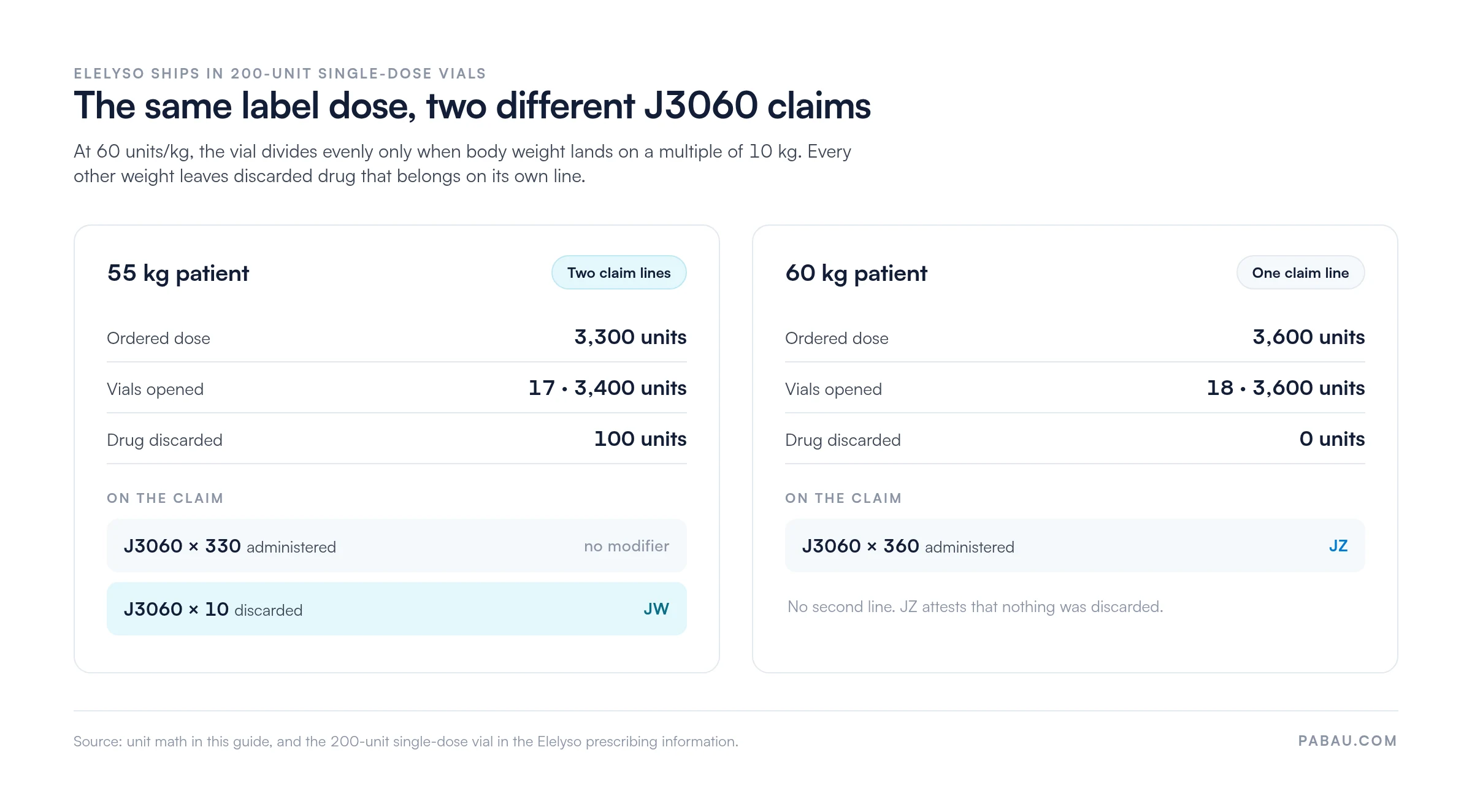
JW and JZ are mutually exclusive, so a line carries one or the other and never both. CMS has required the pair on separately payable Part B drugs from single-dose containers since July 1, 2023. Claims that skip both can come back unprocessed, which is covered in the agency’s JW and JZ modifier guidance.
One practical note: The discarded amount on the claim has to match the discarded amount in the record. That means the nurse writes down how many vials were opened, not just how many units went in. Stock records are the easiest place to prove it later.
E75.22, Gaucher disease, is the diagnosis code that supports the drug. Most payers want it in the primary position, and a J3060 line without a supporting diagnosis gets denied. Secondary codes belong on the claim only where the record documents that complication.
ICD-10-CM changes every October 1. Before you bill an older date of service, check that E75.22 was valid on the day of the infusion.
Report the National Drug Code as 11 digits in 5-4-2 format, with the quantity and the unit of measure beside it. Who insists on it depends on the payer.
Medicaid requires an NDC on physician-administered drug claims under the Deficit Reduction Act of 2005, and most commercial plans ask for one on J-code lines.
Medicare Part B is the exception people get wrong. It does not require the NDC on its own, but it does when the patient is dually eligible for Medicare and Medicaid.
Reporting it every time is the safer habit, since a dual-eligible claim without one gets kicked back.
Package numbers change when the manufacturer changes packaging. Pfizer and Protalix Biotherapeutics supply Elelyso, so check the current package insert or the FDA’s DailyMed entry for Elelyso before each billing cycle. Take the number from the carton in front of you, not from an old claim.
Medicare pays separately payable Part B drugs at the Average Sales Price plus 6%. That rate applies per billing unit, which means per 10 units of taliglucerase alfa. CMS refreshes the ASP pricing files four times a year, so the allowable for J3060 moves every quarter.
Payment also varies by Medicare Administrative Contractor, or MAC. Pull the current rate for your locality rather than reusing last quarter’s figure.
On a drug this expensive, a few cents per unit adds up fast across a year of fortnightly infusions.
Commercial rates are a separate question. Some plans pay a percentage of charges, while others run their own drug fee schedule. Read the contract before you assume the Medicare allowable applies.
Elelyso is a buy-and-bill drug. The practice purchases it, administers it, then bills the payer for the drug and the infusion separately.
Until the remittance lands, the practice is carrying the cost of the vials, which is why the sequence below matters more than it looks.
Keep a specialty drug log for Elelyso, separate from the general claim log. For each infusion, record the lot number, the NDC, the vials opened, the units administered, the units discarded, and the amount paid. Two months of that log will show whether a payer is systematically underpaying the drug line. One claim at a time, that pattern is almost invisible.
Most commercial payers and many Medicare Advantage plans require prior authorization for Elelyso. Traditional Medicare Part B does not, as national policy. That can still change through a Local Coverage Determination, so verify with the specific plan for the date of service.
Criteria differ by payer. UnitedHealthcare has historically asked for step therapy documentation, though plan-year details change, so confirm the current rules directly.
Most payers want some version of the following:
Store the approval number, the approved date range, and the supporting notes together against the patient record. An appeal six months later turns on what your team can still produce, and paper files are where that falls apart.
A J3060 claim almost always carries an infusion administration code beside it. The drug line pays for the vials, and the CPT line pays for the chair time and the nursing.
Each companion code brings its own documentation rules, which our CPT codes directory sets out code by code.
Ask the payer which administration code they accept with J3060. Some plans treat the infusion as chemotherapy administration and want CPT 96413, while others want the non-chemotherapy code.
If a patient transitions to velaglucerase alfa, the claim moves to J3385 and the unit math changes with it.
Most of the work above is transcription. The weight and the dose live in the clinical note.
The NDC is on the carton, and the code sits in a lookup table. Someone then retypes all of it into a claim form. Every hop is a chance to fat-finger a unit count on a line worth thousands of dollars.
Practice management software like Pabau shortens that path. The HCPCS code attached to the service lands on the charge line, and the ICD-10 slots are seeded from the patient’s recorded problem list.
Built-in ICD-10-CM and CPT/HCPCS lookup libraries sit behind a search icon, so a biller can confirm J3060 and E75.22 without leaving the record. Required claim fields have to be complete before the send button unlocks.
In the US, Pabau’s software for billing teams routes claims through Claim.MD. That brings eligibility checks before the infusion, claim status tracking after it, and ERA posting when the money arrives.
For a biller working an Elelyso schedule, that means one screen shows what was authorized, what was sent, and what came back.
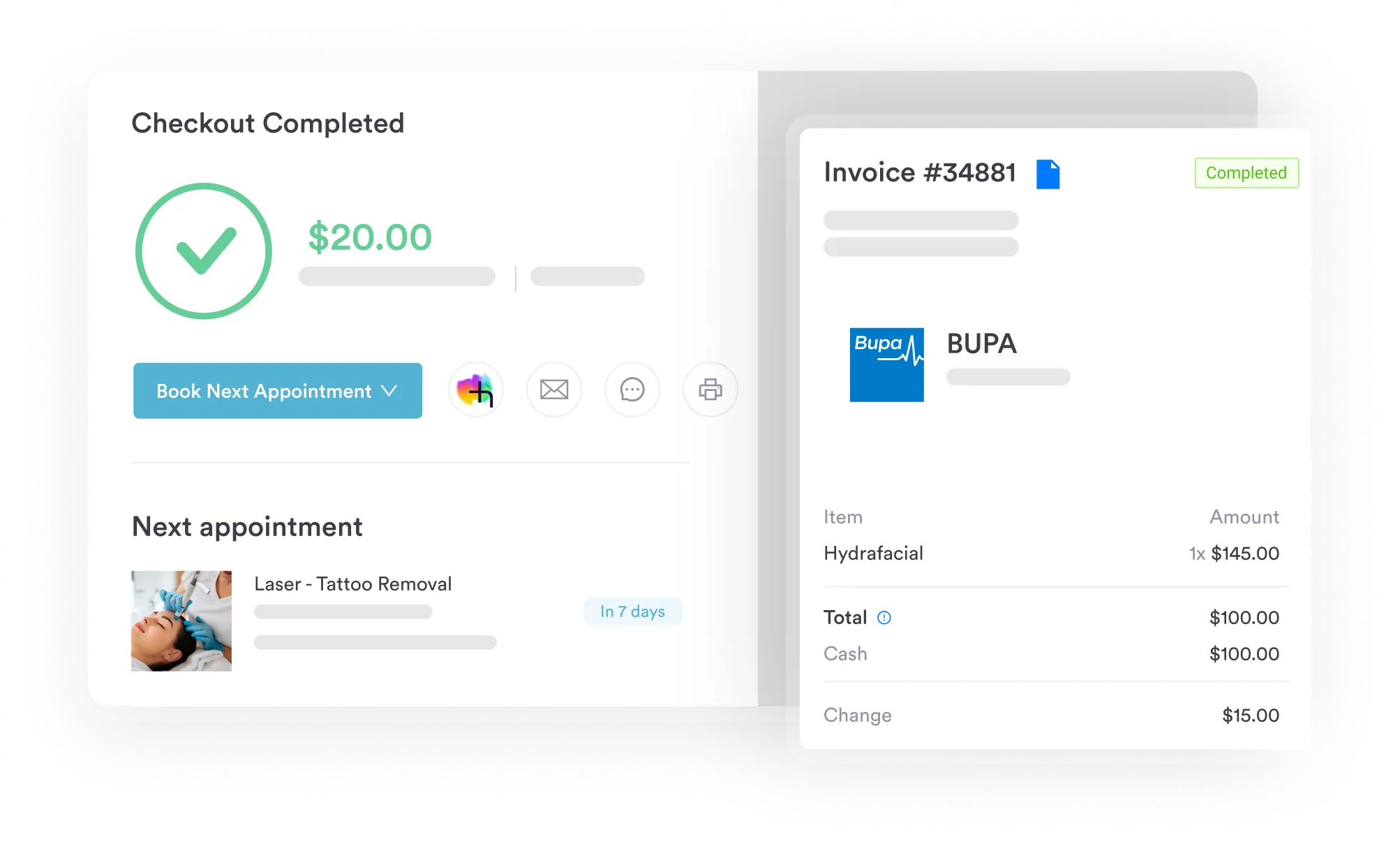

Pabau pre-fills the claim from the patient record and keeps HCPCS and ICD-10 lookups a click away. The claim waits until the required fields are complete. Your team sends the J3060 line it documented, and tracks what comes back.

J3060 rewards a boring, repeatable process. The unit count, the waste line, the NDC, and the diagnosis are all knowable before the claim leaves the building. Each one is cheap to check. A returned claim on a specialty drug is not cheap at all.
So build the check into the visit rather than the month-end review. If the weight, the vials opened, and the discarded amount are in the note on the day of the infusion, the claim almost writes itself. The appeal you never have to file is the one that pays best.
Pabau keeps the clinical record and the claim in one system, so the J3060 line reflects the infusion your team documented. Book a demo to see how your billers would send an Elelyso claim from start to finish.

Working a stack of denied drug claims? Denial management in healthcare sets out how to triage denials, appeal them, and stop the same one recurring.
Need a framework for billing compliance? Medical billing compliance best practices covers the documentation and audit-readiness that specialty drug claims attract.
Wondering how clearinghouses handle Part B drug claims? How medical claims clearinghouses work explains the 837P path from submission through adjudication.
Building a superbill for infusion visits? Superbill generation for specialty practices walks through the fields an infusion and drug claim needs.
Usually the medical benefit. A clinician administers Elelyso, so it bills on a medical claim with the infusion code beside it. Some commercial plans move enzyme replacement therapy to a specialty pharmacy benefit instead, which changes who buys the drug and who bills for it. Check the plan before ordering.
Yes, on separately payable Part B claims. Elelyso comes in single-dose vials, so Medicare wants the discarded amount reported. Put the administered units on one line, then the discarded units on a second line with JW. Where the vials come out even, the administered line carries JZ instead.
Medicare allows 12 months from the date of service. Commercial deadlines are often much shorter, sometimes 90 days from the infusion. On a buy-and-bill drug the practice has already paid for the vials, so a late filing turns into a write-off. File within days rather than weeks.
Sometimes, depending on the plan. The label requires administration under the supervision of a healthcare professional, and some payers allow that at home through a home infusion provider. In that arrangement the provider usually buys the drug and bills J3060, not the practice. Confirm the site-of-care policy first.