CCSD code H4430: Examination of rectum under anaesthetic
CCSD code H4430 pays for the examination alone CCSD code H4430 is the UK private...

Last Updated: Oct 20, 2026
J2650 is the HCPCS Level II code for injection, prednisolone acetate, up to 1 ml.
Two entries on the claim line decide whether it pays. The first is the National Drug Code, or NDC, taken from the vial you used. The second is the diagnosis you pair with it. Miss either one and the payer rejects the drug line, even when the rest of the visit is clean.
Let Pabau's smart automation suggest the right codes, reduce claim denials, and keep your practice compliant—effortlessly.
Automate repetitive tasks and focus on what matters most—your patients.
Reduce coding errors and ensure compliance with the latest regulations.
Clean claims, fewer denials, and faster reimbursements.
Powerful insights and reporting to help your practice thrive.
HIPAA compliant SOC 2 certified GDPR-compliant Trusted by 4,000+ clinics worldwide

HCPCS code J2650 is the Level II J-code for injection of prednisolone acetate, up to 1 ml.
One unit equals 1 ml or less of drug administered, so units follow the dose and never the vial size.
Medicare prices J2650 under the Average Sales Price method, and CMS updates that rate every quarter.
Every Part B drug claim for J2650 needs the 11-digit NDC of the vial used, plus a paired ICD-10-CM diagnosis.
Practice management software like Pabau pre-fills claim forms, provides HCPCS and ICD-10 lookup libraries, and checks required fields before submission.
J2650 identifies a single injectable drug for outpatient billing. It does not describe the injection procedure, the anatomical site, or the visit itself.
CMS maintains it under the Healthcare Common Procedure Coding System (HCPCS), in Level II. That level holds the HCPCS Level II codes for drugs, supplies, and services CPT leaves out.
Under the CMS HCPCS coding system, J-codes cover drugs a patient cannot self-administer. Most are given in a physician’s office or an outpatient setting. J2650 belongs to the corticosteroid injectables group, one of the most frequently billed drug categories in outpatient medicine.
Prednisolone acetate is a synthetic corticosteroid with strong anti-inflammatory and immunosuppressive effects. Its suspension formulation suits local injection, where oral dosing would either work less well or carry more side effects.
Clinicians reach for it in four settings, and each one makes its own demands on the note:
Because the descriptor stops at 1 ml, one unit stands for a single injection episode of 1 ml or less. Administer more than that and you need to check whether extra units apply, or whether another code fits better. Either way, record the exact volume.
Medicare pays J2650 under the Average Sales Price (ASP) method, which CMS refreshes every quarter. The rate is usually ASP plus a percentage add-on, historically ASP+6% outside sequestration periods.
Because that figure moves four times a year, the table below describes the payment structure rather than a current dollar amount. Always verify the live rate in the CMS fee schedule lookup before you submit.
After each submission, read the electronic remittance advice (ERA) against the rate you expected. A payment below the current ASP figure points to one of two problems. Either the units on the line were wrong, or the payer applied a contractual adjustment worth chasing.
Medicare wants the National Drug Code of the product administered on every Part B drug claim. The NDC-to-HCPCS crosswalk maps a manufacturer’s 11-digit NDC to the J-code, then converts units between the two systems. Without the right NDC, the claim gets denied outright.
Prednisolone acetate reaches the market from several manufacturers, so NDCs vary by supplier and package size. The table below breaks down the structure rather than listing specific numbers.
Check the active NDC against the current CMS NDC-to-HCPCS crosswalk file before you submit, because manufacturer updates change these numbers without notice.
Report the NDC in 11-digit 5-4-2 format, and match the unit of measure to the crosswalk file. A unit mismatch is one of the most common reasons a J-code drug claim gets flagged or denied. Either the AAPC HCPCS code lookup or the CMS crosswalk file will settle it before the claim leaves.
Medical necessity for a prednisolone acetate injection rests on a documented diagnosis. The paired ICD-10-CM code tells the payer why the injection was needed.
Local and national coverage determinations set out which diagnoses qualify, so treat the list below as commonly paired rather than guaranteed.
Reach for the most specific code the documentation supports. Unspecified-site codes such as M19.90 and M06.00 are acceptable when the note genuinely does not name a joint.
Payers still flag them for review more often. A site-specific alternative, say M19.011 for primary osteoarthritis of the right shoulder, draws fewer documentation requests.
Audit the diagnosis before every J2650 claim goes out. The code has to match the injection site. It also has to appear on the payer’s active covered-diagnoses list. Finally, the note must tie that diagnosis to the reason for the injection. Those three passes catch most preventable J-code denials.
A clean J2650 claim depends on data captured at the time of service, not reconstructed later. Billing staff need the drug details before the claim is built. Clinicians need to write them down while the patient is still in the room.
Every J2650 claim rests on the documentation below:
Capturing the NDC and the diagnosis before the patient leaves prevents most J-code billing errors. Teams that pull charts retroactively to find NDC data generate far more rework than teams that capture it at checkout.
Quarterly self-audits close the loop. Pull a sample of J2650 submissions and check three points. NDC numbers should match the products on the shelf, units should reconcile with purchase records, and diagnoses should match the documented findings.
The J2650 line travels through five checkpoints, and it can fail at any of them. A later step never repairs an earlier mistake, so the order matters. Here is where each checkpoint sits, and what tends to break it.
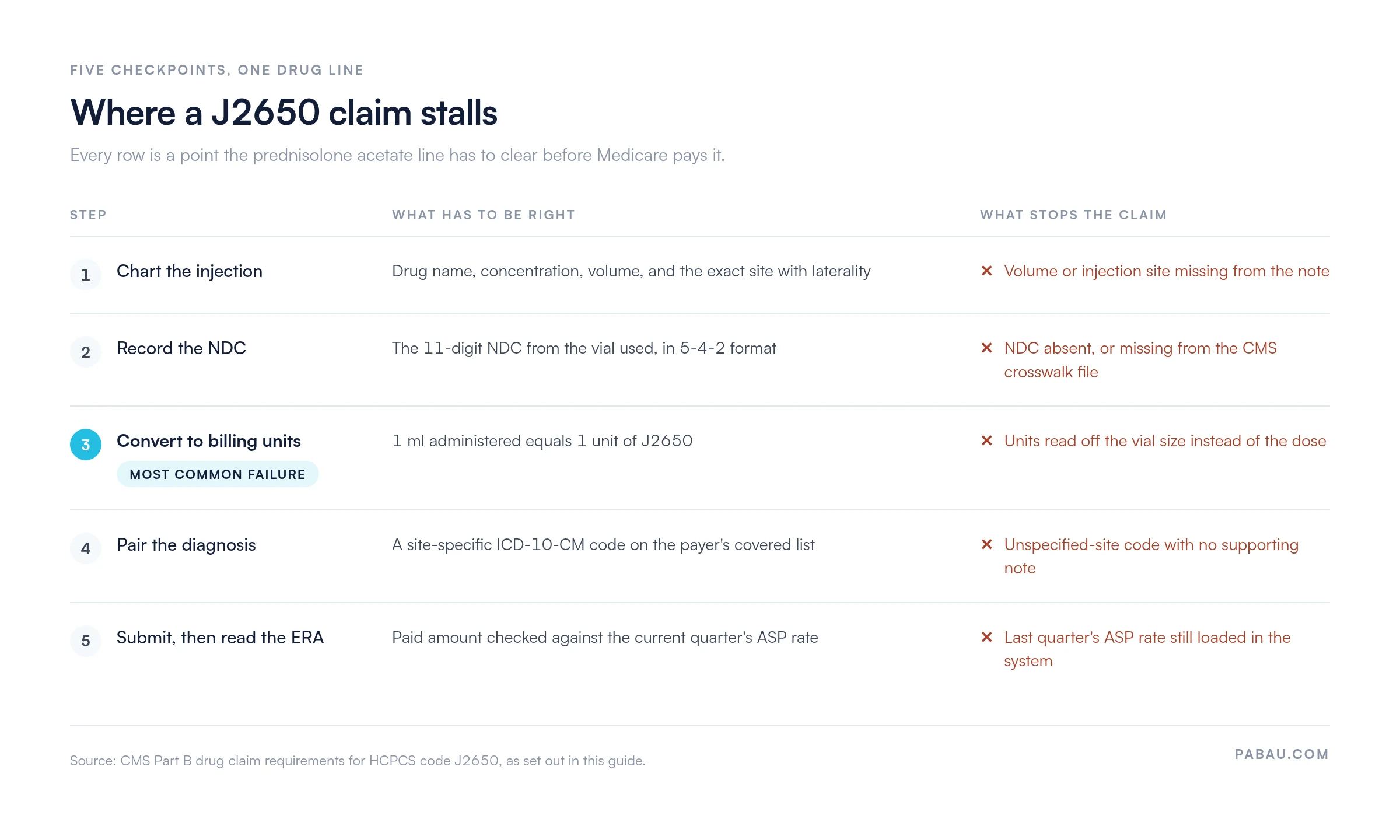
Run that same order as a pre-submission checklist. Two minutes per claim beats a 30-day denial cycle.
Of those five, unit conversion trips teams up most often. A 5 ml vial does not mean five units when only 1 ml went into the patient. Bill the dose, and remember that discarded volume from a multi-dose vial is not separately payable.
Prednisolone acetate is one of several corticosteroids with its own J-code. Picking the wrong one is both a billing error and a compliance problem. Unit bases differ as well, which is where most of the confusion starts. The comparison below lines up what one unit covers in each code.
Methylprednisolone acetate, the Depo-Medrol suspension, sits in the same corticosteroid family but bills on a different basis. CMS deleted its 20 mg code J1020 on April 1, 2024, and replaced it with J1010, billed per milligram.
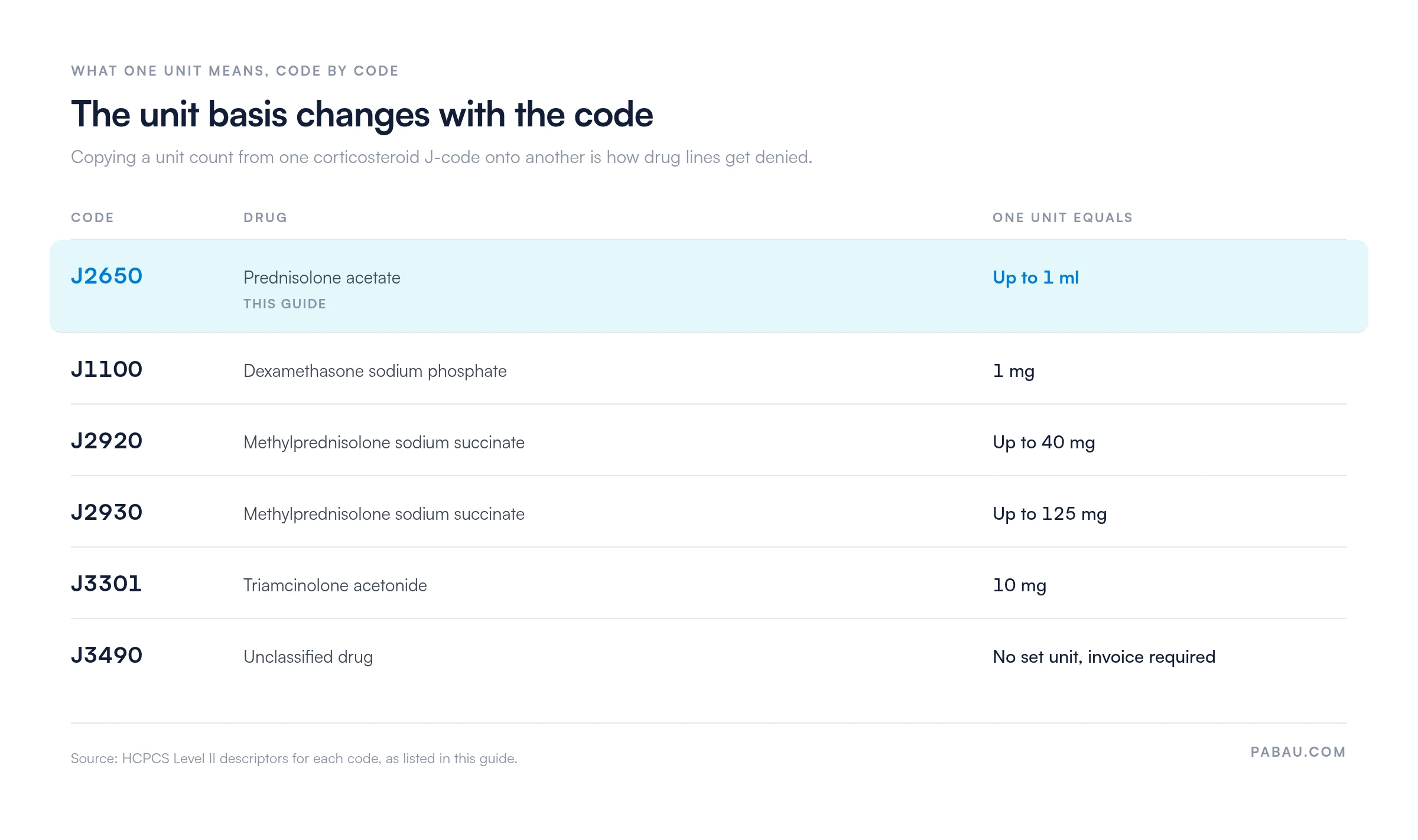
Billing J3490 for prednisolone acetate is a common slip, and J2650 is the code that belongs on the line. J3490 triggers manual review at most payers and delays payment for weeks. Triamcinolone hits the same trap from the other direction. It needs J3301, and its per-10-mg unit does not translate to a per-ml unit.
J2650 has held the same descriptor through both cycles. CMS confirmed the code as valid for 2026, with no structural change to its short or long descriptor.
The code is stable, but its ASP rate is not. CMS releases updated ASP files in January, April, July, and October. Load each one into your charge capture data when it lands, because stale fee schedule figures quietly leak revenue on drug claims.
Put a quarterly reminder in the billing calendar for the day the CMS ASP file drops. Update the expected payment for J2650 in your practice management system that same week. That one habit stops fee schedule drift, which is how underpayments sit unnoticed for months.
Manual J-code billing spreads one claim across several places. The NDC sits on a vial in the treatment room. The unit conversion lives in a CMS spreadsheet.
Meanwhile, the ASP rate changes every 90 days. Each handoff is somewhere the drug line can go wrong.
Practice management software like Pabau keeps those pieces on one record. The code attached to the service lands on the charge line, and ICD-10 slots draw from the patient’s recorded problem list. Search icons open full ICD-10-CM and HCPCS lookup libraries, refreshed with each official release.
Pabau also checks that claim-required fields are complete before the send button unlocks, membership and authorization numbers included. Submission then runs through a regional clearinghouse, Claim.MD in the US, which returns eligibility checks, claim status, and ERA remittance posting.
These claims tools are built for billing teams working inside the clinical record rather than beside it. So there is no export step between the note and the claim, and nobody retypes an NDC from a vial label.

Pabau pre-fills claim forms from the patient record and opens HCPCS and ICD-10 lookup libraries where your coders work. It also checks required fields before submission, then sends the claim through a regional clearinghouse. See how that handles corticosteroid injection billing.

J2650 is a simple descriptor with demanding paperwork behind it. The drug is easy to identify. Payment turns on three smaller details. The NDC has to be on the line, and the units have to match the dose. Beyond that, the diagnosis has to be specific enough to survive review.
So build the checks into the visit rather than the appeal. Capture the NDC at the point of care, load each quarterly ASP file the week it lands, and audit a sample of claims every quarter. Practices that do all three spend their time on patients instead of resubmissions.
Want to see how pre-filled claim forms, code lookup libraries, and required-field checks fit a corticosteroid injection workflow? Book a demo and we will walk through it against your own billing setup.

No specific J-code for the drug you gave? HCPCS code J3490 explains how the unclassified drug code works and what payers ask for.
Billing dexamethasone instead? HCPCS code J1100 covers dexamethasone sodium phosphate and its per-milligram unit.
Need a framework for cleaner submissions? Clean claim fundamentals covers the data elements every Part B drug claim needs to clear the first edit.
Chasing denials on drug lines? Denial management in healthcare sets out how to bring a HCPCS denial rate down.
New to the wider billing workflow? What is medical billing shows where drug claims sit in the revenue cycle.
Yes. J2650 pays for the drug, and a separate CPT code pays for administering it, such as 20610 for a major joint. Report both lines on the same claim and link them to the same diagnosis. Check the payer’s bundling rules first, because a few contracts fold the two together.
Only when the drug comes from a single-dose container. CMS built JW and JZ for single-dose packaging, so a multi-dose prednisolone acetate vial takes neither. Read the label before you decide, since packaging differs by manufacturer.
Part B. A clinician administers the injection in the office, which keeps it outside the self-administered drugs Part D covers. Bill it on the professional claim, with the NDC attached to the drug line.
One calendar year from the date of service. Medicare rejects claims filed after that, and a refile following a denial still counts inside the window. Commercial payers usually allow less, and 90 days is common, so check each contract.
Some do, mostly for repeat injections or ophthalmic use. Prior authorization depends on the plan rather than the code, so check the member’s policy before scheduling. A retroactive authorization request after the injection rarely succeeds.