HCPCS code V2599: Other type contact lens billing guide
What is HCPCS code V2599? HCPCS code V2599 is the Level II supply code for a con...

Last Updated: Oct 20, 2026
J2515 is the HCPCS Level II code for injection, pentobarbital sodium, per 50 mg. Each 50 mg of pentobarbital given by IV or IM injection is one billing unit, so a 100 mg dose bills as 2 units.
Pentobarbital is a Schedule II barbiturate sold in 50 mg/mL multiple-dose vials, so the JW and JZ waste modifiers do not apply. Denials on J2515 come from units billed as milligrams, a missing NDC, or a missing administration CPT code.
Let Pabau's smart automation suggest the right codes, reduce claim denials, and keep your practice compliant—effortlessly.
Automate repetitive tasks and focus on what matters most—your patients.
Reduce coding errors and ensure compliance with the latest regulations.
Clean claims, fewer denials, and faster reimbursements.
Powerful insights and reporting to help your practice thrive.
HIPAA compliant SOC 2 certified GDPR-compliant Trusted by 4,000+ clinics worldwide

HCPCS code J2515 covers pentobarbital sodium injection, billed at one unit per 50 mg given by IV or IM injection.
Pentobarbital ships only in 50 mg/mL multiple-dose vials, so the JW and JZ waste modifiers do not apply to J2515.
Pair every J2515 line with an administration code, such as CPT 96372 for IM or 96374 for IV push, and report the 11-digit NDC.
Pentobarbital is a DEA Schedule II barbiturate, so the chart must record the dose, the route and the vial each dose came from.
Pabau’s claims management software keeps J2515 units, NDCs and administration codes in one workflow, so errors are caught before submission.
HCPCS code J2515 is the CMS Level II code for “Injection, pentobarbital sodium, per 50 mg.” It sits in the J-code range of HCPCS Level II, which covers drugs given other than by mouth. One billing unit equals 50 mg of pentobarbital sodium administered.
Pentobarbital sodium is a short-acting barbiturate, sold under the brand name Nembutal Sodium Solution and as a generic injection. It is a DEA Schedule II controlled substance. CMS has carried J2515 since January 1, 1982, and the code remains active.
The FDA-approved label lists four uses for injectable pentobarbital. J2515 reports the drug for any of them:
The label also says parenteral routes should be used only when oral dosing is impossible or impractical. Payers read that line closely, so the note should say why an injection was needed.
Several scenarios fall outside J2515 or need extra care:
J2515 units follow the dose given, not the vial size. Divide the milligrams administered by 50 and round up to the next whole unit. CMS applies that rounding rule when a dose is not a multiple of the code’s unit.
The label sets typical doses as 150–200 mg IM for adults and 2–6 mg/kg IM for children, up to 100 mg. A common first IV dose for a 70 kg adult is 100 mg. Small increments can follow, up to 200–500 mg in total.
The most expensive mistake on this code is billing milligrams as units. A 100 mg dose billed as 100 units claims 5,000 mg of drug and trips the payer’s unit edits at once.
CMS requires the JW modifier for discarded drug and the JZ modifier for zero waste on Medicare Part B claims. Both apply only to drugs from single-dose containers.
Every pentobarbital vial listed on CMS’s NDC-HCPCS crosswalk is a multiple-dose vial. So J2515 goes on one line, with the units given and no waste modifier. A JW or JZ line on this code is an error, and Medicare contractors return those lines as unprocessable.
A J2515 line reports the drug only. The service of giving it goes on a separate CPT administration line chosen by route, such as 96372 for an IM injection. Leave that line off and the administration goes unpaid, while some payers also reject the drug line.
The worked example below shows how both lines read for a 100 mg IV push.
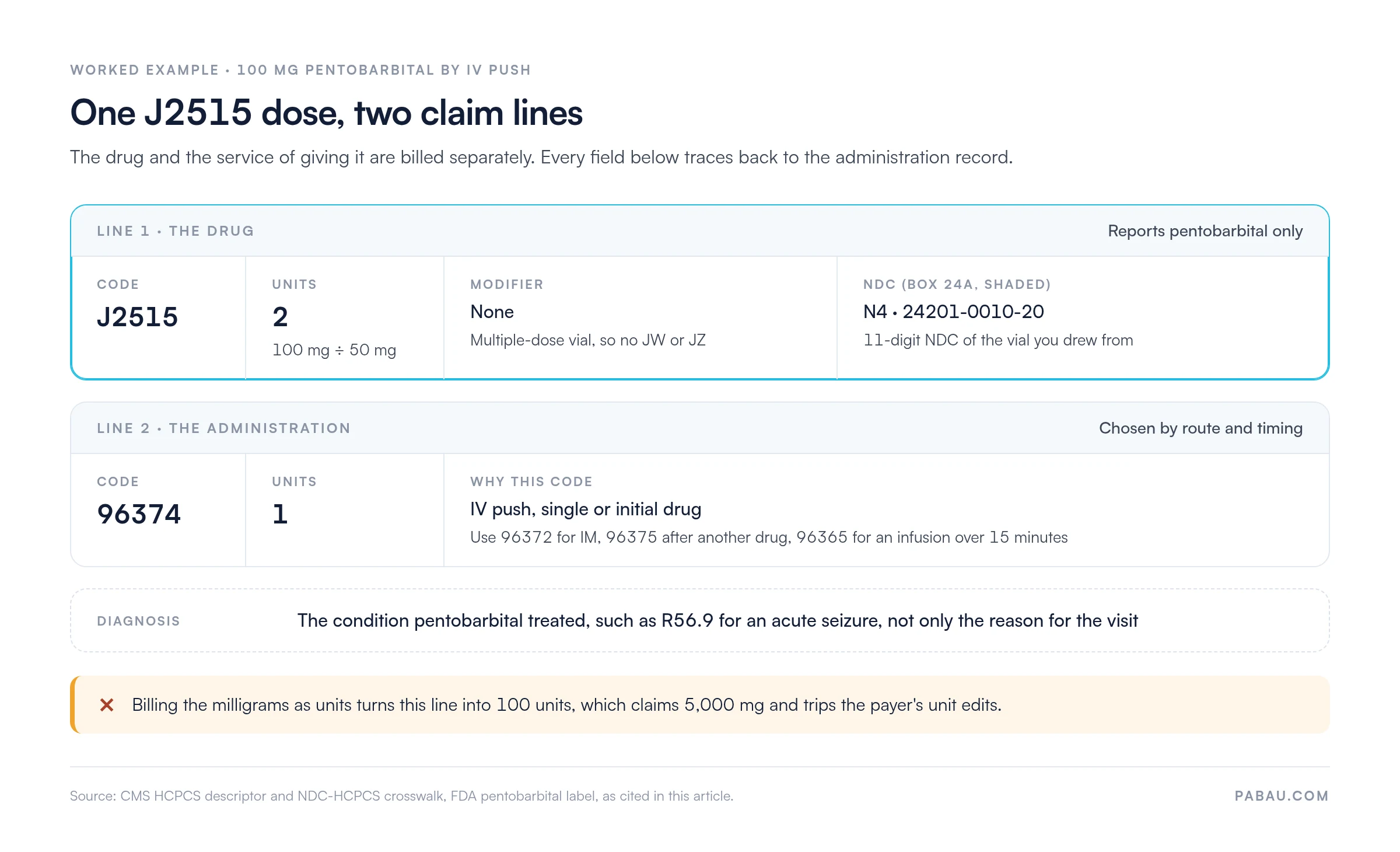
The label limits IV pentobarbital to 50 mg per minute, so larger doses often run long enough to qualify as an infusion. Pick 96374 or 96365 from the start and stop times in the note, not from habit.
Moderate sedation follows its own rules. When pentobarbital is the sedative for a service billed with CPT 99151–99157, that sedation code already covers giving the drug. Do not add 96374 for the same push.
Anesthesia providers billing the 00100–01999 anesthesia series generally do not report J2515 separately. A preanesthetic dose given within those services is part of the anesthesia payment, so check the payer’s policy first.
Medicaid requires the 11-digit National Drug Code (NDC) on J2515 claims under the Medicaid Drug Rebate Program. Many Medicare contractors and commercial payers ask for it too, so report it on every claim.
Use the 5-4-2 format, with leading zeros added where the package label shows fewer digits. On the CMS-1500, enter the N4 qualifier, then the NDC, unit qualifier and quantity in the shaded part of Box 24A. On the UB-04, the NDC goes in FL 43 with the drug description. That habit underpins clean claim submission on every J-code.
These NDCs come from the CMS October 2026 OPPS NDC-HCPCS crosswalk. The NDC on the claim must match the carton of the vial you drew from. Note it each time a new vial is opened.
CMS assigns J2515 pricing indicator 51, the ASP methodology for Part B drugs. Even so, J2515 does not appear in the October 2026 Medicare Part B payment limit file. In the physician office, your Medicare Administrative Contractor (MAC) prices the line locally. Check the current ASP pricing files each quarter before you quote a figure.
Medicaid rates vary by state. Fee-for-service programs set their own maximum allowable cost, and managed Medicaid plans may add their own rules. Confirm coverage and rates with each plan.
Original Medicare has no prior authorization program for J2515. Medicare Advantage, Medicaid managed care and commercial plans set their own rules, so verify before elective use such as sedation for imaging.
CMS coverage code D means special coverage instructions apply. Read your MAC’s guidance in the Medicare Coverage Database before you bill J2515 for an off-label indication.
Write one line in the note on why the patient could not take an oral sedative. The pentobarbital label restricts injection to cases where oral dosing is impossible or impractical, and that sentence answers most medical necessity reviews.
The diagnosis on a J2515 claim must explain why pentobarbital was given at that encounter. Payers match the ICD-10-CM code against the drug’s labeled uses, and a mismatch draws a CO-11 or CO-50 denial.
That is the core medical billing compliance rule here. The code must reflect why the drug was given, not only why the patient came in.
For sedation or preanesthetic use, code the condition that made the procedure necessary. Choose the most specific code the record supports.
Most coding errors here come from a neighboring sedative or anticonvulsant code. The most common one swaps J2515 with J2250, the midazolam code. The table below sets out each code’s drug and unit.
Confirm the current descriptor in the AAPC HCPCS lookup or the CMS quarterly HCPCS file before you set up a new charge code. Our HCPCS library for billers has separate billing guides for most of the other J-codes in that table.
Injectable drug billing is a standing audit focus. Every element of a J2515 claim must trace back to an entry in the medical record. Claims management software that builds the claim from the administration record keeps those entries in step.
Record these details for every J2515 encounter:
Pentobarbital’s Schedule II status adds a second paper trail. DEA rules require Schedule II records that account for each vial, from receipt to the last dose drawn. Your controlled substance log and the claim should show the same milligrams.
Auditors can recoup payment on any claim where one of these details is missing from the record. Capture them in the superbill or clinical note at the time of service, not after the fact.
Reconcile your J2515 claims against the Schedule II log once a month. Add up the milligrams billed and compare them with the milligrams drawn from each vial. Any mismatch is either a billing error or a records problem, and both need fixing before an audit.
J2515 denials follow predictable patterns. A structured denial management process fixes most of them at the source. The table pairs each common trigger with its fix.
In many practices, J2515 lines are still built by hand. A biller reads the nursing note, converts milligrams to units, and copies the NDC from whichever vial was in the drawer.
Pabau, the practice management system we build, moves those checks to the point of charge entry. Inventory tracks each multiple-dose vial, and the treatment record holds the dose given. Claims pass through its Claim.MD clearinghouse integration, which runs pre-submission edits against payer rules.
A unit count that does not match the dose, or a missing NDC, is flagged before the payer sees the claim. Your billers fix it in minutes at submission instead of working an appeal weeks later.

Pabau’s claims management software links the documented pentobarbital dose, the vial NDC and the administration code in one workflow. Unit and NDC errors are caught before the claim leaves the practice.

J2515 rewards practices that chart like pharmacists. The code is simple, but pentobarbital sits at the meeting point of two record systems, the claim and the Schedule II log.
When the note records the milligrams, the route, the timing and the vial, the claim builds itself. Waste modifiers drop out, units divide cleanly by 50, and the same numbers pass a DEA inspection. Treat that discipline as part of your wider medical billing workflow.
Book a demo to see how Pabau ties J2515 doses, NDCs and administration codes together before your claims go out.

Need to submit J2515 claims electronically? Claims management software from Pabau handles HCPCS code submission, NDC linking, and denial tracking in one workflow.
Want a plain-language overview of how medical billing works? What is medical billing explains the end-to-end revenue cycle from service documentation through payer payment.
Building a systematic approach to claim rejections? Denial management in healthcare covers root-cause analysis and appeal workflows for high-volume denial patterns.
Billing the longer-acting barbiturate instead? HCPCS code J2560 covers phenobarbital sodium injection, billed per unit of up to 120 mg.
HCPCS code J2515 reports pentobarbital sodium injection, billed per 50 mg administered. It covers IV or IM pentobarbital given as a sedative, short-term hypnotic, preanesthetic or emergency anticonvulsant in outpatient settings.
Divide the milligrams given by 50 and round up to the next whole unit. A 100 mg dose is 2 units, 150 mg is 3 units, and 75 mg rounds up to 2 units. Never bill milligrams as units.
No. J2515 is pentobarbital sodium, a barbiturate sold as Nembutal. Midazolam hydrochloride, the drug in Versed, bills under J2250 at one unit per 1 mg.
No. CMS applies JW and JZ only to drugs from single-dose containers. Pentobarbital ships in multiple-dose vials, so bill the units given on one line without a waste modifier.
Report the 11-digit NDC from the vial you used, in 5-4-2 format with the N4 qualifier. The CMS crosswalk lists Hikma and Sagent 20 mL and 50 mL multiple-dose vials.
Original Medicare has no prior authorization requirement for J2515. Medicare Advantage, Medicaid managed care and commercial plans set their own rules, so check each plan before elective use.