CPT Code 69610: Tympanic membrane patch repair (myringoplasty)
CPT code 69610: official descriptor and procedure overview CPT code 69610 descri...

Last Updated: Oct 19, 2026
J1700 is the HCPCS Level II code for injection, hydrocortisone acetate, up to 25 mg. Each billing unit covers up to 25 mg administered, and any part-unit above that rounds up, so a 30 mg dose bills two units.
The code applies only to the acetate salt, a suspension given by intra-articular, intralesional or soft-tissue injection. Hydrocortisone sodium succinate, a solution given IV or IM, bills under J1720 instead.
Let Pabau's smart automation suggest the right codes, reduce claim denials, and keep your practice compliant—effortlessly.
Automate repetitive tasks and focus on what matters most—your patients.
Reduce coding errors and ensure compliance with the latest regulations.
Clean claims, fewer denials, and faster reimbursements.
Powerful insights and reporting to help your practice thrive.
HIPAA compliant SOC 2 certified GDPR-compliant Trusted by 4,000+ clinics worldwide

J1700 covers hydrocortisone acetate injection only. Hydrocortisone sodium succinate bills under J1720, which uses a 100 mg unit.
One billing unit equals up to 25 mg administered, and any part-unit above a multiple of 25 mg rounds up to the next whole unit.
J1700 bills the drug only, so pair it with the administration code for the route, such as 20610 for a major joint.
Medicare Part B pays J1700 at ASP+6% in a physician office. In a hospital outpatient department, the drug is usually bundled into the facility payment.
Missing or invalid NDC data and J1720 billed in place of J1700 are two common, preventable causes of denial.
HCPCS code J1700 is defined by the Centers for Medicare and Medicaid Services (CMS) as “Injection, hydrocortisone acetate, up to 25 mg.” It belongs to the J-code series within HCPCS Level II, the code set CMS maintains for drugs, biologicals, and supplies not covered by CPT. You can compare it with neighboring drug codes in our HCPCS codes library.
The key clinical detail is the salt form: Hydrocortisone acetate. This formulation is a suspension rather than a solution, so it produces a slower, more localized effect. It is typically administered by intra-articular, intralesional, or soft-tissue injection for inflammatory conditions rather than by intravenous infusion for systemic emergencies.
One unit of J1700 equals up to 25 mg of hydrocortisone acetate administered. Bill based on the dose given to the patient, not the total volume in the vial. A vial may contain 50 mg, but if the clinician administers only 25 mg, the correct quantity is one unit.
Billing the vial volume instead of the administered dose is a frequent unit error on J1700 claims. Bill one unit for any dose up to 25 mg. When a dose exceeds a multiple of 25 mg, bill the next whole unit (e.g. 30 mg = 2 units). This follows Medicare Claims Processing Manual Chapter 17. Follow payer policy where it differs.
When billing multiple units, document each injection site separately in the administration record. Payers may audit unit counts against the documented clinical notes, so the administration record must show site, dose, and route for every unit claimed.
J1700 covers hydrocortisone acetate, a suspension. J1720 covers hydrocortisone sodium succinate, a solution. The two salts have different clinical uses, so the salt named in the physician order decides the code.
The physician order and medication administration record must state the salt form explicitly. Billing staff cannot infer the correct code from the drug name alone if only “hydrocortisone” appears in the chart without the salt qualifier.
J1700 rarely appears on a claim by itself. An administration code and a diagnosis code are always required, and certain situations call for J3490 as a fallback. The table below covers the codes most often billed alongside, or confused with, J1700.
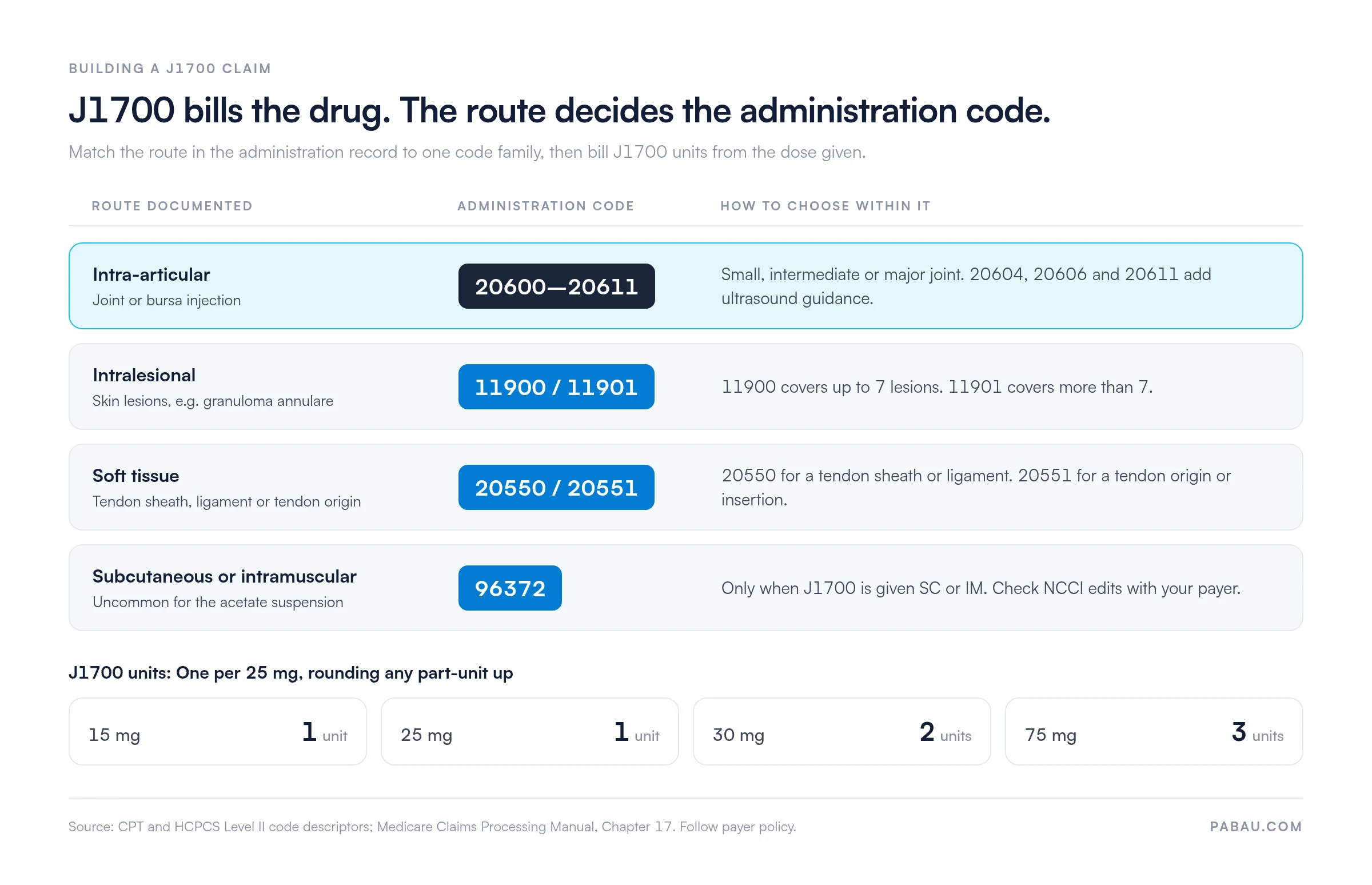
The route in the administration record decides the administration code. Intra-articular injection bills with 20600–20611, chosen by joint size and ultrasound use, so a major joint without ultrasound is 20610. Intralesional injection bills with 11900 for up to 7 lesions, or 11901 for more.
Code 96372 applies only when J1700 is given subcutaneously or intramuscularly, which is uncommon for the acetate suspension. Check National Correct Coding Initiative (NCCI) edits for your payer before billing any administration code with J1700. Some contractors require a modifier to report both on one claim. The map below pairs each route with its code.
Medicare Part B covers J1700 when the drug is given incident to a physician’s service in a non-facility setting. The documented diagnosis must also support medical necessity. Payment is set at ASP+6% (average sales price plus 6%), effectively about ASP+4.3% after the 2% sequestration reduction. CMS updates the rate quarterly.
Because the rate moves every quarter, check the current payment limit in the CMS ASP drug pricing file before you estimate reimbursement.
Pull the CMS ASP drug pricing file at the start of each quarter. Then update any fee schedule templates that reference J1700 payment amounts. The file is published on the CMS website and lists the ASP-based payment limit for every J-code drug. Building a quarterly update into your billing calendar prevents unexpected write-offs when the rate moves.
Place of service (POS) determines whether a separate J-code claim for J1700 is appropriate at all.
Where the drug is already bundled into the facility’s claim, a separate J1700 bill is an overpayment risk and a common audit trigger. Verify with your MAC and the facility’s billing department before submitting a separate drug claim in any setting other than the physician office.
Prior authorization (PA) requirements for J1700 vary by payer, plan year, and state Medicaid program. Traditional Medicare Part B does not universally require prior authorization for J1700. Medicare Advantage plans and most commercial payers may impose their own PA criteria. Always verify with the specific plan before administering the drug if any question of coverage exists.
When PA is required, the supporting documentation typically includes:
For Medicaid, PA requirements differ by state. Some state Medicaid programs restrict corticosteroid injections to specific diagnoses or require physician specialty attestation. Confirm requirements with your state Medicaid agency or managed care organization before billing.
Every J1700 claim must be supported by the following records, all in the patient’s medical chart:
The superbill documentation generated at the point of care should capture each of these fields before the claim is submitted. A claim built from an incomplete superbill is hard to defend when an auditor or payer reviewer asks for the record.
The ICD-10-CM diagnosis code on a J1700 claim must reflect the specific condition for which the hydrocortisone acetate injection was clinically indicated. Common diagnoses paired with J1700 include inflammatory joint conditions, soft-tissue inflammation, and certain dermatological indications.
Always select the most specific ICD-10-CM code available for the documented diagnosis. Generic codes like M79.3 (panniculitis, unspecified) should only be used when the chart does not support a more specific code. Payers may deny claims coded to “unspecified” when a specific code clearly applies.
J1700 denials usually trace back to a coding or documentation slip that can be caught before submission. The six patterns below pair each common denial with its root cause and fix, drawn from standard denial management practice.
The denials above start at the point of care, when the salt, dose and route are written down, and surface weeks later on the claim. Pabau, the practice management and billing platform we build, keeps both ends in one place with its claims management software.
Many practices still bill injection drugs like J1700 from free-text notes. The billing team has to find the salt form, dose, NDC, route and site in the chart before the claim can go out. Each manual lookup is a chance to bill J1720 by mistake or miscount units.
Insurance claiming is included in every Pabau subscription. Build your note templates around clean claim submission standards, and fewer J1700 claims come back for rework.

Pabau raises each claim from the patient’s invoice and validates it before submission. Hydrocortisone acetate billing errors get fixed before they reach the payer.

J1700 claims succeed or fail on details written at the point of care. Get the salt form, the administered dose and the route into the order and the administration record, and the right codes follow.
Your next step is a short audit of your last few J1700 claims. Check that each one bills J1700 rather than J1720, rounds units up from the dose given, and carries an administration code that matches the route. Any mismatch points to the note template or workflow to fix first.
The trade-off is a few extra fields per injection note in exchange for fewer denials and easier audits. Book a demo to see how Pabau carries injection details from the treatment note to a validated J1700 claim.

Need to understand how denials get resolved? Denial management in healthcare covers the full workflow from denial receipt through appeal, with common CARC code patterns.
Want to see how clean claims reduce write-offs? Clean claim submission explains every element a claim must pass before a payer processes it for payment.
Looking for a broader billing compliance framework? Medical billing compliance outlines the documentation, audit, and payer policy requirements that apply across drug injection billing.
Billing a different hydrocortisone salt? HCPCS code J1710 covers hydrocortisone sodium phosphate injection, with its own unit size and billing rules.
Injecting a major joint under ultrasound? CPT code 20611 explains the administration code for an ultrasound-guided major joint injection.
HCPCS code J1700 covers injection, hydrocortisone acetate, up to 25 mg. It applies when a practitioner administers the acetate salt form of hydrocortisone by intra-articular, intralesional, or soft-tissue injection. It does not cover hydrocortisone sodium succinate (J1720) or hydrocortisone in oral or topical form.
One unit equals up to 25 mg administered. Bill based on the dose given, not the vial volume. A dose under 25 mg bills 1 unit, while a 30 mg or 50 mg dose bills 2 units.
J1700 covers hydrocortisone acetate (a suspension, typically used for local intra-articular or intralesional injection) with a 25 mg per-unit ceiling. J1720 covers hydrocortisone sodium succinate (a solution such as Solu-Cortef, used for rapid systemic effect via IV or IM) with a 100 mg per-unit ceiling. The salt form documented in the physician order determines which code applies.
Yes. Medicare Part B covers J1700 when it is administered incident to a physician’s service in a non-facility setting (POS 11). A documented diagnosis must support medical necessity. Reimbursement is at ASP+6%, updated quarterly by CMS. In facility settings such as hospital outpatient departments, the drug cost is typically bundled and a separate J1700 claim is generally not appropriate.
Traditional Medicare Part B does not universally require prior authorization for J1700, but Medicare Advantage plans and commercial payers may impose PA requirements. Medicaid rules vary by state. Verify with the specific plan before administering the drug when coverage is uncertain.
Yes, and the route decides which one. Intra-articular injection bills with CPT 20600–20611, by joint size and ultrasound use. Intralesional injection bills with 11900 or 11901. CPT 96372 applies only when J1700 is given subcutaneously or intramuscularly. Check NCCI edits for your payer before submitting both codes on one claim.