CCSD code H4430: Examination of rectum under anaesthetic
CCSD code H4430 pays for the examination alone CCSD code H4430 is the UK private...

Last Updated: Oct 20, 2026
J1710 is the HCPCS Level II code for injection, hydrocortisone sodium phosphate, up to 50 mg. CMS terminated it with effect from 31 December 2025, so it is no longer valid for claims after that date.
Deleted codes rarely disappear from the places billers work. They sit in charge masters, paper superbills, and inherited fee schedules, and one stale entry can generate denials for months.
Let Pabau's smart automation suggest the right codes, reduce claim denials, and keep your practice compliant—effortlessly.
Automate repetitive tasks and focus on what matters most—your patients.
Reduce coding errors and ensure compliance with the latest regulations.
Clean claims, fewer denials, and faster reimbursements.
Powerful insights and reporting to help your practice thrive.
HIPAA compliant SOC 2 certified GDPR-compliant Trusted by 4,000+ clinics worldwide

HCPCS code J1710 described an injection of hydrocortisone sodium phosphate, up to 50 mg.
The code is deleted, so any current claim that carries it will be denied.
J1720 is the usual crosswalk, but it covers a different salt, so read the vial label first.
Every hydrocortisone claim still needs the matching NDC, the units the descriptor asks for, and a supporting diagnosis.
Pabau, practice management software for medical practices, tracks drug charges and supports clean claim submission.
J1710 sat in HCPCS Level II, the code family for injectable drugs. Those drugs are given in a physician office, an outpatient department, or an infusion suite.
Payers read J-codes for Medicare Part B drug billing, and Medicaid and most commercial plans recognize them too.
The Centers for Medicare and Medicaid Services maintains the set, separately from the AMA’s CPT codes.
The code itself described one drug on one route, at a fixed dose ceiling. It covered hydrocortisone sodium phosphate given intravenously or intramuscularly, capped at 50 mg per unit.
That ceiling is part of the definition, not a footnote. A 50 mg dose equaled one unit, and a larger dose meant more units.
The same logic governs whichever active code you use today, so read the descriptor before you fill the units field.
No, J1710 is not active. A claim that carries it will be denied by Medicare, Medicaid, and most commercial payers.
The code maps to no covered service in a payer’s adjudication engine. Deletion takes effect on a date, not across a transition window.
CMS rebuilds the HCPCS Level II set every year. Codes get added, revised, or retired as drugs change, manufacturers consolidate, or coding policy moves. J1710 now sits in the deleted-code archives, including the AAPC HCPCS reference.
Finding it in your own system is the harder part. Billing software that stores charge codes without status checks will keep J1710 on the list quietly for years.
A charge master audit against the current CMS HCPCS file catches that entry before it costs a batch of claims.
Most reference databases crosswalk J1710 to J1720, injection of hydrocortisone sodium succinate, up to 100 mg. Treat that as a starting point rather than an answer.
CMS revises crosswalk assignments, and payer policy sometimes differs, so confirm against the current HCPCS annual update file.
The reason to slow down is in the drug name. Succinate and phosphate are different salt forms of hydrocortisone, and the NDC on your claim says which one you gave.
Substituting J1720 for a phosphate product creates a code-to-NDC mismatch, which takes longer to unwind than the original denial.
When no active J-code matches the formulation you gave, J3490 is the fallback. It buys accuracy at the cost of speed, because unclassified drug claims carry a written description and usually route to manual review.
If the drug needs prior authorization, request it under the active code, never under J1710. Whichever code you land on, check the dose, the route, and the salt form against the record first.
While it was active, J1710 was a Part B drug code. Part B pays for drugs furnished incident to a physician’s service, in an office or another covered setting.
Hydrocortisone sodium phosphate qualified when the record supported it, for indications such as adrenal insufficiency, allergic reactions, and inflammatory conditions.
Payment for J-codes runs on the Average Sales Price methodology. Medicare pays ASP plus a 6% add-on, and the rate refreshes quarterly.
J1710 has no ASP rate now, because deleted codes drop out of the drug payment files. For the rate on whichever code replaces it, check the CMS Physician Fee Schedule and the quarterly ASP files.
Medicaid is less uniform. Some state programs accept HCPCS J-codes as submitted, while others want an NDC crosswalk alongside the procedure code.
Check your state’s Medicaid billing guide rather than assuming the Part B rules carry across.
When a J-code is deleted mid-year, CMS may issue a transmittal through the Medicare Learning Network specifying the effective date and the crosswalk. Subscribe to CMS MLN Connects alerts, so deletion notices reach you before a denial does.
The code changed, but the claim requirements did not. Whichever active J-code you use, the same six elements decide whether the line pays.
Paper superbills are worth a separate look. A superbill still listing J1710 tells you the document has not been reviewed since the code retired. Whatever else sits on that sheet is probably the same age.
Five checks catch most drug-injection denials, and they take about a minute at charge entry.
The mistakes that survive that list tend to be the same three. Billers copy last year’s charge line and inherit a deleted code.
They map a phosphate product to a succinate code because a crosswalk table said so. Or they type milligrams into the units field, and a 40 mg dose becomes 40 units on a code that bills per 100 mg.
Audit your charge master against the CMS HCPCS annual update file every quarter. CMS publishes it each October for the following year, and deleted codes appear in their own spreadsheet. Cross-referencing your active charge codes against that list takes under an hour.
Corticosteroid injections spread across several J-codes, split by drug, salt form, and dose. A practice that stocks more than one steroid preparation will eventually bill the wrong one.
The table below lists the codes that come up most often, with their current status.
The methylprednisolone consolidation is the one that catches people out. Three fixed-dose codes became one code billed in 1 mg units.
The same 40 mg injection that used to be one unit is now forty. The dose did not change, only the number in the units field.
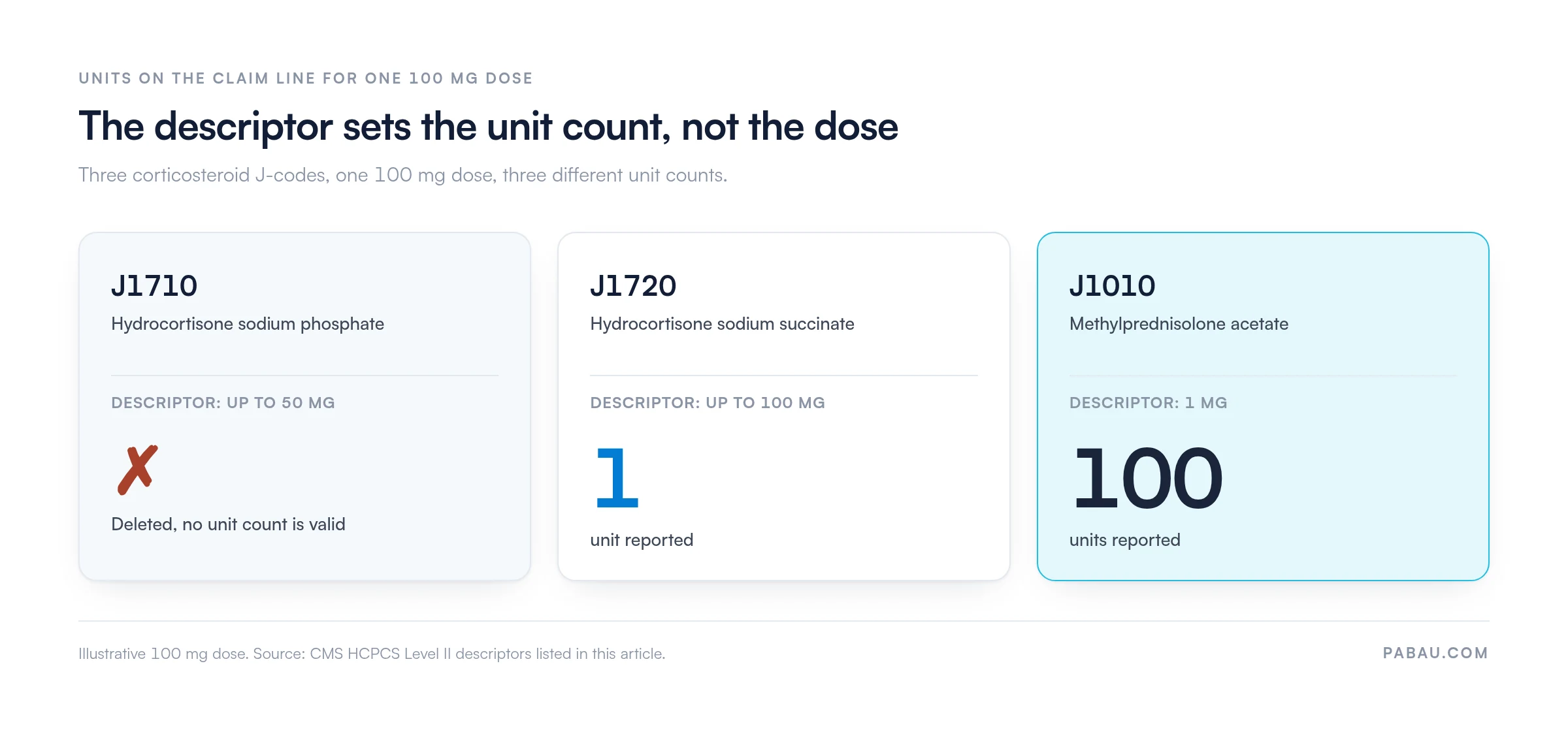
Payer systems cross-reference the J-code against the NDC you submitted. When the descriptor and the product disagree, the claim either denies automatically or drops into medical review.
Those mismatches produce some of the slowest denial codes to clear, because the fix needs a corrected code, a corrected NDC, and a resubmission.
Most practices keep drug codes in three places at once. The charge master holds one version, a paper superbill holds another, and a long-serving biller holds the third. Nobody owns the list, so a retired code stays in use long after CMS drops it.
Pabau, practice management software for medical and aesthetic practices, keeps that work in one system. Charges attach to the appointment and the clinical note as staff enter them. The drug, the dose, and the diagnosis then travel together on the way to the claim.
From there, Pabau’s cleaner claims management handles submission and reconciles each remittance against the charge it came from.
What it will not do is tell you a code has been retired. Code-set maintenance stays with the practice, which is why the quarterly audit above matters.
What you get instead is one place where the charge, the note, and the payer response line up. A pattern of denials then shows up in days rather than quarters.
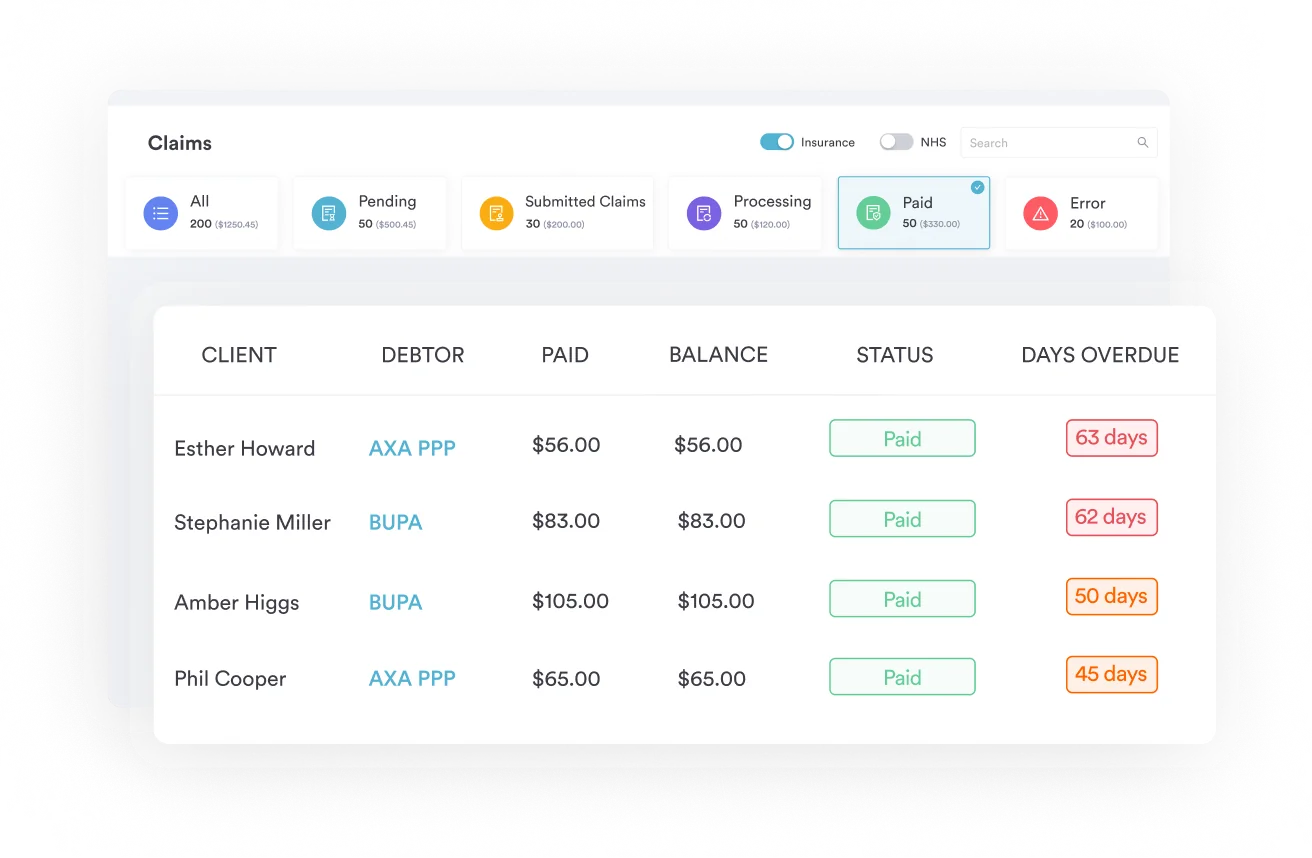

Pabau tracks drug charges against the appointment and the note, submits the claim, and reconciles the remittance. Your billing team works from one record instead of three.

J1710 is settled. It is deleted, and no amount of documentation will make it pay. The work worth doing sits upstream of the claim. Find where the code still lives in your system. Replace it with the active code that matches the salt form and the dose you give. The units then need to match the new descriptor.
The trade-off is worth naming. An hour a quarter on the charge master is cheap next to a quarter spent appealing denials from one stale line. Practices that keep up with the maintenance stop meeting these codes at the remittance stage.
Keeping the charge, the note, and the payer response in one system makes that maintenance visible. Book a demo to see how Pabau handles drug injection billing for US practices.

Not sure which code covers an unlisted injectable? HCPCS code J3490 explains how the unclassified drug fallback works and what the claim has to describe.
Working through a batch of drug-claim denials? Denial management in healthcare covers how to categorize, appeal, and prevent the patterns that repeat.
Want more claims to pay first time? What is a clean claim sets out the fields payers check before a claim reaches adjudication.
New to the revenue cycle behind these codes? What is medical billing walks through the process from charge capture to payment posting.
Code validity follows the date of service, so a claim for a date when J1710 was active is not automatically wrong. In practice the window has closed. Medicare’s timely filing limit is 12 months from the date of service, and commercial deadlines are usually shorter.
Solu-Cortef is hydrocortisone sodium succinate, so it maps to J1720 rather than J1710. Read the salt form on the vial label, not the brand name on the shelf. The label wording is what has to match the code descriptor and the NDC.
Yes. The J-code pays for the drug, and a separate administration code covers the service. An intramuscular or subcutaneous therapeutic injection is 96372, and an intravenous push is 96374. Check the current NCCI edits before you pair them.
They apply when the drug comes from a single-dose container. Medicare wants JW on the line reporting a discarded amount, and JZ when none is discarded. Drugs supplied in multi-dose vials fall outside both. Check the packaging before you add either modifier.
Resubmit as a corrected claim rather than appeal. The denial is correct, because the code was invalid on the date you submitted. Send the active code, the matching NDC, and the same documentation, and note the code deletion in the claim remarks.