HCPCS code J3471: Hyaluronidase ovine injection billing guide
HCPCS code J3471: Descriptor, code type, and quick-reference data HCPCS code J34...

Last Updated: Oct 14, 2026
J0694 is the HCPCS Level II code for injection, cefoxitin sodium, 1 gm.
HCPCS code J0694 pays for one gram of cefoxitin sodium. Bill a 2 g surgical prophylaxis dose as one unit and you collect half of what you are owed. The rest of the code is straightforward. Cefoxitin is a second-generation cephalosporin, given by IV or IM. The code itself is decades old, not a 2026 addition.
Below is how each of those pieces should look before you submit.
Let Pabau's smart automation suggest the right codes, reduce claim denials, and keep your practice compliant—effortlessly.
Automate repetitive tasks and focus on what matters most—your patients.
Reduce coding errors and ensure compliance with the latest regulations.
Clean claims, fewer denials, and faster reimbursements.
Powerful insights and reporting to help your practice thrive.
HIPAA compliant SOC 2 certified GDPR-compliant Trusted by 4,000+ clinics worldwide

HCPCS code J0694 covers injection, cefoxitin sodium, 1 gm, given by IV or IM.
One unit equals one gram, so a 2 g surgical prophylaxis dose bills as 2 units.
Medicare Part B pays J0694 at ASP plus 6%, and CMS refreshes that rate every quarter.
NDC reporting is a Medicaid and crossover rule far more often than a straight Part B one.
Pabau records the dose, NDC, and diagnosis at the point of care, so those details feed claim preparation.
J0694 is the HCPCS Level II code for injection, cefoxitin sodium, 1 gm. One unit is one gram, and that ratio never shifts with the route or the setting.
The Centers for Medicare and Medicaid Services (CMS) maintains the J-code list. J-codes cover drugs a patient cannot take at home.
J0694 is not a new code, despite what some 2026 code lists imply. It has been on the HCPCS Level II drug list since the 1990s. It came through the 2025 and 2026 update cycles unchanged.
Still check the descriptor once a year against the CMS release files or the AAPC HCPCS lookup. Revisions happen quietly, and a descriptor change moves the unit.
Anaerobic coverage is the reason surgeons reach for cefoxitin before colorectal and gynecological procedures.
Anaerobes drive a lot of post-operative infection at those sites, and a first-generation cephalosporin does not reach them as well. The drug also treats active infection, so J0694 shows up on both prophylactic and therapeutic claims.
These are the indications behind most J0694 claims. Each one points at a specific ICD-10 diagnosis code, and payers expect to see that pairing.
A diagnosis that does not match an approved or accepted use is the fastest route to a medical necessity denial. Write the clinical reason into the record before the claim goes out, not after a payer asks.
Divide the grams administered by one, and that is your unit count. Nothing else feeds into it, including the number of vials you opened.
Take a colorectal case. The surgeon orders 2 g of cefoxitin 30 minutes before the incision. A nurse reconstitutes two 1 g vials and gives the full dose. The charge line reads J0694 with 2 units, not 1 unit and not 2 vials.
Now stretch it across a treatment course. A patient on 1 g every six hours receives 4 g in a calendar day, so that day bills as 4 units. Each date of service gets its own line with its own unit count.
Higher-frequency orders add up quickly, so recalculate the daily total rather than copying it from the last claim. Modifiers rarely come into it. Most Medicare administrative contractors (MACs) want no modifier on J0694 at all.
Ignore any guidance that pairs this code with JA or JB. Those two modifiers describe drugs given intravenously and subcutaneously, and cefoxitin has no subcutaneous route, so neither one applies. Route does change the administration code you bill alongside the drug, but it never changes J0694 itself.
Document the dose ordered, the dose given, the NDC, and the lot number in the administration record before the patient leaves. Reconstructing those four fields from memory a week later is how unit errors and NDC mismatches reach a claim.
Units are one half of a drug claim line. The National Drug Code (NDC) is the other, because it names the exact product and package that went into the patient.
Billing guides often overstate when the NDC is required. It is not a blanket Medicare Part B rule. Part B generally does not ask for it on a straight outpatient claim. It is required on Medicare and Medicaid crossover claims for dual-eligible patients.
State Medicaid programs and some commercial payers also mandate it. Read the payer’s own drug billing guide before you treat the field as optional.
Different labelers hold different NDCs for the same drug, and they all map to J0694. Below are current 1 g presentations of cefoxitin sodium.
Check any number against the FDA NDC Directory and the vial label, because packaging changes retire NDCs without notice.
That last column is where clean claims are won and lost. A label prints 10 digits in one of several groupings, and a claim wants 11. The padding zero goes in a different place depending on the grouping, as the visual below shows.
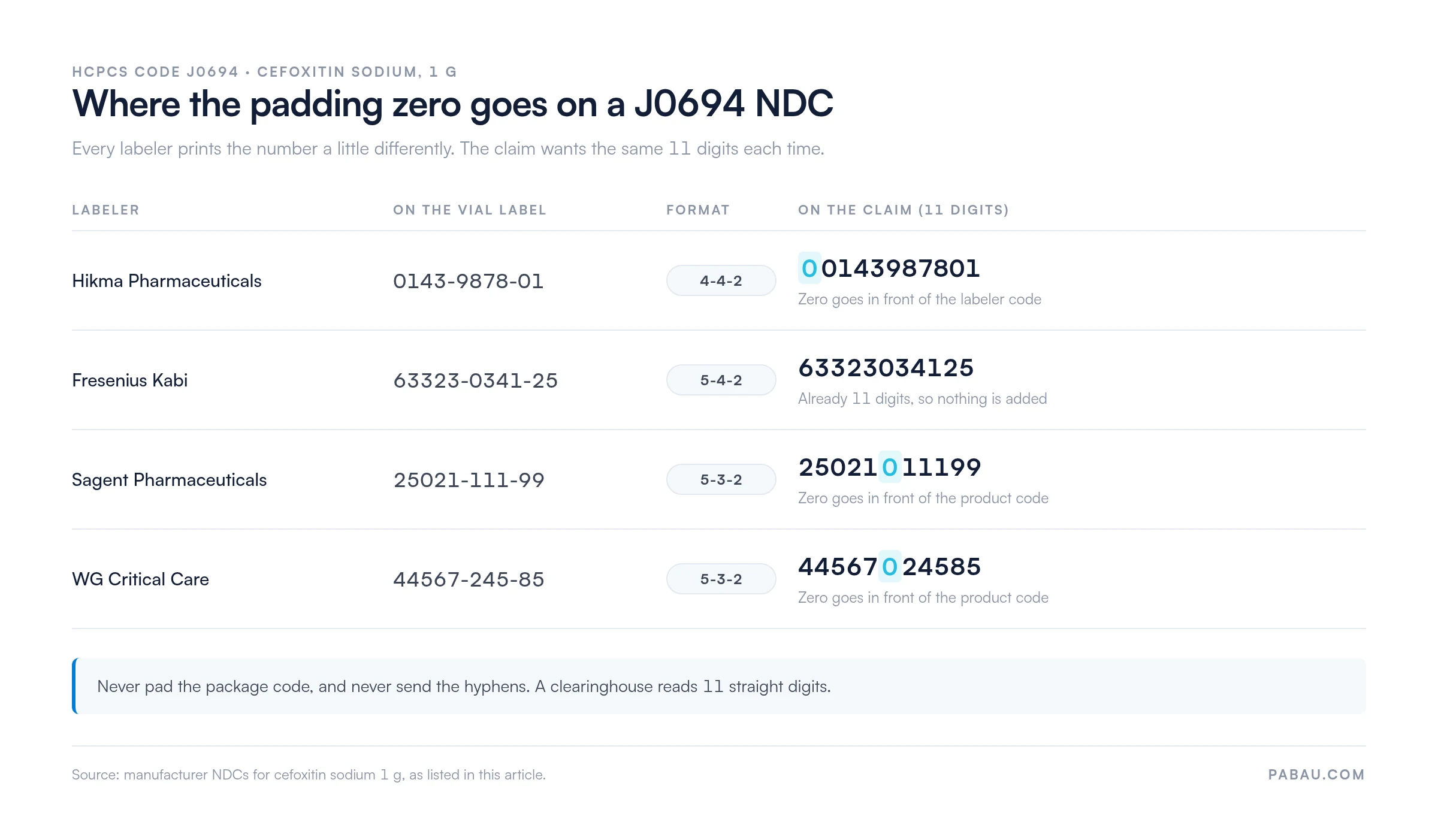
Send the 11 digits with no hyphens. On the 837P the number sits in Loop 2410. On the CMS-1500 it goes in the shaded area of box 24. Put the N4 qualifier first, then the number, then the unit of measure and quantity.
Practices that read the NDC and lot straight off the vial avoid nearly all of this. Pulling the number from a purchase order two weeks later is where mismatches begin.
Payers test J0694 against the ICD-10 code on the claim before they look at the dollar amount. The diagnosis has to make cefoxitin a sensible choice for what was documented.
The table below is the set that shows up most often on cefoxitin claims.
Z29.2 carries most surgical prophylaxis claims. Once the drug is treating an infection instead of preventing one, switch to the code for the condition itself. A claim dated days after the procedure with Z29.2 on it reads as a prophylaxis dose given far too late.
When the documented condition falls outside that table, search the full ICD-10-CM code library rather than defaulting to an unspecified code. Specificity is what carries a drug claim through medical review.
Medicare Part B pays J0694 at the Average Sales Price (ASP) plus 6%. CMS rebuilds the ASP each quarter from manufacturer sales data, so no fixed dollar figure holds for long. Finding the current number takes about two minutes.
Medicaid works differently. Each state sets its own rate for J0694 on its physician-administered drug fee schedule. Some states also cap the units payable per date of service. Look the state schedule up instead of assuming it tracks Medicare.
Commercial contracts often use ASP as a benchmark, but the multiplier is negotiated. Check the fee schedule attached to your own contract before you quote a number to anyone.
Under buy-and-bill, the practice owns the vial and bills J0694. Under white bagging, a specialty pharmacy owns it and bills for it, so the practice bills only the administration.
Most outpatient cefoxitin runs through buy-and-bill. Here is how that claim actually moves.
White bagging removes the acquisition risk, and the J0694 revenue goes with it. Billing the drug in that arrangement produces an overpayment, since the pharmacy already billed for the same vial. That is the kind of duplicate that surfaces in a False Claims Act review.
Confirm which model a patient falls under before the claim is built.
Almost every J0694 denial traces back to one of five things, and none of them are hard to catch.
Before you submit, read the charge line back against the record one more time.
Every item on that list is part of what payers call a clean claim. Each check takes seconds when the record was written at the point of care.
Audit a month of J0694 claims in one sitting. Pull every claim, compare the units billed against the grams in the administration record, and flag the mismatches. Half an hour spots a pattern before a payer does.
Swap the antibiotic and the unit of measure usually changes with it. That is where crossover errors come from, not from picking the wrong drug name. The table covers the J-codes practices bill alongside or instead of cefoxitin.
J0690 is the one to watch. Cefazolin bills per 500 mg, so a 1 g cefazolin dose is 2 units while a 1 g cefoxitin dose is 1 unit. Any practice using both for different procedures will meet that difference regularly.
Read the descriptor before you set the quantity. The drug name tells you which code to use. Only the descriptor tells you the unit.
The descriptor rule that governs J0694 runs through the rest of HCPCS Level II. HCPCS Code K0073 covers a wheelchair caster pin lock, counted as each rather than by dose.
In most practices the drug details and the claim live apart. A nurse writes the dose and lot number on a paper record in the treatment room. Days later, a biller retypes the grams, the NDC, and the diagnosis into a claim form. Every retype is another chance for 2 g to become 1 unit.
Pabau is practice management software for clinics and med spas, with claims management built in. A drug you record against the patient’s file stays attached to that visit. So do the dose, the route, and the diagnosis. When the claim is prepared, those details are already sitting there to work from.
It does not choose your codes for you, and it should not. What it takes out is the retyping, and the retyping is where J0694 claims go wrong.

Pabau keeps the administration record and the claim in the same system. The dose, NDC, and diagnosis you documented are there when the claim is prepared.

J0694 is not a complicated code. One drug, one gram per unit, and a descriptor that has not moved in decades. The denials come from the fields around it. Those get decided at the point of care, not at the point of billing.
So the fix sits upstream of the biller. Write down the grams, the NDC, the lot, and the reason for the dose while the vial is still in your hand. A biller working from that record has nothing left to guess at, and the claim goes out right the first time.
Want to see the drug record and the claim sitting in one place? Book a demo and we will walk through it with your own cefoxitin workflow.

Working a J0694 rejection right now? Denial codes in medical billing decodes the CARC reason codes and says what each one needs from you.
Want fewer rejections across every drug code? What makes a clean claim lists the pre-submission checks that catch most outpatient failures.
Billing several antibiotic J-codes each week? How to structure a superbill shows how to pre-load codes and units for a whole formulary.
Denials piling up faster than you can rework them? Denial management in healthcare sets out a process for triaging and resubmitting.
Unsure where buy-and-bill compliance risk sits? Medical billing compliance covers the documentation standards that hold up under review.
Yes. J0694 pays for the cefoxitin itself, and the injection or infusion is a separate CPT code on the same claim. Bill the drug line and the administration line together, or the administration goes unpaid.
Yes, it is the same drug. Mefoxin was the brand name for cefoxitin sodium and that brand has been discontinued. Generic cefoxitin from any labeler bills under J0694, with the NDC identifying which product you gave.
Generally no. Drugs given during an inpatient admission are bundled into the facility payment for that stay. J0694 belongs on outpatient claims, where the drug is paid separately from the visit.
That depends on the payer. Several state Medicaid programs publish a maximum quantity per date of service for physician-administered drugs. Check the state fee schedule, because a dose above the cap needs documentation to clear the edit.
Rarely. A generic antibiotic given in an outpatient setting usually does not. Some Medicaid managed care plans still require it for drugs given outside a surgical episode, so read the plan drug policy first.