CCSD Code J3900: Therapeutic ERCP billing guide
CCSD Code J3900: Definition and clinical scope CCSD Code J3900 describes therape...

Last Updated: Nov 3, 2026
J7699 is the HCPCS Level II code for not otherwise classified (NOC) inhalation solutions administered through durable medical equipment (DME), such as a nebulizer. Suppliers use it only when the drug has no specific J-code of its own.
Most J7699 claims get denied for a handful of predictable reasons. They include a specific code already existing for the drug, a missing pharmacy or manufacturer invoice, or routing to the wrong contractor.
Let Pabau's smart automation suggest the right codes, reduce claim denials, and keep your practice compliant—effortlessly.
Automate repetitive tasks and focus on what matters most—your patients.
Reduce coding errors and ensure compliance with the latest regulations.
Clean claims, fewer denials, and faster reimbursements.
Powerful insights and reporting to help your practice thrive.
HIPAA compliant SOC 2 certified GDPR-compliant Trusted by 4,000+ clinics worldwide

HCPCS code J7699 covers inhalation solutions with no assigned specific HCPCS J-code, not every nebulizer drug.
A compounded drug still takes its specific code when one exists, such as J7610 for compounded concentrated albuterol.
A pharmacy or manufacturer invoice is required documentation every time J7699 is submitted.
Claims route to the DME MAC for the patient’s state, not the local Medicare Administrative Contractor.
The DME MAC prices J7699 from the invoice, because NOC codes carry no national fee schedule rate.
HCPCS code J7699 is defined by the Centers for Medicare and Medicaid Services (CMS) as “Noc drugs, inhalation solution administered through DME.” It is the not otherwise classified (NOC) code that closes the J7600-J7699 inhalation solution range.
Coders use it when a prescriber orders a nebulized drug that has no designated J-code of its own. The documentation must also support medical necessity for inhalation therapy.
The J7600-J7699 range is the section of Level II HCPCS reserved for inhalation solutions, and most named drugs in it have specific codes. Albuterol has J7611 and J7613, ipratropium has J7644, and levalbuterol has J7612 and J7614. J7699 covers the inhalation drugs that fall outside those named assignments.
CMS updates the HCPCS Level II code file quarterly, and J7699 has stayed the inhalation NOC code across those update cycles.
J7699 covers nebulized inhalation drugs that have no specific HCPCS J-code assigned. The most common case is a compounded inhalation solution, mixed by a compounding pharmacy to a custom concentration, formulation or combination. It qualifies only when no code describes that compounded ingredient and form.
J7699 also applies in three other situations:
In every case, the drug must be given by nebulizer and must have no active specific HCPCS code that applies to it.
J7699 cannot be used when a specific HCPCS code exists for the drug. Submitting it for albuterol, levalbuterol, ipratropium or another coded drug is a coding error, and payers deny it. Compounding doesn’t change this. If a specific code covers the compounded ingredient, form and route, that code applies.
These are the codes most often confused with J7699, with the concentrated and unit-dose forms billed separately:
The choice between J7699 and a specific inhalation code turns on one question. Does a specific HCPCS J-code currently exist for the drug’s ingredient, form and route? If yes, that code is mandatory. If no, J7699 applies, and the decision below shows what each path needs before the claim goes out.
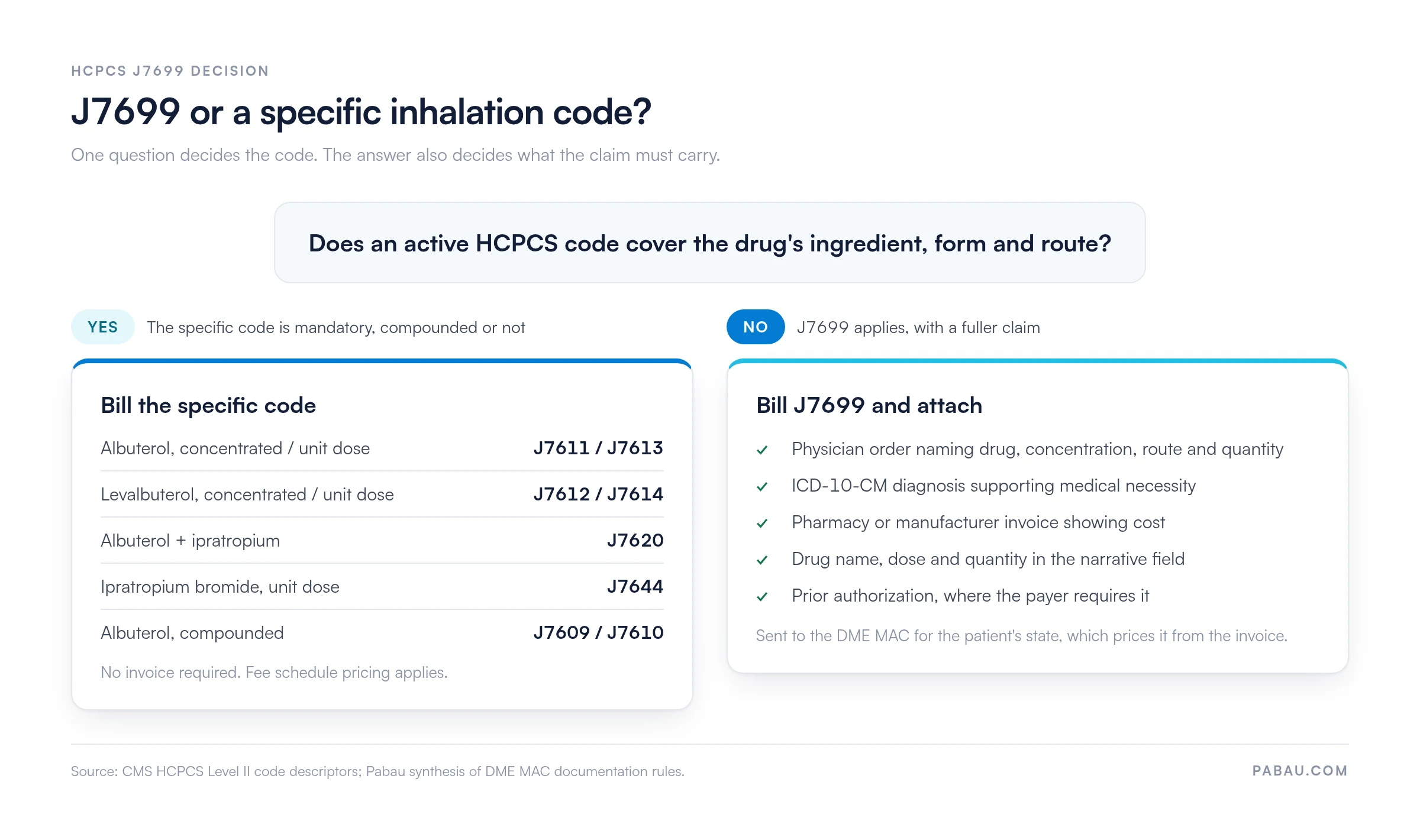
The specific codes also skip the invoice requirement that J7699 carries, as the comparison below sets out code by code.
One frequent error is billing J7699 for a compounded albuterol solution. Albuterol has active compounded codes, J7609 for unit dose and J7610 for concentrated form. J7699 therefore doesn’t apply to a single-ingredient albuterol compound.
Before submitting J7699, search the current CMS HCPCS quarterly file for the drug’s active ingredient. If a J-code exists, use it. Check the AAPC HCPCS code lookup or the CMS Alpha-Numeric file, not a code list from a prior year. New specific codes are added quarterly, so a code may have appeared since the drug was first compounded.
Durable Medical Equipment Medicare Administrative Contractors (DME MACs) apply stricter documentation standards to NOC codes than to specific J-codes. The payer can’t verify the drug from the code alone. Assemble the complete documentation set before submission, not after a denial.
The physician order or prescription must name the drug, its concentration, the route of administration and the quantity dispensed. It must also carry the diagnosis supporting medical necessity, usually one or more ICD-10-CM codes from the respiratory chapter. DME MAC recordkeeping standards require suppliers to keep this documentation and produce it on request.
A missing invoice is one of the most common reasons a J7699 claim is denied. NOC codes carry no fee schedule rate, so the DME MAC uses the invoice to set the allowed amount. Without it, the contractor can’t price the claim, and the claim won’t process.
Store pharmacy invoices and prescription records securely under HIPAA, where an auditor can still retrieve them on request.
Prior authorization (PA) requirements for HCPCS code J7699 vary by payer and by the DME MAC jurisdiction covering the patient’s state. Original Medicare applies no blanket national PA requirement to J7699. Individual DME MACs may still require prior approval for high-cost NOC drugs, or where the diagnosis code alone doesn’t establish medical necessity.
Commercial payers routinely require PA for NOC inhalation codes. Medicaid policies differ by state, and many state programs require PA for any drug billed under a NOC code. Before submitting a J7699 claim, check the payer’s online authorization portal or call the payer about the specific drug.
When PA is required, the request usually needs five items:
Turnaround varies by payer, so check the payer’s portal for its timeline. Medicare Advantage plans follow their own PA timelines, which may differ from Original Medicare rules.
J7699 claims for Medicare Part B patients go to the DME MAC for the patient’s state. They don’t go to the local MAC that processes physician and outpatient claims.
There are four DME MAC jurisdictions, served by two contractors: Noridian (Jurisdictions A and D) and CGS Administrators (Jurisdictions B and C). Submitting to the wrong contractor causes routing denials that delay payment.
Unlike specific inhalation drug codes, J7699 has no national rate on the DMEPOS fee schedule. The DME MAC prices J7699 from the invoice and pays 80% of the allowed amount after the Part B deductible. The remaining 20% is the patient’s coinsurance.
Bill J7699 at your usual and customary charge for the drug. Billing below invoice cost loses money on every claim, and billing far above it invites audit scrutiny. A reasonable markup above invoice cost is standard, but it must match the supplier’s customary charge for similar items.
Run each J7699 claim through your billing software’s pre-submission check to confirm the DME MAC jurisdiction for the patient’s state. Noridian covers Jurisdictions A and D, and CGS covers B and C. A mismatch sends the claim to a contractor with no jurisdiction over it. That triggers an automatic routing denial and restarts the clock on payment.
Payers can’t confirm the drug’s identity from J7699 alone, so NOC claims get closer review than specific J-codes. Most denials fall into five predictable categories, each with a direct fix. Each denial arrives on the remittance advice with a reason code, explained in our guide to medical billing denial codes.
A complete J7699 submission follows seven steps in a fixed order. Skipping one is the most direct path to a denial.
The ICD-10-CM code on a J7699 claim must reflect a documented condition for which nebulized therapy is medically necessary. The DME MAC’s LCD for nebulizer drugs lists which diagnoses support coverage. COPD flare-ups are among the most frequent pairings, coded as J44.1, but the patient’s documented condition always drives code selection.
Always pair the most specific ICD-10-CM code the documentation supports. An unspecified code, used when a more specific one is documented, can trigger a medical necessity review. Check the selected diagnosis code against the applicable LCD before submitting.
Billing J7699 by hand means tracking authorizations, invoices and rejections across separate files and inboxes. A missing piece then surfaces only when the payer sends the claim back.
Pabau, the practice management platform we build, includes claims tools for billers that store each prior authorization as a case. Attach the case at booking, and its authorization code carries through to the claim. A claim missing that code is flagged “Assign case” before it goes out.
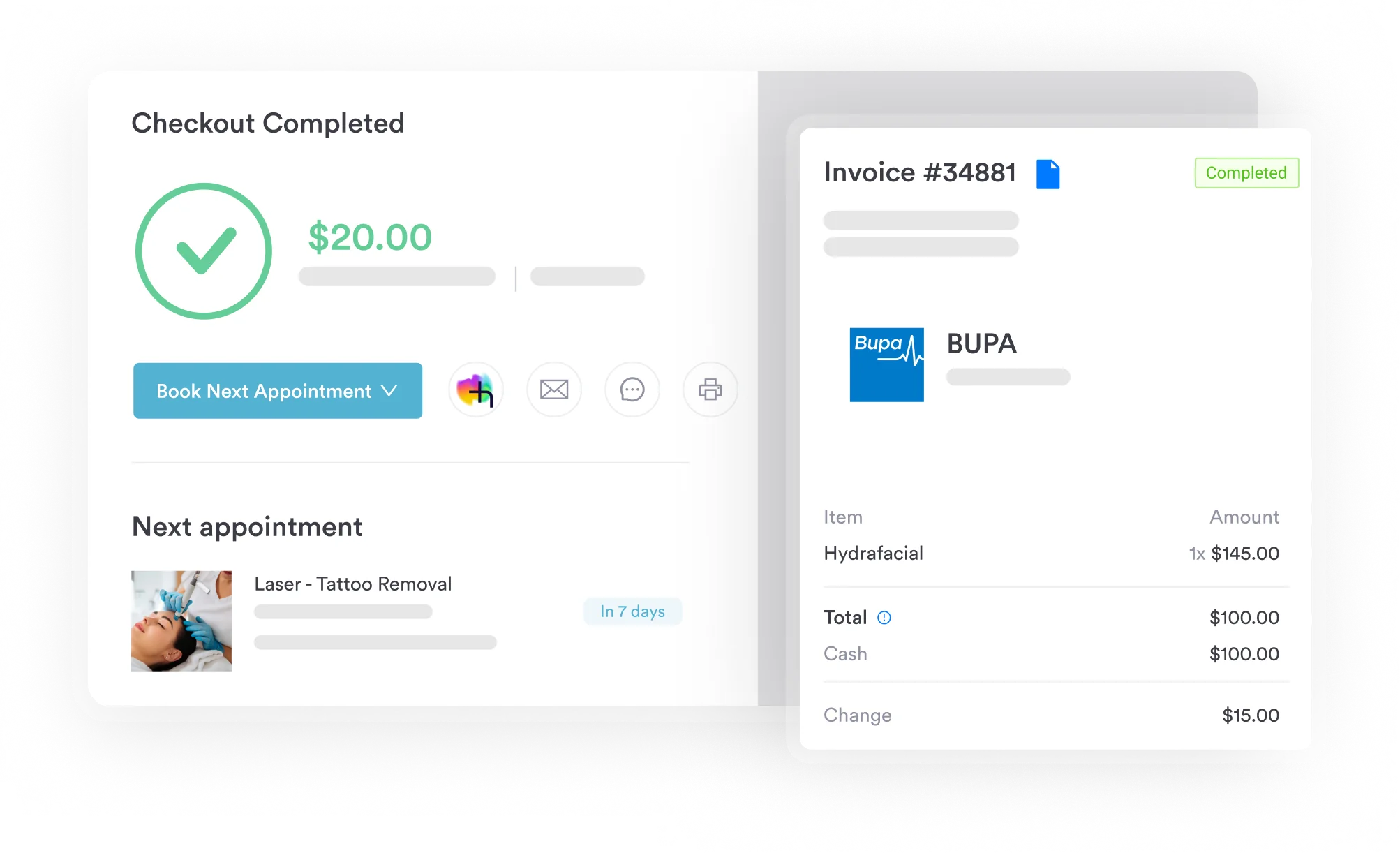
US claims go out on the CMS-1500 through Claim.MD, a clearinghouse that reaches thousands of payers and checks eligibility before the visit. A rejected claim is flagged “Needs action,” and the Fix option shows what went wrong and links to the field to correct.
Your billing team corrects and resubmits from one dashboard. It filters claims by insurer or date and tracks each one from Pending to Paid.

Pabau’s claims management carries each prior authorization onto the claim and flags rejected claims with the field to fix. Your billing team resubmits J7699 claims without rebuilding them.

J7699 rewards the supplier who checks before billing. Confirm that no specific code covers the drug’s ingredient, form and route, including the compounded codes. Then send the order and the invoice with the first submission.
The trade-off is preparation time. A J7699 claim takes longer to build than a specific J-code, but the DME MAC prices it from your invoice. A complete first submission is what gets that price paid without an appeal.
Book a demo to see how Pabau carries prior authorizations onto each claim and flags the rejections your billing team needs to fix.

Need a billing compliance framework for your practice? Medical billing compliance guide covers audit-proofing your claims documentation across code types.
Want to reduce your overall claim denial rate? Denial management in healthcare explains how to build a systematic denial tracking and resolution process.
Billing a non-inhalation drug through DME? HCPCS code J7799 covers the NOC code for other drugs administered through DME.
Looking for broader HCPCS billing context? What is medical billing covers the end-to-end revenue cycle workflow from code selection to payment posting.
HCPCS code J7699 covers inhalation solutions administered via nebulizer for which no specific HCPCS J-code exists. It is the not otherwise classified (NOC) code in the J7600-J7699 inhalation solution range. It’s most often used for compounded nebulizer drugs with no code of their own and newly approved drugs awaiting a code. Investigational drugs used under an IND authorization also qualify.
Use J7699 only when no specific HCPCS J-code currently exists for the drug being administered. If a specific code exists, that code is mandatory. Before submitting J7699, check the current CMS HCPCS quarterly file or the AAPC HCPCS lookup. Confirm that no specific code has been issued for the drug’s active ingredient.
Yes, Medicare Part B reimburses J7699 claims when medical necessity is established, documentation is complete, and the claim goes to the correct DME MAC. J7699 has no national fee schedule rate. The DME MAC prices it from the invoice and pays 80% of the allowed amount after the deductible.
The most common reasons are a specific HCPCS code existing for the drug, a missing invoice, and routing to the wrong contractor. Sending the claim to the local MAC instead of the DME MAC is the usual routing error. Claims also fail when required prior authorization wasn’t obtained. A diagnosis that doesn’t meet the Local Coverage Determination (LCD) criteria for inhalation therapy is the fifth common cause.
Prior authorization requirements vary by payer and DME MAC jurisdiction. Original Medicare does not impose a blanket national PA requirement for J7699. Many commercial payers, Medicare Advantage plans and some state Medicaid programs do require PA for NOC inhalation codes. Verify with the specific payer before dispensing the drug.
Yes, J7699 can be used for pharmacy-compounded inhalation solutions that have no specific HCPCS J-code. Coverage still depends on the DME MAC’s LCD policy for compounded drugs. If a code exists for the compounded ingredient and form, such as J7610 for concentrated albuterol, that code applies instead.