CCSD code H4430: Examination of rectum under anaesthetic
CCSD code H4430 pays for the examination alone CCSD code H4430 is the UK private...

Last Updated: Oct 20, 2026
J0740 is the HCPCS Level II code for injection, cidofovir, 375 mg.
Cidofovir costs enough that payers watch these claims closely. Prior authorization, the JW or JZ modifier, and the diagnosis pairing all have to line up.
Let Pabau's smart automation suggest the right codes, reduce claim denials, and keep your practice compliant—effortlessly.
Automate repetitive tasks and focus on what matters most—your patients.
Reduce coding errors and ensure compliance with the latest regulations.
Clean claims, fewer denials, and faster reimbursements.
Powerful insights and reporting to help your practice thrive.
HIPAA compliant SOC 2 certified GDPR-compliant Trusted by 4,000+ clinics worldwide

HCPCS code J0740 bills the injection of cidofovir, 375 mg, given by intravenous infusion.
One unit is one 375 mg vial, so divide the milligrams given by 375 and round up.
Medicare Part B pays J0740 at ASP plus 6%, and the rate changes every quarter.
Every Part B line for a single-dose vial needs JW or JZ, or Medicare rejects it.
Practice management software like Pabau centralizes the infusion note, the codes, and the claim documentation before submission.
J0740 is the HCPCS Level II code for injection, cidofovir, 375 mg. Level II codes cover drugs and supplies that CPT does not describe.
Within that set, the J series covers drugs given by a route other than oral. CMS maintains the code set through the HCPCS Level II program and updates it quarterly.
The descriptor carries the unit, which is where most J0740 errors start. One unit is 375 mg of cidofovir, not one infusion and not one milligram.
Cidofovir, sold as Vistide, is a nucleotide analogue antiviral. The FDA approved it for cytomegalovirus (CMV) retinitis in patients with AIDS. CMV retinitis threatens sight, and without antiviral treatment it can progress to blindness within weeks.
The drug slows viral DNA replication, and it goes in by intravenous infusion. Most doses are given in a physician office or an outpatient infusion center.
Off-label use exists for other CMV manifestations, though coverage there varies by payer and needs clinical justification.
The label also sets conditions that belong in the chart, and payers look for them:
Units, place of service, and modifiers carry most of the weight on a J0740 claim. Get those three right and the rest is documentation. The two sections below take them in the order the claim is built.
One unit equals one 375 mg dose, so the unit count follows the milligrams given. Divide the total dose by 375, then round up to the next whole unit.
A 70 kg patient at 5 mg/kg receives 350 mg, which bills as one unit. An 85 kg patient receives 425 mg, which opens a second vial and bills as two. The table below runs that math across a range of body weights.
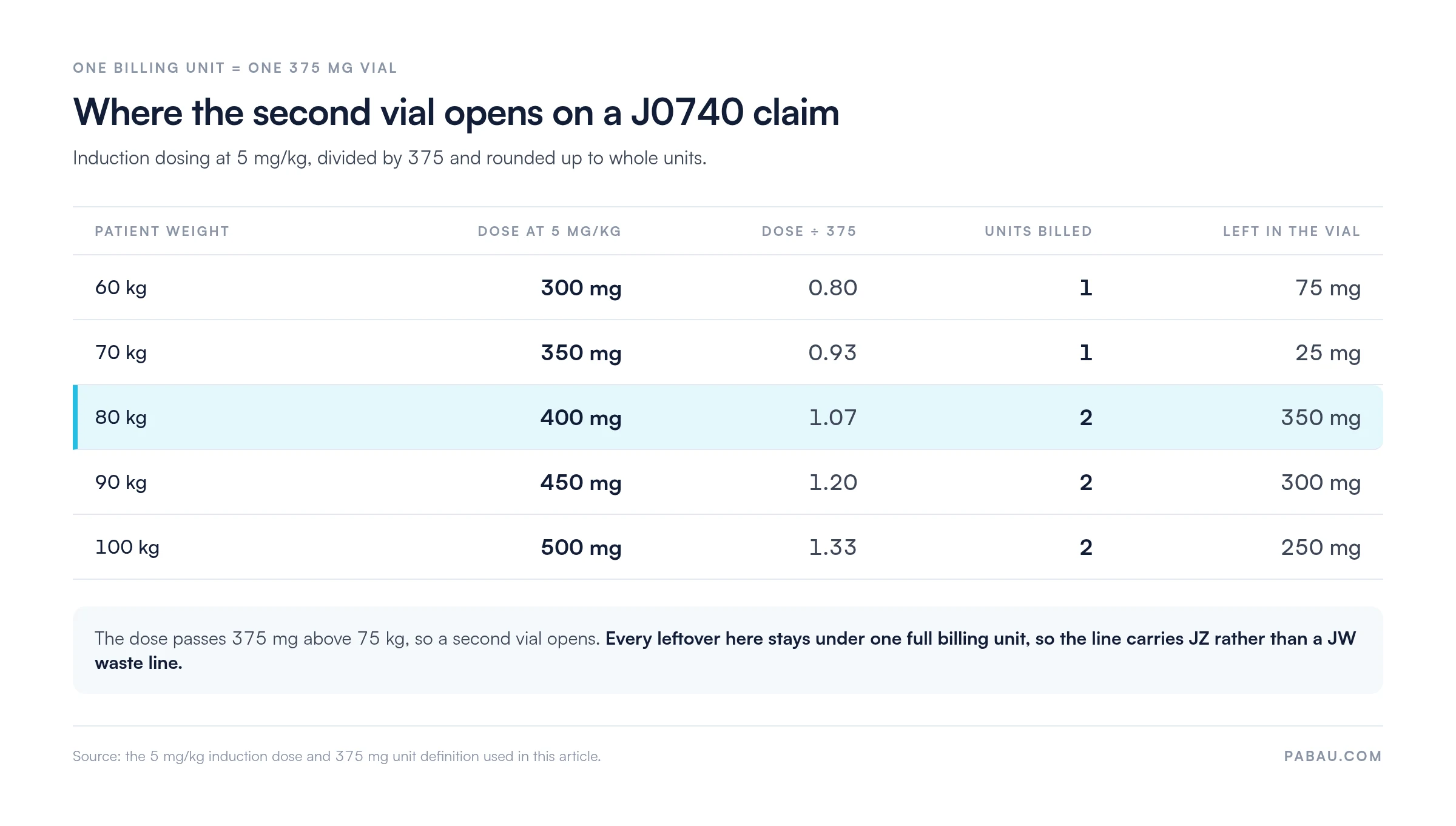
Record the dose in milligrams in the note, not only the unit count. When a payer asks how two units were justified, the milligrams are the answer.
Cidofovir infusions usually run in POS 11 (office) or POS 22 (outpatient hospital), and the setting changes what Medicare pays. The drug and its administration bill separately. Add CPT code 96365 for the first hour of the infusion, then the add-on codes for any additional hours.
Since July 1, 2023, Part B claims for single-dose vials must carry either JW or JZ. JW reports a discarded amount, and JZ attests that nothing billable was discarded. From October 2023, CMS began rejecting lines that carry neither modifier. Check the CMS guidance on the JZ modifier before you set up a claim template.
One billing unit is the whole 375 mg vial, so a partial vial leaves less than one unit behind. Medicare does not pay a separate JW line for less than a full unit. In practice, that means most J0740 lines carry JZ.
Medicare Part B pays J0740 under the average sales price (ASP) method.
The allowable works out to ASP plus 6%, which covers the acquisition cost plus a handling margin. CMS recalculates ASP each quarter from manufacturer sales data, so the J0740 rate changes four times a year.
To find the current allowable, search the CMS Physician Fee Schedule lookup tool by HCPCS code. Do not hardcode a dollar amount into a billing template. A rate that was correct in January will be stale by April, and the practice absorbs the difference.
Set a calendar reminder for the first week of January, April, July, and October. Re-verify the ASP allowable for J0740, then update the fee schedule. One billing cycle at a stale rate creates underpayments that are hard to recover after remittance posting.
Every J0740 claim needs a diagnosis that supports the infusion, and CMV retinitis takes two codes rather than one.
B25.8 records the cytomegalovirus infection. A manifestation code from the H32.8- series records the eye involvement. Sequence the infection first, then the manifestation.
Laterality is not optional on the H32.8X codes. The final digit records the eye. In the fifth position, that X is a placeholder rather than a 7th-character extension.
Match that digit to the eye named in the ophthalmology note, and the pairing holds up under review.
State Medicaid programs require the national drug code (NDC) on J-code drug claims. Many commercial payers ask for it too, usually for formulary validation. The NDC ties the vial you bought to the J0740 line on the claim.
Report the NDC in the 11-digit 5-4-2 format. On a CMS-1500, it goes in the shaded area of item 24D. Add the unit qualifier that matches the product, plus the quantity administered. Check the number against the carton in front of you, because generic and reference products carry different codes.
Record the NDC, the lot number, and the expiration date when the drug arrives, not when the claim is built. Some states also want a repackaged NDC when the drug comes through a specialty pharmacy. Read your state Medicaid bulletin before the first claim goes out.
Most commercial payers require prior authorization (PA) before cidofovir is given, and Medicare Advantage plans increasingly follow the same policy.
Traditional Medicare Part B does not require PA for most Part B drugs. Local coverage determinations can still set documentation rules, so read the ones your contractor publishes.
The worst outcome is a drug already infused with no payment pathway behind it. Verify coverage and secure the authorization before the patient is scheduled, then work through the four steps below.
Build a PA log for J0740 patients. Record the approval date, the authorization number, the approved dose, the approved frequency, and the expiration date. Check it before every infusion visit, and chase renewals at least five business days out.
A J0740 claim pulls from the chart, the drug record, the payer portal, and the current fee schedule. One short pass across all four catches most first-submission errors. Work down the list while the visit is still fresh.
Three mistakes account for most J0740 rework. Units get copied from a previous visit after the dose changed. The line goes out with neither modifier, which Medicare rejects outright. Or the authorization lapses between two maintenance infusions.
Each one comes back with a different remark code. Match the denial codes to the cause before anyone reworks the line.
Billers working with cidofovir usually handle the other CMV antivirals too. The codes below share the same documentation pattern and the same payer scrutiny.
Most of the detail above lives in two places at once. The infusion note sits in the clinical record, and someone rebuilds the claim somewhere else. That hand-off is where the dose, the diagnosis, and the authorization number drift apart.
Practice management software like Pabau closes that hand-off. Its claims software for practices pre-fills the CMS-1500 from the record itself. The HCPCS code attached to the service lands on the charge line. ICD-10 slots come from the patient’s recorded problem list.
Built-in code libraries let staff search current HCPCS and ICD-10-CM codes without leaving the claim. Pabau also checks that claim-required fields are complete before the send button unlocks.
In the US, claims route through Claim.MD, so eligibility checks, claim status, and remittance posting happen in the same system.
Your team still decides the units and the modifier. What changes is that the documentation behind both stays in one record, ready for submission or an appeal.
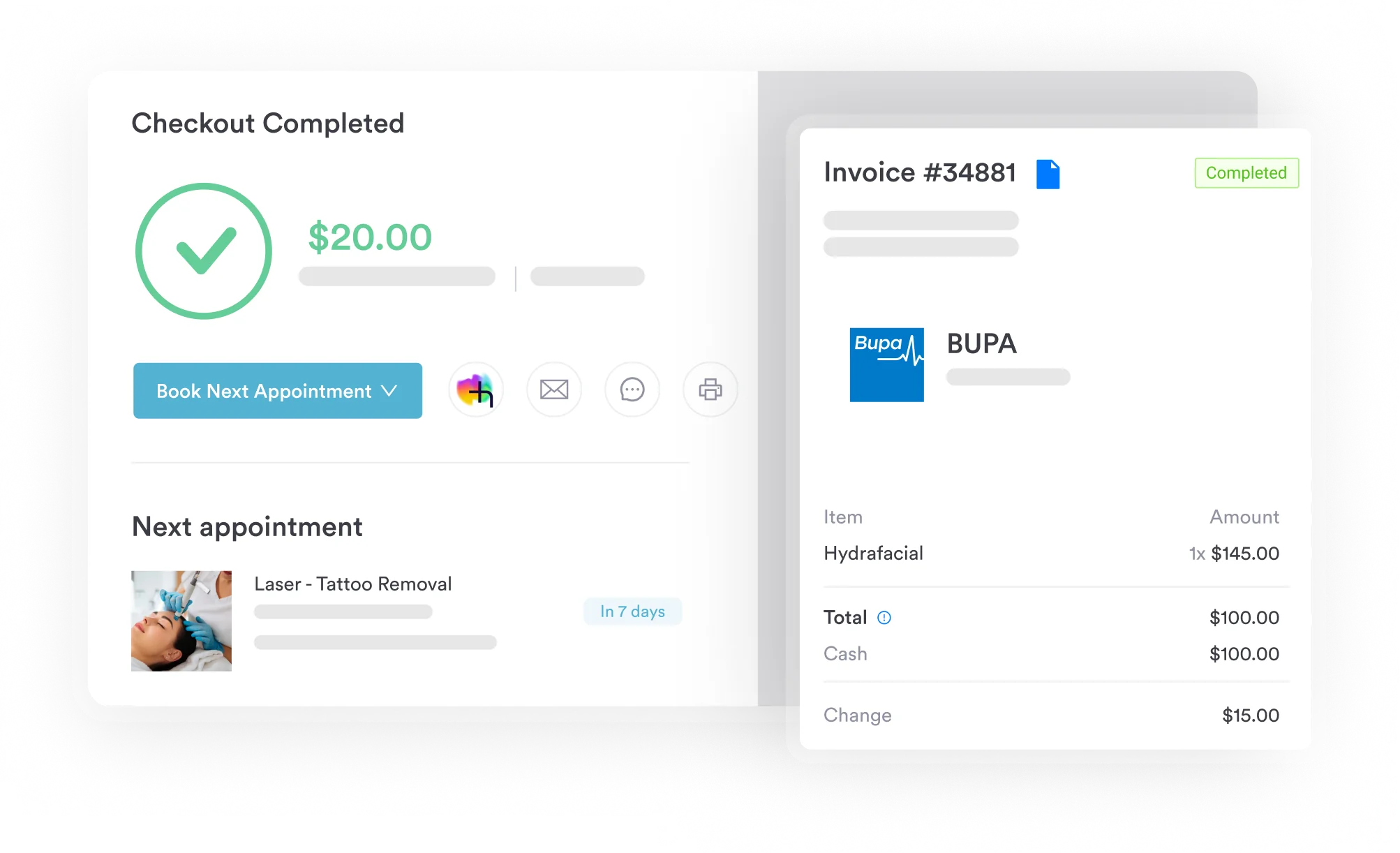

Pabau pre-fills the claim from the clinical record and checks required fields before submission. Claim status and remittances land in the same system, so your team stops rebuilding J0740 claims from scratch.

J0740 rewards a boring, repeatable process. The code itself is simple, and the failures come from the milligrams, the modifier, and the authorization date. Fix that sequence once and the same claim goes out clean every two weeks.
Decide who owns each check, then move it into the infusion visit instead of the billing run. The vial record, the eye exam, and the authorization number are all easier to capture on the day.
Book a demo to see how Pabau keeps that documentation attached to the claim your team submits.

Want every J-code claim submission-ready? Clean claim requirements sets out the payer-agnostic checklist behind first-pass acceptance.
Stuck in repeat denials on high-cost drugs? Denial management in healthcare covers root-cause analysis and the appeal workflow that follows.
Need a prior authorization workflow that holds? The prior authorization process walks through each step, from request to approval and renewal.
Checking coverage before the infusion is booked? Insurance eligibility verification explains what to confirm and when to confirm it.
New to the end-to-end billing process? What is medical billing follows a claim from the encounter through to payment.
A physician office or infusion center bills J0740 on the CMS-1500, or its 837P electronic equivalent. A hospital outpatient department bills the same drug on a UB-04, under the facility’s revenue code. The code and the units do not change. Only the claim form and the payment method do.
The note needs the dose in milligrams, the infusion date, the route, and the NDC of the vial used. Payers also look for the renal labs drawn before the dose and the eye findings behind the diagnosis. Keep the authorization number in the same record.
No. Probenecid is an oral drug the patient takes at home, so Part B does not cover it. Saline hydration given as part of the same infusion is not separately payable either. Both still belong in the note, as evidence the label protocol was followed.
Sometimes, though it takes more work. The FDA label covers CMV retinitis in patients with AIDS, so other indications sit outside it. Payers usually want compendia support, a letter of medical necessity, and prior authorization before the infusion. Expect medical review on the first claim.