CCSD code H4430: Examination of rectum under anaesthetic
CCSD code H4430 pays for the examination alone CCSD code H4430 is the UK private...

Last Updated: Oct 20, 2026
J0348 is the HCPCS Level II code for injection, anidulafungin, 1 mg.
Let Pabau's smart automation suggest the right codes, reduce claim denials, and keep your practice compliant—effortlessly.
Automate repetitive tasks and focus on what matters most—your patients.
Reduce coding errors and ensure compliance with the latest regulations.
Clean claims, fewer denials, and faster reimbursements.
Powerful insights and reporting to help your practice thrive.
HIPAA compliant SOC 2 certified GDPR-compliant Trusted by 4,000+ clinics worldwide

HCPCS code J0348 describes injection, anidulafungin, 1 mg, so each milligram administered equals one billable unit.
A 200 mg candidemia loading dose bills as 200 units, and the 100 mg maintenance dose bills as 100 units.
Esophageal candidiasis uses a 100 mg dose on day one, then 50 mg daily, which is 100 units and then 50 units.
Medicare Part B pays J0348 at ASP+6% in the physician office and the hospital outpatient setting, and the rate changes quarterly.
Practice management software like Pabau records the administration details in the chart, then pulls those values into a pre-filled claim.
HCPCS code J0348 is a Level II HCPCS J-code maintained by the Centers for Medicare and Medicaid Services (CMS). It describes a single 1 mg unit of injectable anidulafungin, the echinocandin antifungal sold as Eraxis. The code applies to Medicare Part B, Medicaid, and most commercial payers when anidulafungin is physician-administered.
Anidulafungin belongs to the echinocandin class of antifungals. It works by inhibiting glucan synthase, an enzyme fungal cells need to build their cell wall. The FDA approved it for adults with candidemia and other forms of invasive Candida infection, including esophageal candidiasis. It is given intravenously in an inpatient or outpatient infusion setting.
Coding J0348 correctly means restricting the claim to an FDA-approved indication. Off-label coverage varies by payer and needs individual review. For comparative pharmacology against the other echinocandins, read the Eraxis prescribing information.
Every J0348 claim needs a supporting ICD-10 diagnosis code that matches the FDA-approved indication. A claim with no valid candidiasis or invasive fungal infection code is one of the fastest routes to a medical-necessity denial. The table below maps the most commonly paired ICD-10-CM codes to the clinical scenario each one describes. Verify currency against the CDC/NCHS ICD-10-CM web tool each fiscal year.
Use the most specific ICD-10 code available. B37.9 raises medical-necessity denial risk because it never documents why IV therapy was chosen over an oral or topical agent. Take the diagnosis from the chart, then confirm the descriptor in the ICD-10-CM code library before the claim is prepared.
The unit rule for J0348 is simple and still gets miscalculated under time pressure. One unit equals one milligram of anidulafungin administered, so the unit count is the milligram total. The dose itself depends on the indication, which is where the 50 mg and 100 mg figures get swapped.
Place J0348 on line 24 of the CMS-1500 for professional claims, with the applicable ICD-10 code in field 21. For UB-04 facility claims, use revenue code 636 for drugs requiring detailed coding and put J0348 in the HCPCS field. Medicaid claims must carry the NDC as a qualifier, and including it on every claim strengthens the audit record.
Pabau’s clinical records hold the dose, route, lot number, and NDC from the point of care. Its software for billing teams then pulls those recorded values into a pre-filled claim, so nobody retypes the unit count. The map below shows where each documented value belongs.
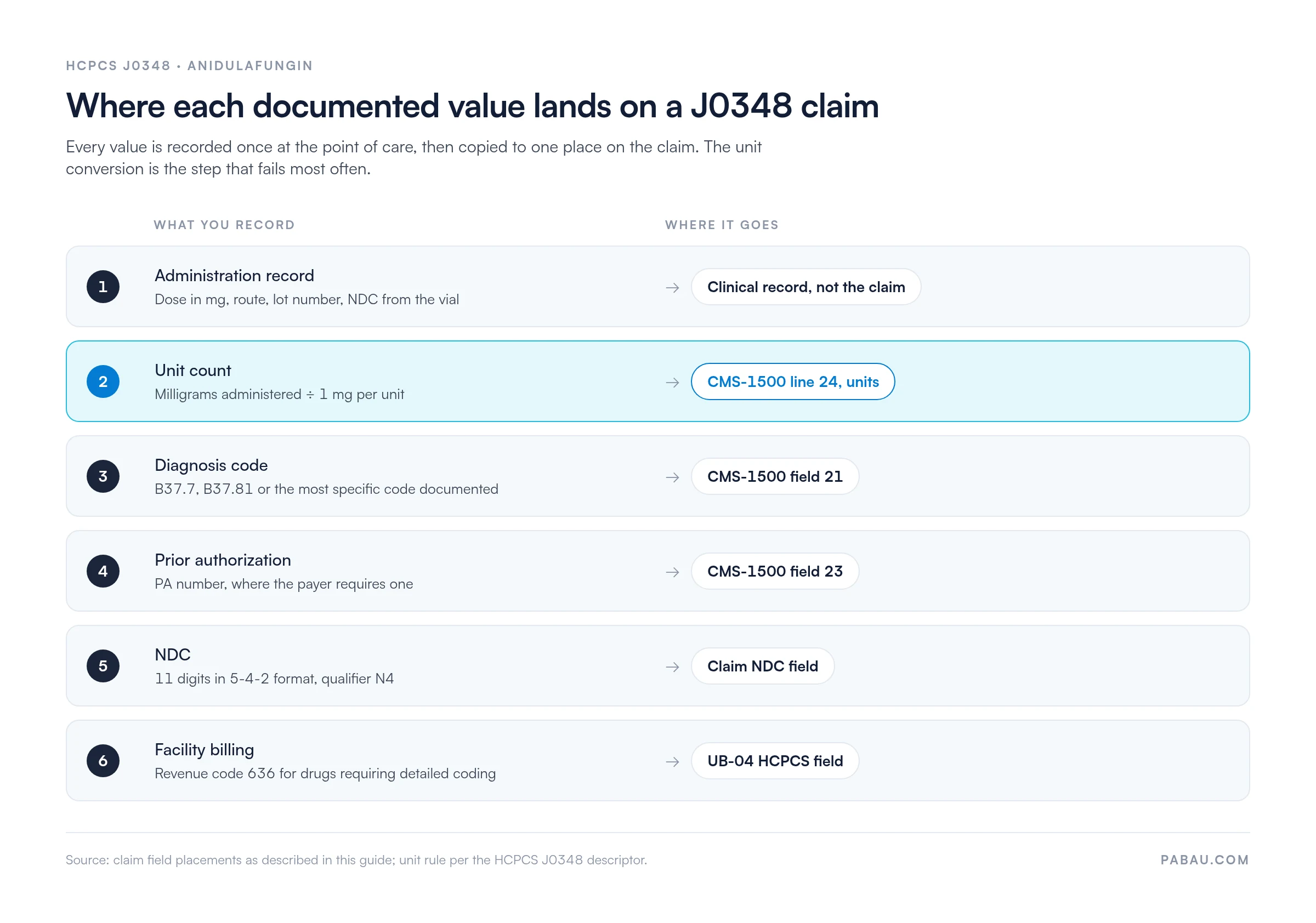
Bill J0348 by the exact milligrams administered, not by vials opened. If a 100 mg vial is used for a 100 mg dose, bill 100 units. If clinical judgment leads to a partial dose, bill only the milligrams actually administered and document the reason.
Medicare Part B pays physician-administered drugs like anidulafungin on the Average Sales Price methodology. The standard formula is ASP+6% in both the physician office and the hospital outpatient setting. CMS updates ASP-based rates every quarter, so any dollar figure has to be pulled for the quarter of administration. The rates live in the CMS ASP drug pricing files.
Because ASP rates move every quarter, never quote a per-unit figure to a patient without pulling the current rate from CMS. Check the rate at the start of each quarter. Then flag any J0348 claim whose expected payment was calculated on the previous quarter’s rate.
State Medicaid programs set their own fee schedules for J0348. Rates vary widely by state and are not tied to the Medicare ASP formula, though many states use it as a reference point. Some states require prior authorization for J0348 in every clinical scenario. Commercial rates are negotiated in provider contracts and may sit above or below Medicare, so verify coverage and contract terms before you buy and bill.
Anidulafungin is a buy-and-bill drug. The practice purchases it, administers it, then bills the payer for reimbursement. The margin between acquisition cost and the ASP+6% rate decides the practice’s position on each claim. That margin only survives precise documentation at every step.
Traditional fee-for-service Medicare Part B does not usually require prior authorization for J0348. Medicare Advantage plans may impose their own PA requirements, and those vary by plan and plan year. Commercial payers frequently require PA for specialty antifungals, particularly high-cost IV agents like anidulafungin.
Verify authorization status with each payer before the drug is administered, not after. A claim submitted without a required PA number is denied on receipt and never reviewed for medical necessity. That makes the denial administrative rather than clinical, and appealing it costs more staff time than the original check would have.
Auditors reviewing J-code drug claims look for one complete administration record. It has to connect the diagnosis to the drug, the drug to the dose, and the dose to the billed units. Any break in that chain is what a post-payment review finds first.
Documenting at the point of care keeps what is billed identical to what was recorded. When the administration record and the claim sit in the same system, the unit count carries over without manual re-entry.
Medicaid programs and many commercial payers require the National Drug Code on J0348 claims. The NDC has to match the product actually administered, not just the HCPCS code. For Eraxis, the NDC is specific to Pfizer’s package configuration. Generic anidulafungin carries different numbers, so confirm that the generic product’s NDC maps to J0348 in the current CMS HCPCS crosswalk files before you bill.
Medicare Part B does not mandate NDC reporting on professional claims, though including it improves audit defensibility. Medicaid requires it under federal drug rebate program rules. Submit it in 11-digit 5-4-2 format with qualifier N4, and verify the current requirement with each state Medicaid program and commercial payer.
Compliance and supply-chain documentation meet at this field. The practice may switch between the brand and a generic during a course of treatment. Each claim’s NDC then has to reflect the product administered on that date of service.
When anidulafungin is unavailable or clinically inappropriate, two other echinocandins carry their own HCPCS J-codes. Billing the wrong code for the administered drug is a claim integrity error and an audit risk. Check the unit definitions as well, because they are not identical across the three codes. A product with no specific code is reported under J3490 with a written description on the claim.
J0348 denials cluster around a predictable set of errors, and a pre-submission checklist prevents most of them. Build the checklist into the billing workflow rather than relying on memory, and first-pass denials fall away.
Build a J0348 pre-submission checklist. Confirm diagnosis code specificity, verify PA status, check NDC format, calculate units from milligrams, and confirm the correct claim form for the setting. Running that five-point check removes most first-pass denials.
In most practices the anidulafungin dose is recorded in one place and billed from another. A nurse writes 200 mg in the infusion note. A biller reads it later, converts it to units, and types the number into the claim. Every one of those hand-offs is a chance for 200 units to become 2.
Pabau closes that distance. The clinical record captures the dose, route, lot number, and NDC while the infusion is happening. The milligram total is stored once, so nobody re-reads it from a vial label. Claims management then pulls those stored values into a pre-filled submission for the biller to review.
The billing team still owns the claim, but it starts from the chart instead of from a transcription. For a practice running repeat courses of anidulafungin, that removes the transfer error behind most J-code unit denials. It also leaves an administration record an auditor can follow.
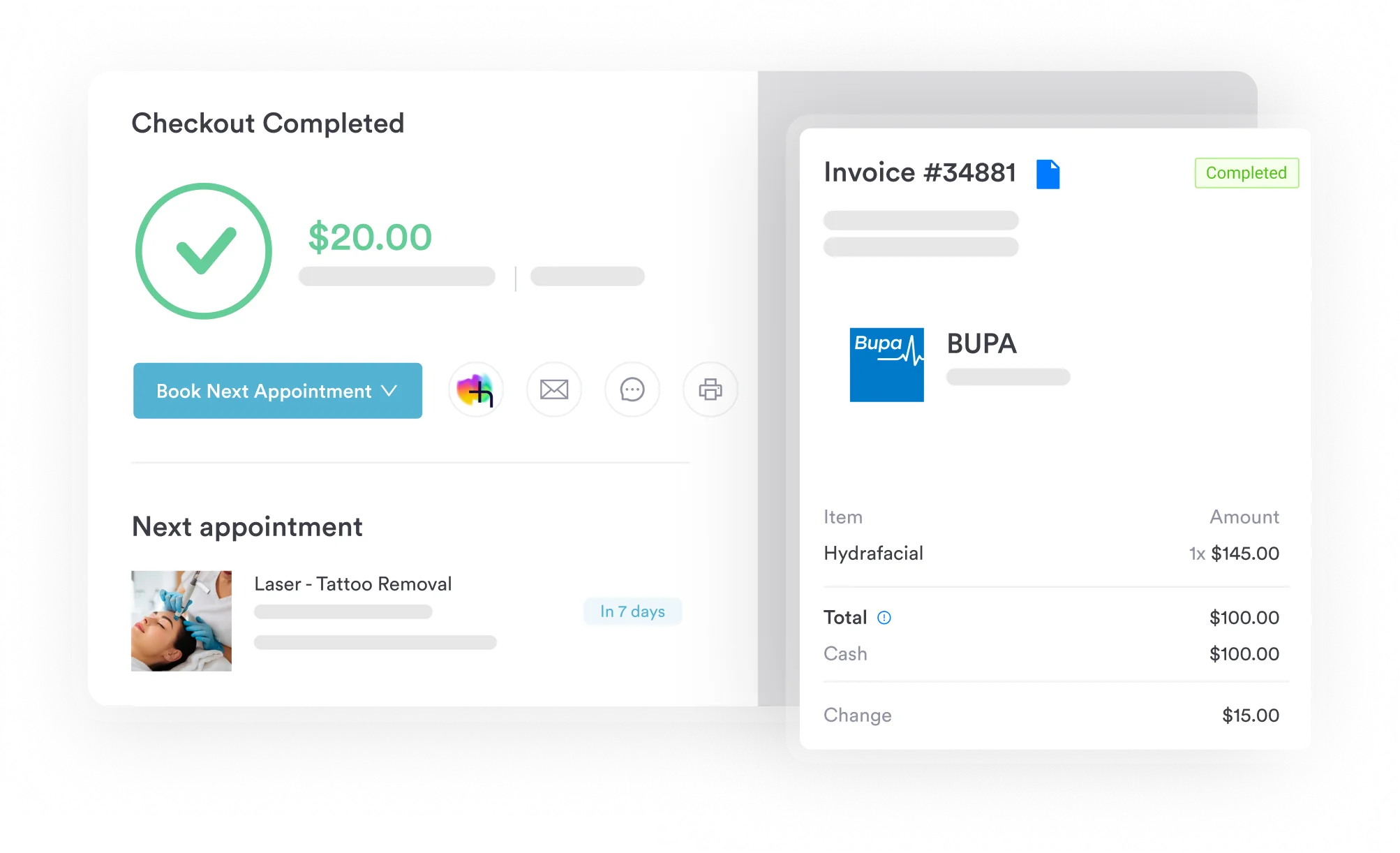

Pabau’s clinical records capture the dose, route, lot number, and NDC at the point of care. Claims management then pulls those recorded values into a pre-filled submission, so the unit count matches the chart.

J0348 rewards a workflow more than it rewards code knowledge. The unit rule takes one sentence to learn. It still fails on claims where the milligram total was read off a vial label instead of the administration record.
So decide where the unit count comes from, write that rule down, and hold it for every course of anidulafungin. Fix the source of the number and the rest of the checklist becomes routine. The diagnosis, the NDC, and the PA number are all in the chart already.
Book a demo to see how Pabau keeps drug administration records and J-code claim units aligned.

Need a framework for managing claim denials systematically? Denial management in healthcare covers the denial workflow stages and how to reduce repeat errors.
Want to know what makes a drug claim pass on first submission? Clean claim requirements sets out the fields payers check before they pay.
Want to understand the full claims submission process? Superbill fundamentals explains how billing data flows from the clinical encounter to the payer.
Billing a drug that has no specific J-code? HCPCS code J3490 explains how to report an unclassified drug without triggering a denial.
Looking for guidance on medical billing compliance for drug claims? Medical billing compliance outlines documentation and audit-readiness requirements for physician-administered drugs.
HCPCS code J0348 is a Level II HCPCS J-code that describes injection, anidulafungin, 1 mg. It is used to bill Medicare Part B, Medicaid, and most commercial payers for this echinocandin antifungal. The drug, sold as Eraxis, is physician-administered in an outpatient or physician office setting. Each 1 mg of drug administered equals one billable unit.
Bill the number of units that equals the milligrams administered. For candidemia and invasive candidiasis, the 200 mg day-one dose is 200 units and the 100 mg daily dose is 100 units. For esophageal candidiasis, the 100 mg day-one dose is 100 units and the 50 mg daily dose is 50 units. Billing one unit for a full vial is the most common denial trigger on this code.
Medicare Part B reimburses J0348 at ASP+6% per unit for both physician office and hospital outpatient settings. Because CMS updates ASP rates quarterly, the specific per-unit dollar amount changes every quarter. Always pull the current rate from the CMS ASP drug pricing file before you bill or quote reimbursement to a patient.
The most commonly paired ICD-10-CM codes are B37.7 (candidal sepsis/candidemia), B37.81 (candidal esophagitis), B37.89 (other candidiasis sites), and B37.1 (pulmonary candidiasis). Use the most specific code available for the documented diagnosis. Avoid B37.9 (unspecified candidiasis) unless no more specific code can be assigned, as it increases medical-necessity denial risk.