HCPCS code V2599: Other type contact lens billing guide
What is HCPCS code V2599? HCPCS code V2599 is the Level II supply code for a con...

Last Updated: Oct 20, 2026
H2026 is the HCPCS Level II code for ongoing support to maintain employment, per diem.
It is a Medicaid code, so traditional Medicare Part B does not pay it and rates are set state by state. Most state plans also expect at least one modifier.
Let Pabau's smart automation suggest the right codes, reduce claim denials, and keep your practice compliant—effortlessly.
Automate repetitive tasks and focus on what matters most—your patients.
Reduce coding errors and ensure compliance with the latest regulations.
Clean claims, fewer denials, and faster reimbursements.
Powerful insights and reporting to help your practice thrive.
HIPAA compliant SOC 2 certified GDPR-compliant Trusted by 4,000+ clinics worldwide

HCPCS Code H2026 describes ongoing support to maintain employment, billed per diem under HCPCS Level II.
One unit equals one calendar day of service, whatever the hours delivered that day.
H2026 is a Medicaid code. Traditional Medicare Part B does not cover it, and rates are set state by state.
H2025 describes the same service in 15-minute units, so the unit your payer accepts decides which code you bill.
Missing modifiers and thin daily service notes are the two most common reasons H2026 claims are denied.
H2026 belongs to the H-series of HCPCS Level II codes. The Centers for Medicare and Medicaid Services (CMS) maintains that series for behavioral health and psychosocial rehabilitation services. The official descriptor is “ongoing support to maintain employment, per diem.”
You can confirm the current code status and effective dates with the AAPC Codify HCPCS lookup, which reflects current CMS data. For the other Level II families a behavioral health biller touches, our HCPCS code reference lists them by series. The letter alone does not predict payment. HCPCS Code G0235 sits in the G-series for temporary procedures, yet Medicare lists it as non-covered.
H2026 covers the day-to-day support an employment specialist provides to help a person with a behavioral health condition keep their job. That typically includes job coaching at the worksite, crisis intervention tied to employment, and communication support with supervisors. Transportation to the job and problem-solving around workplace conflicts also count.
The Individual Placement and Support (IPS) model is the evidence-based framework most often associated with H2026 services. IPS emphasizes rapid job placement followed by ongoing, individualized support. IPS is not a billing requirement under CMS rules. Whether a state Medicaid plan expects alignment with an evidence-based model depends on that state’s managed care contracts.
Each state Medicaid program decides which providers may bill H2026, so qualifications vary. The types most commonly authorized are community mental health centers (CMHCs) and certified behavioral health agencies. State-credentialed supported employment programs and psychosocial rehabilitation providers qualify in many states too. State plans may also let managed care organizations (MCOs) set their own network criteria.
Employment specialists, job coaches, and peer support specialists usually deliver the service. They work under the supervision of a credentialed behavioral health professional.
Agencies operating in more than one state should check enrollment and credentialing separately for each. A credential that satisfies one state plan may not satisfy the next. Whatever system your agency runs on should track credential expiry dates and flag renewals early.
H2026 is a Medicaid code. Traditional Medicare Part B does not cover H-series HCPCS codes, so a patient carrying only Part B has no route to reimbursement for these services. Some Medicare Advantage plans include behavioral health benefits that reach H-codes. Verify that with the specific plan and your Medicare Administrative Contractor (MAC) before billing.
Medicaid coverage is state-plan dependent. Some states cover H2026 through fee-for-service, others route it through managed care contracts, and a few do not cover the code at all. Read your state’s Medicaid provider manual before you submit. Verify payer coverage before each service episode, not only at intake.
Because H2026 sits with Medicaid, there is no single national fee schedule. Each state Medicaid program sets its own rate and updates it periodically, often once a year.
Published analyses have reported roughly $50 to $150 per diem depending on the state, and rates fall outside that band in places. Treat any published figure as illustrative, then confirm the current one from your state fee schedule.
The CMS Physician Fee Schedule lookup does not carry Medicaid H-codes, so it will not price this one. For state-specific rates, contact your state Medicaid agency or check its provider manual. Build those state rates into your billing system so coders apply the correct per-diem figure on every claim.
Modifiers tell the payer how to read the service behind H2026. Many state Medicaid plans and MCOs require one or more, and submitting without the right one is a common denial trigger. The modifiers below are the ones seen most often on H-series behavioral health claims. Applicability varies, so check your state provider manual and each MCO contract before billing.
Modifier rules are payer-specific. One that a state requires may be irrelevant in the next state, or may trigger a rejection there. When your team is unsure, check the state Medicaid behavioral health provider manual or call the MCO’s provider relations line before billing.
Per-diem codes are among the most heavily audited in behavioral health billing, because the record has to support every day billed. A claim for five days of supported employment needs five separate service notes, each describing what happened on that date. Auditors look for the date, the duration, the provider, the service content, and the tie to the employment plan.
Capturing the note digitally at the point of service keeps the record in step with the work. No billed date then reaches the claim run without one. The requirements below are the baseline Medicaid auditors commonly expect. Your state plan or MCO contract may ask for more.
Treat that list as a floor rather than a ceiling. Read your state Medicaid policy and MCO contracts for the complete requirements before you run an internal audit against them.
Build a standing daily note template for H2026 with every required field set as mandatory, so your team cannot skip one. Ask staff to complete the note on the day the service is delivered. Notes written days later draw more scrutiny in a Medicaid audit, even when the content is accurate.
Most H2026 denials trace back to a short list of recurring errors. Spotting the pattern before the denial arrives costs far less than working the appeal. Effective denial management starts with the root cause, before claims leave the building.
A clean H2026 claim means settling all of those variables before it leaves your system. Tracking denial reason codes across a rolling 90-day window shows which errors are systemic and which were one-offs.
The H2023 through H2027 range covers behavioral health supported employment and skills development. Each service in the family exists in two units, and reaching for the wrong twin is the miscode this range produces most often. The grid below maps the service against the unit.
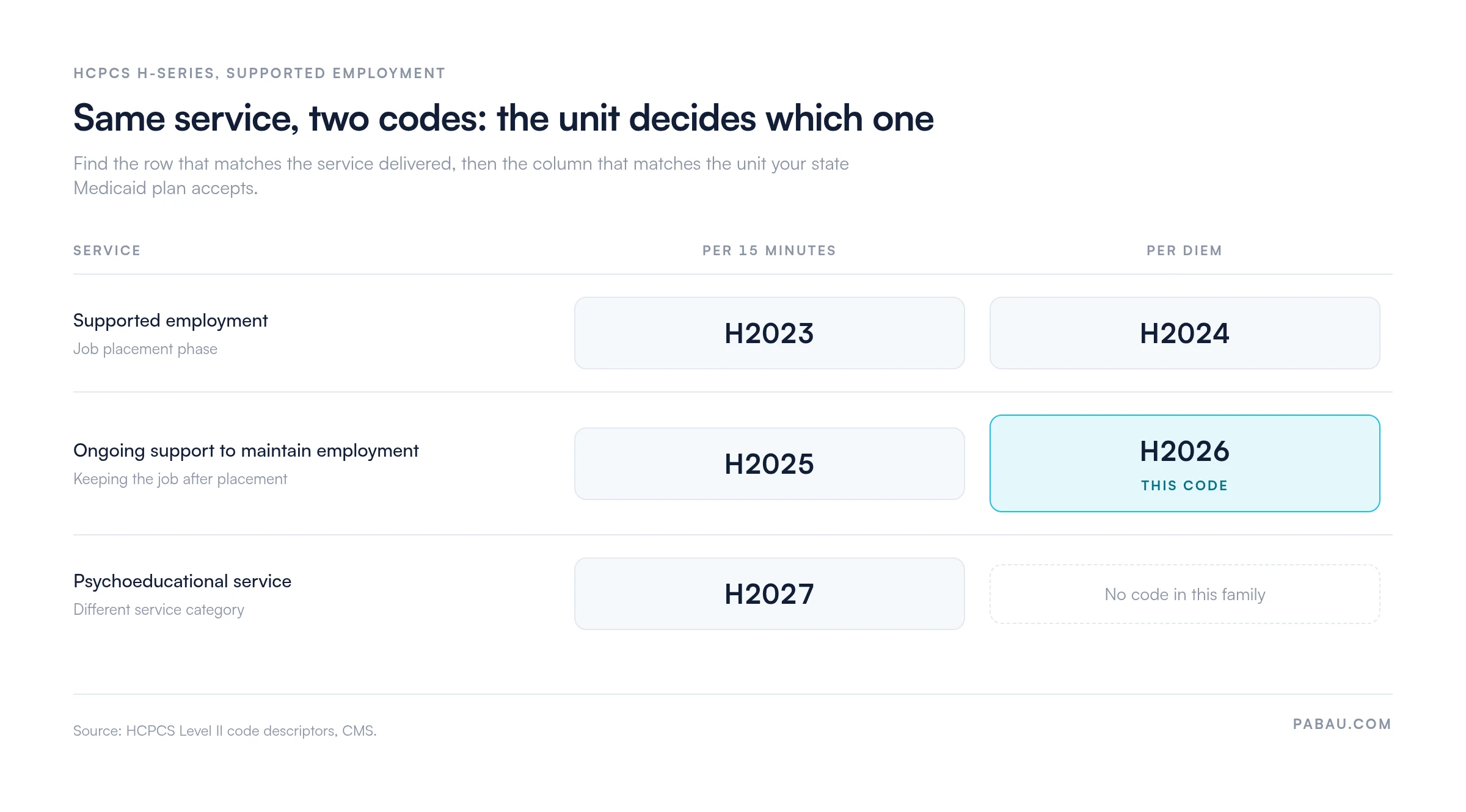
The one distinction that matters between H2025 and HCPCS Code H2026 is the billing unit. Both describe ongoing employment maintenance, but H2025 bills per 15 minutes while H2026 bills per diem. Your state Medicaid plan specifies which unit it accepts. In states that recognize both codes, confirm the preferred unit before you set up billing templates.
The encounter’s charge sheet should map each service type to its correct H-code before the claim is built. That single step catches most of the placement-versus-maintenance mix-ups in this range.
Where your state Medicaid plan covers both H2025 (per 15 minutes) and HCPCS Code H2026 (per diem), compare the two. Run the numbers against a typical week of service for your caseload. Some states pay more per diem for full-day engagement, while others reward the 15-minute unit for shorter daily contacts. Pick the unit that reflects your service model honestly.
Billing H2026 well is a reconciliation job. Your team matches per-diem units to dated service notes and checks modifier accuracy payer by payer. Remittance then has to be followed across Medicaid plans that price the code differently. Past a few dozen clients, that stops working on a spreadsheet.
Practice management software like Pabau links each daily note to the claim line it supports. Missing notes surface before the claim run rather than after the denial. Pabau’s claims management software also flags remittance that lands under the rate you loaded for that state plan. An underpayment gets noticed the week it happens, not at the quarterly review.
Automated workflows route an unfinished note back to the clinician who owns it and hold the claim until it is signed. That takes the chasing off billing staff and brings down days in accounts receivable. Electronic remittance advice flowing straight into the same system makes the rate check automatic rather than a monthly exercise.

Pabau links daily supported employment notes to the H2026 claim line they support, checks modifiers by payer, and tracks remittance against your state rate. Your team catches the problem before the payer does.

Two decisions carry most of the risk on this code. Pick the unit your state plan actually accepts, then make sure a dated note exists behind every day you bill. Get those right and the modifier rules are routine admin.
The trade-off worth remembering is that per diem pays the same whether the specialist spent 20 minutes or five hours with the client. In a caseload built on short daily contacts, the 15-minute code may serve you better. Compare the two against your own week before you commit a billing template to either.
If your team works more H2026 denials than it prevents, the fix sits upstream of the claim. Book a demo to see how Pabau keeps daily notes, modifiers, and remittance in one place.

Want a full breakdown of how claims move through a payer? How a medical claims clearinghouse works explains the submission and adjudication process from start to finish.
Concerned about claim rejections on complex codes? Denial codes in medical billing walks through the most common remittance denial codes and how to resolve them.
Looking to tighten your billing compliance posture? How to get credentialed with insurance companies covers the enrollment steps that must be in place before H2026 claims will process.
Want fewer claims coming back for rework? What makes a clean claim sets out the checks that catch an error while the claim is still yours.
Preparing for a Medicaid audit? Medical billing compliance covers the documentation controls reviewers expect a behavioral health agency to have in place.
HCPCS Code H2026 is a behavioral health HCPCS Level II code that describes “ongoing support to maintain employment, per diem.” It is used by Medicaid-enrolled providers to bill for day-to-day job coaching and employment maintenance. Community mental health centers and supported employment agencies are the typical billers, serving clients with behavioral health conditions.
No. Traditional Medicare Part B does not cover H-series HCPCS codes, including H2026. H-codes are Medicaid-oriented codes. Some Medicare Advantage plans include supplemental behavioral health benefits that reach H2026. Verify coverage with the specific plan and your Medicare Administrative Contractor before billing.
H2026 is billed per diem: one unit equals one calendar day of service, regardless of how many hours of support were provided on that day. Billing multiple units for a single calendar day is an unbundling error and will likely result in denial. If your state Medicaid plan bills this service in 15-minute units instead, use H2025.
Commonly used modifiers include HQ (group setting), HT (multi-disciplinary team), TD (registered nurse), TE (LPN/LVN), and state-assigned U-series modifiers (U1-U9). Modifier requirements vary by state Medicaid plan and MCO. Always verify against your payer’s current provider manual before appending a modifier to H2026.
Each billed date needs its own service note. That note records the date of service, the client’s Medicaid ID, and the provider’s name and credentials. It also describes the support given, the contact time, the location, and the link to the active individualized employment plan. A note written after the fact, or covering several days at once, is a frequent audit finding.