CCSD code H4430: Examination of rectum under anaesthetic
CCSD code H4430 pays for the examination alone CCSD code H4430 is the UK private...

Last Updated: Oct 20, 2026
H0046 is the HCPCS Level II code for mental health services, not otherwise specified.
Let Pabau's smart automation suggest the right codes, reduce claim denials, and keep your practice compliant—effortlessly.
Automate repetitive tasks and focus on what matters most—your patients.
Reduce coding errors and ensure compliance with the latest regulations.
Clean claims, fewer denials, and faster reimbursements.
Powerful insights and reporting to help your practice thrive.
HIPAA compliant SOC 2 certified GDPR-compliant Trusted by 4,000+ clinics worldwide

HCPCS Code H0046 covers mental health services, not otherwise specified. It is the catch-all Level II code used when no more specific behavioral health code applies.
H0046 is billed primarily through Medicaid and state managed care organizations. Medicare generally does not cover it, so verify payer eligibility before submitting.
NOS codes attract higher documentation scrutiny. Every H0046 claim needs a treatment plan, progress notes, and a clear medical necessity justification to survive audit.
Pabau’s claims management software submits and tracks claims and reports denials, so behavioral health practices can see why catch-all codes are rejected.
HCPCS Code H0046 covers mental health services, not otherwise specified. It is a Level II HCPCS code maintained by the Centers for Medicare and Medicaid Services (CMS). It sits in the H-code series, which CMS designates for alcohol and drug abuse treatment.
The same series covers mental health and behavioral health services that fall outside standard CPT coding. H0046 is the code of last resort within it. Bill it only when every more specific H-code has been ruled out, and say so in the note. Alcohol and drug services have their own last-resort code, HCPCS code H0047.
According to CMS’s HCPCS overview, Level II codes are updated annually and are required for HIPAA-covered electronic transactions. Always verify that H0046 is current in the applicable fee year before submitting.
NOS stands for “not otherwise specified.” That label carries a specific billing meaning. Use H0046 only after confirming that no more precise HCPCS code exists for the service rendered. It is not a shortcut for unfamiliar codes or administrative convenience.
Services that may legitimately fall under H0046 include outpatient mental health support activities, case coordination, and psychosocial rehabilitation that lacks a dedicated H-code. A practice billing routine outpatient therapy should use H0004 instead, or a CPT code such as 90837. A full day of assertive community treatment is billed as H0040, so H0046 does not apply.
The sequence below runs those checks in order, from the payer down to the specific codes that displace H0046.
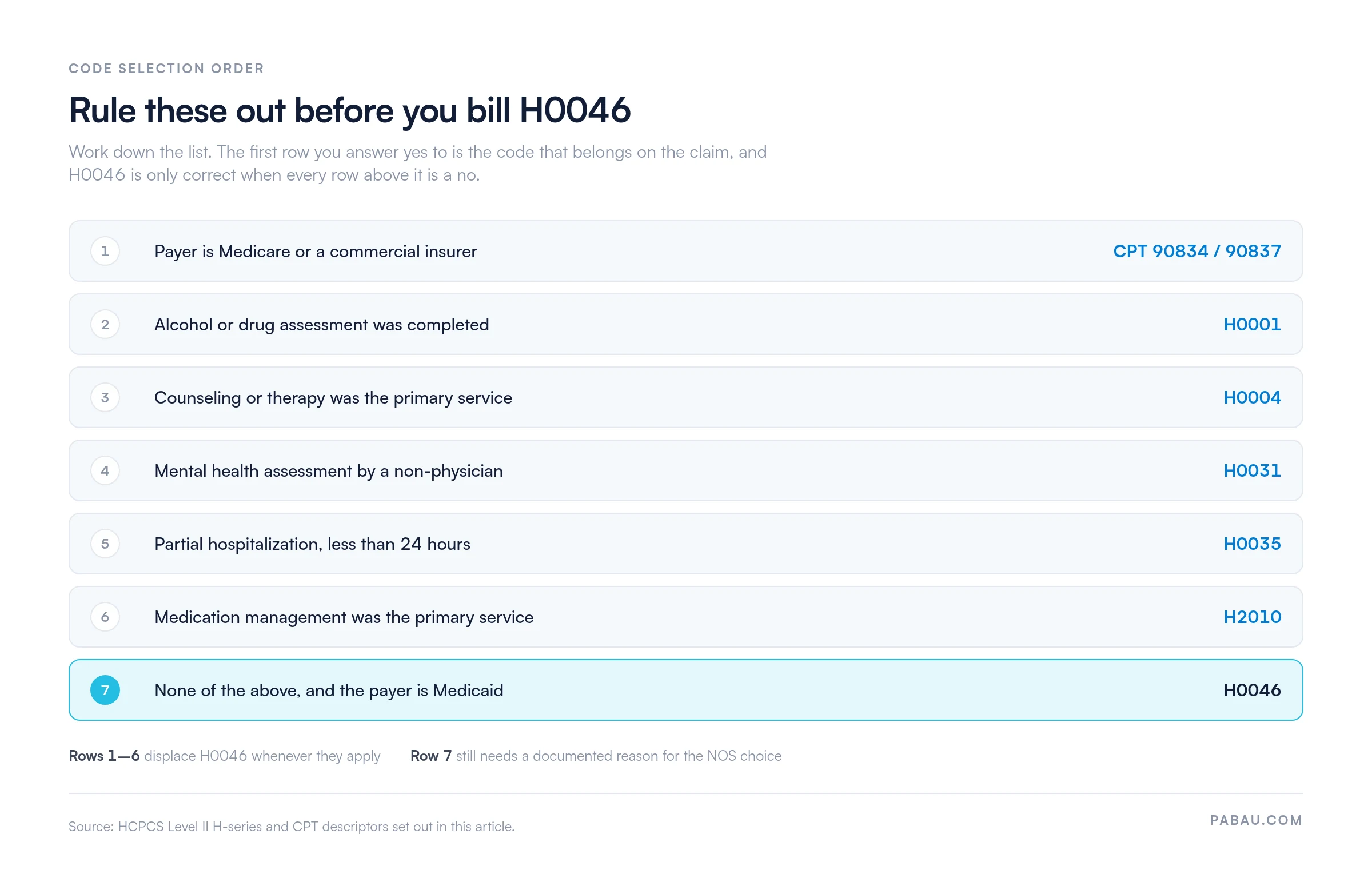
Medicaid is the primary payer for HCPCS Code H0046. Unlike CPT codes billed to commercial insurers or Medicare, H-codes are CMS-designated Level II codes built for Medicaid and other non-Medicare programs. Sort out the fee-for-service question before you submit anything.
Under straight Medicaid FFS, your practice submits claims directly to the state Medicaid agency using a CMS-1500 or electronic 837P transaction. Under managed care, the state contracts with a managed care organization (MCO), and you bill the MCO instead.
Rates, prior authorization requirements, and covered services can differ significantly between the two pathways, even within the same state. Confirm which pathway applies to each patient before the session, not after the denial.
Reimbursement rates for HCPCS Code H0046 vary by state and are updated annually by each state Medicaid agency. There is no single national Medicaid fee schedule for H-codes the way CMS publishes a Physician Fee Schedule for CPT codes. Practitioners must verify rates with their own state Medicaid agency or MCO.
The table below shows illustrative rate ranges based on publicly available state Medicaid fee schedules. These figures are for reference only and may not reflect current rates. H0046 is not priced under the Medicare Physician Fee Schedule. Check your state Medicaid fee schedule or your MCO provider manual for verified figures before you submit.
Every H0046 claim must be paired with an ICD-10 diagnosis code that supports medical necessity. The F-series of ICD-10-CM covers mental and behavioral disorders, and supplies the diagnosis codes most commonly linked to H0046. Payers use the pairing to confirm the service suited the patient’s condition.
Coding teams meet H0046 most often when the diagnosis is documented clearly but no HCPCS service code matches what was delivered. The table below lists the F-series codes paired with it most often.
Coders should select the most specific ICD-10 code available. Pairing H0046 with an unspecified diagnosis such as F99 creates a dual-unspecified claim, which most Medicaid payers flag for review.
Modifiers clarify service circumstances that affect reimbursement or coverage. Modifier requirements for H0046 vary by state Medicaid policy and MCO contract. The modifiers below appear regularly in behavioral health billing guidance, but verify requirements with your payer before using them.
NOS codes attract heightened payer scrutiny. The “not otherwise specified” label signals that the provider could not match the service to a more precise code. Auditors then ask two questions. Was the service clinically necessary, and was the correct code used?
Strong documentation answers both. Digital clinical documentation forms lower the risk of incomplete records by building the required fields into the clinical workflow. Every H0046 claim should be supported by the records below.
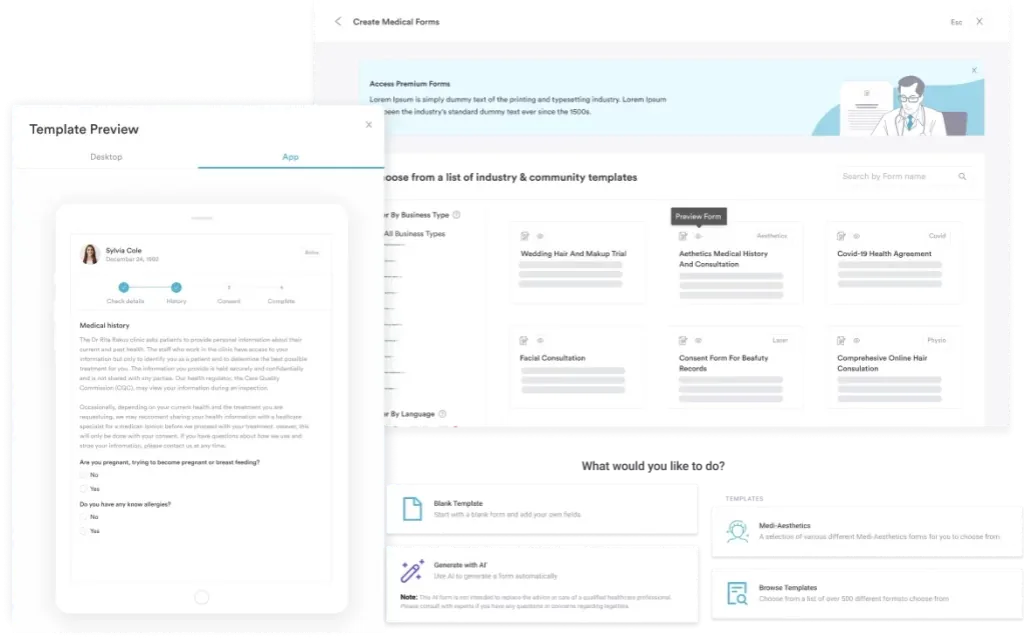
Run a documentation audit on your H0046 claims before submitting. Pull five recent claims and check each one against this checklist. If any claim is missing the code selection rationale or a current treatment plan, revise the documentation before submission. Payers pull H0046 for post-payment review more frequently than specific-code claims.
H0046 claims fail for predictable reasons, and each denial type points to a step the practice can tighten. Good denial management workflows start with understanding why claims reject before they ever leave the practice.
Before billing HCPCS Code H0046, coders should scan the broader H-series for a more precise match. The table below covers the codes most frequently reviewed alongside H0046 in behavioral health practices.
Our HCPCS billing guides break each of these codes down in the same format, so you can confirm a descriptor before switching. Refer to the AAPC HCPCS Level II code lookup for complete coverage details.
Behavioral health practices that accept both Medicaid and commercial insurance have to decide which code set covers the same clinical service. Which set applies is a payer question, not a clinical one.
HCPCS Level II codes like H0046 are built for Medicaid and state payers. CPT codes are the standard for Medicare, commercial insurers, and many private-pay workflows. Submitting H0046 to a commercial payer that expects a CPT code will typically result in a denial. The divide runs by code family, not by code set: Medicare pays G-codes like HCPCS Code G0179, while H-codes stay with Medicaid.
Behavioral health practices billing H0046 face a documentation-heavy workflow. Every claim needs a treatment plan, a progress note, a medical necessity justification, and often a modifier. Doing that by hand across a full caseload is where errors accumulate.
Practice management software like Pabau keeps clinical records and billing in one system. Its claims management software submits claims through a clearinghouse and tracks what happens to each one. The note and the claim stay in the same place.
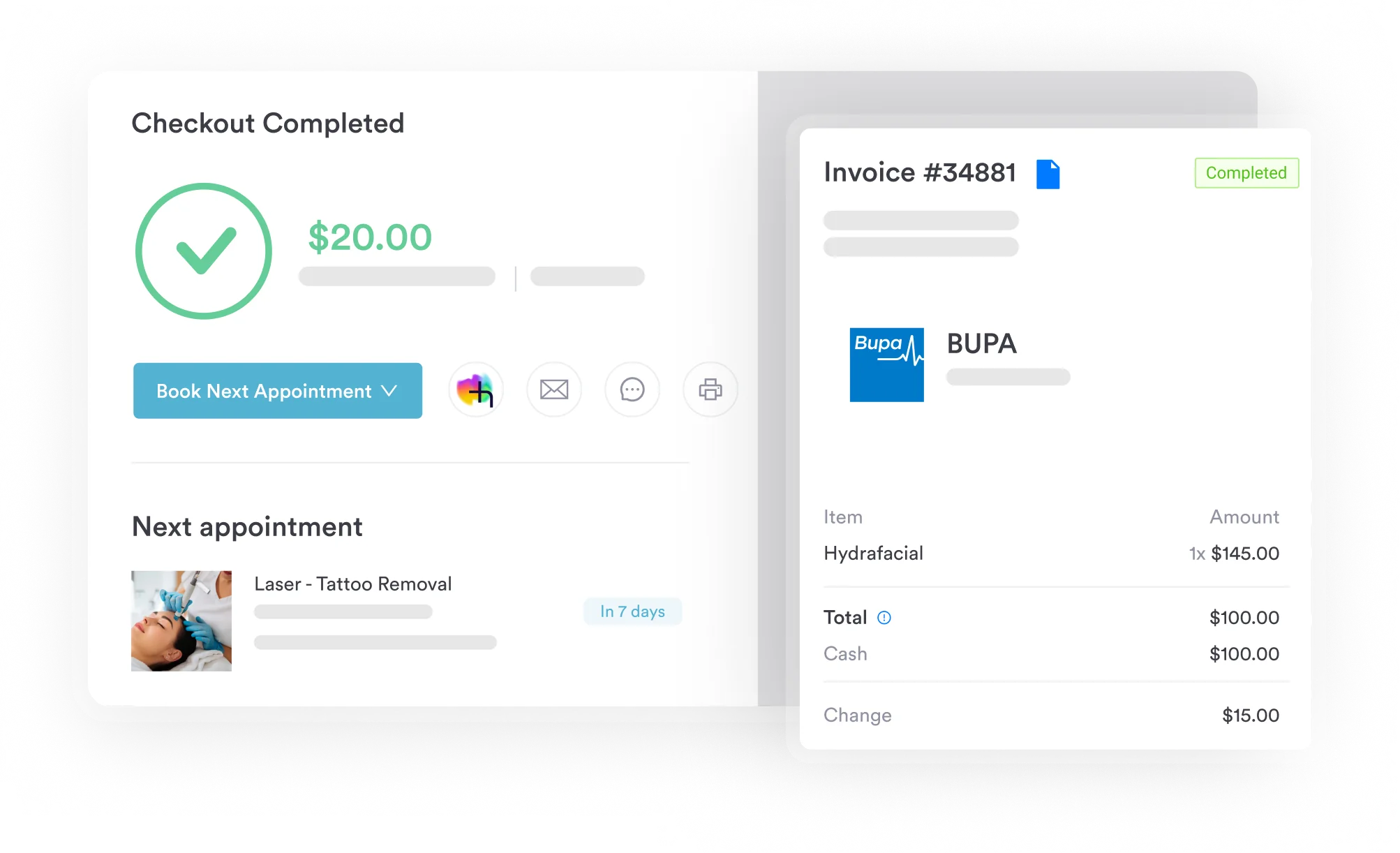
Configurable note templates capture the documentation an NOS code needs, so the code selection rationale is never left to memory. Claim tracking and denial reporting then surface the pattern behind rejections.
Billing teams can see whether H0046 is being denied for thin documentation, wrong payer submissions, or a missing modifier. Fixing the cause beats appealing claim by claim. An H0046 claim that ships complete stands a better chance of paying on the first pass.

Pabau keeps clinical documentation templates and claim submission in the same system, so H0046 claims leave the practice with their supporting notes attached. See how it works for behavioral health practices.

HCPCS Code H0046 has a job in behavioral health billing, but its catch-all nature makes it one of the most documentation-intensive codes in the H-series. Practices that get it right treat H0046 as the last option rather than the easy one.
They choose it only when no specific H-code fits. They pair it with the most precise ICD-10 diagnosis available, and back every claim with a complete documentation set. The cost of that discipline is a few extra fields at the point of care. The alternative is a post-payment review.
Pabau ties documentation and claim submission together, so billing teams have what they need to defend an H0046 claim. To see how that works for a behavioral health caseload, book a demo.

Was the session counseling rather than a catch-all service? HCPCS Code H0004 sets out the per-15-minute rules that displace H0046 on a therapy claim.
Billing an assessment instead of a support service? HCPCS Code H0031 covers mental health assessment by a non-physician, including who may perform it.
Patient in a day program? HCPCS Code H0035 explains how partial hospitalization under 24 hours is billed and documented.
Need to read the rejection on the remittance? Denial codes in medical billing decodes the reason codes payers return on behavioral health claims.
Unsure where coding sits in the wider billing cycle? What is revenue cycle management explains the lifecycle from documentation to payment reconciliation.
H0046 is a HCPCS Level II code used to bill mental health services that do not fit any more specific behavioral health HCPCS code. It is a catch-all NOS (not otherwise specified) code used primarily with Medicaid and state-managed care payers. It applies only when no precise H-series code fits the service rendered.
Medicare generally does not cover HCPCS H-codes, including H0046. Medicare uses CPT codes for mental health services. If your patient has Medicare coverage, bill CPT codes such as 90834 or 90837 for psychotherapy services, not H0046. Verify coverage with CMS before assuming Medicare will process an H-code claim.
Commonly used modifiers include HN (bachelor’s level), HM (less than bachelor’s level), HO (master’s level), and GT or 95 for telehealth delivery. Modifier requirements vary by state Medicaid program and managed care contract. Always check your state’s Medicaid billing manual before adding a modifier to an H0046 claim.
H0046 is denied most often because a more specific HCPCS code was available for the service. Thin documentation that does not support medical necessity is the next most common cause. Claims also reject when the payer does not cover H-codes, such as Medicare or most commercial insurers, or when a required modifier is missing. Reviewing each denial reason and correcting the underlying process reduces repeat denials.
The unit of service for H0046 varies by state Medicaid policy. Some states reimburse per visit; others use per 15-minute units. Check your state Medicaid fee schedule or MCO provider manual to confirm the unit type and maximum units allowed per session before billing.
H0046 is typically paired with F-series ICD-10-CM diagnosis codes for mental and behavioral disorders. Common pairings include F32.9 (major depressive disorder, unspecified), F41.9 (anxiety disorder, unspecified), and F43.10 (PTSD, unspecified). Select the most specific ICD-10 code that reflects the patient’s confirmed diagnosis to support medical necessity.