

HCPCS code E0198: Water pressure pad billing guide
HCPCS code E0198 is a water pad for a standard mattress HCPCS code E0198 is the ...

Last Updated: Oct 13, 2026
G2083 is the HCPCS Level II code for office or other outpatient visit for the evaluation and management of an established patient that requires the supervision of a physician or other qualified health care professional and provision of greater than 56 mg esketamine nasal self-administration, includes 2 hours post-administration observation.
Let Pabau's smart automation suggest the right codes, reduce claim denials, and keep your practice compliant—effortlessly.
Automate repetitive tasks and focus on what matters most—your patients.
Reduce coding errors and ensure compliance with the latest regulations.
Clean claims, fewer denials, and faster reimbursements.
Powerful insights and reporting to help your practice thrive.
HIPAA compliant SOC 2 certified GDPR-compliant Trusted by 4,000+ clinics worldwide

HCPCS Code G2083 covers an outpatient esketamine (Spravato) session for established patients requiring greater than 56 mg nasal self-administration, bundled with 2-hour post-administration observation.
G2083 is billed per session; the provider must both supervise the self-administration AND supply the drug to report this code.
G2083 differs from G2082 by dose threshold: G2082 covers up to 56 mg, G2083 covers greater than 56 mg per session.
Effective January 1, 2026, J0013 replaced S0013 as the permanent HCPCS drug code for esketamine for Medicaid and commercial payers outside Medicare.
Pabau’s claims management software helps psychiatry and mental health practices track bundled service codes, REMS documentation, and per-session billing for Spravato workflows.
HCPCS Code G2083 is a Level II G-code established and maintained by the Centers for Medicare and Medicaid Services (CMS). The full descriptor – often searched as the G2083 CPT code description – reads: “Office or other outpatient visit for the evaluation and management of an established patient that requires the supervision of a physician or other qualified health care professional and provision of greater than 56 mg esketamine nasal self-administration, includes 2 hours post-administration observation.”
Several elements of that descriptor carry hard billing consequences:
Spravato (esketamine) carries FDA approval for treatment-resistant depression (TRD) in adults and for major depressive disorder with acute suicidal ideation or behavior (MDSI). Both indications are relevant to code selection and ICD-10 pairing. Strong mental health EMR workflows keep these indication records accessible at billing time.
These two codes are structurally identical except for the dose threshold. Understanding the split is fundamental to avoiding under-coding or over-coding either session type.
In clinical practice, the 56 mg dose applies to titration sessions and some induction sessions. The 84 mg dose (greater than 56 mg) is the standard maintenance dose for most patients, making G2083 the more commonly reported of the two codes once treatment is underway. CMS set the relative values for both codes using a building block methodology that sums the values associated with the component services, per CMS Manual System Transmittal R10505CP.
Neither code should be billed alongside a separate E/M code for the same encounter. The G-code already bundles that component. Billing both on the same date of service is a common audit trigger. See related outpatient procedure coding guidance for how bundled codes interact with standard E/M workflows.
Track which dose each patient receives at each session in your clinical record before billing. Many practices don’t consistently document the administered mg, which creates ambiguity when the claim is reviewed. A structured note that confirms dose administered, time of self-administration, and 2-hour observation window close time gives you everything needed to defend G2082 vs G2083 selection under audit.
Spravato is dispensed and administered under a mandatory FDA Risk Evaluation and Mitigation Strategy (REMS) program. That program does not just govern clinical safety – it directly shapes what your documentation must contain for billing to hold up. A claim for G2083 without REMS-compliant records is vulnerable at audit.
Required documentation elements for each G2083 session:
Consistent, structured documentation protects against both claim denials and retrospective audits. Staying current on HIPAA compliance documentation standards also matters for these records, given the sensitive psychiatric context.
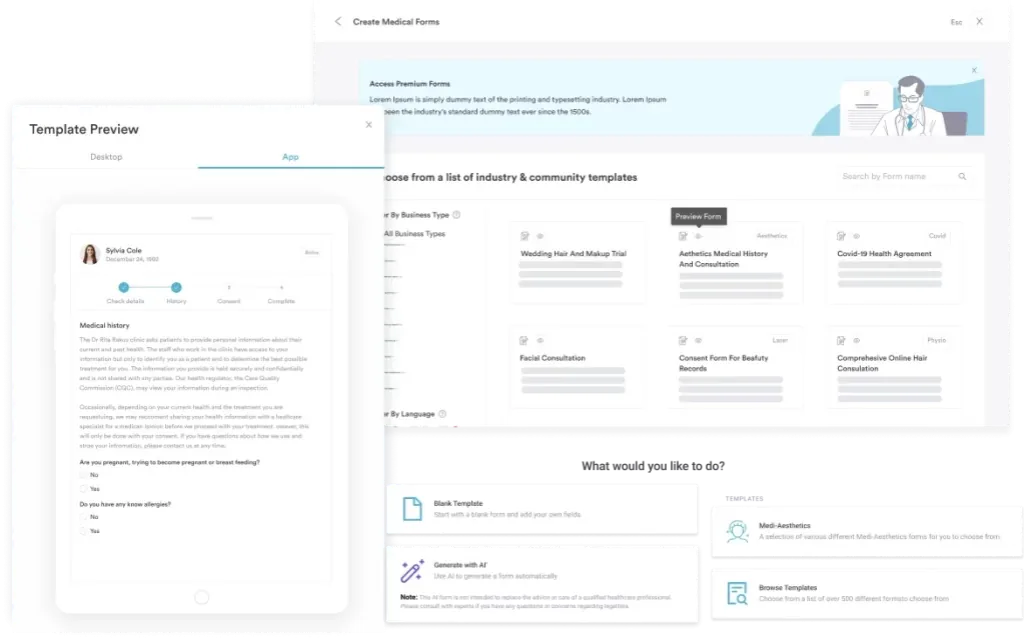

Pabau helps psychiatry and mental health practices document G2083 sessions accurately, track REMS-required fields, and submit claims without the manual rework. See how it fits your workflow.

CMS Article A59249 provides a single unified Group 1 list of 12 ICD-10-CM codes that support medical necessity for both G2082 and G2083. CMS does not split this list by FDA indication (TRD vs. MDSI) — all 12 codes apply to both codes. Submitting G2083 with an ICD-10 code outside this approved list is a common denial reason. Any adjunct neurological workup a treatment-resistant patient undergoes.
* F32.5 and F33.42 (full remission codes) are only appropriate during the maintenance phase of treatment. Note that CMS Article A59249 was retired effective December 18, 2025. Providers should confirm the current approved ICD-10 code list directly with their Medicare Administrative Contractor (MAC) and refer to the FDA label for current coverage guidance. The AAPC Codify HCPCS lookup also provides crosswalk information between G2083 and supporting diagnosis codes. For other anxiety-related diagnostic coding in your mental health practice.
Audit your G2083 claims quarterly for ICD-10 mismatches. The most common error is using a diagnosis code that reflects depression in remission without the suicidal ideation specifier when billing for the MDSI indication. A simple query in your billing system against the CMS A59249 approved code list will surface claims at risk before a payer audit does.
G2083 reimburses at a higher rate than G2082 because of the greater dose and the correspondingly higher drug cost component bundled into the session. According to billing data cited for 2026, the Medicare reimbursement rate for G2083 averages approximately $1,356.08 nationally. Commercial payer rates average around $1,240 for the same session, though rates vary by contract. Verify current figures using the CMS Physician Fee Schedule lookup tool, which allows you to search by HCPCS code and geographic locality.
Several factors affect the actual G2083 reimbursement rate you receive:
Efficient claims management software surfaces these per-session reimbursement discrepancies before they become write-offs, giving billing teams visibility across payer mix for a high-cost bundled session like G2083.
G2083 bundles the professional service, supervision, and observation components. The drug itself (the esketamine nasal spray cartridges) is billed separately in certain scenarios – particularly when a pharmacy supplies the drug rather than the provider dispensing it directly.
Effective January 1, 2026, J0013 became the permanent HCPCS Level II drug code for esketamine nasal spray, replacing the temporary S0013 code. J0013 is billed in 1 mg increments and applies to Medicaid and commercial non-Medicare payers. An 84 mg session would be reported as 84 units of J0013.
For Medicare, the drug component is already bundled into G2082 and G2083 – J0013 is not separately billed on Medicare claims alongside these G-codes. Practices that previously used S0013 for Medicaid or commercial claims needed to transition to J0013 at the start of 2026. Payers that still accept S0013 after the effective date are handling it on a transitional basis; confirm directly with each payer if you are still seeing S0013 accepted.
When a pharmacy supplies the Spravato and bills for the drug separately, the provider cannot report G2082 or G2083 for the same session. The pharmacy bills the drug under J0013 (or S0013 pre-2026); the provider bills only for the supervision and observation using alternative codes. This split arrangement requires careful coordination between the dispensing pharmacy and the administering practice to avoid duplicate billing.
The prescription management workflow in your practice system should flag which sessions involve pharmacy-supplied drug versus provider-supplied drug before billing runs.

Coverage policies for G2083 are not uniform across payers. Understanding each payer’s requirements before billing reduces denials and avoids retroactive audits.
Medicare coverage follows CMS Article A59249 for ICD-10 pairing and the standard HCPCS descriptor requirements. CMS uses the building block methodology (Transmittal R10505CP) to set G2082 and G2083 values. Prior authorization requirements vary by Medicare Advantage plan – commercial MA plans may impose additional PA requirements beyond original Medicare.
TRICARE follows CMS billing guidelines for Spravato, using HCPCS codes G2082 and G2083 rather than E/M codes, per TRICARE provider guidance. Providers billing TRICARE should confirm enrollment in the REMS program and align documentation with CMS standards. Do not substitute E/M codes for the G-codes on TRICARE claims.
Highmark’s Reimbursement Policy Bulletin RP-083 specifies that professional providers use G2082 or G2083 for Spravato claims, consistent with CMS guidance. Anthem’s coding tips for Spravato similarly align professional claims to these G-codes. Both payers have published provider-facing documentation on split-billing rules when a pharmacy supplies the drug. Review the current policy bulletins for each payer in your network, as prior authorization requirements and step therapy criteria (requiring prior antidepressant trials) vary. Organized compliance management within your practice system helps track payer-specific authorization status across a Spravato patient panel.
G2083 billing errors cluster around three points: the dose threshold (reporting G2082 when the dose exceeded 56 mg), missing REMS documentation, and ICD-10 codes outside the A59249 approved list. Getting these right is straightforward once the documentation workflow enforces them at the point of care rather than at claim submission.
Pabau’s claims management tools help mental health and psychiatry practices structure G2083 session documentation, flag required fields before billing, and track per-session reimbursement across payers. To see how Pabau supports Spravato billing workflows, book a demo.

Wondering if bulk billing pays enough? 2026 bulk billing incentive changes covers the incentive amounts by location tier and the private fee needed to beat bulk billing.
Choosing a Claim.MD pricing plan? Claim.MD pricing guide compares the three monthly plans and the claim volume where each one pays off.
Coding situational anxiety without a dedicated code? Situational anxiety ICD-10 code guide explains why no single code exists and how to select the closest match.
G2083 bills an outpatient esketamine (Spravato) session for an established patient where the dose exceeds 56 mg, bundling the E/M component, supervision, and mandatory 2-hour post-administration observation into a single per-session code. It applies only when the supervising provider also supplies the drug.
G2083 is an HCPCS Level II code rather than a true CPT code, though billers often search it that way. Its official descriptor is an office or other outpatient evaluation and management visit for an established patient that requires provider supervision and provision of greater than 56 mg esketamine nasal self-administration, including 2 hours of post-administration observation.
G2082 covers sessions up to 56 mg; G2083 covers sessions greater than 56 mg. Both bundle the E/M service, supervision, and 2-hour observation for established patients. G2083 is used for the standard 84 mg maintenance dose; G2082 for 56 mg titration or induction sessions.
Medicare reimbursement averages approximately $1,356.08 nationally in 2026. Actual payment varies by geographic locality and place of service — use the CMS Physician Fee Schedule lookup tool for locality-specific figures.
No. G2083 already bundles the E/M component. Billing a separate E/M code on the same date of service constitutes duplicate billing and is a common denial trigger.
CMS Article A59249 listed 12 approved ICD-10-CM codes, all within the F32 and F33 major depressive disorder ranges: F32.0, F32.1, F32.2, F32.4, F32.5, F32.89, F33.0, F33.1, F33.2, F33.41, F33.42, and F33.8. F32.5 and F33.42 (full remission) are only appropriate during the maintenance phase. Note that A59249 was retired effective December 18, 2025 — providers should confirm the current approved list with their MAC and refer to the FDA label for up-to-date coverage guidance. Codes outside the approved list will result in denial.
J0013 became the permanent HCPCS drug code for esketamine effective January 1, 2026, replacing the temporary S0013. Medicaid and commercial non-Medicare payers use J0013 when the drug is billed separately. Medicare bundles the drug into G2082/G2083, so J0013 doesn’t appear on Medicare claims.
Not exclusively. G2082 and G2083 are required for Medicare beneficiaries, but non-Medicare payers are not obligated to accept them. Many commercial and Medicaid plans instead accept an evaluation and management code plus J0013 for the esketamine drug itself. Confirm each payer’s preferred billing path before you submit the claim.



