CCSD code H4430: Examination of rectum under anaesthetic
CCSD code H4430 pays for the examination alone CCSD code H4430 is the UK private...

Last Updated: Oct 20, 2026
G0154 is the HCPCS Level II code for direct skilled nursing services of a licensed nurse (lpn or rn) in the home health or hospice setting, each 15 minutes. CMS terminated it with effect from 29 February 2016, so it is no longer valid for claims after that date.
HCPCS code G0154 covered direct skilled nursing services by a licensed nurse in the home health or hospice setting. Either an LPN or an RN could deliver the service, and each unit covered 15 minutes. The code has been deleted since January 1, 2016, so a claim that still carries it comes back denied.
Billers still meet G0154 in archived records, legacy chargemasters, and payer correspondence. Four active codes took its place, and they divide by service type rather than by care setting. That distinction is where wrong-pair denials come from, and this reference works through it. The rules below apply to Medicare-certified home health agencies and hospices.
Let Pabau's smart automation suggest the right codes, reduce claim denials, and keep your practice compliant—effortlessly.
Automate repetitive tasks and focus on what matters most—your patients.
Reduce coding errors and ensure compliance with the latest regulations.
Clean claims, fewer denials, and faster reimbursements.
Powerful insights and reporting to help your practice thrive.
HIPAA compliant SOC 2 certified GDPR-compliant Trusted by 4,000+ clinics worldwide

HCPCS code G0154 covered direct skilled nursing by an LPN or RN in the home health or hospice setting, billed each 15 minutes.
G0154 is deleted. It stopped being valid on January 1, 2016, and any claim carrying it now comes back denied.
Its replacements split by service type, not by setting. G0299 and G0300 cover direct skilled nursing, and G0493 and G0494 cover observation and assessment.
All four codes cover home health or hospice, and all four bill in 15-minute units. None of them is setting-exclusive or paid per visit.
The nurse’s credential decides the code within each pair. G0299 and G0493 are the RN codes, G0300 and G0494 the LPN codes.
G0154 was an HCPCS Level II G-code maintained by the Centers for Medicare and Medicaid Services (CMS). It described direct skilled nursing services delivered by a licensed nurse, either an LPN or an RN, in the home health or hospice setting. Each unit covered 15 minutes of that service.
G0154 sat in the G-code series, which CMS uses for services the CPT system does not describe. Each home health and hospice discipline has its own G-code, so nursing, therapy, social work, and aide visits report separately on the same claim. CMS updates the HCPCS Level II code set every year, adding, revising, and deleting codes as service definitions change.
No. G0154 is deleted and has been invalid since January 1, 2016. CMS retired it for home health episodes ending on or after that date, and for hospice dates of service on or after it.
A claim submitted with G0154 today returns as an invalid or inactive code, whatever the date of service. Correcting it means resubmitting with the active code the visit supports.
A G0154 reference in an old record is not itself a problem. A G0154 reference in a live fee schedule, charge screen, or billing template is. Audit those three places first, because they are what puts the dead code back on a claim.
Two codes replaced G0154 directly, both effective January 1, 2016. G0299 covers a registered nurse, and G0300 covers a licensed practical nurse. Two more codes, G0493 and G0494, arrived a year later on January 1, 2017. Those two replaced a different deleted code, G0163, which covered skilled observation and assessment.
Published crosswalk sheets often describe G0299 and G0300 as the home health codes, and G0493 and G0494 as the hospice codes. That split does not exist. Read the four long descriptors and each one places the service in the home health or hospice setting, each 15 minutes.
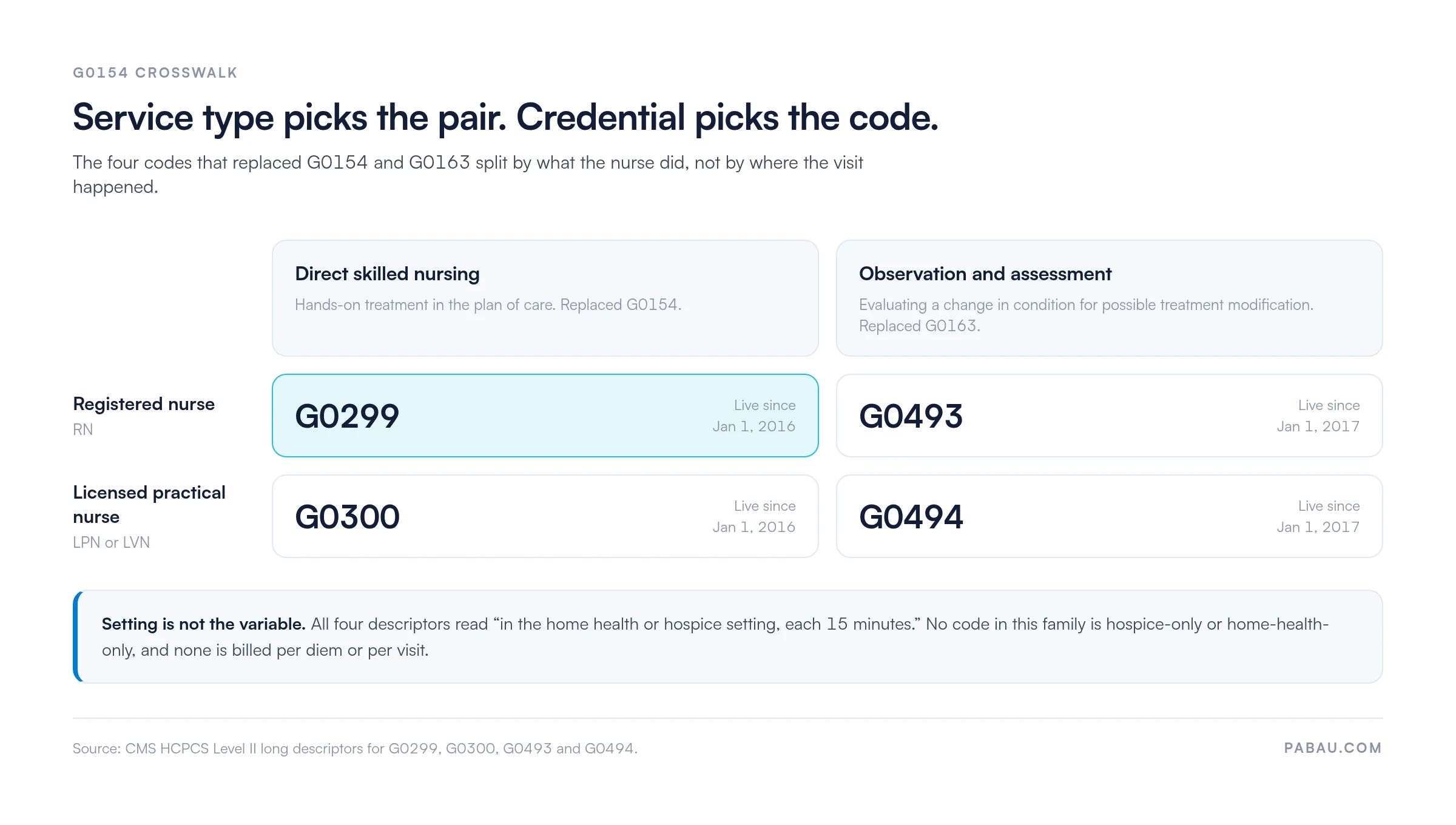
The two pairs run in parallel. They are not stages of one transition, and neither pair retires the other. CMS split the same nursing work along two axes at once. One axis is what the nurse did, and the other is who did it.
The same 2017 update added a third service type, patient and family training. It is G0495 for an RN and G0496 for an LPN. You can read the full descriptor for any of them in the AAPC HCPCS code reference.
Start with what the nurse did on the visit, because that picks the pair. Direct skilled nursing is hands-on treatment carried out under the plan of care, such as wound care, an injection, catheter care, or medication administration.
Observation and assessment is different work. The patient’s condition changed, and skilled nursing judgment was needed to evaluate whether the treatment plan should change with it.
The setting column repeats on purpose. A hospice RN visit for wound care bills G0299, not G0493, because the service was direct nursing. A home health RN visit to assess new shortness of breath bills G0493, not G0299, for the same reason in reverse.
Agencies running both lines of business often carry a billing rule built on the setting split. That rule takes correct visits and sends them to the wrong code.
One visit can hold both service types. When it does, split the documented time and report units against each code separately, on the strength of what the note supports. Reporting the whole visit under one code because it is faster to enter is how a clean visit becomes a wrong claim line.
Observation and assessment is not the routine assessment inside every nursing visit. G0493 and G0494 need a documented change in the patient’s condition, plus the nurse’s evaluation of whether treatment should be modified. Without both, the visit is direct skilled nursing and bills as G0299 or G0300.
Credential and provider enrollment decide eligibility, and both get checked at the claim line. The rules below apply to all four replacement codes:
None of these rules turns on the code pair. An LPN in hospice bills G0300 for direct nursing and G0494 for observation and assessment, exactly as an LPN in home health does. Check your Medicare Administrative Contractor (MAC) for any local supervision or reporting condition on LPN visits before you submit.
All four codes are timed. One unit equals 15 minutes of documented direct service, and a visit reports as many units as the note supports.
Agencies report them on the UB-04, usually against revenue code 0551 for a skilled nursing visit. Rounding conventions for the leftover minutes come from your MAC, so follow its published guidance rather than an outpatient therapy rule.
The documentation that supported G0154 supports its replacements without change. Every claim line needs:
The second and third items are what the crosswalk runs on. A note recording 45 minutes of nursing care by unnamed staff cannot tell a coder which of the four codes applies. The code then becomes a guess. Notes that name the service and the credential remove that guess before it reaches billing.
Record start and end times as clock times, such as 9:05 a.m. to 9:50 a.m., rather than a total. Post-payment reviewers of timed 15-minute codes have treated total-minutes-only notes as insufficient support for the units billed.
Medicare pays for skilled nursing in both settings, through two different payment systems. Home health nursing falls under the Home Health Prospective Payment System (HH PPS), where a 30-day period of care carries a bundled payment. Hospice nursing falls under the Medicare hospice benefit, which pays a per-diem rate by level of care. Both benefits sit in Part A.
Payment structure and billing unit are separate, and reading them as one is a common error. The hospice per diem is how Medicare pays the agency for a day of care. The nursing codes on that claim are still timed, still reported in 15-minute units, and still required.
CMS uses those visit-level units for utilization data even where they do not drive the payment amount. The rate sources differ by benefit:
Recheck these figures every year rather than once at transition. Agencies that set their expected-payment benchmarks when they moved off G0154 are now several rate cycles out of date.
A deleted code is the simplest denial there is. Payers hold lists of inactive codes and reject the claim automatically, which leaves no clinical argument to appeal. The only route is a corrected claim. Wrong-pair denials behave the same way once the payer reads the note against the code.
Prevention does most of the work here, because a denied line costs more to rework than to avoid. Preventive claims management catches a dead code before the batch leaves, rather than after the remittance arrives. Five moves cover it:
When a denial does land, read the Claim Adjustment Reason Code on the remittance advice before resubmitting. An inactive-code remark and a documentation remark point at different fixes. Our reference on common denial codes covers how to read them.
The crosswalk asks a coder two questions: what service was this, and who delivered it. Most wrong codes trace back to a note that answers neither. Free-text time, an unnamed visit type, and no credential on the record leave the coder inferring all of it from context.
Practice management software like Pabau handles the record side of that problem. Clinical notes are built from templates, so the same fields appear on every nursing visit. Those fields cover clock start and end times, the service performed, and the staff member who performed it.
Each service carries the code you configure for it, so the charge reaching billing matches what the note says happened. Claim submission stays in whatever system your agency files UB-04s from, and what changes is the record it draws on.
A coder reading a structured visit note sees the service type and the credential without opening a second screen. That is where the four-code decision gets made correctly.

Pabau’s templated clinical notes capture clock start and end times, the service performed, and the clinician who performed it on every nursing visit. Your coder gets both facts the G0154 crosswalk turns on, without chasing the chart.

If G0154 is still reachable anywhere in your billing setup, that is the first fix, and it takes an afternoon. The second fix takes longer and matters more. Any rule, template, or cheat sheet that sorts G0299, G0300, G0493, and G0494 by care setting is wrong. It will keep producing denials that look like coder error.
Replace it with a two-axis rule. Service type picks the pair, and credential picks the code. Setting has no part in the decision.
The trade-off is that your notes now have to carry both facts, which means tightening the visit template rather than the billing rule. That work lands once. Book a demo to see how Pabau structures nursing visit notes so the right code is the obvious one.

Billing direct skilled nursing visits today? HCPCS code G0299 covers the unit math, the modifiers that apply, and the revenue code for RN visits.
Need to know what makes a claim clean on first pass? Clean claim requirements in medical billing sets out the submission standards that cut denial risk across payers.
Looking at the whole revenue cycle? Revenue cycle management fundamentals explains how claims, payments, and follow-up fit together.
Working through a backlog of denied nursing claims? Denial management in healthcare covers triage, resubmission, and stopping the repeats.
New to the claims lifecycle? Medical billing fundamentals walks from service delivery through to payment posting.
G0154 reported direct skilled nursing services by a licensed nurse, either an LPN or an RN, in the home health or hospice setting. Each unit covered 15 minutes. The code is deleted, so current visits bill as G0299 or G0300 for direct nursing, and G0493 or G0494 for observation and assessment.
No. G0154 has been invalid since January 1, 2016. That covers home health episodes ending on or after that date, and hospice dates of service on or after it. A claim carrying it today is denied as an inactive code, with no exception for older service dates.
G0299 and G0300 replaced it directly, effective January 1, 2016, splitting direct skilled nursing between RN and LPN visits. G0493 and G0494 arrived on January 1, 2017, replacing G0163 for observation and assessment. All four cover home health or hospice, and all four bill each 15 minutes.
No. Both descriptors place the service in the home health or hospice setting, so both apply in either place. G0493 and G0494 differ from G0299 and G0300 by service type, not by setting. They cover observation and assessment of a change in the patient’s condition.
G0299. The visit was hands-on treatment under the plan of care, so it is direct skilled nursing, and the nurse was an RN. Hospice does not move it to G0493. G0493 would apply only if the visit assessed a change in the patient’s condition to judge whether treatment should be modified.
To make the nursing line on a home health or hospice claim more specific. G0154 collapsed RN and LPN work into one code, and G0163 collapsed observation and assessment the same way. The replacements separate the credential and the service type, so CMS can see provider mix and service mix on the claim.