CPT Code 62284: Injection procedure for myelography
CPT Code 62284: official descriptor and procedure overview The American Medical ...

Last Updated: Oct 19, 2026
G0117 is the HCPCS Level II code for glaucoma screening for high risk patients furnished by an optometrist or ophthalmologist. Medicare Part B covers it once per 12-month period for patients with no glaucoma diagnosis who meet one of four CMS risk criteria.
The screening is a dilated eye exam with intraocular pressure measurement, plus direct ophthalmoscopy or slit-lamp biomicroscopy. Choose G0118 instead when the screening was furnished under supervision by staff rather than by the OD or MD personally. A patient with confirmed glaucoma is billed with CPT eye exam codes 92002 to 92014.
Let Pabau's smart automation suggest the right codes, reduce claim denials, and keep your practice compliant—effortlessly.
Automate repetitive tasks and focus on what matters most—your patients.
Reduce coding errors and ensure compliance with the latest regulations.
Clean claims, fewer denials, and faster reimbursements.
Powerful insights and reporting to help your practice thrive.
HIPAA compliant SOC 2 certified GDPR-compliant Trusted by 4,000+ clinics worldwide

G0117 is a screening-only code for Medicare Part B patients at high risk of glaucoma who have no existing glaucoma diagnosis.
G0117 applies when the optometrist or ophthalmologist personally performs the screening, and G0118 covers the same screening performed by staff under their direct supervision.
Medicare covers the screening once per 12-month period, and the standard Part B deductible and 20% coinsurance apply.
Every claim pairs Z13.5 with a code for the qualifying risk factor, such as diabetes or Z83.511 for a family history of glaucoma.
Pabau, the practice management platform we build, keeps the patient record, screening note and claim together, so billers can check documentation before submission.
HCPCS code G0117 reports a Medicare glaucoma screening that an optometrist or ophthalmologist performs personally for a high-risk patient with no glaucoma diagnosis. Medicare Part B covers it once per 12-month period, with the usual deductible and 20% coinsurance. The table sums up the descriptor, payer, frequency rule and companion code.
G0117 belongs to the HCPCS Level II G-code series, which CMS maintains for Medicare-covered services that have no exact CPT equivalent. The CMS HCPCS overview describes G-codes as codes CMS creates for national benefit programs outside the AMA CPT system.
The glaucoma screening benefit comes from the Benefits Improvement and Protection Act of 2000 (BIPA), effective January 1, 2002, and NCD 80.1 governs it. Two codes report the same screening. G0117 applies when the optometrist or ophthalmologist performs it personally, and G0118 applies when staff perform it under the OD or MD’s direct supervision.
G0117 is strictly a preventive screening code. It cannot report an exam for a patient who already has a confirmed glaucoma diagnosis, and doing so is miscoding under CMS policy. Bill those patients with a CPT eye exam code from 92002 to 92014, such as 92014, plus the relevant glaucoma ICD-10 code.
The Medicare benefit under G0117 covers a defined screening encounter rather than an open-ended eye exam. Knowing where it stops keeps the claim from overlapping with services billed separately.
Both the patient and the provider must meet eligibility requirements for a G0117 claim to process. CMS NCD 80.1 defines the high-risk criteria, and those definitions govern what the medical record must show.
A patient qualifies as high-risk under NCD 80.1 if they meet at least one of these criteria:
CMS defines the race and age criteria in law, so document exactly what the NCD requires. A note that says “elderly patient at risk” without race or ethnicity and age can fail medical necessity review.
G0117 and G0118 describe the same clinical screening. The difference is who performs it: the OD or MD personally for G0117, or staff under the OD or MD’s direct supervision for G0118. Choosing the code that doesn’t match the chart is a common cause of G0117 denials.
When technicians perform part of the screening, the note should record who did each step and that the OD or MD directly supervised it. That record decides whether the claim goes out as G0117 or G0118, whatever the staff member’s job title.
Medicare Part B covers glaucoma screening under G0117 once per 12-month period. The window counts full months, not days: at least 11 full months must pass after the month of the last paid screening. A patient screened in March 2025 is not eligible again until March 2026.
Build these coverage rules into your billing workflow, and confirm them through insurance eligibility verification before the encounter:
Every G0117 claim must carry at least one ICD-10-CM code that supports the patient’s high-risk status. A missing diagnosis code is a leading denial cause. Check the codes below against the CDC ICD-10-CM tool for the current fiscal year, because codes are updated annually.
Use Z13.5 as the primary code for the screening encounter. Pair it with the code for the qualifying risk factor, such as diabetes or family history. Z13.5 alone doesn’t show that the patient meets a CMS high-risk criterion, so it can draw a medical necessity denial.
Stage 7th characters apply to confirmed glaucoma codes such as H40.1x and H40.2x, not to the H40.0x suspect codes. The stages are 0 = unspecified, 1 = mild, 2 = moderate, 3 = severe and 4 = indeterminate. A missing stage character on a confirmed glaucoma code triggers claim edits before the payer reviews medical necessity.
Documentation is the strongest defense a G0117 claim has in an audit. Consistent billing compliance starts with knowing what the clinical note must show before the claim leaves the practice. Each element below matches a medical necessity checkpoint that MACs apply in post-payment audits.
Medicare sets G0117 reimbursement each year through the Medicare Physician Fee Schedule (MPFS). Rates vary by geographic practice cost index and differ between facility and non-facility settings. Use the CMS Physician Fee Schedule lookup to find the current allowed amounts for G0117 in your MAC jurisdiction. Published static figures go stale after each January 1 update.
Place of service codes accepted for G0117 billing:
Modifier use on G0117 claims follows standard Medicare rules. When an evaluation and management (E/M) visit is billed on the same date, modifier 25 may go on the E/M code. It signals a significant, separately documented E/M service. Document the E/M’s medical necessity in a separate section of the note, and check your MAC’s LCD for local modifier guidance.
Denied G0117 claims almost always trace back to one of six causes. Proactive denial management means building a check for each one into the billing workflow, so fewer rejections need reworking later.
The choice between HCPCS code G0117 and a CPT eye exam code (92002 to 92014) comes down to four checks, taken in order. The first check that stops you decides how the visit is billed.
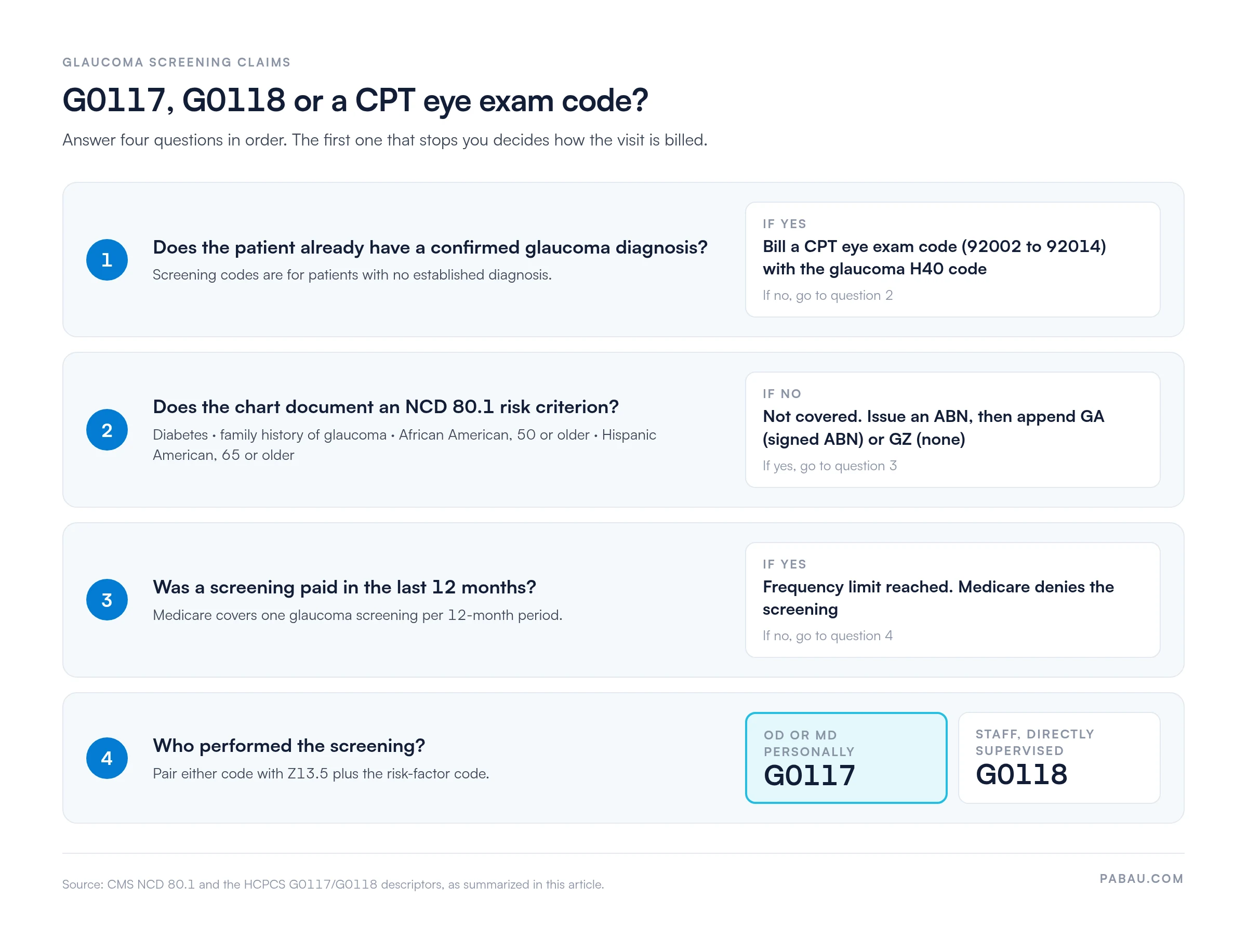
The table below adds the less common scenarios, including a same-day E/M visit and visual field testing billed on its own.
Each denial cause above starts before the claim is built. A risk criterion nobody recorded, an unchecked screening date or a note that doesn’t name who performed the exam all come back later as rework.
Pabau’s claims management software sits in the same system as the patient record, treatment notes and invoicing. Billers can read the screening note and the patient’s history next to the charge, then submit and track the claim without switching tools.
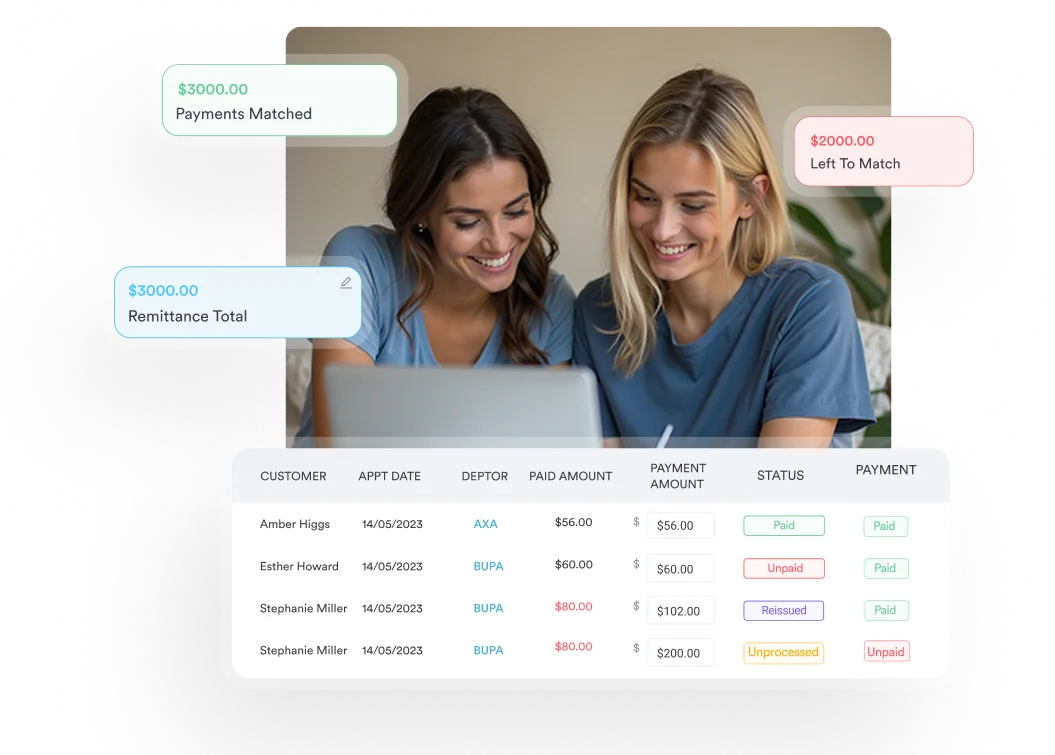
Building these checks into each step of the billing workflow gets more G0117 claims through as a clean claim on first submission.

Pabau keeps the patient record, screening note and claim in one system. Your billers can check eligibility and documentation before a G0117 claim goes out. See how it works for eye care practices.

G0117 rewards the practices that settle eligibility before the patient sits down. Confirm the diagnosis status, the NCD 80.1 risk criterion and the last paid screening date at booking. That handles four of the six denial causes before the exam starts, including the ABN decision.
The other two causes live in the note. Record who performed the screening, and pair Z13.5 with the qualifying diagnosis code. A slightly longer intake costs less than reworking a denied Medicare claim.
With the patient record, screening note and claim in one system, those checks become part of the visit. Book a demo to see how Pabau supports Medicare screening claims for eye care practices.

Billing a technician-performed screening? HCPCS code G0118 covers the supervised version of the same glaucoma screening.
Following up a screening with a full exam? CPT code 92012 explains billing the intermediate exam for an established patient.
Need guidance on handling claim denials systematically? Denial management in healthcare covers the workflow steps to reduce denial rates across your billing team.
Want to understand the full claims submission process? What is medical billing walks through the process from charge capture to payment posting.
Looking to verify patient eligibility before encounters? Insurance eligibility verification explains how to check coverage status and benefit limits before the patient arrives.
HCPCS code G0117 is the Medicare code for glaucoma screening that an optometrist or ophthalmologist performs for a patient at high risk of glaucoma. It covers a dilated eye exam with intraocular pressure measurement, plus direct ophthalmoscopy or slit-lamp biomicroscopy. The patient must meet a CMS risk criterion and have no glaucoma diagnosis.
A patient qualifies as high-risk under CMS NCD 80.1 by meeting at least one of four criteria. These are diabetes, a family history of glaucoma, being African American and 50 or older, or being Hispanic American and 65 or older. The chart must document the criterion to support the claim.
G0117 and G0118 describe the same glaucoma screening. G0117 applies when the optometrist or ophthalmologist performs the screening personally. G0118 applies when staff perform it under the OD or MD’s direct supervision, so the note must record who did the work.
Medicare covers G0117 once per 12-month period. At least 11 full months must pass after the month of the last paid screening, so the window does not follow the calendar year. The standard Medicare Part B deductible and 20% coinsurance apply.
Yes, provided the E/M visit is significant, separately documented, and medically necessary independent of the screening. Append modifier 25 to the E/M code to indicate this. MAC LCDs may add jurisdiction-specific modifier guidance, so verify with your local contractor.
Reimbursement rates for G0117 are updated annually through the Medicare Physician Fee Schedule and vary by geographic location and place of service. Use the CMS Physician Fee Schedule lookup tool at cms.gov to find the current allowed amounts for your MAC jurisdiction. Published static figures go stale after each annual update.