CPT Code 25210: Excision of a single carpal bone
CPT Code 25210: Official descriptor and quick-reference data CPT Code 25210 is a...

Last Updated: Nov 26, 2026
92202 is the CPT code for extended ophthalmoscopy of the optic nerve or macula, with a detailed drawing, interpretation and report. It's used for conditions such as glaucoma, macular disease or a tumor, and one unit covers one or both eyes.
It replaced the deleted codes 92225 and 92226 on January 1, 2020. Its peripheral-retina partner is 92201, which adds scleral depression. The two codes split by anatomy, not by eye, so 92202 takes no RT, LT or 50 modifier.
Let Pabau's smart automation suggest the right codes, reduce claim denials, and keep your practice compliant—effortlessly.
Automate repetitive tasks and focus on what matters most—your patients.
Reduce coding errors and ensure compliance with the latest regulations.
Clean claims, fewer denials, and faster reimbursements.
Powerful insights and reporting to help your practice thrive.
HIPAA compliant SOC 2 certified GDPR-compliant Trusted by 4,000+ clinics worldwide

CPT 92202 covers extended ophthalmoscopy of the optic nerve or macula, with a detailed drawing plus an interpretation and report.
One unit covers one or both eyes, so 92202 takes no RT, LT, 50 or 52 modifier.
92201 is the peripheral-retina code with scleral depression, and the two codes are mutually exclusive in one encounter.
Neither code is billed with fundus photography (92250), and a photo never replaces the required drawing.
Pabau, a practice management platform, sends US claims through Claim.MD and runs eligibility checks before the visit, so 92202 claims go out on verified coverage.
CPT code 92202 reports extended ophthalmoscopy of the optic nerve or macula, with a drawing, an interpretation and a report. It covers one or both eyes in a single unit. It also replaced the deleted codes 92225 and 92226 in 2020, as Retinal Physician’s coding Q&A explains.
The American Medical Association (AMA) descriptor sets out the full service:
Ophthalmoscopy, extended; with drawing of optic nerve or macula (eg, for glaucoma, macular pathology, tumor) with interpretation and report, unilateral or bilateral
It sits in the ophthalmoscopy range of the CPT code set, next to 92201.
Three elements make the service billable as 92202 rather than part of a routine eye exam:
All three must show in the chart before the code is billed. A note that says “extended ophthalmoscopy performed” with no drawing or report doesn’t support the claim.
Extended ophthalmoscopy of the optic nerve or macula is a magnified, dilated exam of the posterior pole. The physician records what a routine fundus check would not, such as the shape of the cup or the detail of a macular lesion.
The code is intended for central retina and optic nerve conditions. Typical reasons to perform and bill it include:
The drawing is the evidence that the extended exam happened. It also gives the next visit a baseline, which is how a change in the nerve or macula gets documented over time.
Submitting a clean claim for 92202 depends on five elements in the medical record. A claim without any one of them is open to denial on review.
Older Local Coverage Determinations (LCDs) for the deleted codes asked for drawings of about 2.5 to 3 inches, with standard colors and labels. Retinal Physician expects similar rules under the new codes. Check your Medicare Administrative Contractor (MAC) for its current expectations.
For glaucoma, draw the optic nerve in detail and note the cupping, the rim, any pallor and the slope of the cup. Add any surrounding pathology. A drawing with those features shows a change clearly when the patient returns.
92201 and 92202 split by anatomy, not by laterality. 92201 covers the peripheral retina, and 92202 covers the optic nerve or macula. Both describe a unilateral or bilateral service.
Pick the code that matches the clinical question for the visit, using the decision diagram below. A glaucoma follow-up points to 92202, and a new flashes-and-floaters complaint points to 92201. NCCI lists the pair as mutually exclusive, so only one is billed per encounter. See CPT code 92201 for the peripheral-retina rules.
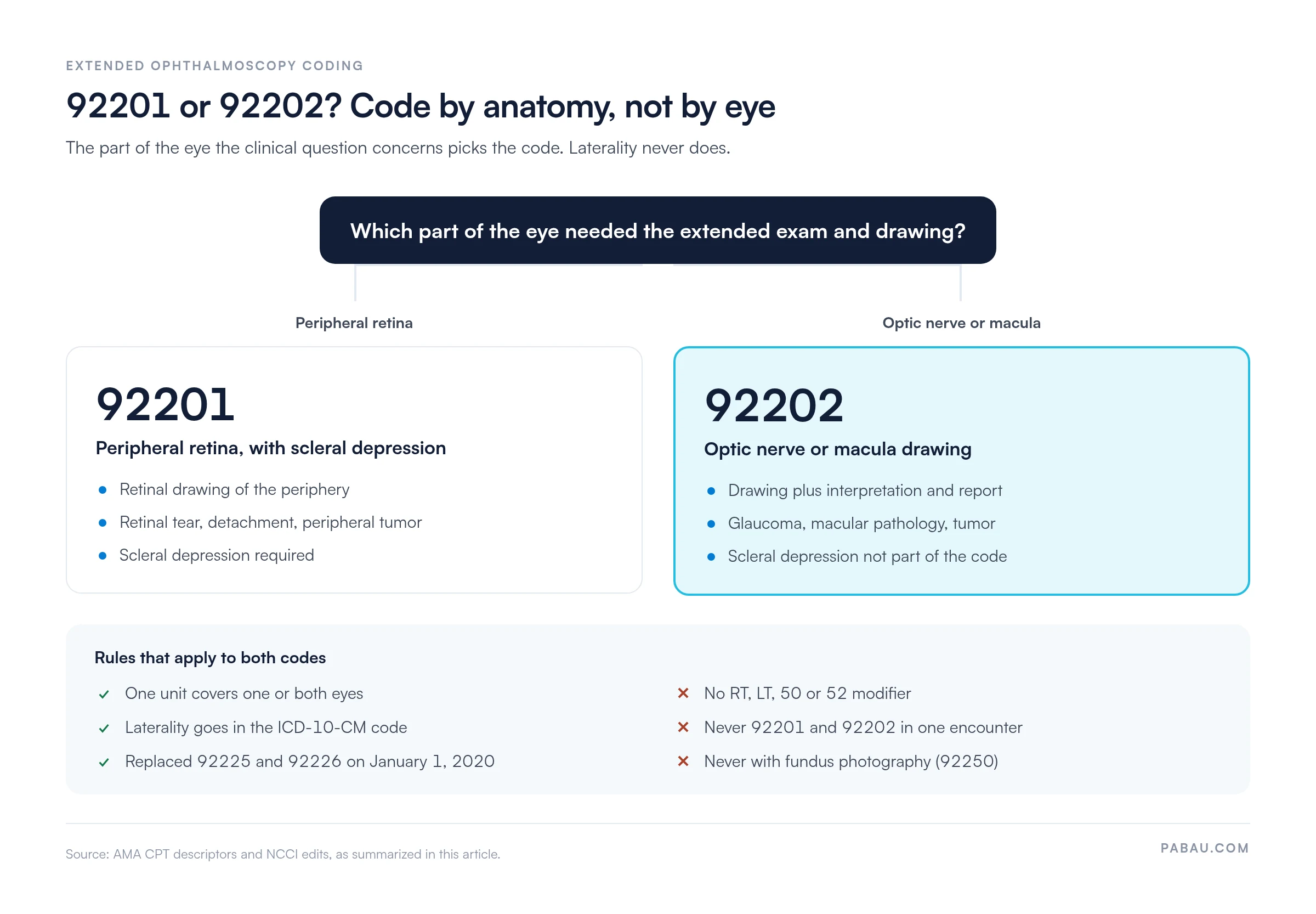
92202 needs fewer modifiers than the codes it replaced. One unit already covers one or both eyes, so laterality modifiers no longer apply.
Laterality still matters on the claim. It lives in the ICD-10-CM codes, which carry the right, left or bilateral eye in their characters. Check commercial payer rules before submission, because some plans differ from Medicare.
Medicare pays for CPT code 92202 under the CMS Medicare Physician Fee Schedule (MPFS). Rates change every year, so pull the current figure from the MPFS lookup before quoting a rate.
Use the FastRVU 2026 RVU lookup tool to see the work, practice expense and malpractice RVUs for 92202. One payment covers the encounter, whether one or both eyes were examined.
The move from per-eye billing to one unit per encounter cut payment for many bilateral exams. Practices that still model revenue on 92225 and 92226 overstate what 92202 brings in.
Every 92202 claim needs an ICD-10-CM diagnosis that explains why the optic nerve or macula needed an extended exam. The codes below are common pairings. Your MAC’s policy decides which ones it accepts.
Codes ending in a dash need further characters, which set the eye and, for glaucoma, the stage. Check each pairing against the applicable LCD, because a code outside the covered list is denied however complete the chart is.
Medicare Part B covers CPT code 92202 when the chart shows medical necessity and the diagnosis is supported by the applicable policy. A repeat exam needs a reason, such as worsening or progression since the last one.
Commercial payer rules differ. Some plans require prior authorization, and others cover the exam when a qualifying diagnosis is present. Run insurance eligibility verification at scheduling, then check prior authorization with each payer separately.
Coverage points to confirm before each encounter:
The denial management patterns for 92202 repeat across payers. Most trace back to the drawing, the code pairing or the diagnosis.
See common denial codes in medical billing for the CARC categories that show up on ophthalmology claims. Tracking denials by code shows which cause above is most common in your practice.
Pull a 10-claim sample of denied 92202 lines each quarter and read each chart against the five documentation elements. One cause usually dominates, such as a missing report or a repeat exam with no documented change.
A set billing routine for 92202 heads off the failures that drive most denials. The steps below follow the visit from exam to payment.
Several codes sit close to CPT 92202. Knowing their scope prevents duplicate billing and the wrong code choice.
Search the ophthalmology range in the AAPC Codify CPT lookup to check descriptors and bundling notes before choosing a code.
Most eye care practices check coverage by phone, send claims from a separate portal and post remittances by hand. A 92202 claim can sit in that chain for weeks before anyone sees a denial.
Pabau runs those steps in one place through its Claim.MD clearinghouse integration. It checks eligibility before the visit, sends 837P claims, handles secondary claims and brings ERA remittances back in. Prior authorization codes are tracked on the case, with a warning when one is missing.
The result is fewer surprises after the visit. Your team sees coverage before the exam and payment against each 92202 line, so denials surface while there is still time to appeal. See how Pabau’s claims management works for eye care practices.

Pabau checks eligibility through Claim.MD, sends 837P claims and brings ERA remittances back into the patient record. See how it works for eye care practices.

CPT 92202 is the code for a detailed look at the optic nerve or macula, drawn and interpreted in the chart. It carries no scleral depression requirement and no laterality modifier, and one unit covers one or both eyes. Choosing it over 92201 depends on which part of the eye the clinical question concerns.
Practices that get it paid keep the drawing and report on every claim. They bill it only when something has changed, and never pair it with 92201 or 92250. Book a demo to see how Pabau keeps eligibility, claims and remittances in one workflow.

Need a plain-language guide to medical billing fundamentals? What is medical billing explains the end-to-end claims cycle for practice staff new to insurance billing.
Seeing repeat denials on ophthalmic claims? Medical billing compliance covers the documentation and audit standards that apply to ophthalmology procedure codes.
Want to understand how the clearinghouse fits into your workflow? Claim.MD clearinghouse explains how 837P claims move from EHR to payer and where in that journey 92202 claims most often stall.
CPT code 92202 covers extended ophthalmoscopy of the optic nerve or macula, with a detailed drawing plus an interpretation and report. It suits conditions such as glaucoma, macular disease or a tumor. One unit covers one or both eyes in the same encounter.
The two codes split by anatomy, not by eye. 92201 covers the peripheral retina, drawn with scleral depression, for problems such as a tear or detachment. 92202 covers the optic nerve or macula. Both cover one or both eyes, and NCCI treats them as mutually exclusive in one encounter.
No. Scleral depression is part of 92201, the peripheral-retina code. 92202 needs a detailed drawing of the optic nerve or macula, plus an interpretation and report in the chart.
No. Since 2020, 92202 describes a unilateral or bilateral service, so one unit covers one or both eyes. The AAO advises against adding RT, LT, 50 or 52. Laterality belongs in the ICD-10-CM codes, which carry the eye in their characters.
No. CPT and NCCI don’t allow 92202 with fundus photography (92250) for the same encounter. A photograph also doesn’t replace the drawing that 92202 requires, so choose the service that answers the clinical question.
92202 and 92201 replaced 92225 and 92226 on January 1, 2020. The old codes were unilateral, initial and subsequent codes billed per eye. The new pair is billed once per encounter, whether one or both eyes are examined.
Yes. Medicare Part B covers 92202 when the chart shows medical necessity and the diagnosis is supported by your Medicare Administrative Contractor’s policy. Repeat exams without a change in signs, symptoms or condition are at risk of denial.
The usual causes are a missing or thin drawing, no interpretation and report, and a diagnosis that doesn’t point to the optic nerve or macula. Billing 92202 with 92201 or 92250 in one encounter also triggers denials, as does a repeat exam without documented change.