



CCSD code G5100: Bypass of duodenum billing guide
CCSD code G5100 bills a bypass that leaves the duodenum in place CCSD code G5100...

Last Updated: Oct 16, 2026

CPT code 92012 reports an intermediate eye exam for an established patient, covering history, external ocular and adnexal examination, and an optional dilation.
The note must support all four service elements, and a thin record is the leading denial trigger for this code.
Medicare pays about $90.52 in the non-facility setting and about $41.42 in a facility, before locality adjustment.
An established patient is one your practice has treated within the past three years, so check that window at scheduling.
Refraction (92015) is not a Medicare benefit, so bill the patient directly when it happens at the same visit.
CPT code 92012 covers an intermediate eye exam for an established patient, and it is one of the busiest codes in eye care. The service has to include four elements. You need a history, a general medical observation, an external ocular and adnexal exam, and a diagnostic or treatment plan.
That last element is where the money goes. Payers deny 92012 far more often for a thin note than for a wrong code. So start with what has to be on the page before the claim leaves your practice.
According to the American Medical Association (AMA) CPT code set, 92012 describes intermediate ophthalmological services for an established patient. It stops short of a full ocular examination. There is no requirement for a slit-lamp, a fundus view, or an intraocular pressure reading.
The verbatim AMA descriptor is: “Ophthalmological services: medical examination and evaluation, with initiation or continuation of diagnostic and treatment program; intermediate, established patient.”
Unpacked, that gives you four required service components:
Mydriasis and pharmacologic agents are optional here, though you must document them if you used them. Any dilating drops are bundled into the exam fee, unlike a separately billed injectable drug such as HCPCS code J1675. The word “intermediate” is what separates this code from comprehensive services. Those need the wider exam, and they carry a different code.
The patient must have received a professional service within the past three years. That service can come from the billing physician, or from a physician of the same specialty in the same group. Bill 92012 outside that window and the payer sees a new patient. That mismatch denies.
Ophthalmologists and optometrists are the eligible billing providers, and payer rules narrow it further from there. Medicare covers 92012 under Part B for both.
Some commercial payers restrict optometry billing to vision-benefit plans rather than medical plans, which decides whether 92012 is payable at all under a given policy.
Opticians and ophthalmic technicians cannot bill 92012 independently. The service has to be performed and billed by a licensed optometrist or physician. Incident-to rules may let non-physician work be billed under a supervising physician’s NPI in some settings, but that varies by payer.
Check the applicable Local Coverage Determinations (LCDs) from your Medicare Administrative Contractor (MAC).
Incomplete documentation is the single most common trigger for a 92012 denial. The record has to support every component of the service you billed, and reviewers read it literally.
Here is what belongs in the chart, and what usually goes missing.
The definition belongs to the AMA’s CPT code set, not to the American Academy of Ophthalmology. Even the Academy’s own published guidance credits it to the AMA.
Under CPT, an intermediate service covers the evaluation of a new problem or finding. It also covers an existing condition complicated by a new diagnostic or management problem.
Nothing in that definition requires a severe presentation. A new complaint layered onto a condition you already manage is enough.
What the record has to do is name the new problem or finding, and say what you did about it. A note reading “glaucoma follow-up” with no new finding and no change of plan does neither.
Write down the clinical decision that made the visit intermediate rather than routine. A line like ‘intraocular pressure elevated to 28 mmHg, changing topical therapy protocol’ does more to protect the claim than any generic follow-up notation.
Payment for 92012 moves with the payer, the geographic locality, and the place of service. The CMS Medicare Physician Fee Schedule (MPFS) is the usual benchmark, and the work RVU for 92012 is 0.92.
Figures below are national and unadjusted. Verify your own locality with the CMS Physician Fee Schedule lookup tool before you quote a figure to a patient or a payer.
The non-facility rate applies when you deliver the service in a physician’s office. The facility rate applies in hospital outpatient departments and ambulatory surgery centers.
Sending the wrong place of service (POS) code is a routine billing error, and it produces either an overpayment or an underpayment. Either way, the POS code has to match the site where care happened.
Modifiers explain the circumstances around a service, and on 92012 they often decide whether the claim pays. These four cover most of what an eye practice sends.
One warning. Modifier 25 draws audits. Appending it without a separately documented, medically necessary service is improper billing. Validate every modifier against current National Correct Coding Initiative (NCCI) edits before the claim goes out.
92012 pays on the strength of the diagnosis attached to it. The ICD-10-CM codes you pair with it therefore matter as much as the exam.
Here are the pairings you will see most often in eye care. Confirm your own payer’s pairings with the AAPC CPT-to-ICD-10 crosswalk.
Always reach for the most specific code the record supports. Unspecified codes such as H57.9 are acceptable only when no more specific code fits the clinical picture. Leaning on them habitually raises your audit risk, and it signals thin clinical documentation to anyone reviewing the chart.
This is the most frequent coding decision in an eye practice, and it goes wrong in both directions. Billing 92014 for a service that was intermediate is upcoding. Billing 92012 for a comprehensive exam quietly gives away revenue.
The comparison below is what separates them.
The working rule is simple. If the physician performed a slit-lamp examination, a funduscopic evaluation, and an intraocular pressure measurement, the visit is comprehensive.
If the exam stayed on the external structures and the adnexa with no posterior segment assessment, 92012 is the right code. The comprehensive counterpart, 92014, carries the same established-patient rule and a wider exam requirement.
Take a patient with primary open-angle glaucoma on a single topical drop. At the March visit you check pressure, look at the lids and conjunctiva, and continue the same therapy. That is an external exam with a plan, which makes it 92012.
By September the pressure has climbed. You dilate, run a slit-lamp and fundus exam, and switch the drop. Same patient, same diagnosis, but the exam reached the posterior segment and the plan changed. That visit is 92014. The diagnosis never decided the code, and neither did the length of the appointment.
92012 sits in a family of four general ophthalmological service codes. Patient type picks the pair, and exam scope picks the level within it. Reading the family as a grid stops most patient-status errors before they happen.
The four codes are mutually exclusive for a single encounter. Never bill 92002 with 92012, or 92004 with 92014. For current descriptors and bundling edits, check the AAPC Codify CPT lookup.
Denials on this code follow a pattern, and almost none of them start at the payer. By the time the rejection lands, the mistake is several steps upstream. Mapping the claim’s path shows you which checkpoint to fix first.
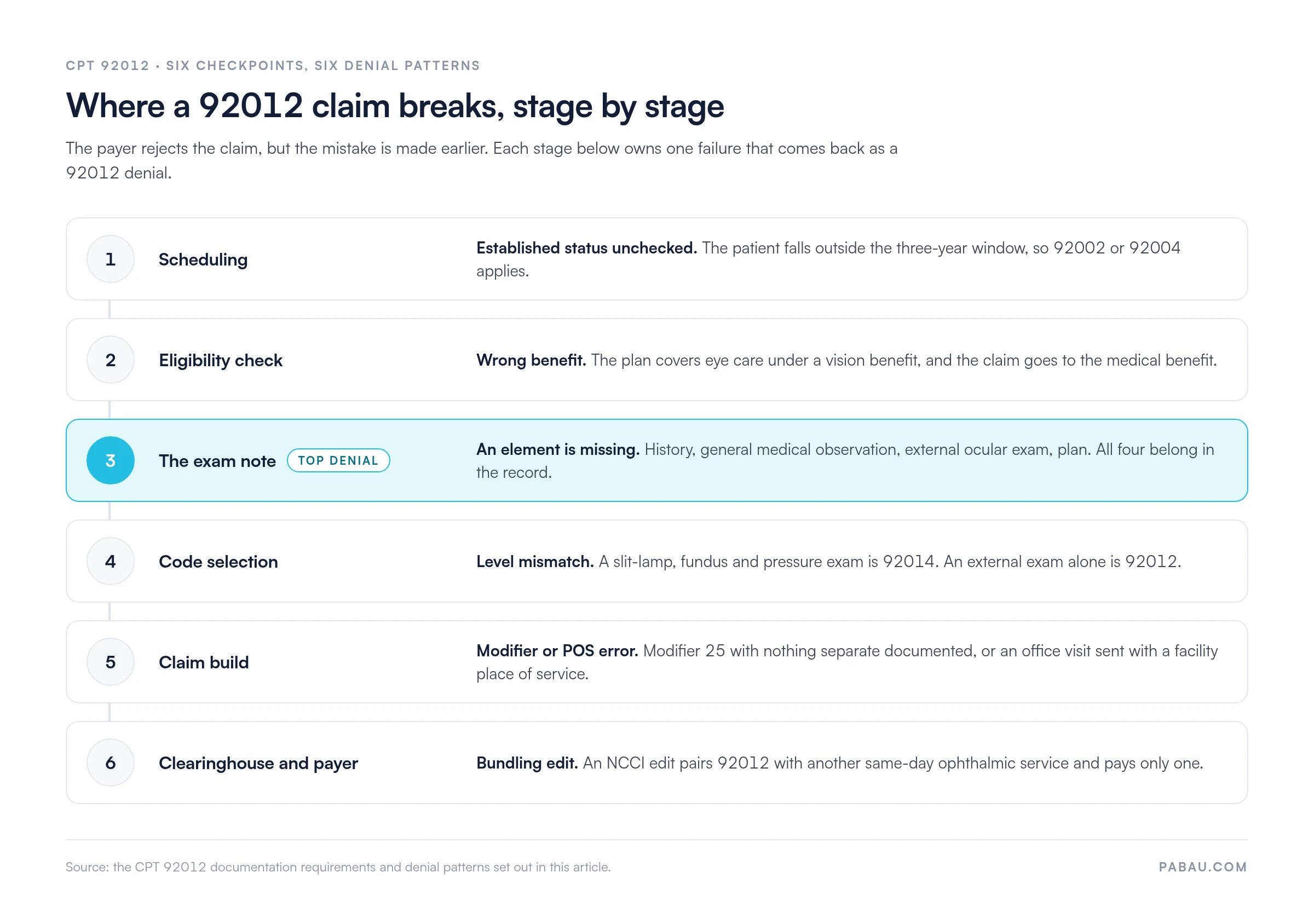
Here is the same set of failures with the fix attached to each one:
Practices that track these root causes rather than the denial totals usually cut their 92012 denial rate inside two or three billing cycles.
Eye practices rarely bill 92012 on its own. Other services land on the same date, and the rules for pairing them are payer-specific. A few principles hold almost everywhere.
One of those services is 92060, the sensorimotor examination with multiple measurements of ocular deviation. The AMA marks it a separate procedure, so it is not reported when a larger same-session ophthalmological service already includes it.
Corneal topography, 92025, is another same-date service. Medicare’s NCCI edits do not bundle it into the eye exam codes, so that pairing needs no modifier. Each service still needs its own documented indication.
Sometimes, and it depends entirely on the plan. CPT 92015 covers determination of the refractive state. Medicare does not cover refraction, so it becomes a non-covered service billed to the patient at a Medicare encounter.
With commercial payers the answer turns on whether the plan includes a vision benefit. Where it does, 92012 and 92015 on the same date are generally separately billable. Confirm it in the payer portal before you make a habit of it.
Spectacle fitting is the dispensing service that follows a refraction. It is billed separately with CPT 92340 when each service is distinct and documented. Modifier 25 then goes on the 92012 exam line, not on the fitting.
Pick one family per encounter and stay in it. Ophthalmologists may bill either the 92xxx ophthalmological service codes or standard Evaluation and Management codes (99202 to 99215) for an office visit.
Eye codes usually fit better in a specialty practice, because they were written for the scope of service performed. An E/M code can be the stronger choice when a systemic condition drives the visit and the ocular evaluation is secondary.
Mixing both families on one encounter for the same condition is not permitted.
Run this list on every 92012 claim before it leaves the practice. Fixing any of these afterwards costs several times what checking it now does.
Audit your 92012 claims monthly against the eight-point check above. Flag any encounter where the plan section reads only ‘continue current management’ with no clinical detail. Those are the easiest denials to prevent and the first ones an auditor pulls.
In most eye practices the note lives in one system and the claim gets keyed into another. Someone reads the chart, picks the code, types the diagnosis, and hopes the two agree. That hand-off is where 92012 claims pick up their errors.
Practice management software like Pabau holds both in the same record. The CPT code attached to the service lands on the charge line by itself. Recorded diagnoses from the patient’s problem list seed the ICD-10 slots.
Pabau’s claims management software then holds the claim until every required field is complete. A missing authorization number stops the claim at your desk rather than at the payer.
For a US practice, claims route out through the Claim.MD clearinghouse, which reaches thousands of US payers.
Eligibility checks come back while the patient is still at the desk, and remittance advice posts itself. You can also see where each 92012 claim sits without phoning anyone. Your staff spend the afternoon on patients rather than on claim status calls.
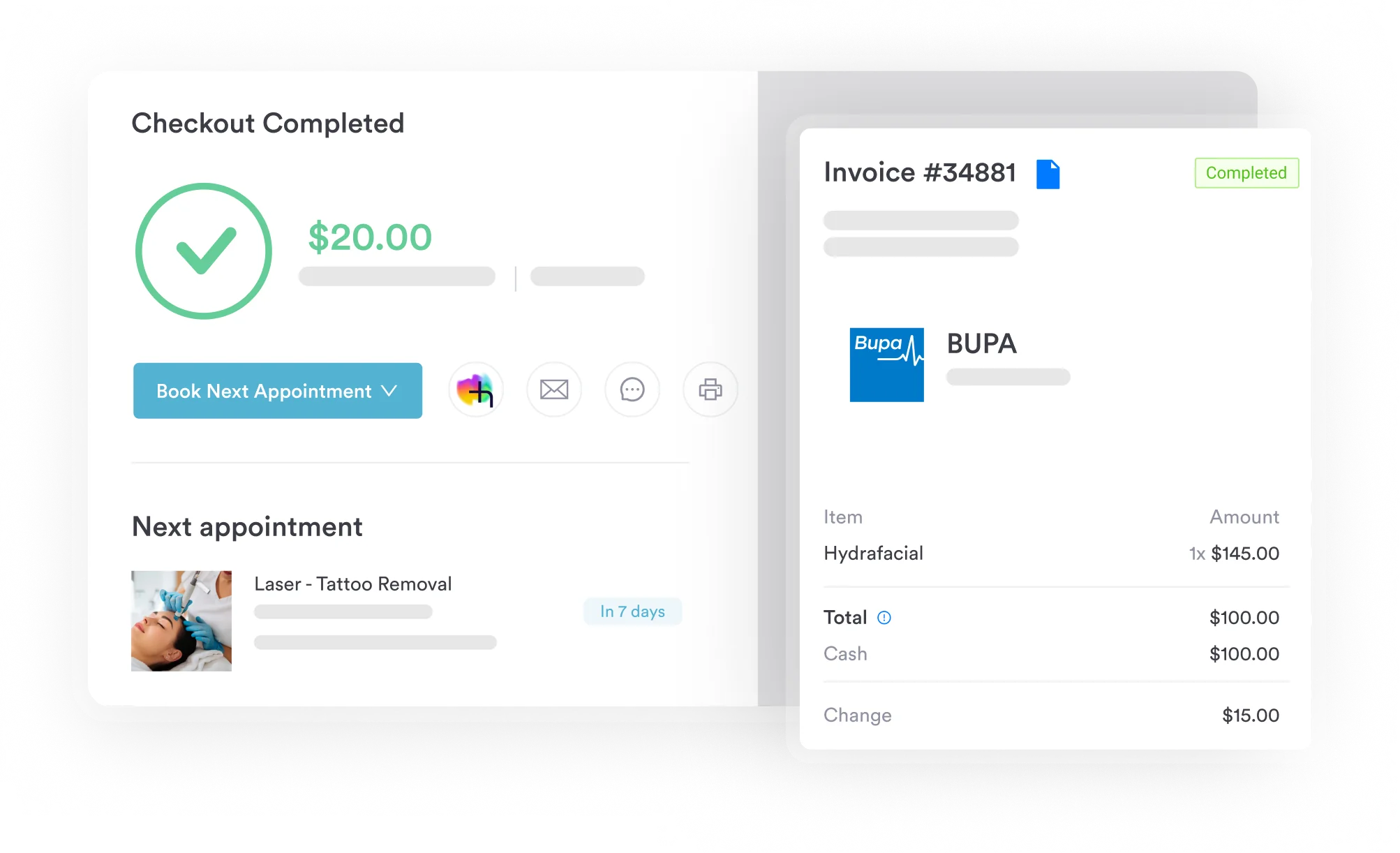

Pabau pre-fills the claim form from the patient record and checks every required field before you send it. It also tracks each claim through the clearinghouse. Your team stops rekeying charts into a billing screen.

The exam behind 92012 is short, and the note tends to get short with it. That is the whole problem. Fix the documentation template once and most of the denial patterns above stop appearing on your remittance.
So pick one change this week. Make every intermediate note name a new problem or finding, with the plan that follows from it. That single line protects more 92012 revenue than any modifier you could append.
Want your notes and your claims to stop drifting apart? Book a demo and see how Pabau builds a 92012 claim straight from the eye exam record.

Need a system for working denials instead of reacting to them? Denial management in healthcare covers how to track, appeal, and prevent billing denials across specialties.
Want to know what the clearinghouse does to your claim? Medical claims clearinghouse guide explains how claims get validated and routed to payers.
Not sure your ERA posting is set up properly? Electronic Remittance Advice (ERA) explained walks through 835 remittance files and the denial codes inside them.
Want fewer claims coming back at all? What makes a clean claim sets out the fields and checks that get a claim paid on first submission.
Worried how your documentation would hold up in an audit? Medical billing compliance covers the record-keeping standards behind defensible coding.
CPT sets no visit limit, and you report 92012 once per date of service. Payers apply frequency screens by diagnosis, so each visit needs its own new problem or finding in the note.
Use POS 11 for an office visit, which earns the non-facility rate. Hospital outpatient departments take POS 22 and pay the facility rate. A POS code that contradicts the site of care gets corrected or denied.
No. Part B pays 92012 only when a medical diagnosis supports the visit. Routine vision screening and refraction sit outside the benefit, so bill the patient for those directly.
Medicare wants the claim within one calendar year of the date of service. Commercial contracts often allow less, so check the filing limit in your agreement. Timely filing denials rarely survive an appeal.
Bill the new patient codes instead. An intermediate exam becomes 92002 and a comprehensive exam becomes 92004. The three-year clock runs from the last face-to-face service by your group.



