



CCSD code G5100: Bypass of duodenum billing guide
CCSD code G5100 bills a bypass that leaves the duodenum in place CCSD code G5100...

Last Updated: Oct 16, 2026

CPT code 92014 reports a comprehensive ophthalmological service for an established patient and may span one or more visits for ongoing care.
Documentation must capture general medical observation, ocular history, anterior and posterior segment evaluation, and a diagnostic or treatment plan.
92014 pays more than the intermediate code 92012, and the 2025 Medicare national average is about $123 in a non-facility setting.
Pabau’s claims management software supports accurate 92014 billing by structuring documentation, flagging missing elements, and submitting electronic claims via Claim.MD.
CPT code 92014 reports a comprehensive ophthalmological service for an established patient. The published CPT descriptor calls it an ophthalmological service: a medical examination and evaluation of the eye. It adds the initiation or continuation of a diagnostic and treatment program, across one or more visits.
Three phrases in that descriptor decide how the code gets used. “Established patient” means the patient received professional services from the physician within the past three years. A physician of the same specialty in the same group practice counts.
“One or more visits” means a single claim can bundle several encounters from the same episode of care. “Initiation or continuation of a diagnostic and treatment program” separates 92014 from a purely diagnostic exam.
The RVU figures above come from the 2025 CMS physician fee schedule. Confirm them against the CMS physician fee schedule lookup tool for the payment year you are billing, because CMS updates the values annually.
Comprehensive ophthalmological services require a specific set of clinical elements. Missing one can move an audit determination from 92014 down to the intermediate code 92012, which pays less. The American Academy of Ophthalmology (AAO) identifies the following as required components.
The posterior segment evaluation is the clinical line between comprehensive and intermediate service levels. If a provider performs every other element but skips the dilated fundus exam, the visit typically supports 92012 rather than 92014.
Payers expect to see every required element written in the medical record, not inferred from context. Generating a superbill from an EHR that pre-populates coded fields helps, but the clinical note still needs substantive content for each element.
Checkbox and dropdown documentation without narrative findings is a common target in Medicare contractor audits. Free-text observations for the anterior and posterior segments lower the downcode risk.
Flag any established-patient visit where dilation was deferred. Document the clinical reason in the record, then evaluate whether the service level supports 92014 or should be billed as 92012. Noting the rationale up front protects the claim and demonstrates medical necessity.
Both codes cover established-patient ophthalmological services. The difference is scope. 92014 requires a comprehensive examination including posterior segment evaluation, while CPT code 92012 covers an intermediate service with no full posterior segment workup.
The decision rule is straightforward. Bill 92014 when the provider performed and documented a dilated fundus examination, the anterior segment elements, and a general medical observation. Bill 92012 when dilation was deferred, or when the fundus exam was brief and thinly documented.
CPT code 92004 is the new-patient companion to 92014. The required examination components are identical, and only the patient’s status differs. A patient who has not received professional services from the physician within the past three years counts as new. The same rule covers other physicians in the same specialty group, and that visit is billed under 92004.
Practices that acquire another ophthalmologist’s patient panel frequently miscategorize patient status. A patient seen only by the departing physician within the past three years is still established. That holds when the departing physician belonged to the same specialty group. Confirm patient status in your scheduling system before the visit, and you prevent the claim rework later.
Ophthalmologists may choose between the general ophthalmological service codes (9200x series) and the standard evaluation and management codes (9920x series) for the same encounter. They cannot bill both on the same date of service without modifier -25. Even then, a separate and distinct reason has to exist.
Palmetto GBA, a Medicare Administrative Contractor, has published guidance on this point. The ophthalmological service codes follow the AMA CPT documentation framework rather than the E/M history, physical and medical-decision-making structure. Practices that audit a 92014 note against E/M criteria are using the wrong benchmark.
A patient may present for a comprehensive eye exam and also raise a new systemic problem unrelated to the eye. In that case, an E/M code carrying modifier -25 may be appropriate alongside 92014. The separate E/M has to be documented as a distinct service. Check current National Correct Coding Initiative (NCCI) edits before co-billing, because payer policies change.
Modifier selection for 92014 affects both claim acceptance and audit risk. The table below covers the modifiers most relevant to ophthalmology practices, with notes on appropriate and inappropriate use.
Modifier -25 carries the most audit risk in ophthalmology billing. Pairing 92014 with an E/M code draws payer scrutiny, so the second service has to stand on its own. The E/M must address a problem distinct from the reason for the eye exam, and the note has to show that distinction plainly.
Modifier -59 comes up most often with the sensorimotor examination, 92060, when it is performed during the same comprehensive exam. NCCI edits may bundle the two, so billing both requires distinct documentation and a modifier indicator that permits the override.
Medicare Part B reimburses CPT code 92014 under the physician fee schedule, with payment calculated from the RVU-based formula. Rates vary by Medicare Administrative Contractor (MAC) locality and the geographic practice cost index applied to each RVU component. Verify current figures with the CMS lookup tool linked above, or with a dedicated tool such as FastRVU’s RVU lookup.
The split between those components matters more than the headline figure. Practice expense supplies most of what Medicare pays for 92014, so staffing and equipment costs drive the code’s economics.
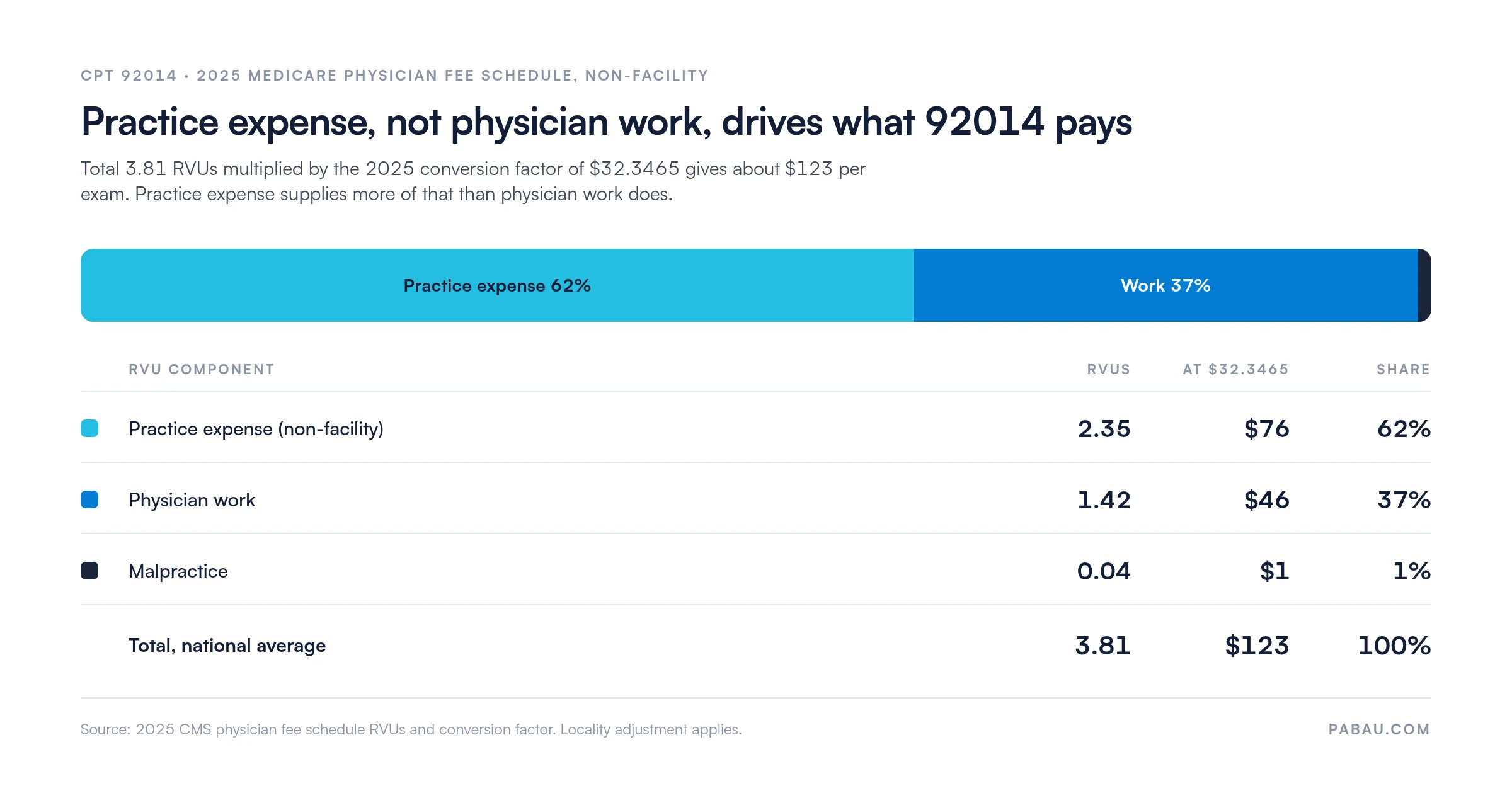
Practices that submit electronically can reconcile the electronic remittance advice against the fee schedule to catch underpayments. Differences between billed charges and Medicare’s allowed amount are common, especially when the conversion factor changes mid-year. A process that flags those variances automatically surfaces systematic underpayment early.
Practice management software like Pabau integrates with Claim.MD, a US medical claims clearinghouse that validates 92014 claims against CMS rules before submission. That covers real-time eligibility checks, CMS-1500 and 837P submission, and ERA reconciliation for Medicare and commercial payers.
Medicare Part B covers CPT code 92014 when the visit is medically necessary. That means the patient has a diagnosed ocular condition needing evaluation and management. Routine eye examinations with no medical diagnosis fall outside Medicare Part B coverage. In that situation, modifier -GY signals patient financial responsibility and lets you bill the patient directly.
Verifying eligibility before each visit is the most practical safeguard. It confirms whether the patient’s Medicare plan is fee-for-service, Medicare Advantage, or a supplemental policy. Medicare Advantage plans set their own fee schedules. Some also cap how many comprehensive eye exams they will cover in a year.
CPT code 92015 describes subjective refraction determination for best corrected visual acuity, and it is commonly performed during a comprehensive eye exam. The codes can be billed together, but one coverage rule governs. Refraction is explicitly excluded from Medicare Part B coverage. Billing 92015 to Medicare produces an automatic denial, whatever the diagnosis or documentation says.
For Medicare patients, use modifier -GY on 92015 to signal a non-covered service and bill the patient directly. Most commercial payers also exclude refraction from coverage, though a minority do cover it. Always check the individual payer’s benefit schedule before assuming 92015 will be paid alongside 92014.
When billing both codes for non-Medicare patients, list 92014 first as the primary evaluation service and 92015 second. No modifier is needed on 92015 when the commercial payer covers it. Some plans still apply a separate copayment or different cost-sharing for refraction.
Build a payer matrix in your practice management system that flags 92015 as non-covered for all Medicare and Medicare Advantage patients automatically. This prevents billing errors at the point of claim creation rather than discovering them after denial.
Refraction is not the only service billed on the same date as a comprehensive exam. An initial keratoconus contact lens fitting, CPT 92072, can go on the same claim, with modifier -25 appended to 92014. The same applies to a monofocal spectacle fitting, CPT 92340, provided the note records two distinct services.
Most 92014 denials and audit findings trace back to a short list of recurring mistakes. The errors below account for most downcoding, denial, and recoupment events in ophthalmology practices.
Denials for 92014 concentrate in two buckets. One is thin documentation, the other is patient status. Fixing those two areas resolves most 92014 denials. Reviewing the denial codes on your remittance advice tells you which bucket a given claim landed in.
Missing documentation and claim errors are workflow problems as much as coding problems. A note template that never asks for the posterior segment findings will not get them, however careful the clinician is. Pabau’s claims management software handles this at the point of care, before the claim goes out.

The platform ships clinical note templates that mirror the documentation 92014 requires. Each one carries dedicated fields for anterior and posterior segment findings, general medical observation, and the treatment plan. Claims are validated before submission, then routed through Claim.MD to more than 4,000 US payers. ERA reconciliation runs automatically and flags payment variances against the fee schedule.

Pabau’s claims management tools help ophthalmology practices document 92014 visits correctly, submit clean claims, and reconcile ERA payments, all from one platform.

The choice between 92014 and 92012 is settled in the clinical note, long before billing. A dilated fundus exam that was performed but thinly recorded pays like an intermediate visit. That is the trade-off worth building your note template around.
Structured note templates and a claims workflow in the same system remove the omissions that drive 92014 downcoding. If your practice is seeing repeat 92014 denials, book a demo. You will see claim validation and ERA reconciliation working in one place.

Need the full picture of how an ophthalmology claim reaches payment? Medical billing fundamentals explains the claims lifecycle from charge capture to payment posting.
Want to see how superbill data feeds claim submission? Superbill guide for medical practices covers what coders need from the provider’s note.
Looking to benchmark your denial rate against industry patterns? Denial management in healthcare covers root-cause analysis and appeal workflows for common ophthalmology denials.
CPT code 92014 bills a comprehensive ophthalmological service for an established patient. It covers the examination and evaluation, plus the initiation or continuation of a diagnostic and treatment program. The service requires full anterior and posterior segment evaluation, general medical observation, and a documented treatment plan. It may span one or more visits within a single episode of care.
CPT 92014 requires a comprehensive examination, including posterior segment evaluation and general medical observation. That usually means a dilated fundus exam. CPT 92012 is an intermediate service for established patients and requires no posterior segment evaluation. If the dilated fundus exam was not performed and documented, 92012 is the correct code and pays less.
Required documentation covers the ocular and general medical history, the chief complaint, and visual acuity for each eye, corrected and uncorrected. It also covers anterior segment findings with measurements or morphology, and posterior segment findings with the dilation status noted. A linked ICD-10 diagnosis code and a diagnostic or treatment plan complete the record. Checkbox-only documentation without narrative findings raises audit and downcode risk.
The 2025 Medicare national average for CPT 92014 is about $123 in a non-facility setting. That comes from a total of 3.81 RVUs multiplied by the 2025 conversion factor of $32.3465. Actual payment varies by MAC locality and the geographic practice cost index applied to each RVU component. Verify your rate with the CMS physician fee schedule lookup tool.
Yes, optometrists may bill CPT code 92014, depending on their state scope of practice and the payer’s credentialing policies. Medicare covers 92014 services provided by optometrists under Medicare Part B when the service is medically necessary. State law determines which examination components optometrists are authorized to perform, so verify current scope-of-practice regulations in your jurisdiction before billing.
General ophthalmological services are a CPT code category (9200x series) covering medical examination and evaluation of the eye and its adnexa. They differ from evaluation and management (E/M) codes in their documentation requirements. Those requirements follow the AMA ophthalmological service criteria: history, examination components, diagnostic instruments, and treatment plan. They do not follow the E/M history, physical and medical-decision-making framework. CPT codes 92002, 92004, 92012, and 92014 all belong to this category.
Yes, they can be billed together for most commercial payers. However, CPT 92015 (refraction) is explicitly excluded from Medicare Part B coverage. For Medicare patients, append modifier -GY to 92015 to indicate the service is non-covered and bill the patient directly. Check individual payer benefit schedules before assuming 92015 will be reimbursed alongside 92014.



