CPT Code 62284: Injection procedure for myelography
CPT Code 62284: official descriptor and procedure overview The American Medical ...

Last Updated: Oct 19, 2026
E0244 is the HCPCS Level II code for raised toilet seat.
Let Pabau's smart automation suggest the right codes, reduce claim denials, and keep your practice compliant—effortlessly.
Automate repetitive tasks and focus on what matters most—your patients.
Reduce coding errors and ensure compliance with the latest regulations.
Clean claims, fewer denials, and faster reimbursements.
Powerful insights and reporting to help your practice thrive.
HIPAA compliant SOC 2 certified GDPR-compliant Trusted by 4,000+ clinics worldwide

HCPCS code E0244 describes a raised toilet seat, a durable medical equipment (DME) item in the HCPCS Bathing Supplies range E0240-E0249.
Medicare does not cover E0244; it is classified as non-covered per CMS Policy Article A52461. Bill with the GY modifier for Medicaid crossover or liability purposes.
State Medicaid programs vary: Medi-Cal’s DME provider manual generally cites a once-every-5-years frequency limit for E0244; MassHealth’s current DME and Oxygen Payment and Coverage Guideline Tool addresses NU and UD modifier use for the code.
Pabau’s claims management software supports modifier attachment and claim submission workflows, reducing manual errors on non-covered DME codes.
HCPCS code E0244 describes a raised toilet seat, classified under the HCPCS Level II Bathing Supplies range E0240-E0249. The code’s short descriptor is “Toilet seat raised.” It applies to adaptive DME devices designed to increase toilet height, making sitting and standing easier for patients with mobility limitations, joint weakness, post-surgical restrictions, or lower-extremity strength deficits. The 1500 claim form and its electronic equivalent ask for the same data in a different layout. The 1500 claim form and its electronic equivalent ask for the same data in a different layout.
| Property | Value |
|---|---|
| HCPCS Code | E0244 |
| Long description | Raised toilet seat |
| Short description | Toilet seat raised |
| Classification | Durable Medical Equipment (DME) |
| HCPCS range | E0240-E0249 (Bathing Supplies) |
| Date added | January 1, 1986 |
| Action code | N (No maintenance for this code) |
| Action effective date | January 1, 1996 |
| Medicare coverage | Non-covered |
E0244 sits within a cluster of toilet and bathing assist codes. Understanding the differences between adjacent codes is essential for accurate selection.
Selecting E0243 or E0245 when the item supplied is actually a raised toilet seat is a coding error that misrepresents the equipment delivered and may lead to audit risk. Other mobility DME.
Medicare does not cover HCPCS code E0244. Per CMS Policy Article A52461 (Commodes), a raised toilet seat is explicitly listed as a non-covered item. This applies regardless of medical necessity documentation or physician order.
The same non-coverage status extends to a commode chair used as a raised toilet seat. When a supplier positions a commode chair over the toilet instead of providing a standalone raised seat, CMS treats the item as functionally equivalent to E0244. The GY modifier must be added to the commode chair code in that scenario.
The GY modifier signals that an item is statutorily non-covered or does not meet the definition of a Medicare benefit. For E0244, the GY modifier applies when:
Without the GY modifier, a Medicare claim for a non-covered item will typically reject at the payer level rather than produce a formal denial, which can delay the Medicaid secondary billing process.
Track GY modifier application as a workflow rule in your billing system. Flag E0244 and any commode chair code where the clinical note indicates toilet positioning use. Catching this at data entry eliminates downstream rejection and speeds Medicaid secondary billing.
Because Medicare classifies E0244 as non-covered, the standard Medicare DME fee schedule does not apply for Medicare payment purposes. However, fee schedule data is still relevant for:
Published fee schedule data for E0244 varies by DME MAC jurisdiction and by year. For the most current figures, reference the official HCPCS E0244 code data alongside the CMS DME fee schedule files published annually on cms.gov. Fee schedules are updated each January 1 and may be adjusted mid-year for geographic adjustments.
The same reference approach applies to other non-covered or state-variable DME codes. Suppliers billing state Medicaid programs should reference each state’s DME fee schedule directly, as Medicaid reimbursement rates for E0244 are set independently of the Medicare fee schedule.
Practices supplying equipment directly rely on inventory management software to know what’s in stock before promising it.
While Medicare does not cover E0244, state Medicaid programs may cover the code under their own DME benefit policies. Coverage rules, frequency limits, and modifier requirements differ by state.
Medi-Cal’s DME provider manual lists a frequency limit for HCPCS code E0244, generally cited as once every 5 years, though suppliers should confirm the current figure directly with Medi-Cal before submission. This limit applies across all adjacent bathing supplies codes in the E0240-E0249 range.
Claims submitted before the frequency window has elapsed will deny. Document the last date of service for E0244 in the structured client record to prevent premature resubmission.
MassHealth (Massachusetts Medicaid) permits billing E0244 with NU and UD modifiers. MassHealth has updated its DME modifier guidance multiple times since the original 2005 DME-26 transmittal, through DME-46 in 2024, so the modifiers below should be confirmed against current guidance rather than the original transmittal:
Applying the wrong modifier (or omitting it) on a MassHealth E0244 claim will produce a rejection. Confirm current modifier requirements using MassHealth’s DME and Oxygen Payment and Coverage Guideline Tool before submission.
Coverage for E0244 across other state Medicaid programs is not uniform. Some states follow Medicare’s non-coverage status; others provide limited DME coverage for toilet assist devices under home health or personal care benefit categories.
This same state-by-state variation shows up in codes like HCPCS code E2607 (wheelchair cushion), where coverage and documentation rules also differ from one Medicaid program to the next.
Always verify the specific state’s DME fee schedule and coverage policy directly with the state Medicaid agency before submitting a claim.

Pabau helps billing teams attach the right modifiers, track claim outcomes, and manage documentation for non-covered DME codes like E0244, all within a single workflow.

Because Medicare does not cover E0244, Medicare’s standard medical necessity documentation requirements do not generate payment, but documentation still matters for three reasons: Medicaid billing, commercial payer adjudication, and liability protection when the patient is billed directly.
For state Medicaid programs that do cover E0244, standard DME documentation requirements typically include:
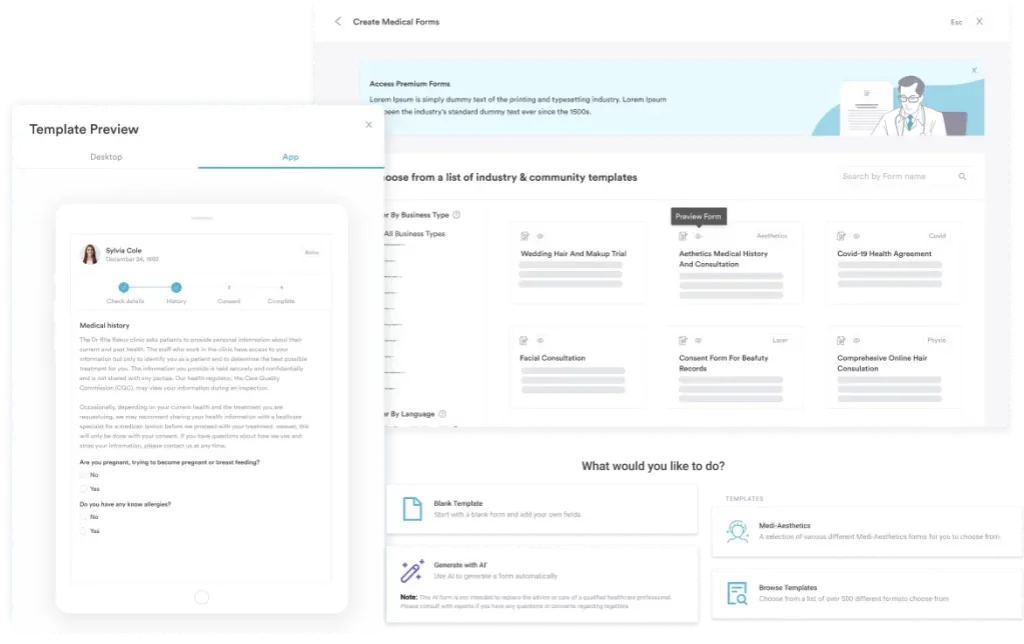
Using digital forms for clinical documentation allows prescribing clinicians to capture functional limitation data in a structured format that maps directly to the billing record. This reduces the documentation-to-claim turnaround and ensures required fields are not missed.
Attach the physician order and clinical note to the claim record at time of service, not at time of billing. When a payer requests additional documentation after submission, retrieval is immediate rather than requiring a separate records pull.
Understanding how E0244 relates to adjacent codes helps suppliers select the most appropriate code and avoid upcoding or undercoding.
| HCPCS Code | Description | Medicare covered? | Key difference from E0244 |
|---|---|---|---|
| E0240 | Bath/shower chair, with or without wheels | Non-covered | Used inside tub or shower, not on toilet |
| E0243 | Toilet rail, each | Non-covered | Grip rail only, does not raise seat height |
| E0244 | Raised toilet seat | Non-covered | Reference code |
| E0245 | Tub stool or bench | Non-covered | Bathing device, not toilet assist |
| E0246 | Transfer tub rail attachment | Non-covered | Rail for tub transfer, not toilet seat elevation |
| E0247 | Transfer bench, tub/toilet/commode opening | Non-covered | Bench for transfers, different device type |
All codes in the E0240-E0249 Bathing Supplies range are non-covered by Medicare, per the AAPC HCPCS Bathing Supplies code range reference. State Medicaid coverage varies by code and by state, so each code must be verified independently.
When a patient carries both Medicare and Medicaid (a dual-eligible beneficiary), the billing sequence is: submit to Medicare first, receive the non-coverage denial with GY modifier, then submit to Medicaid as secondary payer with the Medicare denial documentation attached.
For DME suppliers and practices that provide or prescribe raised toilet seats, a reliable billing workflow reduces both denial rates and manual rework. The steps below outline a practical E0244 billing process for suppliers dealing with Medicare beneficiaries and dual-eligible patients.
Integrated practice management workflows that link clinical documentation, modifier rules, and claim submission in one system reduce the manual steps in this sequence and make crossover billing for non-covered DME codes more consistent.
For practices managing multiple DME codes alongside clinical appointments.

Billing another non-covered DME item? The HCPCS code A9270 (non-covered items) guide explains how the GY modifier and statutory non-coverage rules apply across the wider DME category.
Billing a geriatric assessment instead? Geriatric assessment billing guide covers the S-code series, payer-specific rates, and modifiers for comprehensive geriatric assessment claims.
Billing personal care services instead? Personal care services billing guide explains 15-minute billing units and Medicaid eligibility rules for personal care services claims.
HCPCS code E0244 carries a deceptively simple description but a billing workflow that catches many suppliers off guard. Medicare’s non-coverage status means claims without the GY modifier will reject, Medicaid frequency limits create recurring denial patterns, and crossover billing for dual-eligible patients requires documentation to be in place before submission, not after.
Pabau’s claims management software supports modifier attachment, claim outcome tracking, and documentation-to-billing workflows that keep non-covered DME code submissions clean. To see how it works in a live practice environment, book a demo.
HCPCS code E0244 describes a raised toilet seat, a durable medical equipment (DME) item in the HCPCS Level II Bathing Supplies range (E0240-E0249). It is used to bill for an adaptive device that elevates toilet height to assist patients with mobility limitations.
No. HCPCS code E0244 is non-covered by Medicare per CMS Policy Article A52461. Medicare does not reimburse raised toilet seats regardless of medical necessity documentation or physician order. State Medicaid programs may cover the code under their own DME benefit policies.
The GY modifier should be attached to signal that the item is statutorily non-covered. This is required when billing a commode chair positioned as a raised toilet seat, and when processing Medicare/Medicaid crossover claims that require a formal non-coverage denial from Medicare before Medicaid secondary billing can proceed.
Medi-Cal’s DME provider manual generally cites a frequency limit of once every 5 years for E0244, though suppliers should confirm the current figure directly with Medi-Cal before billing. The same frequency limit generally applies to adjacent bathing supply codes in the E0240-E0249 range.
E0243 describes a toilet rail (a grip rail that attaches to the toilet for stability support), while E0244 describes a raised toilet seat (a device that increases toilet seat height). Both are non-covered by Medicare, but they serve different clinical functions and must not be used interchangeably.
State Medicaid programs that cover E0244 typically require a written prescribing order dated before equipment delivery, a diagnosis code supporting the functional limitation, a clinical note documenting the patient’s mobility restrictions, and supplier delivery confirmation. Requirements vary by state, so verify with the specific Medicaid agency before submission.