CCSD code H4430: Examination of rectum under anaesthetic
CCSD code H4430 pays for the examination alone CCSD code H4430 is the UK private...

Last Updated: Oct 20, 2026
CCSD code AA588 is the UK private insurance code for a coronary angioplasty standby team. It covers a team kept ready while a cardiologist performs coronary angioplasty, in case the procedure runs into trouble.
The angioplasty itself goes on its own code, and AA588 sits beside it. National Friendly’s schedule of fees lists AA588 as a Minor procedure with a £253 fee. Other insurers set their own fees and rules, so check each schedule before you bill.
Be ready to justify the claim, too. UK guidance no longer expects surgical cover on site for routine angioplasty. An AA588 claim therefore needs a recorded clinical reason for arranging standby on this patient.

CCSD code AA588 covers a coronary angioplasty standby team, billed around a percutaneous coronary intervention (PCI).
The angioplasty goes on its own code, such as K4910 for angioplasty with stent insertion, with AA588 alongside it.
National Friendly’s schedule lists AA588 as Minor at £253, but each insurer sets its own fee and complexity band.
BCIS guidance says on-site surgical cover for PCI is not required, so record why this patient needed a standby team.
At authorization, confirm the insurer recognizes AA588, accepts it with the PCI code and knows who will bill it.
The narrative for AA588 reads “Coronary angioplasty standby team”. Coronary angioplasty widens a narrowed heart artery with a balloon passed through a catheter, often followed by a stent. The standby team is held ready while that happens.
The narrative is short, and it doesn’t say who makes up the team. Historically, standby meant a cardiac surgical team ready for emergency bypass surgery if the angioplasty failed. A 1992 JAMA study of surgical standby for balloon angioplasty examined exactly that arrangement.
Because the code names a team rather than an operation, agree with the insurer which professionals it covers on your case. Do it before the procedure, while there’s still time to change the plan.
The code is maintained by the Clinical Coding and Schedule Development (CCSD) Group, which publishes the schedule UK private insurers work from. Each insurer still decides whether it pays for a code, and at what rate.
The CCSD Technical Guide (October 2025) explains that most codes are one letter followed by four numbers. The letter points to the chapter the code sits in. AA codes don’t follow that pattern, so the prefix tells you little about the specialty.
AA codes turn up across unrelated areas of medicine. National Friendly’s schedule lists AA460 for destruction of a branch of the trigeminal nerve and AA489 for transtympanic chemical labyrinthectomy, right beside AA588. CCSD code AA378 covers pharyngolaryngectomy.
AA588 is not a physiotherapy or allied health code, and there is no AA series for therapy sessions. Bupa’s physiotherapy terms for providers refer to a single Physiotherapy in Person CCSD code and a single Remote Physiotherapy code instead. Read the narrative every time, not the prefix.
AA588 is unusual in one more way. The Technical Guide says CCSD primarily codes the procedure, not who performs it, and names the professional in only a small number of codes. AA588 describes a team.
The British Cardiovascular Intervention Society (BCIS) updated its UK recommendations for PCI in 2025. They state that on-site surgical cover for PCI is not required, and that emergency bypass surgery after PCI is rare.
Hospitals without cardiac surgery agree a written protocol with a surgical center instead. Under that guidance, the patient should be transferred within one hour, with cardiopulmonary bypass possible within two hours of the call.
That changes how an AA588 claim reads. Routine standby is no longer the UK norm, so an insurer can reasonably ask why this case needed it. The answer belongs in the consultant’s notes before the procedure, not in a letter written after a query.
Keep the reason specific to the patient, such as the anatomy or risk factors the consultant weighed. A general line about hospital policy doesn’t show the insurer why this patient needed it. Standby claims in other specialties turn on the same patient-specific reasoning, including CCSD code C7181 for a cataract case.
The standby team supports the procedure. The angioplasty goes on its own code from the coronary section of the schedule, and AA588 is added alongside it. The table shows the PCI codes AA588 is most likely to accompany.
Narratives, bands and fees come from National Friendly’s schedule of fees (reference SOF 10.25). Confirm each code on Bupa’s code search or the wider CCSD codes guide, because narratives change when the CCSD Group issues updates.
The CCSD single code principle says one code should usually describe a whole intervention, from preparation to aftercare. The Technical Guide accepts that two procedures at one attendance may legitimately need two codes.
It also warns that each insurer has its own contract rules on multiple codes, and tells you to contact the insurer. Check the CCSD website for any unacceptable combinations, too. Then put AA588 and the PCI code on the same authorization request, as the diagram below shows.
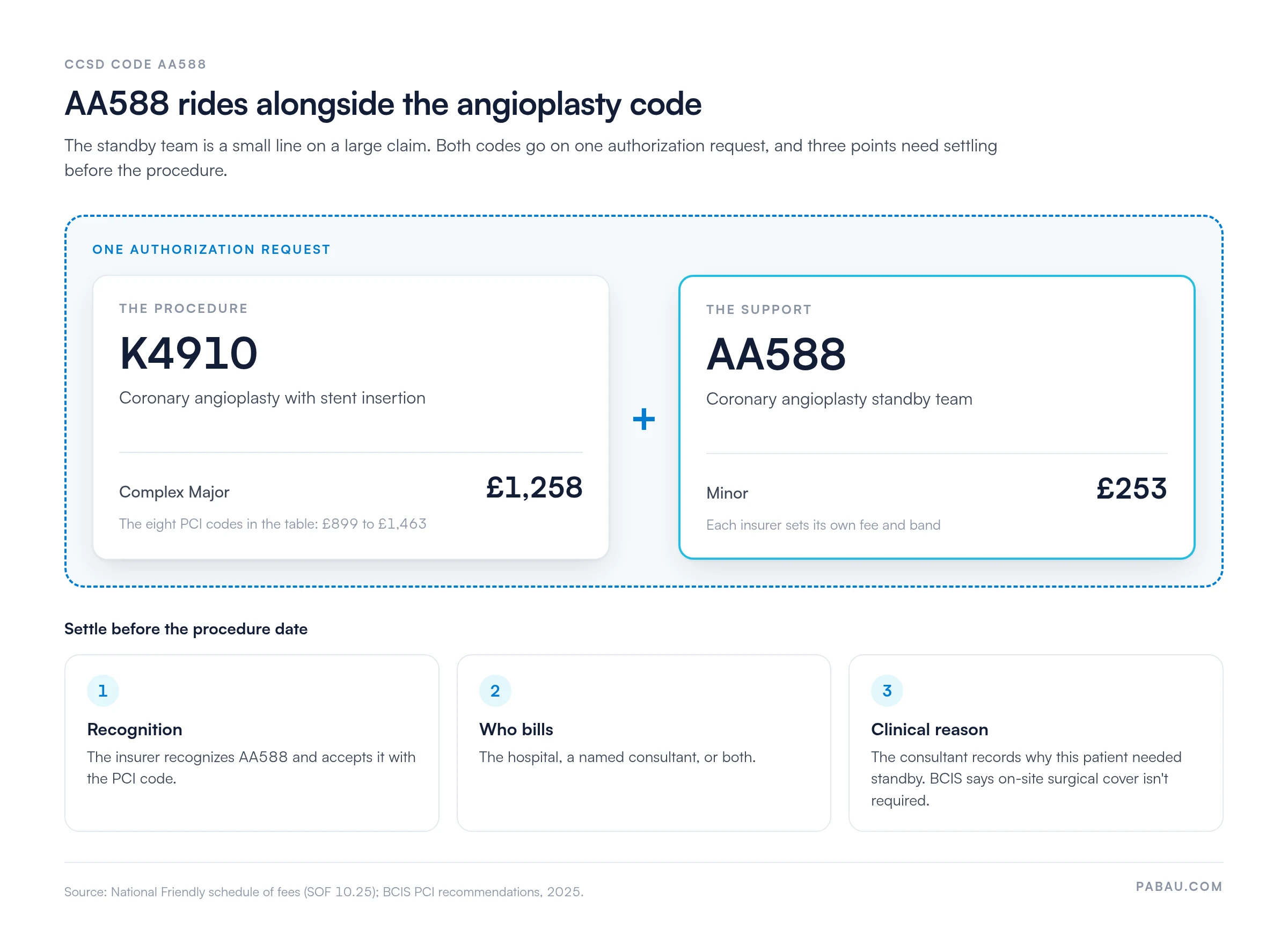
No single fee applies. The Technical Guide leaves eligibility, complexity bands and fees to each funder and provider to agree by contract. National Friendly’s £253 is one insurer’s figure, not a benchmark for the rest.
Schedules also differ on who claims the code. Salisbury NHS Foundation Trust’s private patient tariff lists AA588 under its PCI service, with a day bed rate included. That makes it a hospital charge there.
So before you bill, confirm whether the insurer expects the AA588 claim from the hospital, a named consultant, or both. Then check the current figure in that insurer’s own schedule:
The safest time to settle AA588 is at authorization, before the procedure date. Work through these steps.
A standby claim is only as strong as the record behind it. Build these details into your templates, so they’re captured on the day rather than rebuilt from memory:
If the team was called and emergency surgery followed, that surgery is coded in its own right. The Technical Guide says complications are coded to the final intervention performed, and insurers may add local policies.
The claim follows the angioplasty claim closely. Keep the two in step at every stage.
The problems below follow from the code’s short narrative and the BCIS position on surgical cover. The table pairs each failure point with the fix.
An AA588 claim fails when it drifts away from the procedure it supported. In many practices, the standby note sits in one system, the authorization in an email and the invoice in the Healthcode portal.
Pabau, the billing and patient records software we build, keeps the procedure note, consent, authorization reference and invoices on one patient record. Its private practice claims software pre-fills the Healthcode submission from the invoice, so nobody re-keys codes.
Before a claim goes out, Pabau checks that details such as the membership number and authorization code are filled in. If one is missing, the claim can’t be sent until it’s fixed. That stops an AA588 line leaving without the reference it depends on.
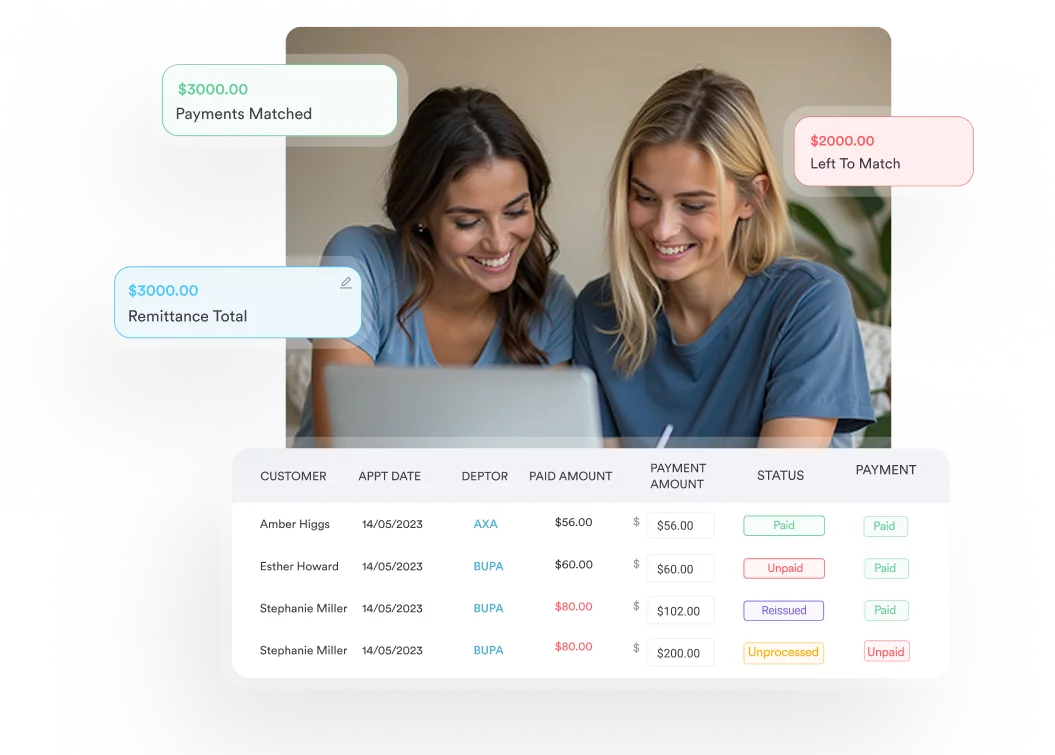

Pabau holds the authorization, consent and procedure note on one patient record. Your team sends AA588 and the angioplasty claim through Healthcode with the required details checked first.

AA588 is a small code attached to a major procedure, and that’s where the risk sits. Settle three points at authorization: that the insurer recognizes it, who bills it, and why this patient needed standby.
With BCIS no longer expecting on-site surgical cover, the consultant’s reason is what the insurer weighs. Record it before the procedure, and the claim carries its own evidence.
Pabau keeps that reason, the authorization and both claims on one record. Book a demo to see how it handles a standby claim alongside the angioplasty it supported.

Need the wider schedule? Pabau’s CCSD codes guide explains how the schedule works across UK private insurers.
Submitting to Bupa? Bupa CCSD codes covers Bupa’s code rules and authorization requirements.
Billing cardiac tests as well? CCSD code 20130 covers exercise ECG billing for UK private practice.
AA588 is the CCSD code for a coronary angioplasty standby team. It covers a team held ready while a cardiologist performs coronary angioplasty. The angioplasty itself is billed under its own code.
No. AA588 covers standby cover during coronary angioplasty, and there is no AA series for therapy sessions. Bupa, for example, bills physiotherapy under a Physiotherapy in Person or Remote Physiotherapy CCSD code.
It depends on the insurer. National Friendly’s schedule of fees lists AA588 as a Minor procedure with a £253 fee. Other insurers set their own fees, so check the paying insurer’s schedule.
AA588 describes cover around the procedure, so it sits alongside the PCI code. Insurer rules on multiple codes differ, though. Put both codes on the authorization request and confirm the insurer accepts them together.
Not routinely. BCIS recommendations published in 2025 say on-site surgical cover for PCI is not required. Hospitals without cardiac surgery agree an emergency transfer protocol with a surgical center instead.