CCSD code H4430: Examination of rectum under anaesthetic
CCSD code H4430 pays for the examination alone CCSD code H4430 is the UK private...

Last Updated: Oct 20, 2026
B0813 is the CCSD code for total thyroidectomy including block dissection of lymph nodes. It covers removal of both thyroid lobes and the isthmus, plus a formal en-bloc dissection of a named cervical lymph node compartment. Both are billed as one bundled procedure.
B0813 sits in the B08 thyroid surgery family at Major complexity. It applies only when the operative note documents both elements. If nodes were only sampled, or a sentinel biopsy was done, the correct code is B0812.
Let Pabau's smart automation suggest the right codes, reduce claim denials, and keep your practice compliant—effortlessly.
Automate repetitive tasks and focus on what matters most—your patients.
Reduce coding errors and ensure compliance with the latest regulations.
Clean claims, fewer denials, and faster reimbursements.
Powerful insights and reporting to help your practice thrive.
HIPAA compliant SOC 2 certified GDPR-compliant Trusted by 4,000+ clinics worldwide

CCSD code B0813 covers total thyroidectomy combined with formal block dissection of lymph nodes, billed as a single bundled procedure code.
B0813 is only valid when the operative note explicitly documents a formal block dissection, not lymph node sampling or sentinel node biopsy.
Pre-authorization obtained for B0812 does not automatically extend to B0813 if the surgical plan changes intraoperatively.
Pabau’s claims management tools help UK surgical practices code CCSD claims accurately and track each claim’s status by insurer.
CCSD code B0813 is the procedure code for total thyroidectomy including block dissection of lymph nodes. It sits in the Clinical Coding & Schedule Development (CCSD) schedule, the procedure coding framework used by all major UK private medical insurers. Bupa applies the same codes, as its Bupa CCSD code guide shows.
B0813 belongs to the B08 thyroid surgery family and carries Major complexity. The key word in its descriptor is “including.” The block dissection of lymph nodes is bundled into this single code, so billers must not add a separate lymph node dissection code alongside it. Doing so is unbundling, and it reliably triggers a denial.
B0813 applies when all three of the following are true:
Total thyroidectomy with block dissection is a major combined procedure. It’s most often performed for papillary or medullary thyroid carcinoma where regional lymph node spread is confirmed or anticipated. On the claim, that diagnosis is usually reported with ICD-10 code C73.
The surgery has two distinct components, and the operative note must document both for B0813 to be valid. The thyroidectomy component removes both thyroid lobes and the isthmus, with care taken to preserve the parathyroid glands and the recurrent laryngeal nerves.
The block dissection component removes a defined cervical lymph node group en bloc. That’s typically the central compartment (level VI) or the lateral neck (levels II–V), depending on the extent of disease.
Selective lymph node sampling and sentinel node biopsy are different techniques. They remove individual nodes or a small representative sample, and neither counts as a block dissection. If the surgeon sampled nodes rather than dissecting a compartment, B0812 is the correct code.
Phrases such as “lymph nodes removed” or “lymph node clearance performed” are insufficient. The note should state which compartment was dissected (central, lateral, or bilateral) and that the dissection was performed en bloc. It should also request formal pathological examination of the excised lymph node specimen.
The most consequential decision in thyroid surgery billing is whether to use B0812 or B0813. The lymph node block dissection decides it. If it’s present and formally documented, bill B0813. If it’s absent, or the surgeon sampled nodes only, bill B0812.
Upcoding to B0813 when only sampling occurred is a billing compliance risk. Downcoding to B0812 after a full block dissection undervalues the surgeon’s work and leaves the claim underpaid.
Most thyroid procedures sit in the B08 family of CCSD codes, but re-operations are coded separately. A completion thyroidectomy after an earlier lobectomy, for example, is billed as B1250.
A bilateral resection that leaves a remnant on each side is B0820, not a total thyroidectomy. A partial resection matching no named descriptor falls to B0860, the residual code for partial thyroidectomy not elsewhere classified.
Billers in endocrine or head-and-neck surgical practices should know the whole set. That way, codes follow the operative findings rather than the plan made before the patient went into surgery.
Read the operative note against three questions, in order, and stop at the first outcome that fits.
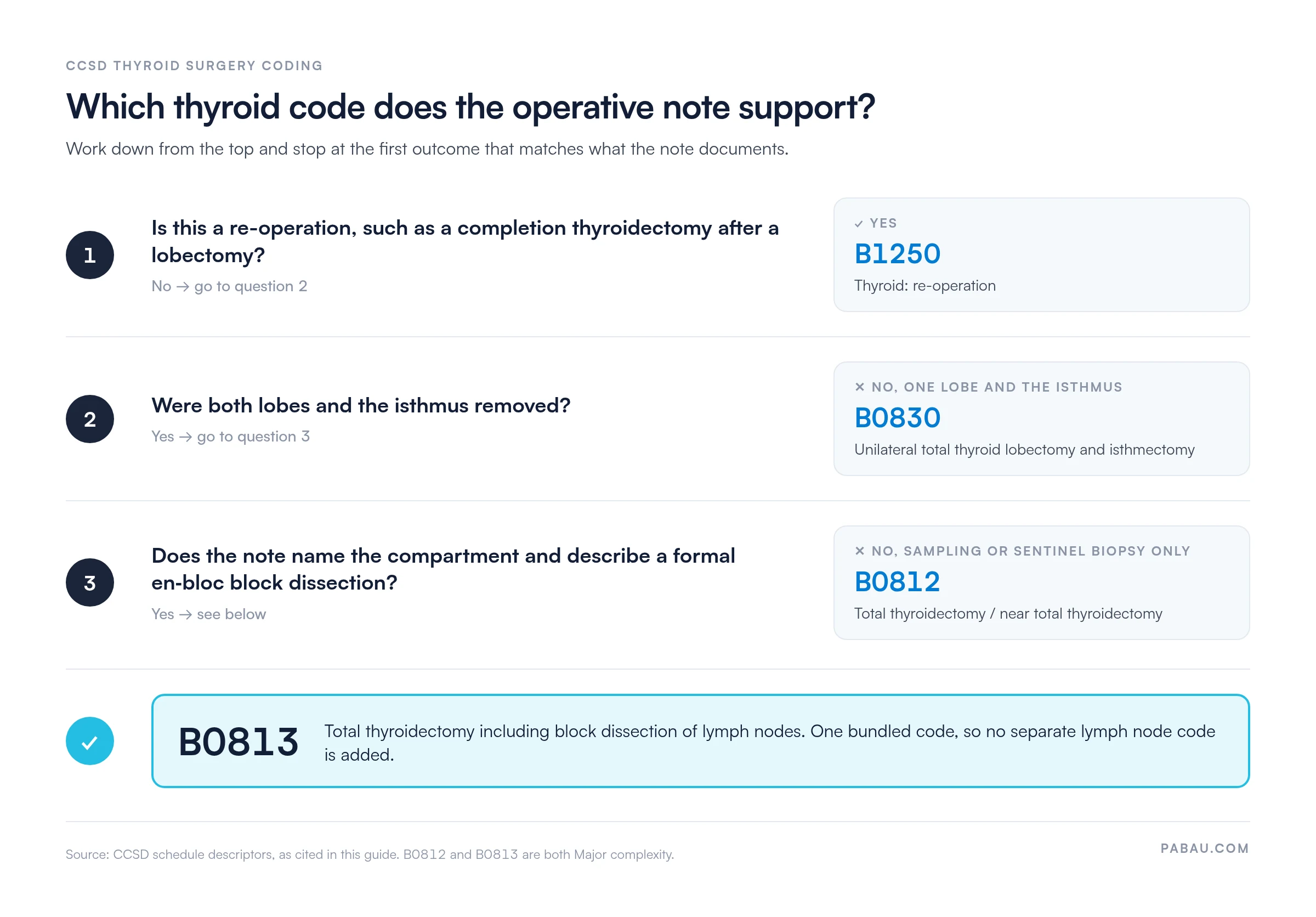
Insurer reviewers assessing a B0813 claim read the operative note first, and vague language fails. The note must show, in surgical terms, that both the thyroidectomy and the block dissection were performed as the code describes.
The following elements must appear in the operative record to support a B0813 claim. Missing any one of them gives the insurer grounds to downcode to B0812 or reject the claim outright.
Structured operative note templates help here. A template can prompt the surgeon for each element above before the note is finalized. That catches a missing compartment long before the claim reaches the insurer.
B0813 is a major surgical procedure, and all major UK private medical insurers require pre-authorization before it goes ahead. The harder part is how that authorization interacts with decisions made during surgery.
Say pre-authorization was obtained for B0812, and the surgeon then finds nodal involvement that needs a formal block dissection. The existing authorization does not automatically extend to B0813. Contact the insurer to request re-authorization before the surgical plan changes, or immediately after the procedure if the change was clinically unavoidable.
Fee amounts for B0813 vary by insurer and are updated periodically. Check the current insurer fee schedule before quoting a procedure fee to a patient, rather than relying on figures from a previous billing cycle.
B0813 attracts a specific set of denial patterns, and most are preventable with better documentation and clearer pre-authorization communication. These are the denial triggers billing staff report most often for this code.
B0813 covers the surgeon’s fee for the combined procedure. Anesthetic fees are separately billable under the applicable CCSD anesthetic codes, and the anesthetist invoices them independently. The surgeon’s billing team does not include anesthetic fees within a B0813 claim.
Assistant surgeon fees are separately billable where applicable. This depends on the insurer’s policy and whether an assistant was clinically necessary for the procedure. Document the assistant’s role in the operative note, and verify whether the insurer covers assistant fees for B0813 before submitting.
Several additional codes can legitimately appear alongside B0813, provided each is separately documented and medically justified. However, some insurers apply global fee policies that cover all components of the procedure under a single tariff. Check with each insurer before co-billing any of the following.
Before co-billing any additional codes alongside B0813, check the relevant insurer’s current fee schedule. Bupa, AXA Health, Aviva, and Cigna each publish their own schedules and global fee policies. What is separately billable under one insurer’s tariff may be bundled into B0813 under another. Confirm in writing where possible and retain that confirmation with the claim file.
Submitting a B0813 claim correctly the first time is faster and less costly than managing a denial and appeal. The following sequence applies to most major UK private medical insurers, though each insurer’s portal and submission timeline may differ slightly.
In many surgical practices, the operative note lives in one system and the pre-authorization reference in another. Claims are then chased by phone, one insurer at a time. That split is how a B0813 claim goes out against a B0812 authorization, or without the compartment named.
Pabau’s claims management software keeps the treatment note, the invoice, and the insurer claim on the same patient record. Operative note templates can prompt the surgeon for the compartment, the en-bloc description, and the pathology request before sign-off.
Once a claim is submitted, the claims dashboard sorts it by status and insurer. A queried B0813 claim with Bupa or AXA Health surfaces while there’s still time to send the operative note, not weeks later.
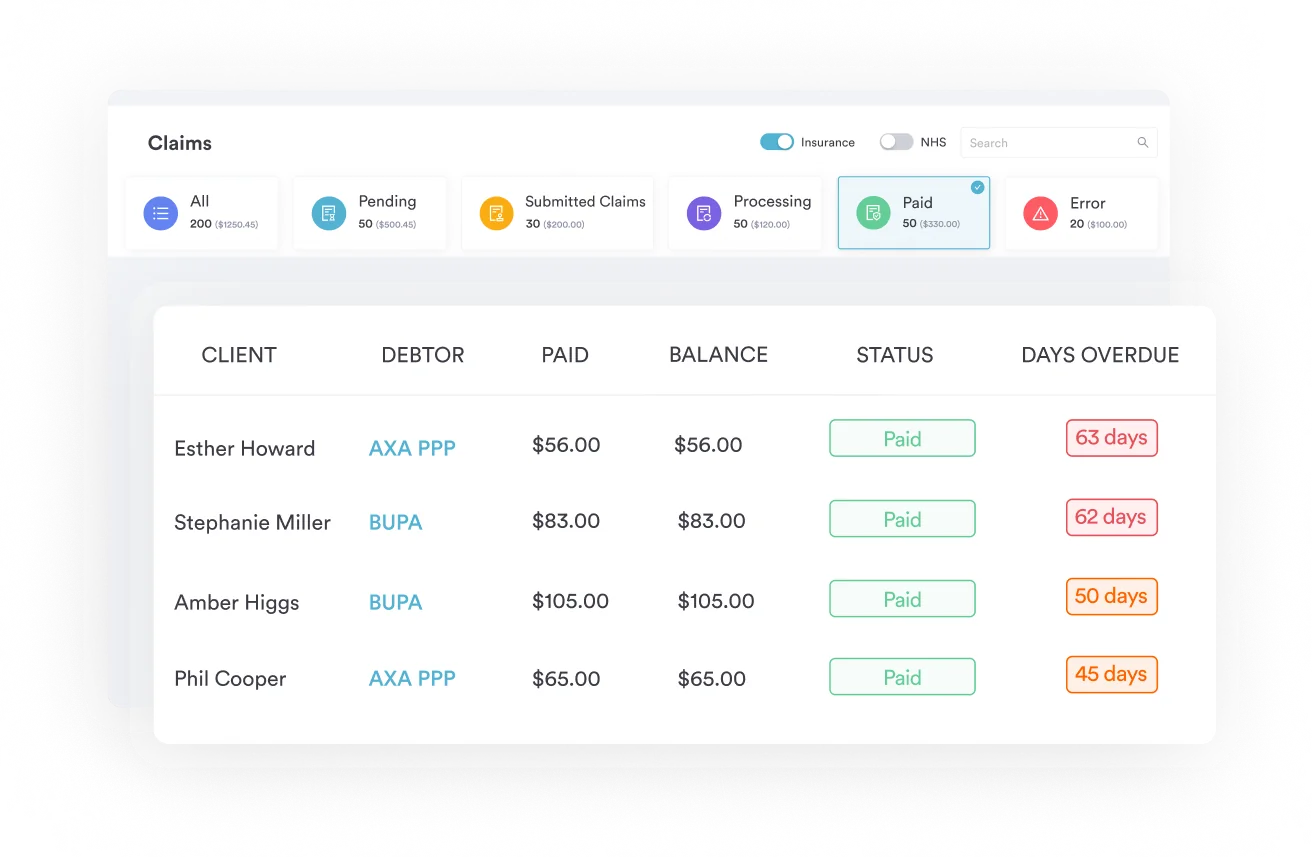

Pabau helps UK private practices code CCSD claims accurately, keep the operative note with each claim, and track every insurer claim through to payment.

Code B0813 from the operative note, never from the booking. If the note names the compartment and describes an en-bloc dissection, B0813 stands up with any major UK insurer. If it doesn’t, bill B0812 and accept the lower fee rather than defend an upcode.
The costliest errors happen before the claim is written. An authorization left at B0812 after an intraoperative upgrade can’t be fixed at submission, and neither can a note that says “nodes removed.” Those checks belong in surgical scheduling and in your note templates.
Book a demo to see how Pabau keeps operative notes, authorizations, and CCSD claims together for your surgical practice.

Need to understand UK private practice billing compliance? Medical billing compliance for private practices covers documentation standards, audit readiness, and insurer requirements.
CCSD code B0813 covers total thyroidectomy including block dissection of lymph nodes as a single combined procedure. It applies when the surgeon removes the entire thyroid gland and performs a formal en-bloc dissection of a defined cervical lymph node group. The block dissection is bundled into B0813 and must not be billed separately.
B0812 covers total thyroidectomy alone, without a formal lymph node block dissection. B0813 covers total thyroidectomy including block dissection of lymph nodes. It is only valid when the operative note documents a formal block dissection of a defined cervical compartment. If lymph nodes were sampled or a sentinel biopsy was performed instead, B0812 is the correct code.
Yes, the lymph node block dissection is included within B0813. The word “including” in the official descriptor means the dissection is bundled into the single code. Adding a separate lymph node dissection code is unbundling, and it is a direct denial trigger with all major UK private medical insurers.
All major UK private medical insurers require pre-authorization for B0813, including Bupa, AXA Health, Aviva, and Cigna. Request the authorization for B0813 specifically. If a B0812 plan changes during surgery to include a formal block dissection, contact the insurer. Amend the authorization before or immediately after the procedure.
The most common reason is an operative note that doesn’t explicitly document a formal block dissection. Others include billing B0813 when only sampling or sentinel biopsy was performed, or billing it against a B0812 authorization. Insurers also deny claims that add a separate lymph node code, or where they don’t recognize the surgeon. Precise notes and timely pre-authorization prevent most of these denials.
The operative note must confirm that both thyroid lobes and the isthmus were removed. It must use the term “block dissection” or equivalent surgical terminology, not simply “lymph nodes removed.” It should name the cervical compartment dissected: central level VI, lateral levels II–V, or bilateral. It should also request formal histopathology of the excised node specimen. Vague documentation leads the insurer to downcode to B0812 or reject the claim.