HCPCS code G0143: Thin-layer Pap screening with rescreening
HCPCS code G0143 means two manual reads of one liquid-based slide HCPCS code G01...

Last Updated: Oct 19, 2026
A4500 is the HCPCS Level II code for surgical stockings below knee length, each. It describes one knee-high surgical stocking, not a pair, and its descriptor names no compression class.
Medicare does not pay on this code. CMS lists surgical stockings among items that do not meet the statutory definition of a surgical dressing, so A4500 is statutorily non-covered. Medicaid programs and commercial plans set their own rules, and that is where billing work on this code pays off.
Let Pabau's smart automation suggest the right codes, reduce claim denials, and keep your practice compliant—effortlessly.
Automate repetitive tasks and focus on what matters most—your patients.
Reduce coding errors and ensure compliance with the latest regulations.
Clean claims, fewer denials, and faster reimbursements.
Powerful insights and reporting to help your practice thrive.
HIPAA compliant SOC 2 certified GDPR-compliant Trusted by 4,000+ clinics worldwide

HCPCS Code A4500 describes one below-knee surgical stocking, billed per stocking rather than per pair, and its descriptor names no compression class.
Medicare treats A4500 as statutorily non-covered under CMS Policy Article A54563, so no order, diagnosis or modifier makes the claim payable.
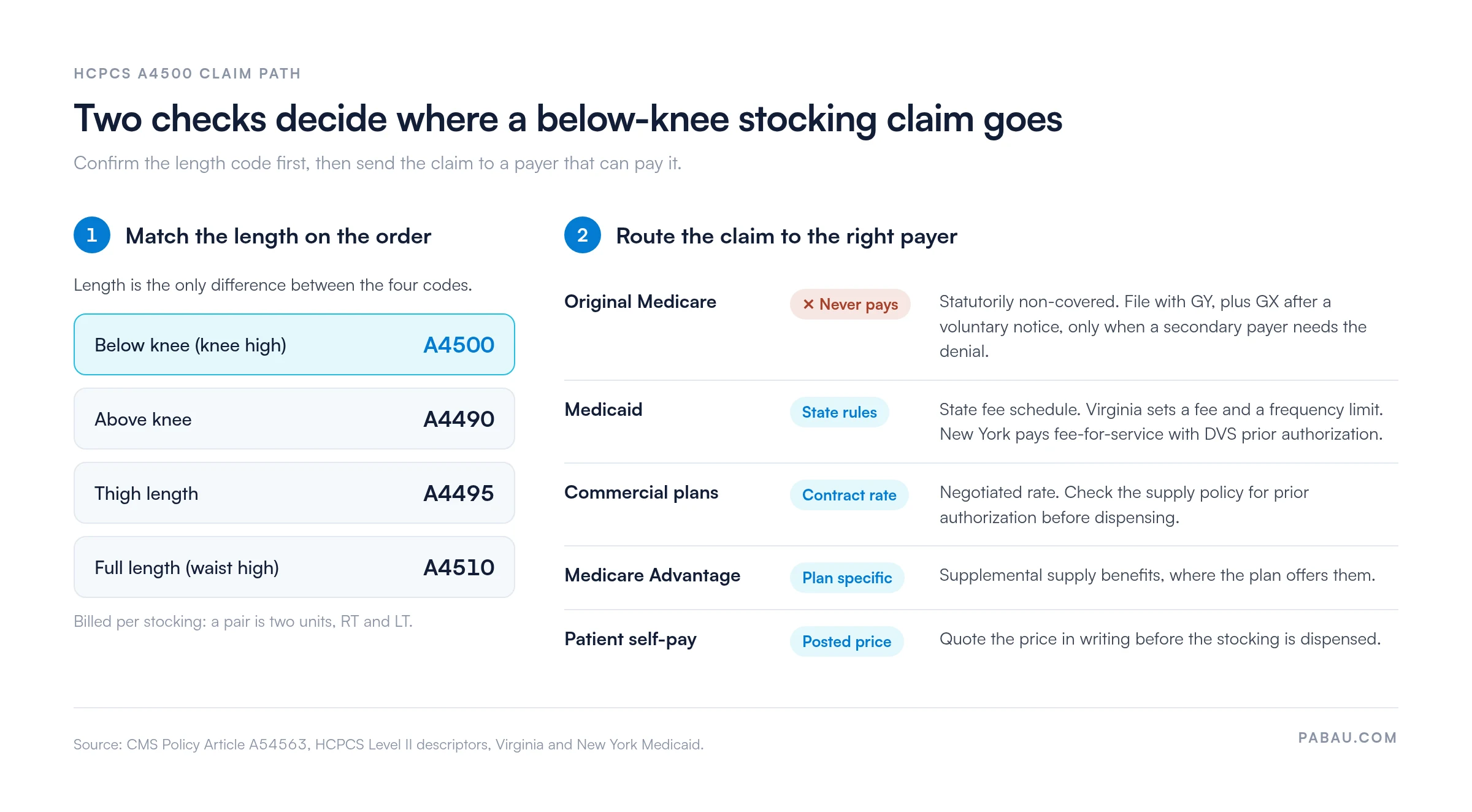
Length is the only difference between A4490 (above knee), A4495 (thigh length), A4500 (below knee) and A4510 (full length).
Medicare pays only gradient compression stockings A6531 and A6532, and only to treat an open venous stasis ulcer.
Practice software such as Pabau helps submit and track claims with the codes and diagnoses your team has already entered.
HCPCS Code A4500 is a CMS HCPCS Level II supply code with the official descriptor: Surgical stockings below knee length, each. It has been part of the code set since 2003. The code is valid and active, but Medicare assigns it no benefit category.
That one fact shapes the whole billing workflow. The quick-reference table below shows the data points coders need before an A4500 claim goes to any payer.
Because Medicare recognizes no benefit category for A4500, the usual DMEPOS coverage checklist never comes into play. There is no medical-necessity test to pass and no prior authorization to request. Payment, where it exists, comes from a state Medicaid fee schedule or a commercial contract.
A4500 describes a single knee-high surgical stocking. Length is the only attribute the descriptor sets, so the code is silent on how much pressure the garment applies. Claims that cite an mmHg value as part of A4500 are reading a requirement into the code that CMS never wrote.
Clinicians commonly prescribe a below-knee surgical stocking for:
Those indications describe clinical use, not Medicare coverage. A documented DVT or a confirmed venous diagnosis does not make an A4500 claim payable by Medicare. The exclusion sits in the benefit definition itself, so it applies before any medical-necessity review.
During an inpatient stay, anti-embolism stockings are part of the facility payment and are not billed separately. Outpatient stockings are a separate question, answered by the Medicaid program or commercial plan that covers the patient.
The four surgical stocking codes differ by garment length and nothing else. Choosing the wrong one is the most common coding error in this family. It usually happens when the order says compression stocking and leaves the length out.
When the order says knee high or below knee, A4500 is correct. A full-length garment is HCPCS code A4510, and an above-knee one is HCPCS code A4490. When the order is silent on length, ask the prescriber before dispensing rather than after a commercial denial.
Medicare does not pay for A4500 under any circumstances. The CMS Surgical Dressings policy article (A54563) names surgical stockings A4490, A4495, A4500 and A4510. None of them meets the statutory definition of a surgical dressing, so all four are non-covered.
The surgical dressings benefit itself is set out in LCD L33831. A statutory exclusion works differently from a medical-necessity denial in several ways.
Medicare does pay for two gradient compression stockings under the surgical dressings policy. A6531 (below knee, 30-40 mmHg) and A6532 (below knee, 40-50 mmHg) are payable only to treat an open venous stasis ulcer. Those claims carry the AW modifier plus RT or LT.
A6530, the below-knee 18-30 mmHg gradient stocking, is non-covered as well. Compression garments for lymphedema fall under a separate Medicare benefit with its own codes, and A4500 is not one of them.
Submit A4500 to Medicare only when a secondary payer needs a formal denial on file. Append GY to signal a statutorily excluded item, and add GX if you gave the patient a voluntary notice of liability.
There is no Medicare allowable for A4500. The code carries pricing indicator 00 and no rate in the CMS DMEPOS fee schedule. Locality adjustments, competitive bidding and the January update do not apply to it.
Revenue for below-knee surgical stockings comes from other payers instead. The table below shows what decides the amount in each case.
Commercial contracts rarely price A4500 line by line. The rate usually falls under a supply category, so remittance data is the only reliable guide to what the code earns. Track it per payer over a few billing cycles before you build an expected-payment figure.
The flow below puts the length check and the payer choice in the order a biller meets them.
Documentation still matters once Medicare is out of the picture. Medicaid programs, commercial plans and secondary payers ask for a similar core file, and several of them audit it. The prescriber record and the dispensing record must agree on length, quantity and laterality.
What the patient record should hold before an A4500 claim goes out:
Capture the code, the modifiers and the delivery confirmation at the point of dispensing. That step removes the manual reconstruction work when a payer asks for the file later.
Medicaid programs and commercial plans usually want a supporting ICD-10-CM diagnosis on an A4500 claim. Medicare has no covered-diagnosis list for this code, so the diagnosis cannot change a Medicare outcome. The codes below are common pairings for paying plans, not a Medicare coverage list.
The diagnosis must come from the ordering clinician record, never from the supplier. Check each code against the specific plan supply policy, since commercial and Medicaid lists differ.
Each in the A4500 descriptor means one stocking, not one pair. A bilateral dispense is two units, reported as two lines with laterality modifiers or as two units, depending on the payer.
A clean commercial claim for both legs reads A4500-RT and A4500-LT, one unit each, matched to a delivery receipt for two stockings. Confirm laterality conventions with each plan, and review clean claim standards before the first batch.
A4500 denials split into two groups. Medicare denials are expected and cannot be fixed, while most Medicaid and commercial denials can. Knowing which group a denial belongs to decides whether it is worth reworking.
Sorting denials by reason code separates the two groups quickly. A reference of denial codes in medical billing speeds that triage, and a billing compliance routine keeps the file ready for audit.
Flag A4500 in your claim-scrubbing rules so it never goes to Medicare as a primary claim without GY. One rule at order entry prevents a predictable denial and keeps denial-rate reporting accurate.
A practice dispensing surgical stockings often keeps the order in the chart and the delivery receipt in a folder. The payer response sits in a third place. When a plan asks for the file a year later, someone rebuilds it by hand.
Pabau, the practice management platform we build, keeps the order, the delivery confirmation and the payer response against the same patient record. The file for a supply claim comes out in one step instead of three.
In the US, Pabau claims management software helps submit and track claims with the codes and diagnoses your team has already entered. Your coders still choose A4500 and its modifiers, while the status of each claim stays visible until it is paid or denied.

Pabau helps your team submit and track supply claims with the codes and diagnoses already entered. Orders, delivery proof and payer responses stay in one patient record.

HCPCS Code A4500 is a valid, active supply code that Medicare will never pay. The denial is statutory, so a KX modifier, a diagnosis list or a better-written order cannot reverse it.
The work that pays off is correct length coding, accurate units and a complete file for the Medicaid program or commercial plan that can pay. Send Medicare claims only when a secondary payer needs the GY denial, and stop reworking them after that.
To see how Pabau helps your team submit, track and document supply claims, book a demo.

Billing the full-length garment instead? HCPCS Code A4510 covers the same non-coverage rules for waist-high surgical stockings.
Coding an above-knee stocking? HCPCS Code A4490 explains the above-knee length code in the same surgical stocking family.
Need to map denial reasons to fixes? Denial codes in medical billing is a structured reference for CARC and RARC codes on supply and professional claims.
Want to reconcile what each payer paid? Electronic remittance advice explains how to read ERA files and spot payment variances at the code level.
HCPCS Code A4500 describes one below-knee surgical stocking, billed per stocking rather than per pair. Its descriptor names no compression class. Above-knee, thigh-length and full-length stockings use A4490, A4495 and A4510 instead.
No. CMS Policy Article A54563 lists A4490, A4495, A4500 and A4510 among items that do not meet the statutory definition of a surgical dressing. The claim is denied whatever the documentation shows, and there is no KX, covered-diagnosis or prior authorization pathway.
No. The official descriptor sets only the garment length. Gradient compression stockings with a stated mmHg range use the A6530 to A6532 codes instead.
Some state programs do. Virginia Medicaid lists a fee and a frequency limit for A4500. New York Medicaid pays it in fee-for-service with DVS prior authorization, after reactivating the code in December 2013. Check the state fee schedule and its limits before dispensing.
Medicare does not require an Advance Beneficiary Notice for a statutorily excluded item. Many suppliers still give a voluntary notice so the patient sees the cost in writing. When you do, add GX alongside GY on the claim.
There is none. A4500 carries coverage code M and pricing indicator 00, so the DMEPOS fee schedule publishes no allowable for it. Payment comes from Medicaid, commercial contracts or self-pay.