

HCPCS code E0198: Water pressure pad billing guide
HCPCS code E0198 is a water pad for a standard mattress HCPCS code E0198 is the ...

Last Updated: Oct 13, 2026
A4510 is the HCPCS Level II code for surgical stockings full length, each. It covers one waist-high garment, not a pair, and not the thigh-length code A4495.
Medicare does not pay on this code. CMS lists surgical stockings among the items that do not meet the statutory definition of a dressing, so A4510 is statutorily non-covered. No written order, clinical note or ICD-10-CM pairing changes that. This reference covers length coding, unit and modifier rules, documentation for commercial payers, and the denial patterns that cause the most rework.
Let Pabau's smart automation suggest the right codes, reduce claim denials, and keep your practice compliant—effortlessly.
Automate repetitive tasks and focus on what matters most—your patients.
Reduce coding errors and ensure compliance with the latest regulations.
Clean claims, fewer denials, and faster reimbursements.
Powerful insights and reporting to help your practice thrive.
HIPAA compliant SOC 2 certified GDPR-compliant Trusted by 4,000+ clinics worldwide

HCPCS Code A4510 describes one full-length surgical stocking, billed per stocking rather than per pair
Medicare treats A4510 as statutorily non-covered under CMS Policy Article A54563, so no order or diagnosis makes the claim payable
A4510 differs from A4500 (below knee), A4490 (above knee) and A4495 (thigh length), and length errors are the most common coding mistake in this family
Append GY on a Medicare claim, and only when a secondary payer needs a formal denial on file first
Pabau’s claims management software keeps supply orders, delivery proof and payer responses in one audit-ready record
HCPCS Code A4510 is a CMS HCPCS Level II supply code with the official descriptor: Surgical stockings full length, each. It sits in the A-code range of HCPCS Level II, which covers medical and surgical supplies. The code is valid and active, but Medicare assigns it no benefit category, so a claim submitted to Medicare is denied as statutorily non-covered.
That single fact reorganizes the billing workflow. The quick-reference table below shows the data points coders need before submitting an A4510 claim to any payer.
Because Medicare recognizes no benefit category for A4510, the usual DMEPOS coverage checklist does not apply. There is no medical-necessity test to pass and no prior authorization to request. Payment, where it exists, comes from a commercial contract rather than a published Medicare rate.
A4510 describes a single full-leg surgical stocking, meaning a waist-high or pantyhose-style garment. It is not the thigh-length code (A4495), the above-knee code (A4490), or the below-knee code (A4500). The garment must be a medical-grade compression stocking supplied on a physician’s order, not an over-the-counter support hose.
Clinical conditions for which a full-length surgical stocking is commonly prescribed include:
Those indications describe clinical use, not Medicare coverage. A documented DVT or a confirmed lymphedema diagnosis does not make an A4510 claim payable by Medicare. The exclusion is written into the benefit itself, not into a medical-necessity rule.
Stockings billed under A4510 are also distinct from anti-embolism stockings (TED hose) used in inpatient or immediate post-operative settings. TED hose are supplied as part of the hospital charge and are never separately billable to Medicare. Commercial plans treat both categories under their own supply policies, which is where the coverage question gets answered.
A4510 covers full-leg stockings and A4500 covers below-knee stockings. Choosing the wrong code is the most frequent error in this product category. The prescribing order often omits the length, and the coder defaults to the familiar code. Neither code is payable by Medicare, so the consequence lands with the commercial payer or shows up as a compliance finding.
When the order specifies “full length” or “waist high,” A4510 is correct. When the order says “knee high,” use A4500. When the order is silent on length, contact the prescriber to clarify before dispensing and billing, not after a denial arrives.
Medicare does not pay for A4510 under any circumstances. The CMS Surgical Dressings policy article (A54563) names surgical stockings A4490, A4495, A4500 and A4510. None of them meets the statutory definition of a dressing. They are non-covered under the surgical dressings benefit set out in LCD L33831.
This is a statutory exclusion, not a medical-necessity decision. The distinction matters, because the two are worked in completely different ways.
The denial reads as statutorily non-covered, no benefit category. A team that reworks it as a documentation problem spends hours on a claim that was never payable. Routing the line to the secondary payer or to self-pay on first receipt ends that cycle.
Plan type is still worth checking before writing the patient off as self-pay. Some Medicare Advantage plans add supplemental supply benefits that original Medicare does not offer. Medicaid and commercial coverage varies by state and by contract. Verifying the patient’s benefits before each dispensing cycle is the step that protects revenue here.
Submit A4510 to Medicare only when the patient’s secondary payer needs a formal denial on file. Append GY to signal a statutorily excluded item, and add GX if you issued a voluntary notice of liability. Filing without GY invites a different denial reason and a slower turnaround.
There is no Medicare allowable for A4510, in 2025, 2026, or any prior year. The code carries no published rate in the CMS DMEPOS fee schedule, because a statutorily excluded item has no price to publish. Competitive bidding, jurisdiction differences and the annual January update are all irrelevant to this code.
Revenue for full-length surgical stockings comes from three places instead. The table below shows what determines the amount in each case.
Commercial contracts rarely name A4510 line by line. The rate usually falls under a supply category, which means the finance team needs the remittance data to know what the code earns. Reading the remittance advice after each batch submission is how that figure gets established. Tracking it per payer across a billing cycle shows where the supply category actually lands.
Build your A4510 expected-payment model from commercial remittance data, never from a Medicare fee schedule lookup. The lookup returns no allowable for this code, and a zero can be misread as a data error rather than a statutory exclusion. Record the contracted supply rate per payer instead.
Documentation still matters once Medicare is out of the picture. Commercial plans, Medicaid programs and secondary payers all ask for the same core file, and several of them audit it. The ordering physician’s records and the supplier’s dispensing records must agree. A discrepancy between the two is the fastest way to lose a commercial appeal.
What the patient record should hold before an A4510 claim goes out:
Put the order and the clinical notes in the file before submission, not after a denial. A charge-capture step that records the HCPCS code, the modifiers and the delivery confirmation at the point of dispensing removes the manual reconstruction work later. Suppliers are expected to retain this documentation for at least seven years from the date of service.
Commercial payers and Medicaid programs require a supporting ICD-10-CM diagnosis on every A4510 claim. Medicare does not, because the claim is rejected before any diagnosis is evaluated. Pairing the right diagnosis matters for the payers that can pay, and it has no effect on the Medicare outcome.
The diagnosis must be documented in the ordering physician’s medical record, not selected by the supplier. The table below lists the codes most often paired with full-length surgical stockings. Check each against the specific plan’s supply policy before submitting.
Z-codes describing a past condition, such as a resolved DVT, seldom stand alone as the primary diagnosis. Commercial supply policies look for an active condition documented by the treating physician. Where the surgical event has resolved but the venous condition persists, the chronic venous insufficiency or post-thrombotic syndrome code is the better primary.
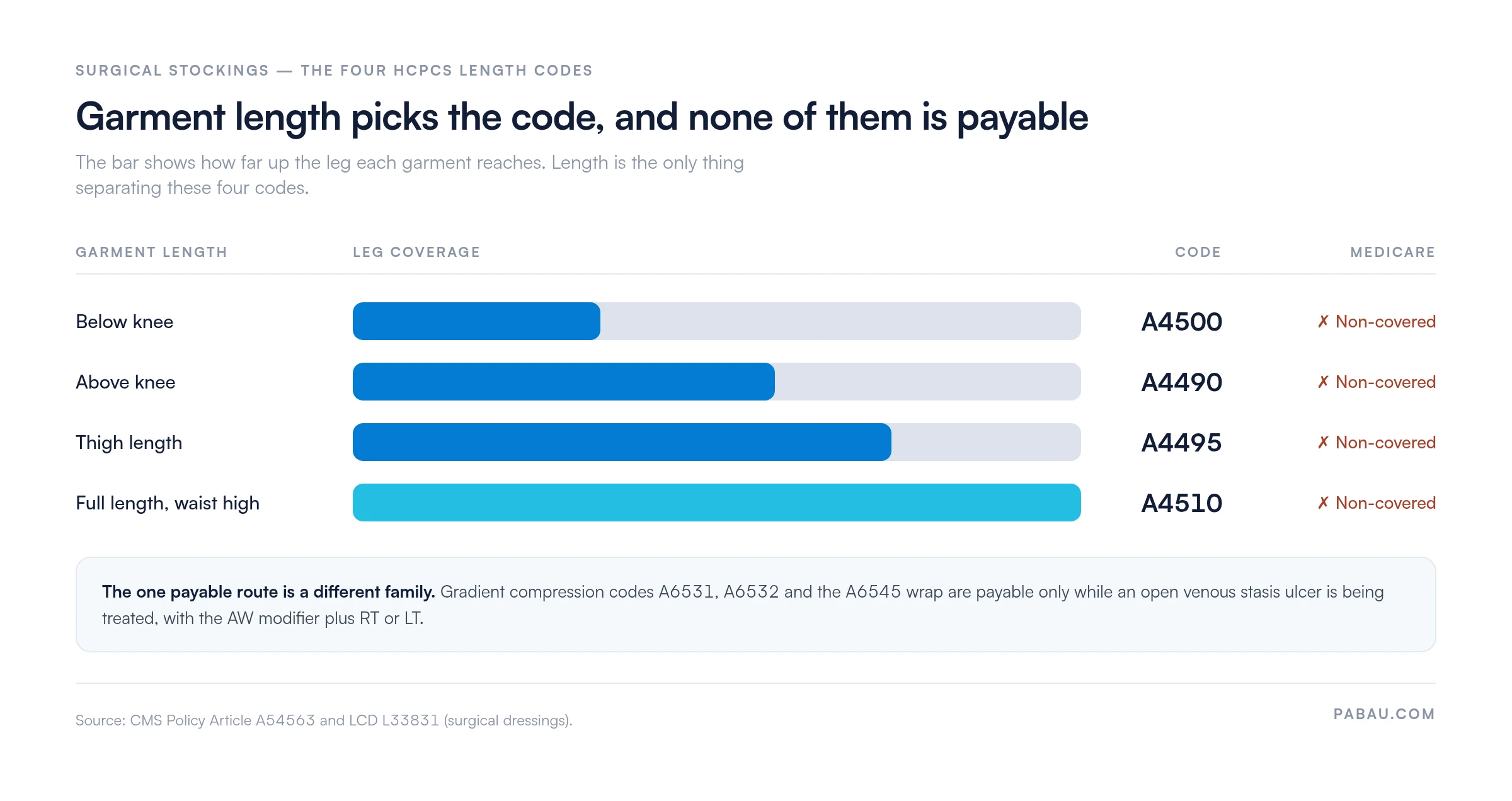
Length and construction decide which code applies. Surgical stockings sit in the A4490 to A4510 range and carry no compression class in the descriptor. Gradient compression garments sit in the A65xx range and name an mmHg class, which is why a few of them behave differently under Medicare.
Under the surgical dressings policy, only A6531, A6532 and the A6545 wrap are payable, and only while an open venous stasis ulcer is being treated. Venous insufficiency without an ulcer, ulcer prevention and lymphedema without ulceration are all listed as non-covered. When one of those three is billed for a qualifying ulcer, the claim needs the AW modifier plus RT or LT. The chart below maps each stocking length to its code and marks where that single payable exception sits.
Separately, Medicare’s Lymphedema Compression Treatment Items benefit covers a defined list of garments for patients with a lymphedema diagnosis. Those codes run roughly from A6501 to A6609, and A4510 is not among them. Where a full-leg garment is prescribed for lymphedema, the payable route runs through the lymphedema codes rather than through A4510.
A4510 carries no compression class in its descriptor, so it cannot tell a payer how much pressure the garment applies. When the physician’s order specifies an mmHg range, the A65xx family is usually the correct one to bill. Where the order stops above the knee rather than at the waist, A4490 is the code to bill.
“Each” in the A4510 descriptor means one stocking, not one pair. This is the most costly unit-billing mistake in the stocking supply category. A bilateral dispensing is two units of A4510, reported either as two units or as two lines carrying laterality modifiers, depending on payer preference.
Modifiers applicable to A4510 claims:
Bilateral billing on a commercial claim usually requires two line items: A4510-LT and A4510-RT. Billing one unit with no modifier for a bilateral dispense under-bills by half and creates a mismatch against the delivery receipt. A clean submission here means two line items, each carrying its laterality modifier, and a delivery confirmation that references both units.
A billing review of stocking claims should audit modifier usage alongside unit counts every cycle. Confirm current modifier requirements with each payer, since commercial plans set their own conventions for supply laterality.
A4510 denials split into two groups. Medicare denials are expected and cannot be fixed, and commercial denials usually can be. Knowing which one you are looking at decides whether the claim is worth reworking at all.
Routing denials by reason code lets billing teams separate the two groups automatically. Cross-referencing each one against denial codes in billing speeds that triage. The CGS Medicare coding verification guidance is useful for confirming HCPCS product categorization when a denial cites coding inconsistency.
Flag A4510 in your claim-scrubbing rules so it never routes to Medicare as a primary payer by default. One rule at the point of order entry prevents a predictable denial, and it keeps your denial rate reporting honest. Route the line to the commercial plan, the Medicaid program, or self-pay instead.
A practice dispensing surgical stockings keeps the order in the chart and the delivery receipt in a folder. The payer response sits separately, in the billing system. When a commercial plan asks for the file eighteen months later, someone rebuilds it by hand from three places. That work stays invisible until an audit makes it urgent.
Practice management software like Pabau holds those records together. The prescriber’s order, the signed delivery confirmation, the eligibility check and the remittance all sit against the same patient. The complete file comes out in one step.
Pabau’s claims software for practices also carries code-level rules. A supply code that Medicare will never pay gets routed to the correct payer before submission. Billing staff spend their time on claims that can still be paid, and a post-payment review takes days rather than weeks to answer.

Pabau’s claims management tools track supply code documentation, modifier flags, and delivery confirmations in one workflow. Every claim reaches the payer that can actually pay it. See how it works for your team.

HCPCS Code A4510 is a valid, active supply code that Medicare will never pay. CMS lists surgical stockings among the items excluded from the surgical dressings benefit, so the denial is statutory rather than clinical. No written order, chart note or ICD-10-CM pairing changes that result.
The billing work that pays off sits elsewhere. It is correct length coding, accurate unit reporting, and a clean documentation file. Add a payer routing rule that sends the line to the commercial plan, the Medicaid program, or self-pay. That one rule is worth more than any appeal you could file on this code.
To see how Pabau supports supply billing and keeps the documentation file ready for review, book a demo with the team.

Need to understand how denial reason codes map to corrective actions? Denial codes in medical billing provides a structured reference for CARC and RARC codes used in DMEPOS and professional claims.
Want to tighten your overall claims submission workflow? Clean claim submission standards covers the data elements every claim must carry before it reaches the payer.
Looking to reduce payment delays after submission? Electronic remittance advice explains how to read ERA files and reconcile payment variances at the code level.
Billing the above-knee stocking instead? HCPCS Code A4490 covers the same documentation and modifier rules for the shorter garment length.
HCPCS Code A4510 describes a single full-length surgical stocking, meaning a waist-high or pantyhose-style garment, billed per stocking rather than per pair. It is not the code for below-knee (A4500), above-knee (A4490) or thigh-length (A4495) stockings. Medicare assigns the code no benefit category, so payment comes from commercial plans, Medicaid, or the patient.
A4510 is for full-length surgical stockings and A4500 is for below-knee (knee-high) stockings. Garment length decides the code, so bill A4510 when the physician order specifies full length and A4500 when it specifies knee high. Selecting the wrong code from an incomplete order is the most common error in this supply category. Both codes are statutorily non-covered by Medicare.
No. CMS Policy Article A54563 lists surgical stockings A4490, A4495, A4500 and A4510 among items that do not meet the statutory definition of a dressing. They are therefore non-covered under the surgical dressings benefit in LCD L33831. This is a statutory exclusion rather than a medical-necessity decision. No written order, clinical note or ICD-10-CM diagnosis makes an A4510 claim payable, and stockings are not durable, so no DME benefit applies either.
Medicare does not require an Advance Beneficiary Notice for statutorily excluded items, because there is no coverage decision to warn the patient about. Many suppliers still issue a voluntary notice so the patient sees the cost in writing before dispensing. When you do issue one, append the GX modifier alongside GY on the claim.
Under the surgical dressings policy, only A6531, A6532 and the A6545 wrap are payable, and only while an open venous stasis ulcer is being treated. Those claims need the AW modifier plus RT or LT. Medicare also runs a separate Lymphedema Compression Treatment Items benefit, whose codes run roughly from A6501 to A6609, for patients with a lymphedema diagnosis. A4510 appears on neither list.
Yes. A bilateral dispensing is two units, usually reported as two line items: A4510-LT for the left leg and A4510-RT for the right. Billing a single unit with no modifier under-bills by half and creates a mismatch against the delivery receipt. Confirm the preferred format with each commercial payer, since supply laterality conventions vary by plan.
TED hose (anti-embolism stockings) are dispensed in inpatient settings as part of the hospital charge and are never separately billable to Medicare. Surgical stockings billed under A4510 are medical-grade compression garments prescribed for outpatient management of a venous or lymphatic condition. Medicare pays for neither, so the coverage question for both is answered by the commercial plan or Medicaid program.
Medicare has no prior authorization process for A4510, because the code has no benefit category to authorize. Commercial plans are a different matter, and several supply policies require authorization before the garment is dispensed. Verify each payer’s requirement at intake, since a retroactive authorization request is rarely granted.



