CCSD code H4430: Examination of rectum under anaesthetic
CCSD code H4430 pays for the examination alone CCSD code H4430 is the UK private...

Last Updated: Oct 20, 2026
A4465 is the HCPCS Level II code for non-elastic binder for extremity.
Medicare Part B pays it when a signed physician order and medical necessity documentation are on file. Local coverage rules in the beneficiary's jurisdiction still apply. The KX modifier is what tells the payer that documentation exists, and leaving it off is a leading cause of denials on this code.
Let Pabau's smart automation suggest the right codes, reduce claim denials, and keep your practice compliant—effortlessly.
Automate repetitive tasks and focus on what matters most—your patients.
Reduce coding errors and ensure compliance with the latest regulations.
Clean claims, fewer denials, and faster reimbursements.
Powerful insights and reporting to help your practice thrive.
HIPAA compliant SOC 2 certified GDPR-compliant Trusted by 4,000+ clinics worldwide

HCPCS Code A4465 describes a non-elastic binder for extremity, a Level II supply code maintained by CMS.
Medicare Part B covers A4465 as a DMEPOS supply when a signed physician order and medical necessity documentation are on file.
Missing the KX modifier is a leading cause of A4465 denials, and every modifier has to match the documentation you hold.
If the product stretches, A4465 is the wrong code, because elastic bandages fall in the A6448 to A6452 range.
Commercial payers set their own rules for this supply, so verify benefits and prior authorization before you dispense the binder.
HCPCS Code A4465 is the Centers for Medicare & Medicaid Services (CMS) Level II supply code for a non-elastic binder for extremity. The code sits in the A-series of HCPCS Level II. That series covers transportation services, medical and surgical supplies, and other items not captured by CPT (Current Procedural Terminology) codes. CMS publishes and maintains the Level II descriptors annually. The A4465 wording has been stable across recent fiscal years, but check the current year’s CMS HCPCS file before you bill.
The code captures rigid or semi-rigid wraps applied to an extremity for compression, stabilization, or post-surgical support. Products billed under A4465 include figure-eight compression binders, extremity compression wraps, and non-elastic surgical binders sized for the arm or the leg. Clinically, these binders turn up in the management of lymphedema, chronic venous insufficiency, and post-surgical swelling. Elastic bandages such as ACE-style wraps do not fall under A4465, and they carry their own supply codes.
A4465 lives in Level II, not Level I. The structural difference decides which payer route the claim takes and which form it goes out on.
For Medicare, A4465 runs through the DMEPOS pathway, which stands for Durable Medical Equipment, Prosthetics, Orthotics, and Supplies. That means a Durable Medical Equipment Medicare Administrative Contractor (DME MAC) adjudicates the claim rather than a standard Medicare MAC. Practices new to supply billing often route A4465 to the wrong contractor, which adds weeks of processing before the first denial even arrives.
The official CMS descriptor limits A4465 to non-elastic binders applied to an extremity. That wording rules out several products that sit beside it on the same supply shelf.
Material type is the first thing to check, because it decides the whole code family. If the product stretches, it is not A4465. Three questions settle the choice before the supply leaves the building.
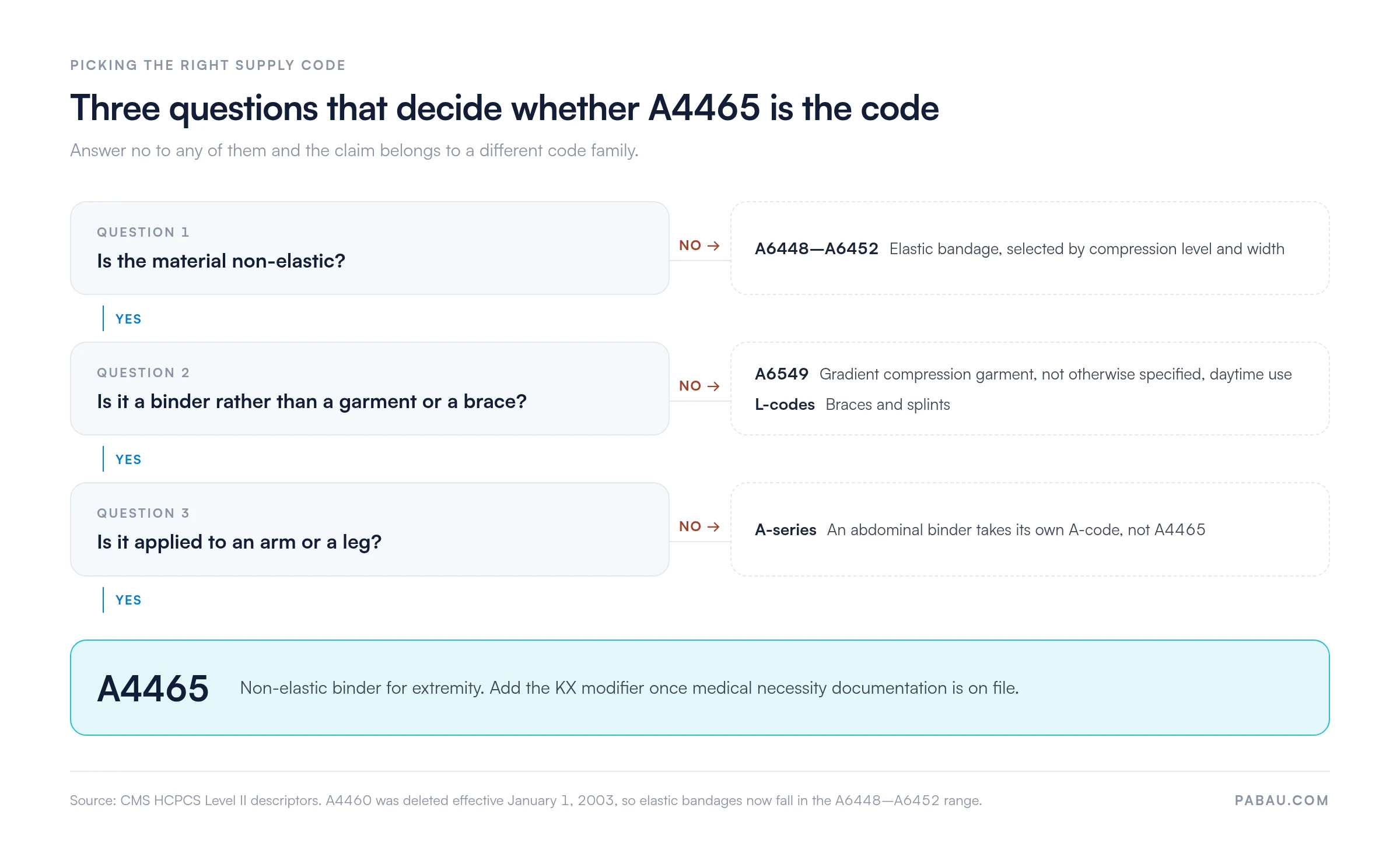
Put material type on the supply order form itself, not just in the clinical note. A line that reads only “compression wrap” leaves the coder guessing, and a guess at this step is what produces a wrong-code claim.
Medicare Part B covers A4465 as a DMEPOS supply when medical necessity criteria are met. The Local Coverage Determination (LCD) for the beneficiary’s region sets those criteria. Coverage is not automatic, and the rules differ by program.
Practices billing across multiple states should write each payer’s A4465 rules into their billing policy manual. The time spent once at the front end saves claim-by-claim research later.
Billing A4465 correctly takes more than picking the right code. Each step below has to happen in sequence, and skipping one at the front shows up as a denial at the end. Practices with real supply volume usually lean on claims management software to hold that checklist for them.
Modifier errors are the single largest cause of A4465 denials. The modifiers below are the ones that come up most often, and which apply depends on the payer and the circumstances.
Confirm modifier requirements with the specific DME MAC or commercial payer before you submit. Policies differ between jurisdictions and change as part of LCD revisions. Reading CMS’s HCPCS coding resources at each annual reset is the cheapest way to stay current.
Thin documentation is a slow-moving denial risk. An ADR may not land until months after the claim pays, and post-payment recovery costs far more than getting the file right the first time. DMEPOS supply codes are held to a stricter documentation standard than most professional services.
Every one of those records should be retrievable within 24 hours of an ADR arriving. Practices working from paper files or scattered drives routinely miss the response deadline, which turns a recoverable claim into a permanent write-off.
Commercial payers do not inherit Medicare’s DMEPOS rules. Some cover A4465 at parity with Medicare. Others apply different criteria, require pre-authorization, or exclude the code outright. Assuming commercial coverage mirrors Medicare is what produces the most avoidable denials on this code.
Record the verification result in the patient’s account before the binder is dispensed. A timestamp, the representative’s name, and the call reference number give you a defensible record if the claim later denies on coverage grounds. The AAPC HCPCS Level II code lookup is useful for checking the payer policy notes attached to A4465.
Before you dispense any A4465 supply, log the benefit verification call. Note the date, the payer representative’s name, the call reference number, and the coverage status they confirmed. That log is your first line of defense if a commercial payer denies the claim weeks later.
Practices billing A4465 hit the same denial patterns again and again. The errors are predictable, which makes them preventable with a short pre-submission check. Supply-code denials also need a different lens than professional service denials, because the triggers sit further upstream.
Patterns like these are worth a quarterly review. Pull your A4465 denial history, sort it by CARC code, and find which error type repeats most at your practice. Fixing the most frequent reason recovers revenue faster than a broad policy change. Our guide to denial codes in billing maps each CARC and RARC code back to its root cause.
A4465 sits in a cluster of adjacent supply codes in the HCPCS A-series. Coders billing one of them run into the others in clinical practice. Knowing where each boundary falls avoids unbundling errors and downcoding.
One retired code is worth knowing about, because old charge masters still carry it. A4460 was deleted effective January 1, 2003. Its former descriptor covered an elastic bandage, per roll. Any elastic bandage supplied today is coded from the A6448 to A6452 range instead, chosen by compression level and width.
Where the documentation supports A4465 specifically, meaning non-elastic material and extremity application, bill A4465 rather than a broader NOS code. Specificity supports medical necessity and lowers the risk of payer downcoding.
Audit your charge master for A4460. The code was deleted in 2003, so a live A4460 line means someone is still selecting a retired code at order entry. Replace it with the A6448 to A6452 range, then check whether any of those claims should have been A4465 all along.
Most A4465 denials trace back to a document nobody could find quickly. The signed order sits in a scanner folder and the clinical note sits in the chart. The invoice sits in an accounting tool that never sees either of them. When the ADR arrives, someone spends a day reassembling a claim worth a fraction of that day’s labor.
Practice management software like Pabau keeps those pieces in the same patient record. The physician order, the intake and consent forms, the treatment note, and the invoice all attach to the same patient file. A documentation request then becomes a lookup rather than a search. That is the difference between answering an ADR inside the deadline and writing the claim off.
Pabau also itemizes each supply on the invoice and reports on what every payer actually paid. So you can see which supply lines keep coming back unpaid and fix the order form before the next batch of claims goes out.

Pabau holds the physician order, the signed forms, the clinical note, and the invoice in a single patient record. So when a payer asks what supported an A4465 claim, your team answers in minutes instead of days.

A4465 denials cluster around two failure points: the modifier and the documentation. Neither one starts at billing. Both start at the order and at the moment the binder comes off the shelf. Build the requirements into those two steps and the claim goes out clean the first time.
The trade-off worth remembering is that A4465 is a small line item with outsized audit exposure. The supply itself barely moves the monthly number, but an unanswered ADR can claw back months of paid claims. That asymmetry is why the order form deserves more of your attention than the claim form does.
Book a demo to see how Pabau keeps supply orders, signed forms, and invoices in one patient record, ready for the next documentation request.

Need a framework for reducing claim denials practice-wide? Denial management in healthcare covers root-cause analysis workflows for common CARC codes across payer types.
Want to understand the full revenue cycle behind supply billing? Revenue cycle management explained breaks down each stage from patient intake to remittance posting.
Preparing a compliant superbill that captures HCPCS codes? How to build a superbill walks through charge capture design for both CPT and HCPCS Level II codes.
Checking benefits before you dispense a supply? Insurance eligibility verification sets out what to confirm with the payer, and when in the visit to confirm it.
HCPCS Code A4465 is a Level II supply code that describes a non-elastic binder for extremity. It is used to bill Medicare, Medicaid, and commercial payers for non-elastic compression or stabilization binders applied to an arm or a leg. CMS maintains it and updates the descriptor annually with the rest of the HCPCS Level II code set. Elastic bandages are not covered under this code.
Medicare Part B may cover HCPCS Code A4465 as a DMEPOS supply when medical necessity is established and a valid physician order is on file. Coverage is subject to the Local Coverage Determination (LCD) issued for the patient’s DME MAC jurisdiction. Reimbursement rates change annually, so check the CMS fee schedule lookup for the current year’s allowable amount.
KX is the modifier most often required on A4465 Medicare claims, and it signals that medical necessity documentation meets LCD criteria. GA applies when an ABN has been signed. RT and LT indicate the right or left extremity where the payer wants laterality. Confirm current requirements with your DME MAC before submitting, because LCD updates can change them.
The current official descriptor is published in the CMS annual HCPCS Level II data file, which you reach through the CMS HCPCS overview page. Free lookup tools such as the NLM Clinical Table Search API carry the current descriptors too. Verify against the current year’s CMS file before you bill.
Medicaid coverage for HCPCS Code A4465 varies by state. Some state plans cover the supply with no prior authorization, and others require it or apply quantity limits different from Medicare. Contact the beneficiary’s state Medicaid program, or use the state’s provider portal, to confirm coverage before you dispense and bill.
You need a written physician order specifying the supply and the diagnosis, plus clinical notes establishing medical necessity for extremity compression or stabilization. Where the relevant LCD requires it, face-to-face encounter documentation is also required. All of those records must be on file before the KX modifier goes on the claim.
A4460 was deleted effective January 1, 2003. Its former descriptor covered an elastic bandage, per roll. Elastic bandages supplied today are coded from the A6448 to A6452 range, selected by compression level and width. A4465 stays reserved for non-elastic binders applied to an extremity.