CPT code 52648: Laser ablation of the prostate billing guide
What CPT code 52648 covers, and what it bundles in CPT code 52648 is the code fo...

Last Updated: Oct 21, 2026

CPT code 99349 covers a home or residence visit for an established patient. It requires a moderate level of medical decision making, or 40 minutes or more of total time on the encounter date.
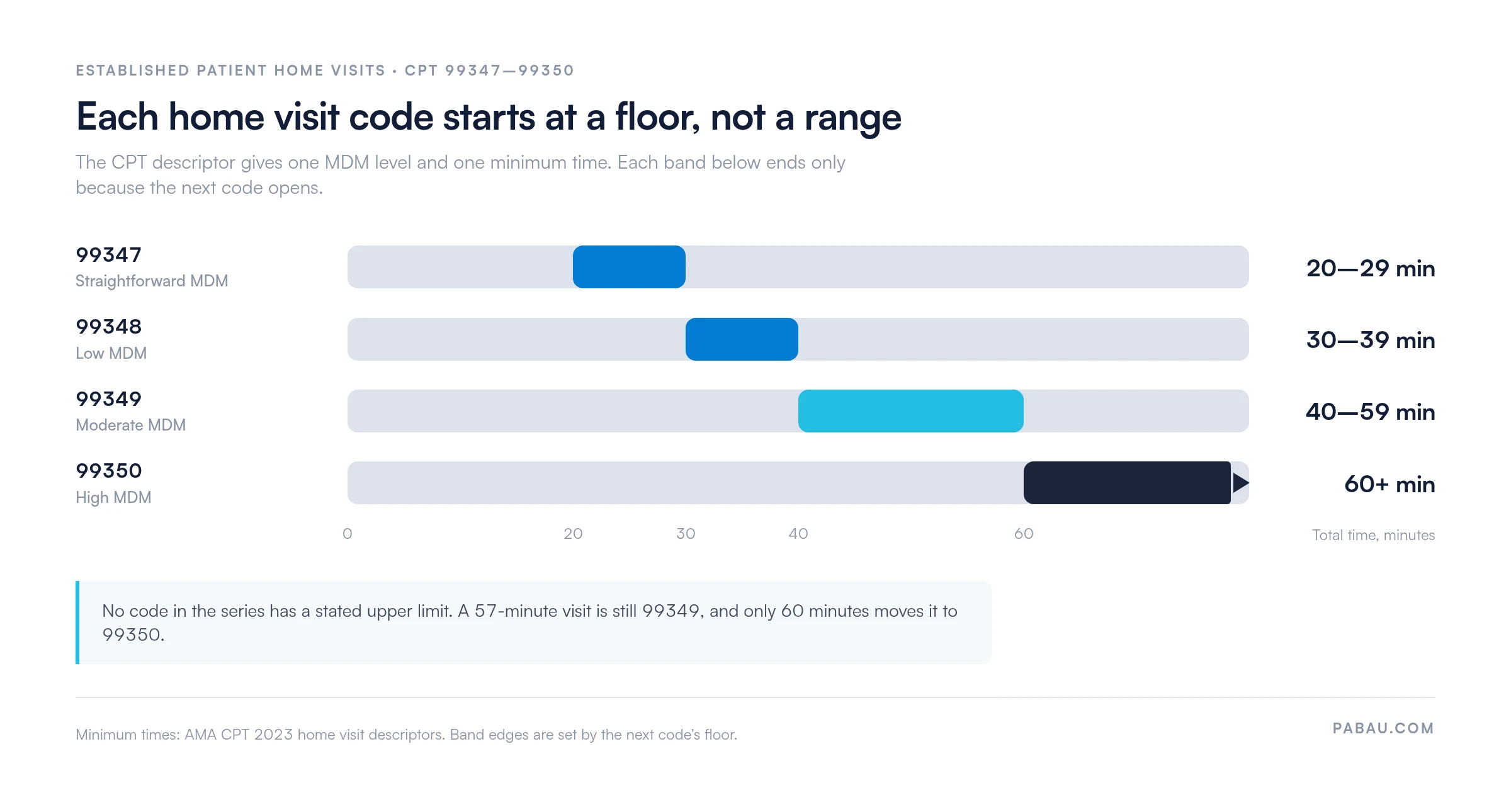
The CPT descriptor sets a minimum time, not a time range. There is no stated upper bound. A visit stays at 99349 until the note supports high complexity MDM or reaches 60 minutes, which is the 99350 threshold.
Two pathways qualify a visit for the code. One is the MDM complexity level, the other is total time on the date of service. Only one of them has to be met.
Billing 99349 during an inpatient admission is an open CMS Recovery Audit Contractor (RAC) audit topic. Verify patient status before submission.
Practice management software like Pabau supports E/M home visit documentation, electronic claim submission, and internal coding audits.
CPT code 99349 is an evaluation and management (E/M) code for a home or residence visit with an established patient. The American Medical Association (AMA) publishes and maintains it within the 99341-99350 home visit series.
The code describes a visit requiring a moderate level of medical decision making (MDM). The alternative pathway is 40 minutes or more of total time on the encounter date. Place of service (POS) 12 applies in the patient’s private residence.
This is the second-highest of the four established patient home visit codes, sitting directly below CPT 99350. Providers reach for it when a chronic problem is exacerbating and the visit involves prescription drug management at moderate risk.
The 2023 descriptors give each code in the home visit series a single MDM level and a minimum time. There is no tier range and no bounded time window. Bounded ranges belong to the office visit codes 99202-99215, and they never appeared in the home visit descriptors.
Two pathways qualify a visit for 99349, and only one must be met. The 2023 AMA E/M revisions eliminated history and physical exam as selection criteria. Providers now choose either MDM complexity or total time.
MDM is assessed across three elements: problems addressed, data reviewed or analyzed, and risk of complications. The provider must meet or exceed the threshold in at least two of the three to qualify at a given level. For 99349, that means two of the three elements documented at moderate level.
The high column below is included for contrast. When two of the three elements reach high level, the correct code is 99350 rather than 99349.
When billing by time, 40 minutes must be met or exceeded on the date of service. The descriptor states a minimum only. It does not cap the code at 54 minutes or at any other figure. That cap is a misreading carried over from the office visit codes.
Total time is not limited to face-to-face contact. It counts four kinds of work done on the date of service:
Travel time to the patient’s home does not count toward the total.
The practical ceiling comes from the next code up rather than from the descriptor. Once total time reaches 60 minutes, the 99350 threshold is met and 99350 becomes the code that matches the work performed. Time between 40 and 59 minutes sits squarely at 99349, as the bands below show.
There is also no prolonged-service add-on at this level. CPT 99417, and HCPCS G0318 for Medicare, attach only to 99345 and 99350 in the home and residence series. A visit that runs long is reported by moving up to 99350, not by adding units to 99349.
The 2023 revision merged the old domiciliary and rest home codes into this series, so 99349 now covers several residential settings. The POS code on the claim must match where the visit actually happened. Using POS 12 for an encounter in an assisted living facility is a coding error that will not survive a record request.
All four settings pay at non-facility rates, so a POS mix-up inside this group does not change the payment. It does change whether the claim accurately describes the site of service. Nursing facility settings are billed with the nursing facility E/M codes instead, not with 99349. Check the setting’s certification status before choosing the code family.
Documentation must support whichever pathway the provider selects. A note that describes complex problems without documenting MDM elements explicitly, or that fails to record the time spent, leaves the claim undefended at audit. The 837P claim file used for electronic submission also needs the correct place of service and encounter date.
If billing by time, the note must state the total time spent and indicate that it includes non-face-to-face activities. Vague language like “time spent approximately one hour” does not satisfy this requirement. A clean claim depends on having that detail in the note before it leaves the practice.
Document MDM and total time in every home visit note, even when billing by one pathway only. If a payer requests records and the MDM documentation is thin, having time documented as a backup prevents a denial. Build this dual-track documentation habit into your visit note template.
Home visits use non-facility rates under the CMS Physician Fee Schedule. The home qualifies as a non-facility setting (POS 12). The practice expense component of the relative value unit (RVU) therefore reflects higher costs than a facility setting.
The 2026 national average non-facility rate for CPT 99349 is approximately $130-$145. The exact figure depends on the CMS Physician Fee Schedule conversion factor in force for the year. Verify current rates in the CMS fee schedule lookup tool for your own MAC jurisdiction.
Multiplying the total RVU by the non-QP conversion factor gives roughly $132 before geographic adjustment. Practices in alternative payment models bill against the slightly higher qualifying participant factor.
Pabau submits claims electronically through Claim.MD, with real-time eligibility checks run before the visit. After Medicare adjudicates the claim, the practice receives an electronic remittance advice (ERA) file detailing the payment and any adjustments applied.
Geographic Practice Cost Indices (GPCI) adjust the fee schedule rate by MAC jurisdiction. A practice in San Francisco will receive a meaningfully different payment than one in rural Mississippi for the same CPT 99349 claim. The difference can range 20-30% between high-cost and low-cost localities.
Commercial payers set their own rates, typically as a percentage of the Medicare fee schedule (often 100-130%). Check each payer contract individually. Applying your own locality’s GPCI values to the total RVU gives a closer estimate than the national average.
Modifiers are appended to the base code to signal special circumstances to the payer. Using the wrong modifier, or omitting a required one, is among the most common reasons E/M home visit claims are returned or denied. Practice management software like Pabau checks each modifier against the code first. Its medical claims management tools flag the conflict before the claim goes out, so your team fixes it once.
Modifier -AI has no valid use with 99349. It identifies the principal physician of record on initial hospital care, 99221-99223, and initial nursing facility care, 99304-99306. Neither range covers a home or residence visit.
The diagnosis submitted with 99349 must explain why the visit reached moderate complexity. Pick the condition that actually drove the decision making, not a background chronic problem sitting on the chart. A stable, well-controlled diagnosis paired with a moderate-level code invites a downcode request.
ICD-10-CM updates annually on October 1. Verify every code against the current tabular list in our ICD-10-CM code library. Then check your MAC’s Local Coverage Determinations for home visit medical necessity language.
Physicians and qualified non-physician practitioners can report 99349 under their own National Provider Identifier. That includes nurse practitioners, physician assistants, and clinical nurse specialists, subject to state scope of practice and payer credentialing.
Incident-to billing works differently in the home than in an office. Medicare requires direct supervision, which in a private residence means the physician is present in that residence during the service. A physician sitting in the office cannot supervise a home visit incident-to.
Split or shared visit rules also do not extend to this setting the way they do for facility-based E/M services. When a non-physician practitioner performs the visit alone, bill under that practitioner’s own NPI at the applicable payment percentage.
The 99341-99350 home visit series covers both new and established patients across complexity levels. Selecting the correct code means matching the patient type to a single MDM level or to a minimum total time. Read the time column as a floor, never as a window.
CPT 99343 was deleted in the 2023 AMA revision. Do not bill it for dates of service on or after January 1, 2023, because claims using a deleted code will deny. There has never been a valid CPT 99346. A claim carrying that number rejects as an invalid code rather than as a deleted one.
Because each code carries one MDM level and one minimum time, the three established patient levels above straightforward sort cleanly. Work through MDM first, then check time as the alternative pathway.
Pick whichever pathway the note supports best, then document that pathway explicitly. Recording both costs a line of text and removes the argument entirely.
The AMA restructured the home visit E/M series in 2023 to align it with the 2021 outpatient E/M overhaul. One code, 99343, was deleted from the new patient series, which dropped from five codes to four. The established patient series was untouched in count and still holds 99347 through 99350.
The remaining codes were redefined to use MDM complexity or total time as the sole selection criteria. That replaced the prior system built on history and physical exam. The AAPC CPT code lookup reflects the current post-revision descriptors for each code in the series.
The revision also folded the old domiciliary and rest home codes, 99334-99337, into this series. Practices that once split residential visits across two code families now report them all from 99341-99350.
CMS Recovery Audit Contractors (RAC) maintain an approved audit topic specifically targeting home visit E/M codes. RAC Topic 0011 covers inappropriate billing of home visit professional service E/M codes during inpatient stays. That makes patient status the first thing to check on any 99349 claim.
Five errors account for the majority of denials and audit findings on CPT 99349 claims. Strong medical billing compliance processes catch these before submission rather than after a RAC letter arrives.
Run a quarterly internal audit on a sample of 99349 claims. Pull 10-15 charts and verify each one meets MDM or time thresholds with documented evidence. This mirrors what a RAC auditor does and gives your team a chance to correct documentation habits before an external review.
Home visit billing has more moving parts than office-based E/M coding. Clinicians travel between addresses, time tracking is manual, MDM detail gets written away from a desk, and claims often sit for days before submission. Each of those steps is where a 99349 error starts.
The usual patch is a paper time log plus recall, with the note reconstructed in the evening. That reconstruction is what an auditor picks apart, because the time attestation was never captured at the point of care.
Pabau tightens three of those steps. Structured treatment note templates prompt the clinician to record problems addressed, data reviewed, and risk level. The moderate MDM pathway is then documented rather than implied.
Time can be logged in the chart during the visit, which turns the 40-minute threshold into a recorded fact instead of an estimate. Claim submission through Claim.MD then moves the charge out the same day, with eligibility already verified.
The outcome is a chart that defends the code it billed. When a RAC letter or payer record request arrives, the MDM elements and the time attestation are already in the note. Your team spends minutes on the response rather than days.

Pabau’s claims management tools support E/M documentation, electronic claim submission, and denial tracking for home visit codes including CPT 99349. See how it works for your practice.

CPT 99349 carries one MDM level and one time floor. Moderate MDM qualifies, and so does 40 minutes or more. Reading it as a range is how practices underbill a long visit, or defend a level the note never supported.
Practices that bill home visits regularly get the most protection from capturing MDM and time at the point of care. A note reconstructed from memory hours later is far weaker.
Pabau connects your documentation workflow to electronic claim submission and denial tracking. Your team catches the most common 99349 errors before the payer does. See how it fits your home visit schedule by booking a demo.

Moving a long home visit up a level? CPT code 99350 covers the high-complexity end of the established patient series, starting at 60 minutes.
Need the lower end of the same series? CPT code 99347 covers straightforward medical decision making from 20 minutes of total time.
Need a framework for clean claim submission? Clean claim requirements in medical billing covers the key elements every claim needs before leaving your practice.
Want to understand how payer remittances work? Electronic remittance advice (ERA) explained walks through how to read ERA files and reconcile payments.
Seeing the same denials on home visit claims? Denial management in healthcare shows how to track reason codes and fix the pattern behind them.
CPT code 99349 is used to bill a home or residence visit for an established patient. The visit must involve a moderate level of medical decision making, or 40 minutes or more of total time on the date of the encounter. It sits in the E/M home visit series (99341-99350) maintained by the American Medical Association.
The 2026 national average non-facility Medicare rate for CPT 99349 is approximately $130-$145. The exact figure depends on the CMS conversion factor and on geographic GPCI adjustments by MAC jurisdiction. Verify the current rate for your locality using the CMS Physician Fee Schedule search tool.
The visit note must document the date of service, place of service (POS 12 for a private home), and established patient status. It then needs either explicit MDM elements (problems, data, risk) at moderate level, or total time in minutes including non-face-to-face activities. Provider signature and credentials are required, and a superbill or charge capture document should reference the code.
CPT 99349 requires a moderate level of MDM, or 40 minutes or more of total time. CPT 99350 is the highest established patient home visit code and requires high complexity MDM, or 60 minutes or more of total time. High complexity often involves intensive drug monitoring or a decision about hospitalization.
No. The CPT descriptor states a minimum of 40 minutes and gives no upper bound. Bounded time ranges belong to the office visit codes 99202-99215, not to the home visit series. In practice, a visit moves to 99350 once total time reaches 60 minutes.
Standard Medicare does not include CPT 99349 on its covered telehealth services list. Home visit codes are generally excluded from telehealth coverage. Temporary COVID-era waivers that expanded telehealth eligibility have largely expired. Verify the current CMS telehealth services list before billing any home visit code with a telehealth modifier.
Modifier -25 applies when a significant, separately identifiable E/M service happens on the same day as a procedure. Modifier -59 can override a specific NCCI bundling edit where documentation supports it. Modifier -95 applies only if the service qualifies as covered telehealth, which CPT 99349 typically does not.
Total time on the date of service must meet or exceed 40 minutes. That total includes face-to-face time plus non-face-to-face work such as reviewing records, documenting the note, and coordinating care. Travel time does not count. The provider must document the total time in minutes in the visit note.
No. Only 99343, a new patient home visit code, was deleted effective January 1, 2023. CPT 99346 was never a valid code, so a claim carrying it rejects as invalid rather than as deleted. The established patient series held four codes (99347-99350) both before and after the revision.
No. CPT 99349 cannot be billed on the same date a patient is admitted as an inpatient. CMS bundles home visit E/M services into the inpatient DRG payment. Billing 99349 during an inpatient stay is an active CMS RAC audit topic (Topic 0011). Practices must verify patient admission status before submitting home visit E/M claims.