



CCSD code G5100: Bypass of duodenum billing guide
CCSD code G5100 bills a bypass that leaves the duodenum in place CCSD code G5100...

Last Updated: Oct 16, 2026

CPT code 99232 describes subsequent hospital inpatient or observation care per day requiring moderate complexity medical decision-making (MDM) or 35 minutes or more of total provider time.
As of January 1, 2023, code selection is based on MDM or total time – the previous two-of-three key components requirement (History, exam, MDM) no longer applies.
Missing specific MDM documentation linking problems, data review, and risk of complications is the top denial trigger for 99232 claims flagged by Medicare Administrative Contractors.
Pabau’s claims management software helps hospitalists and attending physicians capture compliant 99232 documentation and track claim status from submission through adjudication.
CPT code 99232 bills subsequent hospital inpatient or observation care, per day, requiring moderate-complexity medical decision-making (MDM) or at least 35 minutes of total provider time. It covers follow-up visits after admission – not admission or discharge – and is reported once per calendar day.
This guide covers the 2023-updated E/M rules governing CPT code 99232, the documentation elements that satisfy moderate complexity MDM, time-based coding thresholds, RVU values, and the specific denial patterns flagged by Medicare Administrative Contractors (MACs). It also covers how 99232 compares to adjacent codes 99231 and 99233.
CPT code 99232 is defined by the American Medical Association as: Subsequent hospital inpatient or observation care, per day, for the evaluation and management of a patient, which requires a medically appropriate history and/or examination and moderate level of medical decision making.
The code belongs to the Hospital Inpatient and Observation Care Services section (CPT 99221-99239) and applies to follow-up visits after the initial hospital admission – not to admission or discharge services. It is billed once per day regardless of the number of visits made to the patient. Discharge day management itself is billed separately under CPT code 99239 when the visit runs more than 30 minutes.
Before 2023, selecting 99232 required meeting two of three key components: History, physical examination, and medical decision-making. Effective January 1, 2023, the AMA’s CPT E/M guideline update eliminated that structure entirely.
Code selection now hinges on either MDM complexity or total provider time on the date of the encounter – whichever the provider chooses to use. This is the single most consequential change affecting 99232 billing today, and misapplying the old two-of-three logic is a documented audit risk. Hospitalists working through coaching CPT codes frameworks and other E/M categories often carry this misunderstanding across service types.
The code is valid in both inpatient and observation settings – a second major 2023 change that merged previously separate code sets into a unified subsequent-care category.
These three codes cover the full spectrum of subsequent hospital and observation care. The difference between them is clinical complexity, not visit duration alone. Selecting the wrong level in either direction creates audit exposure: Undercoding to CPT code 99231 leaves revenue on the table; upcoding to 99233 without high-complexity MDM documentation is a flagged pattern with MACs.
The most common miscoding pattern is billing 99233 for patients who are actually responding to treatment but have multiple chronic conditions documented in the note. Active management of multiple chronic problems can support moderate MDM – it does not automatically reach high complexity.
Auditors look for notes that list comorbidities without documenting acute management decisions tied to each one. Providers who have worked through ADHD screening CPT code documentation frameworks will recognize a similar principle: The note must show the reasoning, not just the diagnosis list.
Under the 2023 E/M guidelines, a medically appropriate history and/or examination is required but no longer drives code selection. What the chart needs to demonstrate is moderate complexity MDM – or, if using time-based coding, the total provider time on the date of the encounter.
The AMA defines moderate complexity MDM through three elements, two of which must be met at the moderate level or higher:
Each of these three elements must be documented separately in the note. Reviewers commonly see notes that satisfy the problems element but provide no documentation of data review or risk reasoning. A diagnosis list alone is not evidence of moderate MDM. The note must show what data was reviewed, what independent interpretation occurred, and what the prescription or management decision was – and why.
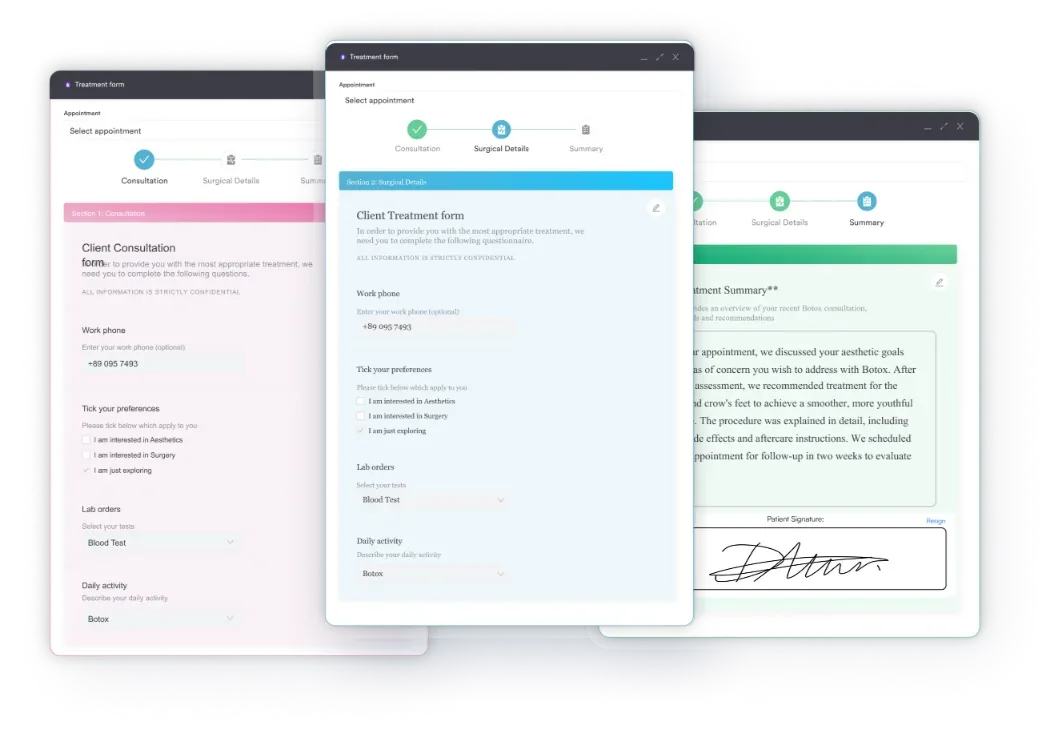
Providers using digital intake forms and structured clinical note templates can build these three MDM elements directly into the daily follow-up note workflow, reducing the likelihood of omissions under time pressure.
When time is used for code selection, 99232 requires at least 35 minutes of total time on the date of the encounter (35 minutes must be met or exceeded, up to 49 minutes). “Total time” includes all time the provider spends on the patient’s care that day: Reviewing records and results, ordering and reviewing tests, communicating with the care team, documenting the note, and time at the bedside.
Practices billing IVF CPT codes and other time-sensitive procedure families face similar documentation precision challenges – total time must be both accurate and defensible in an audit context.
Before selecting 99232 based on time, confirm the note explicitly states total time in minutes spent on the date of the encounter – not just time at the bedside. Auditors look for a single, clear time statement. A note that says ‘spent approximately 40 minutes’ without context for what those 40 minutes included will not withstand MAC review.
General practices bill E/M codes daily, and GP clinic software keeps visit notes, coding, and follow-ups together.
Moderate complexity MDM is the clinical core of 99232. The three MDM elements – problems, data, and risk – each have defined thresholds, and two of the three must reach the moderate level for the code to be supported. Meeting only one element at moderate, even if the other two are well-documented at straightforward levels, does not justify 99232.
Stable chronic conditions managed without change do not reach moderate on their own. Moderate complexity requires at least one of the following: exacerbation or progression of a chronic condition; management of two or more stable chronic conditions simultaneously; an undiagnosed new problem where the prognosis is uncertain; or an acute illness with systemic symptoms (Fever, hypotension, elevated inflammatory markers).
Providers working in psychiatry EMR software environments should note that psychiatric inpatient follow-ups frequently involve multiple co-occurring conditions with active medication management – a scenario that commonly supports moderate MDM when documented with precision around each active problem and the clinical reasoning behind each medication decision.
For moderate data, the note should document at least one of: independent interpretation of a test result (not just reviewing a radiology read, but forming an independent clinical interpretation); review and summarization of records from an external source; or direct discussion of management with an external provider or qualified health professional. Simply ordering a test does not count as data review – the result must be actively addressed in the note.
For most hospitalists and attendings, prescription drug management is the most reliable path to moderate risk. The note must document a decision about a prescription medication – initiating, adjusting, discontinuing, or reviewing for drug interactions or adverse effects.
A note that mentions current medications without documenting a management decision around them does not satisfy this element. Missing risk documentation is one of the most frequently cited deficiencies in appealed 99232 claims.

Pabau’s claims management software gives hospitalists and billing teams real-time visibility into claim status, denial reasons, and resubmission workflows – so 99232 documentation omissions get caught before payers flag them.

Medicare reimbursement for CPT 99232 varies by geographic location, facility vs. non-facility setting, and the annual CMS Physician Fee Schedule final rule. Rather than citing a specific dollar figure that may be out of date, providers should verify current rates directly through the CMS Physician Fee Schedule lookup tool. Where the hospitalist is out of network, the patient needs an itemized statement carrying this code and its charge.
For RVU reference, the structure for 99232 looks like this:
For verified current wRVU values and Medicare payment amounts by locality, pull the figures directly from the CMS Physician Fee Schedule data files. Always cite the year when documenting RVU values internally, as they are updated with each annual CMS Physician Fee Schedule final rule.
CPT 99232 is billed with Place of Service 21 (Inpatient hospital) or POS 22 (On-campus outpatient hospital, for observation patients). Using an incorrect POS code is a distinct denial trigger that operates separately from MDM documentation issues. POS 11 (Office) applied to an inpatient follow-up is an immediate claim reject. That same claim form uses a diagnosis pointer on each service line to show which code justifies the charge.
The HIPAA compliance requirements for medical offices extend to accurate claim data fields including POS – inaccurate POS submissions create audit exposure beyond the individual claim.
99232 does not routinely require a modifier for standard subsequent care visits. Specific situations where modifiers apply:
Modifier AI is frequently omitted by admitting physicians who also perform subsequent visits. When the same provider who admitted the patient bills 99232 for follow-up care, Modifier AI must appear on the claim. Without it, Medicare may deny the subsequent visit as a duplicate of the admission E/M service. Audit your superbills for this pattern if your hospitalist group uses a shared NPI.
Consider a day-two follow-up on an admitted patient whose condition is responding slowly. The provider reviews new lab and imaging results, reassesses the plan, and adjusts drug therapy. That prescription drug management supplies the moderate-risk element and, combined with an ongoing problem and independent review of test results, meets moderate-complexity MDM – supporting 99232.
Alternatively, if the provider documents 35 minutes or more of total time spent on the patient’s care that calendar day (chart review, examination, coordination, and note-writing), 99232 can be selected on time instead. Either way, the visit is billed once for the day with Place of Service 21, and no modifier is required unless the admitting physician appends Modifier AI.
Denials for 99232 concentrate around a narrow set of documentation failures. Understanding the specific MAC denial language helps billing teams build targeted corrective action rather than generic chart review protocols.
The Recovery Audit Contractors (RAC) program specifically targets high-volume E/M upcoding patterns, and 99232 is one of the codes with documented RAC review history. The Office of Inspector General (OIG) includes E/M level selection in its annual Work Plan reviews.
Effective patient scheduling and appointment management systems that tag encounter types at scheduling can help billing teams pre-screen which visits are likely to support 99232 vs. 99231 based on the patient’s current acuity.
Most 99232 denials come down to one omission – the note describes the patient’s condition but does not document the provider’s clinical reasoning around MDM complexity. Under the 2023 AMA E/M guidelines, that reasoning – problems, data review, and risk – must be explicit, not implied.
Pabau’s claims management software gives billing teams and hospitalist groups real-time visibility into 99232 claim status, denial reason codes, and resubmission workflows – so documentation omissions are caught before payers flag them, not after. To see how Pabau handles inpatient billing workflows, book a demo with our team.

Coding PAP device supplies too? PAP humidifier water chamber billing explains how missing modifiers and frequency violations cause most preventable denials.
Need the code for hot or cold therapy supplies? Cold or hot fluid bottle billing covers the HCPCS code for cold or hot fluid bottles, ice caps, and wraps.
Billing continuous glucose monitors too? External CGM receiver billing explains the April 2022 coverage change and when E2102 applies instead.
CPT code 99232 is used to bill subsequent hospital inpatient or observation care per day when the encounter requires a medically appropriate history and/or examination and moderate complexity medical decision-making. It covers follow-up visits after the initial admission, not the admission or discharge itself, and is billed once per calendar day regardless of how many times the provider sees the patient.
CPT 99232 applies to both inpatient and observation (Hospital-based outpatient) settings following the 2023 AMA code revisions that merged the two previously separate code sets. It is billed with Place of Service 21 for inpatient encounters and POS 22 for observation encounters on an outpatient hospital campus.
CPT 99232 requires 35 minutes or more of total provider time on the date of the encounter when time-based coding is used (35 minutes must be met or exceeded, up to 49 minutes). Total time includes all care-related activities on that calendar day, not just time at the bedside. Encounters reaching 50 minutes or more qualify for CPT 99233 instead.
CPT 99231 requires straightforward or low complexity MDM (or at least 25 minutes); 99232 requires moderate complexity MDM (or at least 35 minutes); and 99233 requires high complexity MDM (or 50 or more minutes). All three cover the same service setting (subsequent inpatient or observation care per day) – the difference is the documented level of clinical complexity, not the type of service.
The most common denial reasons are: insufficient MDM documentation (Especially missing prescription drug management decisions under the risk element), total time not recorded when time-based coding is used, incorrect place of service, and missing Modifier AI when the admitting physician bills subsequent visits. Missing MDM documentation elements are consistently the leading driver of appealed 99232 denials.
Not routinely, but Modifier AI is required when the admitting physician (Principal care physician) bills a subsequent visit. Modifier 25 is needed when a separately identifiable E/M service is performed on the same day as a procedure. Teaching hospital encounters require Modifier GC or GE depending on the level of resident supervision documented by the teaching physician.



