CPT code 52648: Laser ablation of the prostate billing guide
What CPT code 52648 covers, and what it bundles in CPT code 52648 is the code fo...

Last Updated: Oct 21, 2026
CPT code 98942 is the billable code for chiropractic manipulative treatment (CMT) delivered across all five spinal regions. The American Medical Association (AMA) descriptor reads: Chiropractic manipulative treatment (CMT); spinal, 5 regions. It applies when a licensed chiropractor treats the cervical, thoracic, lumbar, sacral, and pelvic regions in a single visit.
That makes 98942 the highest-complexity spinal CMT code in the 98940-98942 series. Medicare pays it only when every region is documented individually and the AT modifier is on the claim. Under the 2026 Medicare Physician Fee Schedule, the national average runs roughly $45 to $65 per encounter.

CPT code 98942 describes chiropractic manipulative treatment (CMT) covering all five spinal regions: cervical, thoracic, lumbar, sacral, and pelvic.
All five regions must be documented individually in the clinical record to justify 98942 over lower-level codes 98940 or 98941.
Medicare requires the AT modifier on every 98942 claim to show active or acute treatment. Maintenance therapy claims sent without it are denied automatically.
The 2026 Medicare national average sits near $45 to $65 per encounter, roughly 20% to 30% above 98941.
Pabau’s chiropractic practice management software validates CPT codes, flags missing modifiers, and routes claims through the Claim.MD clearinghouse.
The five-region requirement is what separates 98942 from every other spinal CMT code. Each region must be independently treated and individually documented.
Payers treat “cervical and thoracic” as two regions, not one. Every region named above requires a separate notation in the encounter note. Documenting “full spine manipulation” without naming each of the five regions is a common reason 98942 gets downcoded to 98940 on audit.
Billing eligibility for 98942 is narrow, and it changes with the provider’s license type.
Confirm payer-specific credentialing requirements with your Medicare Administrative Contractor (MAC) before billing. Commercial contracts vary more than Medicare does on which license types they recognize for spinal CMT. For a DO billing the osteopathic set, CPT code 98926 covers treatment of three to four body regions in one session.
Selecting the wrong CMT code is the single most common chiropractic billing error. The table below shows how each code differs, so coders can match documentation to the correct level. The AAPC CPT code lookup provides full descriptors and bundling edits for each.
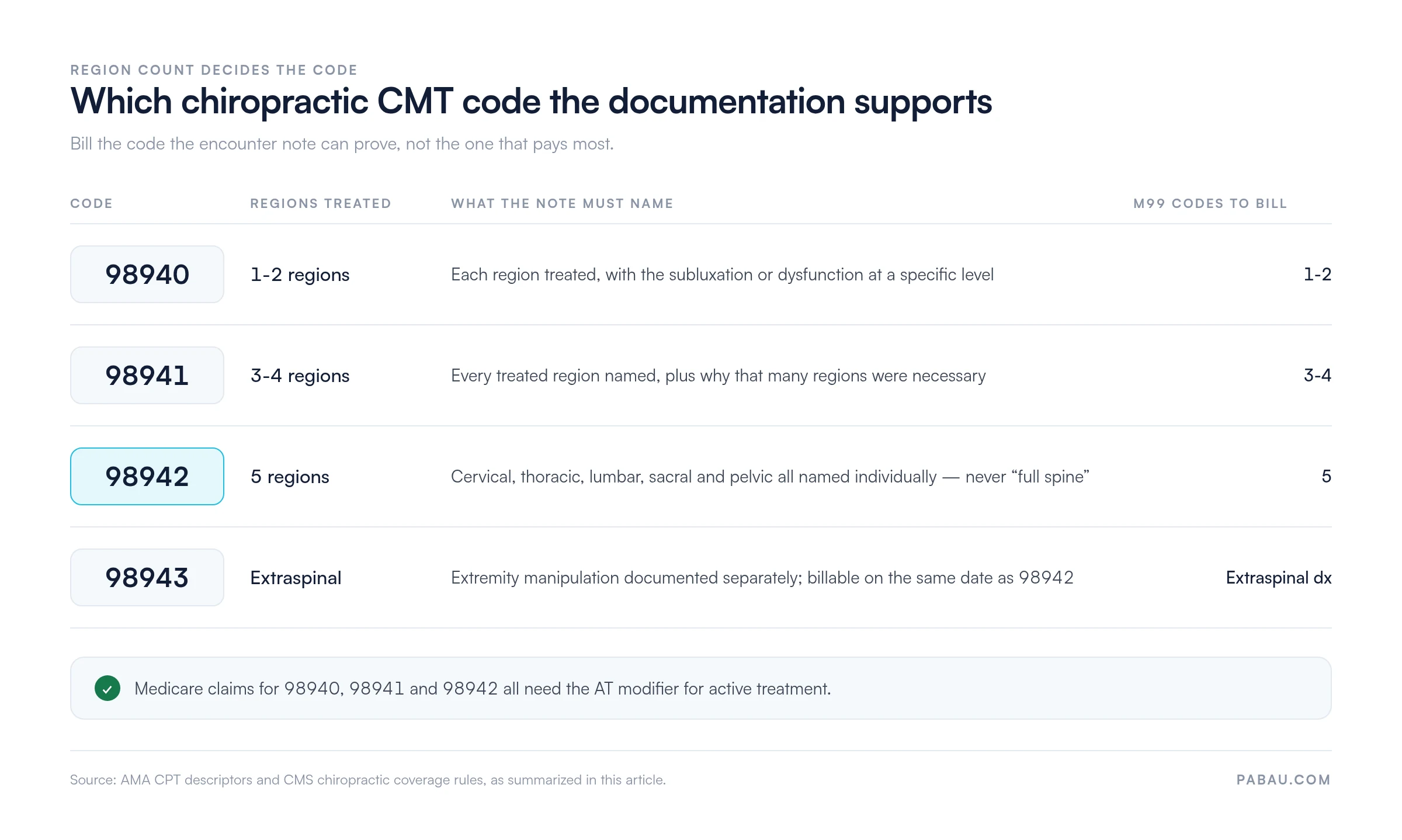
98943 can be billed on the same date as 98942 when extraspinal manipulation is separately documented. You cannot bill 98940, 98941, and 98942 together on the same encounter. Bill only the one code that reflects the highest number of regions treated and documented.
Underdocumentation causes more 98942 denials than any other error. Each of the elements below must appear in the encounter note before you submit the claim.
Keep the superbill aligned with the encounter note. A discrepancy between the code on the superbill and the clinical record is a common trigger for post-payment audits. The ladder below sets out what each code in the series obliges the note to prove.
Audit a random sample of 10 recent 98942 claims every quarter. Pull the encounter note for each and confirm all five spinal regions are named by anatomical label, not just counted. If the note says ‘full spine’ without naming regions, the claim is underdocumented even where the payer paid it.
Medicare Part B covers CPT code 98942 exclusively for the correction of spinal subluxation. CMS article A56273 is the authoritative source for chiropractic coverage criteria. Every billing team handling Medicare chiropractic claims should have it bookmarked.
The AT modifier is not optional under Medicare. Omitting it on a 98942 claim submitted to Medicare results in automatic denial. No appeal argument will succeed if the AT modifier was simply forgotten.
Commercial payers generally do not require the AT modifier. Apply it only to Medicare claims. Using AT on commercial claims may trigger manual review from payers whose systems do not recognize the modifier.
Reimbursement for 98942 varies by geographic locality under the Medicare Physician Fee Schedule (MPFS). The 2026 national non-facility average runs approximately $45 to $65 per encounter. High-cost localities such as Manhattan and San Francisco sit at the upper end of that range. Verify the exact rate for your locality using the CMS Physician Fee Schedule lookup tool.
Under Medicare, 98942 pays roughly 20% to 30% more than 98941, whose 2026 national average sits near $38. That premium reflects the added clinical work of treating all five regions. Upcoding from 98941 to 98942 without adequate documentation is an audit risk, because the note has to substantiate the code rather than follow it.
Every 98942 claim requires at least one ICD-10-CM diagnosis code supporting the medical necessity of treating all five spinal regions. Subluxation codes from the M99 category are the primary pairing. Spine pain codes from M54 support the narrative, but on Medicare claims they accompany a subluxation code rather than replace it.
Bill multiple M99 codes when multiple regions have documented subluxation. Listing a single M99 code on a 98942 claim invites downcoding, because the diagnosis then supports one region rather than five.
Five denial patterns account for the majority of rejected 98942 claims. Reviewing the full list of medical billing denial codes shows how payers communicate the specific reason behind each rejection.
Manual billing workflows create friction at the three moments that decide a 98942 claim: modifier selection, diagnosis code pairing, and submission timing. A purpose-built chiropractic billing platform handles each of them systematically.
Pabau is practice management software for chiropractic practices. Its medical claims management validates CPT selection against the documented diagnosis codes at the point of encounter. If a clinician selects 98942 and the note carries only one M99 subluxation code, the system flags the mismatch before the claim is queued. The AT modifier check then runs on every Medicare claim in the batch, so nothing slips through on high-volume days.

Claims are routed through Claim.MD, Pabau’s clearinghouse partner, which scrubs each 98942 claim against payer-specific edits before transmission. The clearinghouse returns eligibility checks and Electronic Remittance Advices (ERAs), so your billing team sees denial reason codes the same day the payer responds. That shortens the correction and resubmission cycle on the denial types this article covers. It is also the first step toward a clean claim rate you can hold.
The outcome is fewer write-offs from preventable denials, and less staff time spent on manual claim rework. That rework is where chiropractic practices quietly lose revenue they had already earned.

Pabau validates every CPT selection against the documented diagnosis codes and enforces the AT modifier on Medicare claims before they leave the practice. See how it works for chiropractic billing teams.

Run a denial-reason analysis on all 98942 rejections from the past 90 days and group them by denial code. If more than 30% share the same denial reason, the process is at fault rather than any single note. Fix the SOAP template or the billing system rule first, rather than coaching each biller individually.
98942 pays more than its sibling codes, and it asks for more in return. Five documented regions, a subluxation diagnosis for each, a medical necessity narrative, and the AT modifier on every Medicare claim.
Treat the encounter note as the thing that decides the code, and the code selection stops being a judgment call. Practices that bill 98942 well usually have a SOAP template that makes naming all five regions unavoidable. The alternative is auditing claims after the payer has already responded.
Fixing one denied claim costs more staff time than documenting it correctly at the visit would have. Book a demo to see how Pabau catches a missing AT modifier or a thin diagnosis pairing before your 98942 claim reaches the payer.

Need the code for a three or four region adjustment? CPT code 98941 covers the level directly below 98942, with its own documentation and modifier rules.
Want to understand how clearinghouses process CMT claims? Medical claims clearinghouse guide explains the scrubbing, eligibility, and ERA workflow from submission to payment posting.
Billing Medicare for the first time? Medicare billing for practices walks the claim from the appointment through to the payment posting.
Looking for a full chiropractic billing software review? Best medical billing software in the US compares the leading platforms by clearinghouse integration, modifier validation, and denial management.
CPT code 98942 is used to bill chiropractic manipulative treatment (CMT) performed across all five spinal regions in a single encounter. Those regions are cervical, thoracic, lumbar, sacral, and pelvic. It is the highest-complexity spinal CMT code in the 98940-98942 range, and each region treated needs its own documentation.
The five spinal regions are cervical (C1-C7), thoracic (T1-T12), lumbar (L1-L5), sacral (S1-S5), and pelvic (ilium, ischium, pubis). Each must be treated and documented individually to justify billing 98942 over 98940 or 98941.
CPT 98941 covers chiropractic manipulation of 3-4 spinal regions, while CPT code 98942 covers all five. You cannot bill both codes on the same date of service. Bill only the code that matches the number of regions documented in the encounter note.
The AT modifier (active/acute treatment) is mandatory on every Medicare CMT claim, including 98942. Omitting it results in automatic denial, with no right of appeal on the missing modifier alone. Use GA instead when the patient has signed an ABN and the service is maintenance therapy.
The 2026 Medicare national non-facility average for CPT code 98942 is approximately $45 to $65 per encounter, depending on geographic locality. Rates are adjusted by locality, so verify the figure for your ZIP code using the CMS Physician Fee Schedule lookup tool.
Four causes account for most 98942 denials. The first is a missing AT modifier on a Medicare claim. The second is documentation naming fewer than five spinal regions. The third is a single subluxation diagnosis paired with a five-region CPT code. The fourth is active treatment billed for a patient who has moved to maintenance care. Structured SOAP templates and billing system modifier validation prevent all four.