







HCPCS code L2040 — HKAFO with torsion bilateral rotation straps
HCPCS code L2040: Device description and code overview HCPCS code L2040 is the H...

Last Updated: Sep 22, 2026

CPT Code 93351 is the billing code for a transthoracic stress echocardiogram that includes continuous ECG monitoring and physician supervision. One code covers the resting echo, the stress phase, the ECG tracing, the supervision, and the written report.
Medicare pays roughly $233 for the code nationally in 2026, and that amount barely moves between a physician office and a hospital outpatient department. ECG monitoring is what decides the code. Without it, the correct code is 93350, which pays less.
Four causes account for most 93351 denials. They are code choice against 93350, NCCI bundling with 93015, the wrong Place of Service code, and missing ECG documentation.

CPT Code 93351 describes a transthoracic stress echocardiogram with continuous ECG monitoring and physician supervision bundled into a single code.
The difference from CPT 93350 is electrocardiographic monitoring, which 93351 includes and 93350 does not, so the two are not interchangeable.
Medicare pays CPT 93351 at essentially the same rate in an office and a facility, because CMS assigns the code the same practice expense RVU.
The ICD-10-CM diagnosis on the claim has to match a covered indication, or the claim is denied for medical necessity.
Practice management software like Pabau validates required claim fields, submits electronically, runs eligibility checks, and posts ERA remittances.
The American Medical Association’s CPT code set defines CPT Code 93351 in two parts. The base procedure comes first, then the component that separates it from 93350.
The procedure runs in two halves. A cardiologist or qualified health care professional (QHP) performs a transthoracic echo (TTE) on a resting patient. The echo is then repeated during or immediately after a stress test. Real-time images are captured throughout, and continuous ECG monitoring runs for the duration.
The physician then interprets both the echo images and the ECG tracing and produces a single written report. All of that sits inside CPT Code 93351.
The stress modality can be treadmill exercise, bicycle exercise, or a pharmacologic agent such as dobutamine or adenosine. The code is the same regardless of which stress method is used.
CPT Code 93351 applies when the record documents all four of these components:
Missing any one of them shifts the claim to a different member of the stress echo family. According to the Centers for Medicare and Medicaid Services (CMS), covered indications for stress echocardiography generally include:
Non-covered indications include routine screening in asymptomatic low-risk patients. Repeat testing within short intervals, without a change in clinical status, also falls outside coverage.
The ICD-10-CM diagnosis code on the claim has to support the clinical indication. A diagnosis that does not align with a covered indication drives medical necessity denials, even when the procedure itself is coded correctly.
Check your Medicare Administrative Contractor’s (MAC) Local Coverage Determination (LCD) for cardiovascular stress testing before billing. LCDs can vary by region and may list additional covered or excluded indications beyond the national Medicare policy.
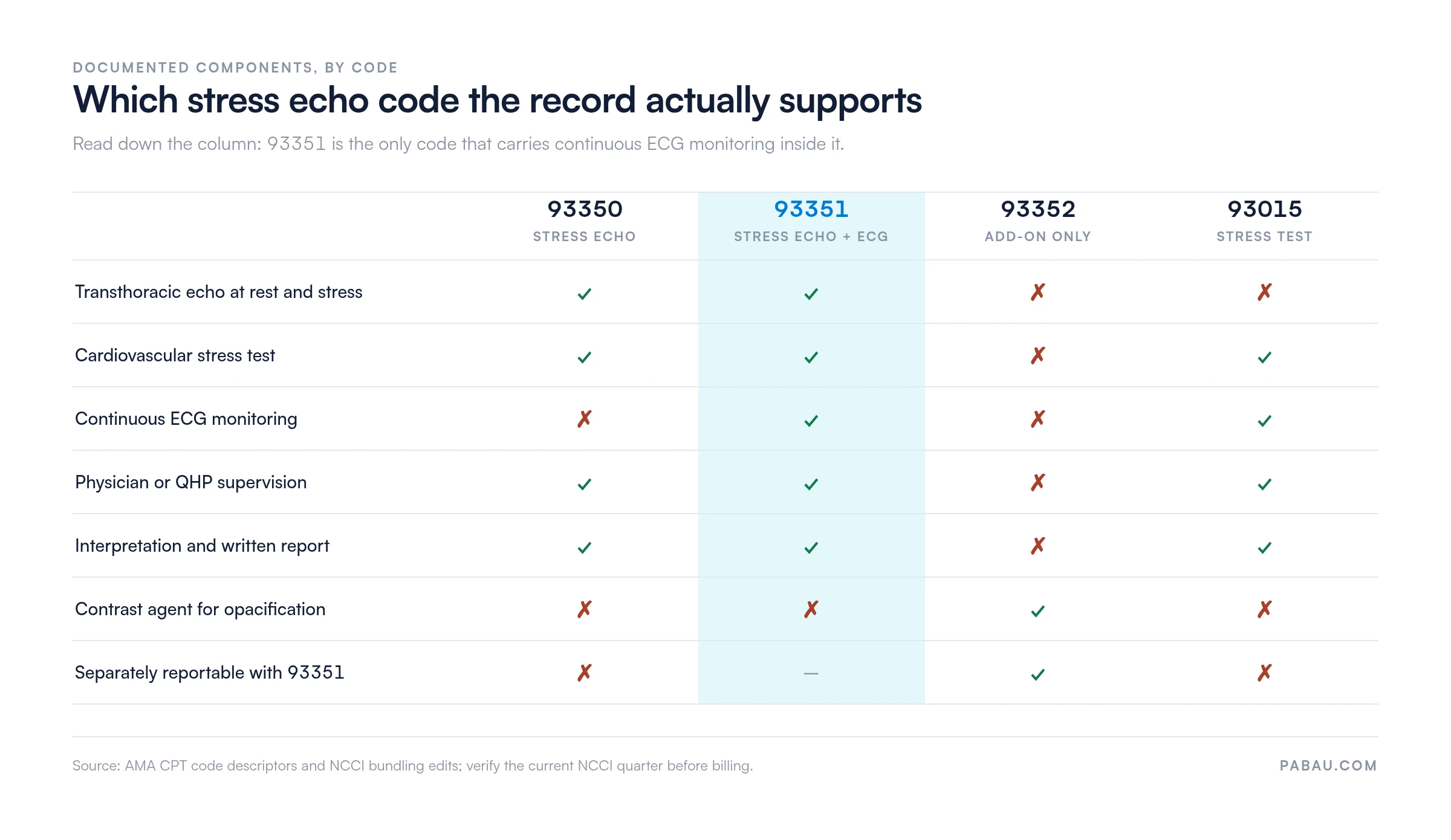
One bundled component separates CPT 93350 from CPT Code 93351, and that component is electrocardiographic monitoring. CPT 93350 covers the stress echo without it. CPT Code 93351 includes it. Reporting the wrong one is the most common undercoding error in stress echo billing.
If the cardiologist performed continuous ECG monitoring and supervised the test, the claim should carry CPT Code 93351 rather than 93350. Choosing 93350 when 93351 applies is undercoding, and it leaks revenue steadily across a high-volume stress echo practice.
CPT 93352 is an add-on code for echocardiographic contrast agent use, and it cannot be billed independently. When a contrast agent is injected to improve left ventricular opacification or endocardial border definition, 93352 is appended to either 93350 or CPT Code 93351.
Key billing rules for CPT 93352:
CPT 93352 carries its own RVU value and raises the total reimbursement for the encounter. Missing it when contrast was used loses revenue the record already supports. Add-on codes need explicit documentation of the clinical condition that triggered them.
What CPT Code 93351 bundles matters as much as what it leaves out. The cardiovascular stress testing family (93015-93018) covers non-echo stress tests and their component parts. NCCI bundling rules decide which of them can be reported alongside 93351.
National Correct Coding Initiative (NCCI) edits prohibit reporting CPT 93015 alongside CPT Code 93351, because the ECG supervision and recording components already sit inside 93351. Billing both generates an automatic edit flag. Bundling rules are updated quarterly, so check the current NCCI edit table before you submit.
The components that decide the code are spread across the two tables above. The matrix below maps them onto all four codes at once, so the choice comes down to reading a column.
Every CPT Code 93351 claim needs a supporting ICD-10-CM diagnosis code that justifies stress echocardiography. Payers cross-reference the diagnosis against their covered-indications policy before adjudicating. A non-covered diagnosis is the second most common denial reason after bundling errors.
Use the CrossCoder CPT-to-ICD-10 crosswalk tool to see the full list of diagnosis codes that Medicare and commercial payers accept for CPT Code 93351. Whichever code you land on, code to the highest level of specificity the documentation supports.
Medicare reimbursement for CPT Code 93351 is set through the CMS Physician Fee Schedule (MPFS). Rates are updated each January and vary by locality through the Geographic Practice Cost Index (GPCI). Verify the current figure with the CMS MPFS lookup tool rather than a prior-year table.
Setting does not change what Medicare pays for this code. CMS assigns CPT Code 93351 the same practice expense RVU in both places of service. The total payment therefore lands at roughly the same amount either way. There is no facility discount to plan around here.
Both figures are national unadjusted amounts for 2026, before any GPCI adjustment. CMS also publishes two conversion factors this year, one for qualifying APM participants and one for the rest. The same RVUs therefore produce two slightly different totals. Confirm your own locality figure in the MPFS lookup tool before quoting it.
GPCI multipliers move the amount up or down by locality. High-cost areas such as San Francisco, New York City, and Anchorage carry higher GPCI values. Use the FastRVU 2026 RVU lookup tool to retrieve the work, practice expense, and malpractice RVU values behind the figure.
The Place of Service code still matters, even though the payment is the same in both settings. POS 22 tells the payer that a facility owns the technical component, which changes who may bill what. A hospital-employed cardiologist scanning in the hospital uses POS 22, not POS 11.
Modifiers change how a payer reimburses CPT Code 93351. The wrong modifier, or a missing required one, is a top-five denial trigger for the stress echo code family.
A global bill carries no modifier at all. It says the same physician or group performed both the technical and professional components in a non-facility setting. A hospital-based cardiologist reading studies for a hospital-owned echo lab bills Modifier 26 instead.
Billing the global in a facility setting pays only the professional component value. The hospital outpatient payment system has already paid the technical side.
Denials that follow a modifier error arrive with a remittance code attached. The denial codes reference maps the most common ones back to the mistake that produced them.
A correctly coded CPT Code 93351 claim still fails on audit if the record does not support every element of the descriptor. CMS and commercial payers expect four documentation components in the chart note and the formal written report.
Missing or vague documentation is a leading cause of post-payment audits for stress echo claims. The medical billing compliance guidelines set out the retention and audit-readiness standards that apply across every CPT code family.
Build a stress echo documentation checklist into your pre-claim workflow. Before CPT Code 93351 goes out, confirm that the signed interpretation report is filed. Then check the ECG strip, the supervision attestation, and the stored echo images linked to the encounter.
Stress echo claims generate a predictable set of denial patterns. Most are preventable at the point of claim creation rather than through the appeals process.
Each of these is a workflow problem rather than a coding-knowledge problem. A denial log that records the remittance reason against the CPT code will show which of the six is actually costing your practice money.
In many cardiology practices the coder works from a printed superbill and a CPT reference. The rules live in one place and the claim gets built in another. An absent authorization code or membership number only surfaces when the payer rejects the file.
Practice management software like Pabau keeps the claim beside the encounter that produced it. Its streamlined claims management validates the fields a payer requires before the claim leaves the practice. A missing membership number gets caught at creation rather than on a remittance.
Claims then submit electronically through Claim.MD, our US clearinghouse partner. Eligibility checks run against the payer before the appointment. ERA remittances post back against the original claim, so reconciliation does not need a second spreadsheet.
For a practice running high stress echo volume, that removes the rekeying between the chart and the claim. Fewer rejections for missing fields also means less time spent chasing the same claim twice.

Pabau builds the claim beside the encounter that produced it. Required fields get validated before submission, and ERA remittances post back against the original claim.

CPT Code 93351 has a narrow set of denial triggers, and every one of them is visible before the claim goes out. Code choice against 93350, NCCI bundling with 93015, the Place of Service code, and ECG documentation account for most of them.
The one assumption worth dropping is the facility discount. CMS pays this code the same in an office and a hospital outpatient department. The modifier decides the amount that lands, while the Place of Service code tells the payer who owns the technical component.
Pabau validates the fields a payer requires, submits through Claim.MD, and posts remittances back against the claim they belong to. Book a demo to see how the claim and the stress echo record stay together from encounter to payment.

Need to understand how clearinghouse submissions work? Claim.MD clearinghouse overview explains how electronic claims reach payers and why clearinghouse validation reduces denial rates.
Want to reduce first-pass denial rates across all CPT codes? Clean claim best practices walks through the checklist every claim must pass before it reaches the payer.
Exploring the 837P file format for electronic claim submission? 837 file guide covers EDI structure, loop requirements, and how the file maps to your superbill data.
Building a denial log for your cardiology claims? Denial management in healthcare shows how to track denial reasons by code and feed the pattern back into the workflow.
Reconciling payments after the claim is paid? Electronic remittance advice explains how an ERA posts back against the original claim and what to check on each line.
CPT Code 93351 is the billing code for a transthoracic stress echocardiogram that includes continuous electrocardiographic monitoring and physician or qualified health care professional supervision. It covers echocardiographic imaging at rest and during cardiovascular stress, whether by treadmill, bicycle, or a pharmacologic agent. Interpretation and a written report are bundled into the same code.
Yes. The AMA CPT descriptor for CPT Code 93351 explicitly requires physician or other qualified health care professional supervision during the stress phase. The level of supervision, direct or general, may vary by payer policy. The physician’s presence and availability must still be documented in the medical record.
No. CMS assigns CPT Code 93351 the same practice expense RVU in both the facility and non-facility settings. The total payment is essentially the same in either place. What changes in a hospital is the split. The physician bills the professional component with Modifier 26, and the hospital bills the technical component.
Generally no. Billing CPT Code 93351 alongside nuclear perfusion imaging code 78452 on the same date of service will typically trigger an NCCI edit. Payers treat the two as overlapping cardiac stress test procedures. Verify the current NCCI edits and your MAC policy before billing both on one claim.