

HCPCS code E0198: Water pressure pad billing guide
HCPCS code E0198 is a water pad for a standard mattress HCPCS code E0198 is the ...

Last Updated: Oct 13, 2026
V5210 was the HCPCS Level II code for hearing aid, bicros, in the ear. It described a BICROS in-the-ear device fitted to a patient with profound loss in one ear.
CMS deleted V5210 effective January 1, 2019, and no single code replaced it one for one. Contralateral routing fittings now use V5171, V5172 and V5181 for monaural devices, and V5211 through V5215 and V5221 for binaural systems.
Let Pabau's smart automation suggest the right codes, reduce claim denials, and keep your practice compliant—effortlessly.
Automate repetitive tasks and focus on what matters most—your patients.
Reduce coding errors and ensure compliance with the latest regulations.
Clean claims, fewer denials, and faster reimbursements.
Powerful insights and reporting to help your practice thrive.
HIPAA compliant SOC 2 certified GDPR-compliant Trusted by 4,000+ clinics worldwide

V5210 described a BICROS in-the-ear hearing aid for patients with asymmetric hearing loss
CMS deleted V5210 effective January 1, 2019, with a termination date of December 31, 2018 in the HCPCS file
No single code replaced V5210. Monaural fittings use V5171, V5172 or V5181, and binaural systems use V5211 through V5215 and V5221
Dispensing fees bill separately as V5200 for monaural fittings and V5240 for binaural ones, and neither is a device code
Medicare Part B excludes hearing aids by statute, so these devices are not covered for most Medicare beneficiaries
Pabau’s claims management software tracks HCPCS V-code claims, flags missing documentation, and routes denials for correction
HCPCS code V5210 sat within the V5000-series of the HCPCS Level II code set. That set is the alphanumeric system CMS administers for products and services CPT does not cover. The code is now retired. The table below summarizes the reference fields a coder needs when a V5210 claim or an old record turns up.
A BICROS (Bilateral Contralateral Routing of Signal) hearing aid system routes sound from the non-hearing ear to the ear that retains usable hearing. It also amplifies the sound arriving at that better ear.
The in-the-ear (ITE) style means both the microphone on the poorer-hearing side and the receiver on the better side are housed in custom shells. Those shells sit within the ear canal or concha, rather than behind the ear or in a body-worn unit.
V5210 was the right code for that device until the end of 2018. The clinical picture has not changed, and it still holds when all three conditions are met.
The patient has profound or total sensorineural or conductive hearing loss in one ear. The contralateral ear has measurable residual hearing that benefits from amplification. The device delivered is an ITE-style BICROS system, rather than a behind-the-ear (BTE) or eyeglass-style variant. For a fitting today, that combination is billed as V5211.
Where both ears have loss that benefits from amplification, contralateral routing is not indicated. A conventional binaural ITE pair applies instead, and a digitally programmable pair bills as V5252.
Mixing up CROS and BICROS codes is one of the most common miscoding errors in audiology billing. It triggers automatic denials on payers that adjudicate based on device type. The distinction turns on whether the better ear also needs amplification. It survived the 2019 code overhaul intact, even though every code number changed.
One cell in this comparison trips up coders more than any other. V5200 is not a CROS device code. It is the dispensing fee for a monaural fitting, revised in 2019 to read “dispensing fee, contralateral, monaural”. V5240 is the binaural equivalent. The CROS in-the-ear device code was V5170, which CMS deleted on the same date as V5210.
If the chart shows the better ear has thresholds in the mild-to-moderate impairment range, the clinically correct device is BICROS. Bill that fitting with a binaural contralateral routing code. Submitting a monaural CROS code for a BICROS device, or the reverse, is a coding error. Payers that audit device types will recoup payments on this basis.
CMS deleted V5210 effective January 1, 2019. The current HCPCS Alpha-Numeric master file carries a termination date of December 31, 2018 for the code. Both dates come straight from the CMS file. Any claim with a date of service on or after January 1, 2019 must carry a current contralateral routing code instead.
Some lookup sites still show V5210 as if it were live, which is where the confusion starts. The CMS master file is cumulative. It retains terminated codes with a termination date rather than dropping them from the download.
A tool that reads the descriptor column without reading the termination column will report the code as present. Present in the file is not the same as valid for billing.
V5210 was not deleted on its own. The same 2019 overhaul also deleted V5170 (CROS, in the ear), V5180 (CROS, behind the ear) and V5220 (BICROS, behind the ear).
CMS rebuilt the family around monaural and binaural descriptors, so there is no single one-to-one successor to V5210. The replacement code depends on the pair of device styles actually fitted.
Payer fee schedules lag CMS deletions, sometimes by years. Pull each hearing aid payer’s current fee schedule once a year and compare it against the CMS HCPCS Alpha-Numeric file. Read the termination date column, not just the code list. A code that a payer still lists but CMS terminated in 2019 is still the practice’s liability on audit.
The 2019 revision changed how contralateral routing devices are described. The old codes named a single device style. The new codes split into two groups instead. Monaural codes describe one routing device worn with no aid on the other side, which is the CROS arrangement. Binaural codes describe a two-device system and name the style of each device in the pair, which is the BICROS arrangement.
Read the binaural descriptors as a pair of styles. V5211 covers an in-the-ear device on each side, which is why it is the nearest equivalent to the old V5210.
A patient fitted with an in-the-ear transmitter and a behind-the-ear receiver takes V5213 instead, even though the clinical system is identical. The grid below maps every style pair to its code.
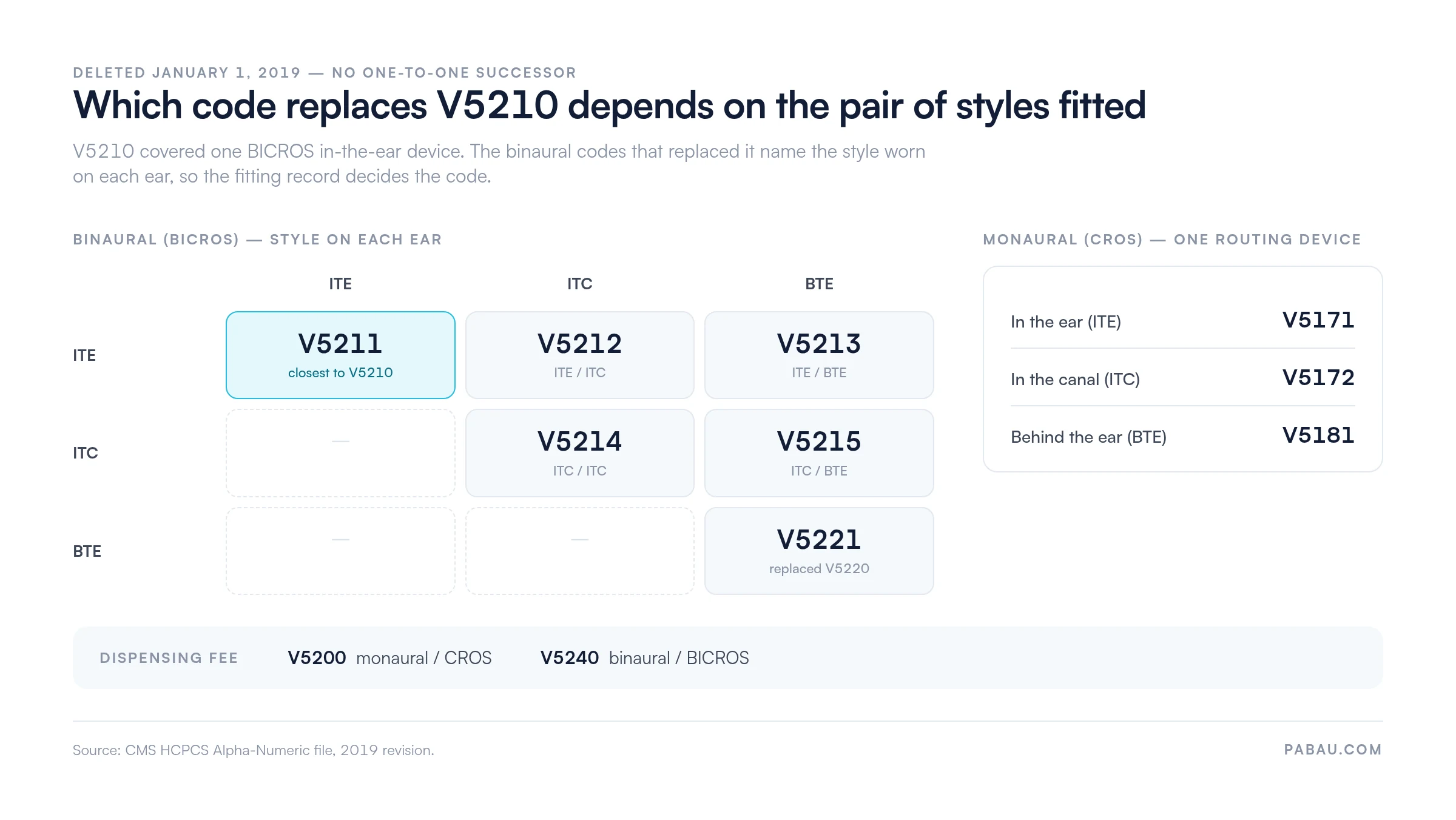
Dispensing fees bill alongside a device code and never in place of one. Use V5200 for a monaural CROS fitting. A binaural BICROS fitting takes V5240 instead, so the fee code matches the device code on the claim. A monaural fitting without contralateral routing takes V5241, the general monaural dispensing fee.
Verify with each payer whether the device and the dispensing fee are separately reimbursable. Ask too whether the fee needs its own claim line or is bundled into the device allowable.
Incomplete documentation is the second most common denial trigger for hearing aid claims, after non-coverage. These are the records that must be in the chart before the claim goes out. They follow the standards payers apply to durable medical equipment. Capturing them on a digital form at the fitting appointment means the chart is complete before the claim is built.
Medicare Part B does not cover hearing aids. Section 1862(a)(7) of the Social Security Act explicitly excludes “hearing aids or examinations therefor” from Medicare coverage. The exclusion applied to V5210 and applies equally to its replacement codes. The device is therefore non-covered for most Medicare beneficiaries, regardless of medical necessity.
Two exceptions exist and both require verification before billing.
For commercial insurance and Medicaid plans that do cover BICROS hearing aids, conduct insurance eligibility verification before the fitting appointment. Confirm that the current binaural contralateral routing code is on the plan’s covered list and whether a deductible applies. Ask about frequency limitations too, such as one hearing aid per ear every three years.
This workflow applies to commercial payers and Medicaid plans that cover BICROS hearing aids. Skip to the denial section if Medicare Part B is the primary payer, as the claim will be denied as non-covered.
Hearing aid claims have a higher denial rate than most HCPCS categories because coverage is non-universal and documentation requirements are strict. Working the denials in a set order reduces rework time and stops the same error repeating on the next claim.
Reviewing denial reason codes against this table after each remittance cycle shows which denial types keep recurring. A pattern usually traces back to the fitting record rather than to the coder, so the fix belongs upstream in the documentation workflow.
Every HCPCS claim requires a supporting ICD-10-CM diagnosis code that establishes medical necessity. For a BICROS in-the-ear hearing aid, the diagnosis code must document the hearing loss pattern that justifies the device.
Some ICD-10-CM hearing loss codes split by laterality and others do not, which is where coders lose time. H90.3 is a single bilateral code with no right or left sub-codes, while H90.41 and H90.42 do name a side.
Always select the code that most precisely matches the audiogram findings. A BICROS fitting is justified because the better ear also has measurable loss, so the bilateral code usually carries the claim. The CMS Physician Fee Schedule lookup and the NLM HCPCS API are useful cross-references for validating code pairings before submission.
Check whether the diagnosis code you picked even has a laterality option before you go looking for one. H90.3 is bilateral only, so H90.31 and H90.32 do not exist and a claim citing them will reject. H90.41 and H90.42 do split by side, and reaching for H90.5 instead of one of them is a common cause of preventable specificity denials.
In most audiology practices the fitting record and the claim live in different systems. The audiologist writes the styles fitted, the serial numbers and the delivery signature into the chart. A biller then rekeys the code from an order that may still name V5210.
Pabau keeps both in one record. Its claims management software reads the claim off the same patient record that holds the audiogram, the fitting note and the proof of delivery. Missing items are flagged before submission rather than after a denial.
For a practice fitting contralateral routing devices, the style pair on the chart and the code on the claim line stay in step. Denials that do land are queued by reason code, so the same V-code error does not repeat across a month of fittings.

Pabau tracks V-code claims, surfaces missing documentation before submission, and routes HCPCS denials to the right team member for correction. See how audiology practices use Pabau to reduce claim rework.

Treat V5210 as history and the rest of these claims get easier. The code has been dead since January 1, 2019. The only place it still belongs is a retrospective claim with a pre-2019 date of service.
Three habits keep these claims clean. Record the device style on each ear, because the binaural codes are chosen from the pair. Pair the device code with the right dispensing fee, V5200 for monaural and V5240 for binaural.
Check payer fee schedules against the CMS file rather than the other way round, since payer tables are the ones that go stale. Medicare’s statutory exclusion means most of these claims land with commercial or Medicaid payers that carry an explicit hearing aid benefit.
Book a demo to see how Pabau handles HCPCS billing from intake to remittance.

Working a stack of hearing aid denials? Denial management in healthcare sets out the workflow for triaging, appealing and tracking denied claims.
Want fewer denials in the first place? What is a clean claim? explains the checks that get a claim paid on first submission.
Reading remittance files each week? Electronic remittance advice breaks down the adjustment reason codes that explain a V-code denial.
Not sure a hearing aid benefit applies? Insurance eligibility verification covers what to confirm before the fitting appointment.
New to HCPCS and CPT claims? What is medical billing? walks through the full path from encounter to payment.
HCPCS code V5210 described a BICROS (Bilateral Contralateral Routing of Signal) hearing aid in the in-the-ear (ITE) style. It applied when a patient had profound loss in one ear and amplifiable loss in the better ear. CMS deleted the code effective January 1, 2019. Current fittings are billed with the binaural contralateral routing codes V5211 through V5215 and V5221.
It has been deleted. CMS terminated V5210 effective January 1, 2019, and the HCPCS Alpha-Numeric file carries a termination date of December 31, 2018. The code is invalid for any date of service from 2019 onward. It still appears in the CMS master file because that file retains terminated codes with a termination date rather than removing them.
No. Traditional Medicare Part B does not cover hearing aids, including BICROS devices. The statutory exclusion sits in Section 1862(a)(7) of the Social Security Act, and it applied to V5210 just as it applies to the replacement codes. Medicare Advantage plans may offer supplemental hearing aid benefits, but coverage varies by plan and must be verified individually.
V5210 was the BICROS in-the-ear code that CMS deleted in 2019. V5211 is one of the codes that replaced it, describing a binaural contralateral routing system with an in-the-ear device on each side. V5211 is not a straight swap, because V5212 through V5215 and V5221 cover the other style combinations. The pair of devices actually fitted decides which code applies.
H90.3, sensorineural hearing loss, bilateral, is the usual primary diagnosis for a BICROS fitting, because both ears carry measurable loss. H90.3 is a single complete code with no laterality sub-codes, so H90.31 and H90.32 do not exist. Where one ear is affected and the other hears normally, use H90.41 (right) or H90.42 (left) rather than the unspecified H90.5.
A CROS system routes sound from the non-hearing ear to a better ear that has near-normal hearing without adding amplification. A BICROS system does the same routing but also amplifies sound at the better ear, because that ear also has a measurable hearing loss. The audiogram determines which system is clinically appropriate and therefore which HCPCS code applies.
None, because V5200 was never a CROS device code. V5200 has always been a dispensing fee code, and its descriptor was revised in 2019 to read “dispensing fee, contralateral, monaural”. The CROS in-the-ear device code was V5170, which CMS deleted effective January 1, 2019 and replaced with V5171.



