CPT Code 31653: EBUS With 3+ Mediastinal Stations
CPT code 31653: Official descriptor and clinical scope CPT code 31653 is the pro...

Last Updated: Oct 20, 2026
93225 is the CPT code for the recording component of Holter monitoring. It covers external electrocardiographic recording up to 48 hours by continuous rhythm recording and storage, including connection, recording, and disconnection. It is a technical-component code billed by whoever supplies and connects the monitor.
Scanning analysis with report is billed as 93226, and physician review and interpretation as 93227. When one provider performs all three parts, bill the global code 93224 instead, never alongside 93225.
Let Pabau's smart automation suggest the right codes, reduce claim denials, and keep your practice compliant—effortlessly.
Automate repetitive tasks and focus on what matters most—your patients.
Reduce coding errors and ensure compliance with the latest regulations.
Clean claims, fewer denials, and faster reimbursements.
Powerful insights and reporting to help your practice thrive.
HIPAA compliant SOC 2 certified GDPR-compliant Trusted by 4,000+ clinics worldwide

CPT Code 93225 covers only the recording component of Holter monitoring up to 48 hours: connecting, recording, and disconnecting the device.
Scanning analysis is billed under 93226 and physician interpretation under 93227. CPT 93224 is the global code when one provider performs all three.
Modifiers TC and 26 don’t apply to 93225, and billing 93224 with any component code for the same episode triggers an NCCI bundling edit.
Recordings longer than 48 hours move to the 93241-93248 family, so the documented hook-up and return times decide which code you bill.
Claims management software like Pabau pre-fills each claim from the patient record and flags missing details before you submit.
CPT Code 93225 is the recording component of Holter monitoring. The American Medical Association descriptor reads: External electrocardiographic recording up to 48 hours by continuous rhythm recording and storage; recording (includes connection, recording, and disconnection).
In plain terms, it covers hooking up the monitor, the patient wearing it, and taking it off. Scanning the data and interpreting it are separate codes, and that split is where most billing errors start.
The code sits within the Cardiovascular Monitoring Services section of CPT (codes 93224-93278). It applies to ambulatory ECG recordings of up to 48 hours from a device the patient wears continuously. Longer recordings are not billable under 93225. They fall under codes 93241-93248, which CPT added in 2021.
Holter monitor CPT codes split by how long the patient wears the device. CPT added codes 93241-93248 in 2021 for external ECG recordings longer than 48 hours. Codes 93241-93244 cover more than 48 hours up to 7 days, and 93245-93248 cover more than 7 days up to 15 days.
Recording length decides between 93225 and 93241. If the device came off within 48 hours, the 93224-93227 family applies. If it stayed on longer, bill from 93241-93244, which carry their own global and component split. You can browse both families in AAPC’s CPT code range index.
Device type matters as well as duration. A monitor that captures rhythm around symptom-triggered events through a memory loop belongs to the event monitor family, where 93270 covers the recording component.
The 93224-93227 family uses a global/component model. One code covers the whole service, and three component codes cover each part when different providers share the work. The physician who reads that recording bills 93227 as the professional component. The chart below starts with recording length, then maps who did the work to the codes you bill.
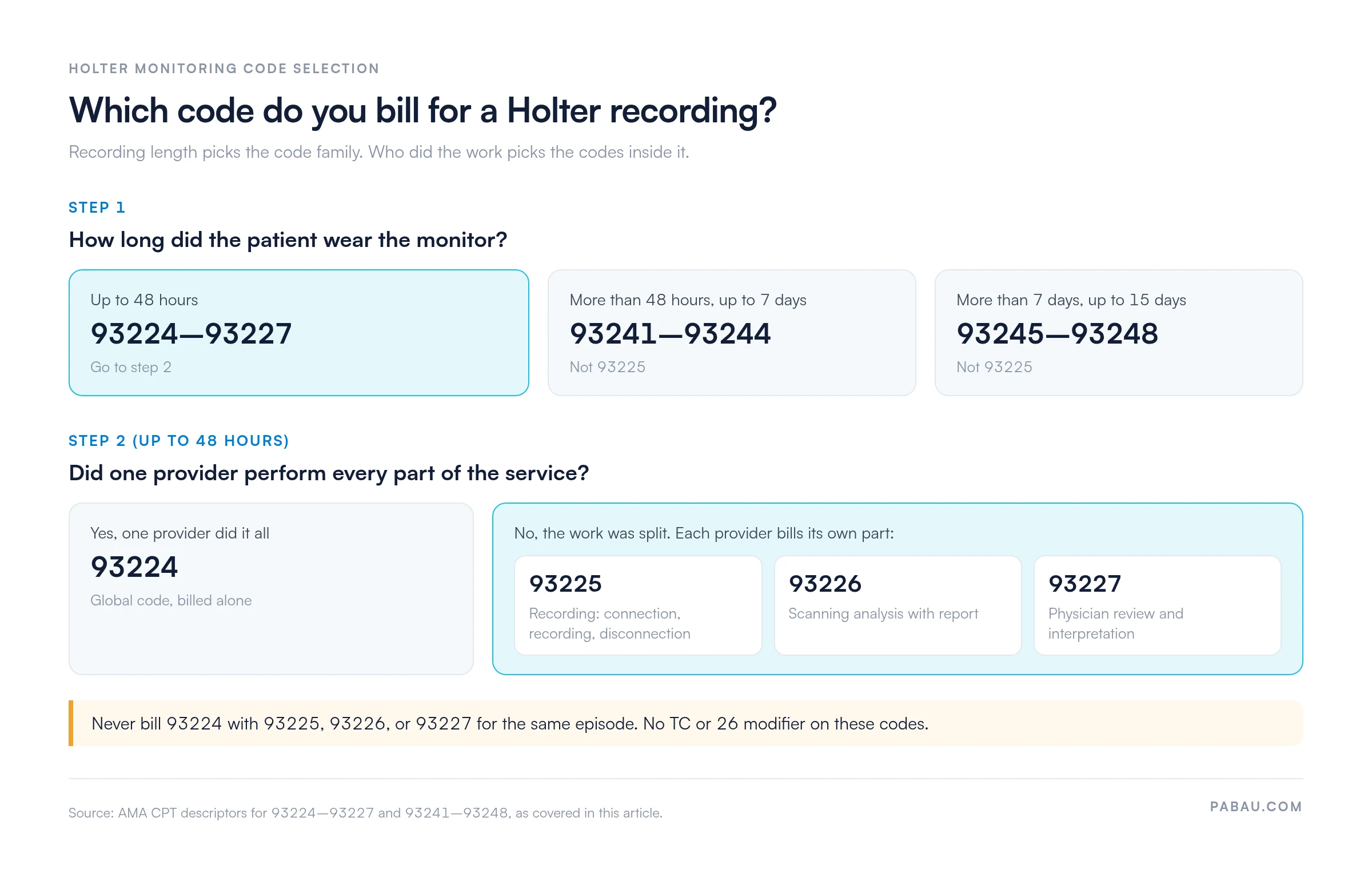
Split billing is where most of these errors happen. Each provider bills only the component code for its own work, with no TC or 26 modifier. The component codes already define who did what. If two providers bill overlapping codes for the same date, expect a denial.
Run a monthly charge capture audit for cardiovascular monitoring codes. Pull every claim where 93224 appears alongside 93225, 93226, or 93227 for the same patient and date of service. Each one is a bundling violation. Either consolidate to 93224 or keep only the component codes each provider performed.
Modifiers work differently on CPT Code 93225 than on most diagnostic tests. The technical and professional split is built into the codes themselves, so TC and 26 don’t apply. Appending the wrong modifier is a common reason ambulatory monitoring claims get rejected.
Place of service (POS) also affects payment. Non-facility settings (POS 11, office) carry higher technical reimbursement because the practice absorbs the overhead. Facility settings (POS 21, 22, or 23) pay less because the facility bills separately for resources. Confirm POS accuracy before submitting, since a mismatch with where monitoring took place is a common audit trigger.
Billing 93225 requires the medical record to support both medical necessity and procedural completeness. Missing any of the following elements is grounds for denial or post-payment recoupment.
Strong billing compliance ties every submitted code back to documented clinical necessity. Medicare Administrative Contractors (MACs) issue Local Coverage Determinations (LCDs) that set minimum documentation standards for cardiac monitoring, and these differ by region. Review the applicable LCD for your jurisdiction before billing.
Selecting the right ICD-10-CM code is as important as selecting the right CPT code. Payers cross-reference the diagnosis against their covered-diagnosis list during claim adjudication. An unspecified code such as I49.9 fits when the rhythm is not yet identified, which is often why the monitor was ordered. The following codes are among the most frequently accepted for Holter monitor medical necessity.
Always use the most specific diagnosis the documentation supports. If the record documents atrial fibrillation, code I48.91 or a more specific I48 code rather than R00.0. Some LCDs require the I48 code for that indication, so the symptom code risks a medical-necessity denial.
Medicare Part B covers CPT Code 93225 when the claim is supported by medical necessity and a covered ICD-10-CM diagnosis code. That code must be listed in the applicable MAC’s Local Coverage Determination. Payment rates vary by geographic locality and change annually with the Medicare Physician Fee Schedule update.
Any specific dollar figure goes out of date within months, so verify current reimbursement using the CMS Physician Fee Schedule Look-Up Tool. Search by HCPCS code 93225, select the applicable year and locality, and confirm the non-facility and facility rates separately. The non-facility rate is consistently higher because it includes practice expense for in-office monitoring.
Once a claim adjudicates, the electronic remittance advice (ERA) shows the allowed amount per code. On split-billed claims, each component appears on its own line, along with contractual adjustments and patient responsibility. Match these amounts to your superbill before posting payment.
Medicare does not require prior authorization for CPT Code 93225, but many commercial payers do. Their rules differ widely, and practices often learn about a requirement only after a denial.
Before scheduling ambulatory monitoring, verify insurance eligibility and confirm authorization requirements. A Holter monitor returned without authorization approval often results in a full denial. There is usually no appeal pathway if the plan terms required authorization.
Ambulatory cardiac monitoring claims deny often because the rules demand the right code family, the right component codes, and tight ICD-10 linkage. Most of the fixes below happen before the claim goes out. When a denial does arrive, match its claim adjustment reason code (CARC) against the common denial codes to see what the payer objected to.
When appealing a denial, attach the recording log, the hook-up documentation, and the ordering physician’s clinical notes in a single package. Piecemeal appeals take longer and often fail because the reviewer cannot reconstruct the clinical picture. Submitting a clean claim the first time remains the most efficient way to prevent denials.
Correct claim submission for CPT Code 93225 depends on how your billing system is set up. Three setup issues cause most software-related errors on Holter monitoring claims.
Practice management software like Pabau handles the submission side. With Pabau’s claims software for practices, insurer details live on the patient record, so each invoice builds a pre-filled claim without re-keying. Before you send, Pabau checks that details such as membership numbers and authorization codes are in place.
In the US, Pabau submits claims through Claim.MD, its clearinghouse partner, to thousands of payers. You can run real-time eligibility checks before hook-up, track each claim’s status, and post ERA remittances from the same dashboard. Coverage problems then surface before the patient leaves with the monitor, while they are still easy to fix.
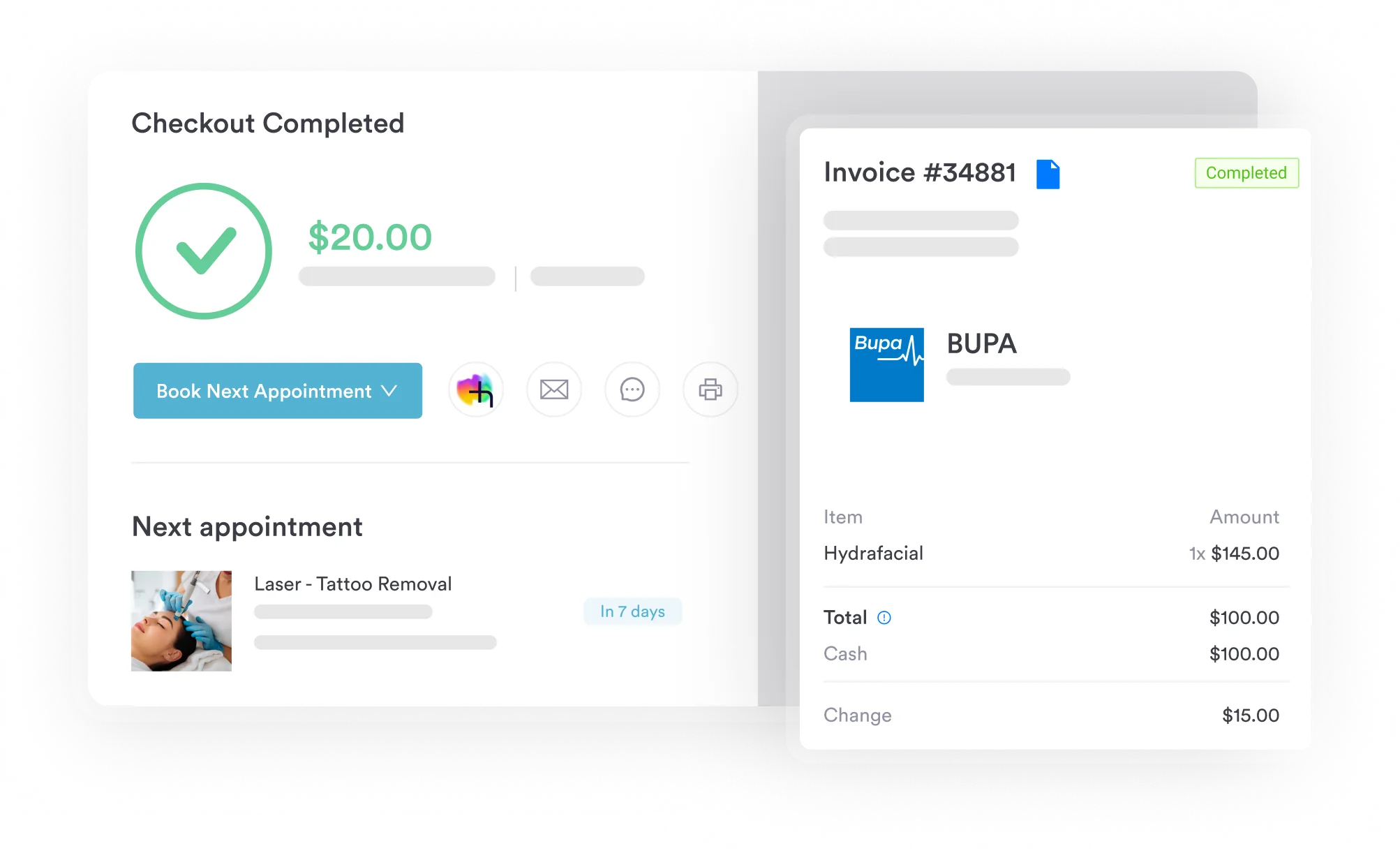

Pabau pre-fills insurance claims from the patient record and checks for missing details before you send. You can then track every 93225 claim through to ERA posting.

Bill 93225 when your practice hooked up the monitor and someone else handled the scanning or interpretation. If your practice did all three, bill 93224 alone. If the recording ran past 48 hours, leave this family and move to 93241.
The trade-off is setup work. Building the component codes into your superbill and scrubber takes some time up front, but it stops bundling denials before they reach the payer.
Book a demo to see how Pabau pre-fills Holter monitoring claims and checks them for missing details before they go out.

Need to understand clearinghouse claim submission for cardiac codes? Medical claims clearinghouse guide explains how clearinghouses validate and route CPT claims to payers.
Billing a routine ECG on the same day as a Holter hook-up? CPT Code 93000 covers the 12-lead ECG code and how it interacts with cardiac monitoring claims.
Still seeing Holter claims come back denied? Denial management in healthcare walks through tracking, appealing, and preventing claim denials.
Setting up split billing for 93225, 93226, and 93227? How to build a superbill shows what each line item needs so component codes reach the payer correctly.
Billing a new payer for cardiac monitoring? Getting credentialed with insurance companies covers the payer enrollment steps that affect cardiovascular monitoring reimbursement.
CPT Code 93225 covers the recording component of external electrocardiographic monitoring for up to 48 hours. That includes connecting the device, the patient-worn recording, and disconnection. Scanning analysis (93226) and physician interpretation (93227) are billed separately.
CPT 93224 is the global code covering recording, scanning analysis, and physician interpretation when one provider performs all three. CPT 93225 covers the recording only, used when other providers handle the scanning or interpretation. Billing both on the same claim triggers an NCCI bundling edit.
Modifiers TC and 26 are not used with 93225, because the code already describes the technical recording alone. The interpreting physician bills 93227 instead of adding modifier 26. Modifier 59 may apply when 93225 is performed on the same date as another service that would otherwise be bundled under NCCI edit rules.
Medicare reimbursement for CPT 93225 varies by geographic locality and changes annually with the Physician Fee Schedule update. Always verify the current rate using the CMS Physician Fee Schedule Look-Up Tool. Published figures go out of date within months of each January update.
Billing 93225 with CPT 93000 (routine ECG) on the same date requires modifier 59 on 93000. The documentation must show the ECG was a distinct, separately indicated service. Without modifier 59 and clinical justification, NCCI edits may bundle the two codes and deny 93000 as included within the Holter monitoring service.
CPT 93225 covers the recording component for monitoring up to 48 hours. CPT 93241, added in 2021, is a global code for recordings of more than 48 hours up to 7 days. It includes recording, scanning analysis, and interpretation. Choose between them by how long the patient wore the device.