HCPCS code J3471: Hyaluronidase ovine injection billing guide
HCPCS code J3471: Descriptor, code type, and quick-reference data HCPCS code J34...

Last Updated: Oct 14, 2026

CPT Code 93000 describes a routine 12-lead electrocardiogram with both the tracing and the physician interpretation, making it the global ECG code.
When a physician performs only the interpretation, bill CPT 93010. When only the tracing is performed, bill CPT 93005.
Modifier 26 or TC applies only when one entity bills a single part of a global service it owns. Split-facility work uses 93005 and 93010 with no modifier.
The screening-vs-diagnostic decision rule settles coverage, because Medicare pays for a symptom-driven ECG and denies routine screening in asymptomatic adults.
Practice management software like Pabau supports ECG billing with built-in CPT catalogs, pre-submission validation, and electronic claim submission through Claim.MD.
CPT Code 93000 covers a routine electrocardiogram with at least 12 leads, physician interpretation, and a written report, billed as one global service. Denials on CPT 93000 almost always trace back to one of three mistakes.
This guide covers the official description, how the ECG CPT codes 93000, 93005, and 93010 divide the work, and which modifiers apply. It also covers 2026 Medicare rates, paired ICD-10 diagnosis codes, documentation requirements, and the denial triggers that send ECG claims back.
The CPT Code 93000 description reads: electrocardiogram, routine ECG with at least 12 leads, with interpretation and report.
That wording comes from the American Medical Association’s CPT code set. The CPT electrocardiogram family sits in the Cardiography section of the Medicine chapter. CPT 93000 counts as a global code because it bundles the technical and professional components into one billable unit.
Three components must all be present for CPT 93000 to apply.
If any one of these three elements is absent, CPT 93000 cannot be billed. The matching component code, 93005 or 93010, applies instead.
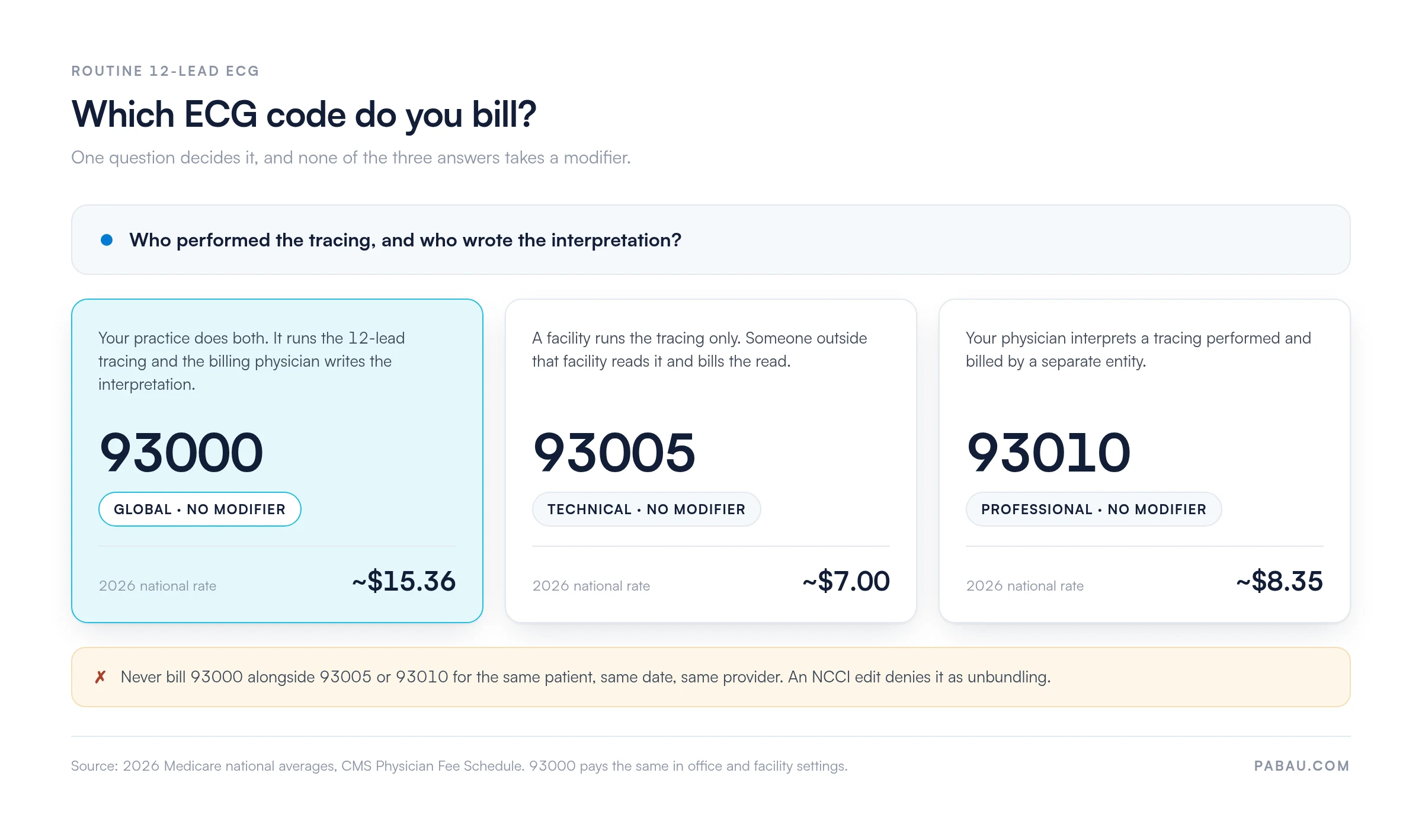
Bill 93000 when your practice performs and interprets the ECG, 93005 when it only performs the tracing, and 93010 when it only interprets.
Searchers usually frame this as 93000 vs 93010, and that framing hides the third option. The CPT code 93005 description covers the tracing only, without interpretation and report. Procedure code 93005 therefore belongs to whoever owns the machine. CPT code 93010 covers the interpretation and written report only, so it belongs to whoever wrote the read.
Plenty of US coders type EKG rather than ECG. The EKG CPT code choices are the same three numbers either way, and none of them takes a modifier in the standard case.
CPT 93000 and CPT 93005 or 93010 cannot be billed together for the same patient, on the same date, by the same provider. The National Correct Coding Initiative (NCCI) carries an edit that blocks that unbundling. Billing all three codes at once is a common audit trigger.
Ambulatory monitoring splits along the same lines. 93225 covers the Holter recording alone, with the scanning analysis and the physician read billed as separate codes.
Most CPT 93000 claims need no modifier at all, because the global code already covers both components.
Modifiers only tell payers how the service was divided when the default global scenario does not apply. Four modifiers come up in ECG billing. In practices we onboard, the modifier field is where ECG claims go wrong most often, usually because someone reached for -26 out of habit.
A cardiologist reads ECGs performed at a hospital outpatient department. The hospital bills 93005 for the tracing. The cardiologist’s practice bills 93010 for the interpretation. Neither party bills 93000, because neither performed both components.
The rule is short. When the technical and professional components sit with two separate entities, each entity bills its own component code, 93005 or 93010, with no modifier. Modifiers 26 and TC belong to a single entity that owns the whole global service and is claiming only one part of it.
Modifier 25 is the one you need, appended to the same-day E/M code rather than to CPT 93000 itself.
The modifier 59 vs 25 confusion costs practices money, because only one of the two belongs on an ordinary same-day ECG claim. Take a patient seen for palpitations whose hypertension is also reviewed. The practice bills the office visit and the ECG on the same claim.
That claim carries CPT code 99214 modifier 25 on the visit line, which tells the payer the office visit was separately identifiable from the ECG. Modifier 25 never goes on 93000. Appending modifier 59 to 93000 in this scenario adds no information and invites a review.
Modifier 59 has one narrow slot with the ECG codes. CMS covers a one-time screening ECG referred from the Welcome to Medicare exam under HCPCS codes G0403, G0404, and G0405, not under the 93000 series. If a medically necessary 93000-series ECG has to happen on that same date, modifier 59 marks it as the distinct procedure.
Medicare’s 2026 national average for CPT 93000 is about $15.36, and that figure is the same in an office and in a facility.
The practice expense RVU for CPT 93000 does not vary by place of service, so the usual non-facility premium never appears. That surprises billing teams who expect a lower facility rate. The component codes pay less because each one covers half the service.
Figures above are 2026 national averages and vary by Medicare Administrative Contractor (MAC) locality. Verify the current amount with the CMS Physician Fee Schedule lookup tool before submitting claims. Commercial payer rates differ from Medicare and follow each payer contract.
You can also pull the RVU breakdown from the FastRVU 2026 RVU lookup tool. The electronic remittance advice from your clearinghouse shows the exact allowed amount per claim after adjudication.
Sending a portable machine out to the patient does not add a payable line. Medicare has bundled R0076, the portable EKG transport code, into the ECG payment since 1997.
Medicare covers an ECG that answers a clinical question and denies one ordered as routine screening in an asymptomatic adult.
Call that the screening-vs-diagnostic decision rule, and settle it before the electrodes go on. Per CMS Local Coverage Article A57326, Medicare covers an ECG performed for a medically necessary clinical indication. The rule has three outcomes and no fourth.
The US Preventive Services Task Force (USPSTF) grades resting ECG screening as D in low-risk asymptomatic adults. For asymptomatic adults at intermediate or high risk, the USPSTF issues an I statement instead, meaning the evidence is insufficient either way. Neither grade gives Medicare a reason to pay for a screening ECG.
The guidance around the web contradicts itself here. Several billing blogs describe dropping 93000 into an annual wellness visit, which this rule does not allow.
Covered clinical indications generally include:
Confirm coverage for the indication before the encounter, so a non-covered ECG never reaches the claim stage.
Document the specific symptom or clinical indication in the medical record before the ECG is ordered. Z13.6 (screening for cardiovascular disorders) paired with CPT 93000 on a standard Medicare claim is a frequent denial trigger. The diagnosis code has to state the clinical reason for the test, not the fact that it was a screen.
CPT 93000 pairs with the ICD-10 code naming the symptom or condition that prompted the ECG, never with a screening code.
That pairing is what demonstrates medical necessity to the payer. Check the descriptor and any coding notes in our ICD-10-CM codes reference before you attach a diagnosis to the claim. The codes paired most often are listed below.
The second half of the pairing gets far less attention, and it is where the screening-vs-diagnostic decision rule bites. The codes below describe wellness and administrative encounters. Each one tells the payer that no clinical question prompted the ECG, so a 93000 claim carrying it comes back denied.
Always check the supported ICD-10 codes against the current version of CMS Local Coverage Article A57326 and your MAC’s local policies. Coverage policies are updated annually, and a code accepted one year can need extra documentation the next.
A clean CPT 93000 claim needs six elements: the indication, the date, the tracing, the interpretation, the signature, and the place of service.
Missing or incomplete documentation is the second most common reason ECG claims are denied or recouped on audit. Treat the list below as the six-point clean-claim checklist, and run it before every clean claim goes out.
Practices using HIPAA-compliant documentation systems reduce audit exposure by keeping structured, date-stamped records for every service. Electronic records that attach the ECG tracing to the encounter note automatically satisfy the storage requirement and head off missing-document denials.
ECG claims follow a straightforward billing pathway, yet a handful of recurring errors account for most denials. Recognizing these patterns before submission is what keeps cardiology and primary care claims moving.
Review your practice’s denial reports quarterly to see whether any of these patterns keep repeating. Targeted pre-submission edits catch most of them before the claim reaches the payer.
A consistent billing workflow reduces errors and speeds up reimbursement. Below is the standard claim submission sequence for CPT 93000 in a non-facility office setting. Step four is where the code choice gets made, and the chart below settles it with one question.
Manual ECG billing leaves room for error at several steps. A wrong POS code, a missing modifier, or an unchecked NCCI edit each sends the claim back. Practice management software with integrated claims workflows runs those checks before submission instead of after a denial.

Pabau’s practice management platform includes built-in claims management and electronic submission workflows. See how cardiology and primary care practices use Pabau to reduce ECG billing denials.

Pabau, an all-in-one practice management system, includes claims management software with built-in CPT and ICD-10 catalogs, pre-submission validation, and direct electronic claim submission. For US practices, Pabau submits electronic claims through Claim.MD, our clearinghouse partner, which connects to thousands of US payers.
Pabau validates claims against current NCCI edits before transmission. The platform also returns real-time eligibility results and electronic remittance advice, so your team can action a denial the day it posts.
For practices billing CPT 93000 alongside E/M codes, Pabau’s superbill workflow builds the claim from the encounter. It pulls the CPT codes, diagnosis codes, and modifiers across without manual re-entry.
That removes the transcription step where most modifier errors start. Teams can also review denial and adjustment reports in the platform to see which ECG lines keep coming back.
CPT Code 93000 is a simple code with three unforgiving requirements: a 12-lead tracing, a substantive written interpretation, and a physician signature. Miss one of them and the correct answer is 93005 or 93010, not 93000 with a modifier bolted on.
Run the screening-vs-diagnostic decision rule before the electrodes go on. A symptom or a known condition on the chart makes the ECG billable. A wellness visit on its own does not, whatever the patient’s age or risk profile.
Practices that build CPT and ICD-10 validation into the claim before submission spend far less time appealing denials afterward. Pabau’s claims tools and Claim.MD integration support that workflow end to end. Book a demo to see how Pabau keeps cardiology and primary care claims clean before they reach the payer.

Want to reduce claim denials across your practice? Denial management in healthcare covers the systematic workflow for tracking, appealing, and preventing recurring claim rejections.
Unsure which clearinghouse fits your billing volume? Claim.MD vs Office Ally compares the two most common US clearinghouses for small and mid-sized practices.
Need to verify payer-specific ECG coverage before the appointment? Insurance eligibility verification explains the real-time eligibility check workflow that catches non-covered services before the appointment.
CPT Code 93000 is the global electrocardiogram code. The code covers a routine ECG with at least 12 leads, plus physician interpretation and a written report, billed as one service. CPT 93000 applies when the same provider or practice performs and interprets the ECG. If either component is performed by a different entity, use 93005 for the tracing or 93010 for the interpretation instead.
CPT 93000 is the global code including both tracing and interpretation. CPT 93005 covers the tracing only, the technical component, and is typically billed by a facility. CPT 93010 covers the interpretation and written report only, the professional component, and is typically billed by the reading physician. Billing 93000 and either component code from the same provider on the same date triggers an NCCI unbundling edit.
No. CPT Code 93000 is a procedure code, and its description covers the routine 12-lead ECG service itself. The diagnosis travels separately as an ICD-10-CM code, such as R00.2 for palpitations or R07.9 for chest pain. Payers read the CPT code to see what was done and the ICD-10 code to see why it was done.
The 2026 national average Medicare rate for CPT 93000 is approximately $15.36, and that rate is the same in office and facility settings. CPT 93010 pays about $8.35 and CPT 93005 about $7.00. Rates vary by MAC locality and are updated annually. Verify the current rate for your locality using the CMS Physician Fee Schedule lookup tool before submitting claims.
Modifier -26 or -TC on CPT 93000 is rarely the correct approach. When the components sit with two separate entities, bill CPT 93010 for the interpretation or CPT 93005 for the tracing, with no modifier. Use 93000-26 only when your entity owns the equipment and bills its professional portion of that global service. Using 93000-TC and 93000-26 from the same billing entity at once is incorrect.
Yes. Append modifier 25 to the E/M code, so 99214-25 and 93000 both sit on the claim. The modifier tells the payer the office visit was separately identifiable from the ECG. Never append modifier 25 to 93000 itself, and do not reach for modifier 59 in its place on an ordinary same-day visit.
No. Medicare does not cover an ECG ordered solely as preventive screening in an asymptomatic adult. The USPSTF grades resting ECG screening as D in low-risk adults and issues an insufficient-evidence I statement for higher-risk adults. One screening ECG is covered after a Welcome to Medicare exam referral, reported under G0403, G0404, or G0405 rather than 93000. Every other ECG needs a clinical indication and a covered ICD-10 code.
No. Billing CPT 93000 together with 93005 or 93010 from the same provider on the same date violates NCCI unbundling rules. The claim comes back denied. Bill 93000 when your practice performs and interprets the full service. Use the matching component code when only one part of the service is provided.
Required documentation starts with a clinical indication linked to a covered ICD-10 diagnosis code. The record also needs the 12-lead tracing itself. A substantive written interpretation must be signed and dated by the billing physician. The date of service must match the claim date. The place of service code must reflect where the ECG was performed.