CPT Code 31653: EBUS With 3+ Mediastinal Stations
CPT code 31653: Official descriptor and clinical scope CPT code 31653 is the pro...

Last Updated: Oct 20, 2026
92920 is the CPT code for percutaneous transluminal coronary angioplasty in a single major coronary artery and its branches, using a balloon without a stent. Since January 1, 2026, branch work in that artery is part of 92920, because the old branch add-on 92921 was deleted.
Coders most often confuse 92920 with 92928, which reports a stent and already includes the balloon work. When a second major artery is treated in the same session, it takes its own primary code, often with a coronary modifier.
Let Pabau's smart automation suggest the right codes, reduce claim denials, and keep your practice compliant—effortlessly.
Automate repetitive tasks and focus on what matters most—your patients.
Reduce coding errors and ensure compliance with the latest regulations.
Clean claims, fewer denials, and faster reimbursements.
Powerful insights and reporting to help your practice thrive.
HIPAA compliant SOC 2 certified GDPR-compliant Trusted by 4,000+ clinics worldwide

CPT code 92920 reports balloon angioplasty in one major coronary artery and its branches, and a stent in that artery moves the claim to 92928.
The branch add-on 92921 was deleted on January 1, 2026, so angioplasty in a branch of the same artery is now part of 92920.
A second major artery takes its own primary code, and some payers require a coronary modifier (LC, LD, RC, LM or RI) on each line.
Same-day diagnostic angiography is billable with modifier -59 or XS only when the report documents a separate decision to intervene.
Pabau’s practice software submits PCI claims through Claim.MD, checks eligibility, and tracks claim status and ERA remittances.
CPT code 92920 reports percutaneous transluminal coronary angioplasty in a single major coronary artery and its branches.
The cardiologist opens a narrowed segment with a balloon, and no stent is left behind. The American Medical Association’s CPT code set revised the descriptor for 2026 so that branch work now sits inside the primary code.
Three parts of the descriptor decide whether 92920 fits the case. Check each one against the operative report.
The 2026 revision changes old habits. The branch add-on 92921 was deleted on January 1, 2026, along with the matching stent and atherectomy add-ons. A claim that still lists 92921 for a 2026 date of service will reject.
Clinically, 92920 appears in PCI for coronary artery disease when balloon dilation alone gives an acceptable result. Most claims pair it with a native-vessel atherosclerosis code such as I25.10, or with an acute coronary syndrome code for emergent cases.
When the balloon only pre-dilates the lesion before a stent, 92928 replaces 92920 for that artery.
Several services are paid inside 92920 and cannot be reported on their own. Others are billable next to it when the documentation supports them.
NCCI edit tables change quarterly, so check the current bundling status of intravascular imaging codes before you submit. Reporting a bundled service without a valid modifier is the fastest route to a CO-97 denial.
The PCI family runs from balloon-only angioplasty through stenting, atherectomy and chronic total occlusion work. Picking the right code for each artery prevents the most common coding errors.
The grid below works through one artery at a time.
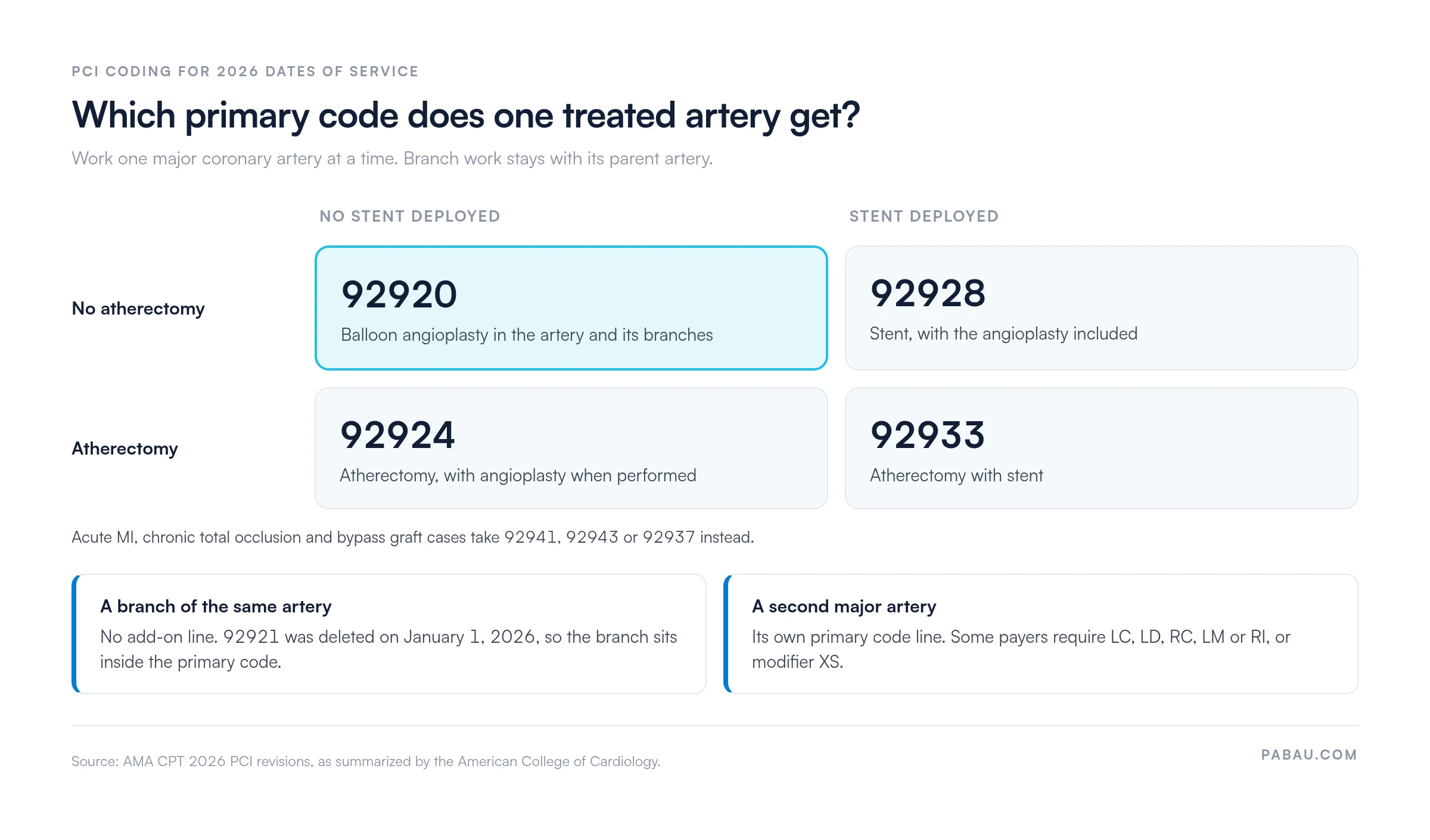
Key rule: 92920 and 92928 are never reported together for the same lesion. When a stent follows balloon pre-dilation, 92928 is correct because it already includes the angioplasty. Use 92920 only when the balloon is the definitive treatment for that artery.
A clean claim submission for 92920 depends on what the interventional cardiologist writes in the cath lab report. Check each element below before the claim goes out.
Place of service affects payment. Almost all PCI procedures happen in hospital outpatient departments (POS 22) or inpatient settings (POS 21), and 92920 is rarely billed in a non-facility setting.
Knowing the path helps you see where a claim stalls. A typical hospital outpatient PCI claim goes through six steps.
Modifier choice on 92920 drives both underpayment and audit exposure. A missing modifier leaves a line unpaid, while a forced one unbundles work that belongs together. Ask one question every time: does the documentation support the extra service on its own?
On modifier -59 and the X-modifiers: CMS introduced XE, XS, XP and XU as more specific alternatives to -59. XS (separate structure) fits PCI best when the diagnostic study and the intervention involve separate anatomy. Some MACs now prefer XS over -59 for this family, so check your local MAC’s guidance before defaulting to -59.
Before adding modifier -59 to a same-day diagnostic cath code, pull the operative report. Confirm the physician documented a separate decision point, usually a finding during the diagnostic study that then led to intervention. If the patient arrived already scheduled for PCI, the diagnostic angiography is bundled and -59 does not apply.
Medicare pays CPT 92920 under the Physician Fee Schedule (MPFS), which uses relative value units. For CY 2026, the code carries 11.59 total RVUs in both the facility and non-facility columns.
Pull locality rates from the CMS MPFS lookup tool, because the conversion factor and geographic adjustments set the dollar figure.
For contract talks or budget projections, the FastRVU 2026 RVU lookup tool gives locality-adjusted estimates. Medicare Advantage plans often apply their own fee schedules, so check each remittance against the contract.
Posting electronic remittance advice promptly lets you spot short payments on PCI claims while the appeal window is still open.
PCI claims rarely travel alone. These adjunct codes are the ones coders see most often next to 92920. The AAPC CPT code lookup has the full descriptor for each.
Report 92978 for the first vessel imaged, then 92979 for each additional one, at one unit per vessel. On the physician claim, 92978 takes modifier 26, because Medicare pays only the professional component.
Prior authorization rules for CPT 92920 vary by payer and by whether the PCI is elective or emergent. A missed authorization is a preventable denial, so build the check into your prior authorization process at scheduling.
When a required authorization is missing, the denial usually comes back as CO-197 (precertification or authorization absent) or a plan-specific code. These denials are rarely overturned on appeal without a new authorization.
A short list of root causes drives most 92920 denials. Learn the claim denial codes behind them, because a targeted denial management workflow fixes them faster than a general audit.
The National Correct Coding Initiative (NCCI) treats certain codes as Column 2 components of 92920. They count as part of the balloon work and need a valid modifier to be reported. Edits update quarterly, so check the live NCCI table. Current relationships include the following.
Using -59 to override an edit without independent documentation is unbundling, and it carries False Claims Act risk. Your medical claims clearinghouse will not catch this, because documentation review is the only control.
CPT 92920 carries a 0-day global period under the MPFS. No post-procedure services are bundled into the payment, so follow-up visits are billable from the day of the procedure. Major surgery, by contrast, often carries a 90-day global.
Check the global period in the CMS MPFS lookup before billing post-procedure services, because designations can change in annual updates.
Run a monthly denial report filtered to CPT 92920 and sort it by denial code. If CO-97 leads, your cath lab documentation for same-day diagnostic angiography needs a checklist update. If CO-4 leads, look at modifiers first, usually a missing coronary modifier on a second artery.
Each point below maps to one of the denials above, so a claim that passes all six rarely comes back.
Without a connected system, a PCI claim gets tracked across a payer portal, a clearinghouse login and a spreadsheet. Status checks happen by phone, and remittances get matched by hand.
Pabau, the practice management platform we build, keeps that work in one place. Its claims management software submits claims through Claim.MD and runs 270/271 eligibility checks before the procedure. Claim status and ERA remittances then come back into Pabau, so your team sees what was paid and what was denied.
The coding decisions in this guide still belong to your coders. What shrinks is the time spent chasing claims, which leaves more of the week for working denials against the operative report.

Pabau submits CPT 92920 claims through Claim.MD, checks patient eligibility, and tracks claim status and ERA remittances in one place. See how it fits your cardiology billing workflow.

For 2026 dates of service, treat 92920 as a per-artery code. Branch work stays inside it, a stent moves that artery to 92928, and a second major artery earns its own line and modifier.
Update your charge templates and coder checklists now, and the deleted add-ons stop turning into CO-181 rejections. The cost is a closer read of each operative report, which is far cheaper than reworking denied claims.
Pabau keeps those claims visible from submission to remittance, so denials surface while you can still fix them. Book a demo to see how it handles PCI claims for your cardiology practice.

Need to understand how clearinghouse claim routing works? Claim.MD clearinghouse overview explains how electronic claims reach payers and where edits are applied before adjudication.
Want to reduce claim rework across your billing team? Denial management in healthcare covers the workflows and escalation logic that prevent repeat denials on the same code families.
Ready to submit cleaner claims from day one? Clean claim submission guide outlines the data completeness checks a claim must pass before it reaches a payer.
Still chasing authorizations by phone? Prior authorization software compares tools that help practices request and track authorizations for elective procedures.
Coding an emergent PCI? ICD-10 code I24.9 explains how to code acute coronary syndrome when the documentation stays unspecified.
No. CPT 92921 was deleted on January 1, 2026, along with the other PCI branch add-ons. Angioplasty in a branch of the same major artery is now included in 92920, and a 2026 claim that lists 92921 will reject.
Yes, when angioplasty is performed in two different major coronary arteries. Each artery gets its own 92920 line. Some payers also require a coronary modifier, such as LD or RC, or modifier XS to show the separate vessel.
CPT 92920 reports balloon angioplasty alone. CPT 92924 reports atherectomy, which removes plaque with a cutting or rotational device, together with any angioplasty in the same artery.
For CY 2026, CPT 92920 carries a work RVU of 8.14, a practice expense RVU of 1.54 and a malpractice RVU of 1.91. The 11.59 total is the same in facility and non-facility settings.
Yes. Medicare added 92920 to the ASC covered procedures list in 2020, and the claim uses place of service 24. Commercial coverage for ASC-based PCI varies, so confirm it with each payer.