CCSD Code H5230: Haemorrhoid sclerosing injection
CCSD Code H5230: definition and clinical scope CCSD Code H5230 is the Clinical C...

Last Updated: Oct 21, 2026
90680 is the CPT code for rotavirus vaccine, pentavalent (RV5), 3 dose schedule, live, for oral use. It reports one oral dose of RotaTeq, Merck's rotavirus vaccine given at two, four, and six months.
The code covers the vaccine product only, so each dose is billed with an administration code such as 90460 or 90471. Rotarix, the two-dose rotavirus vaccine, is billed under 90681 instead.
Let Pabau's smart automation suggest the right codes, reduce claim denials, and keep your practice compliant—effortlessly.
Automate repetitive tasks and focus on what matters most—your patients.
Reduce coding errors and ensure compliance with the latest regulations.
Clean claims, fewer denials, and faster reimbursements.
Powerful insights and reporting to help your practice thrive.
HIPAA compliant SOC 2 certified GDPR-compliant Trusted by 4,000+ clinics worldwide

CPT Code 90680 covers RotaTeq (RV5, pentavalent, three-dose oral) only. Rotarix (RV1, monovalent, two-dose) is billed under CPT 90681.
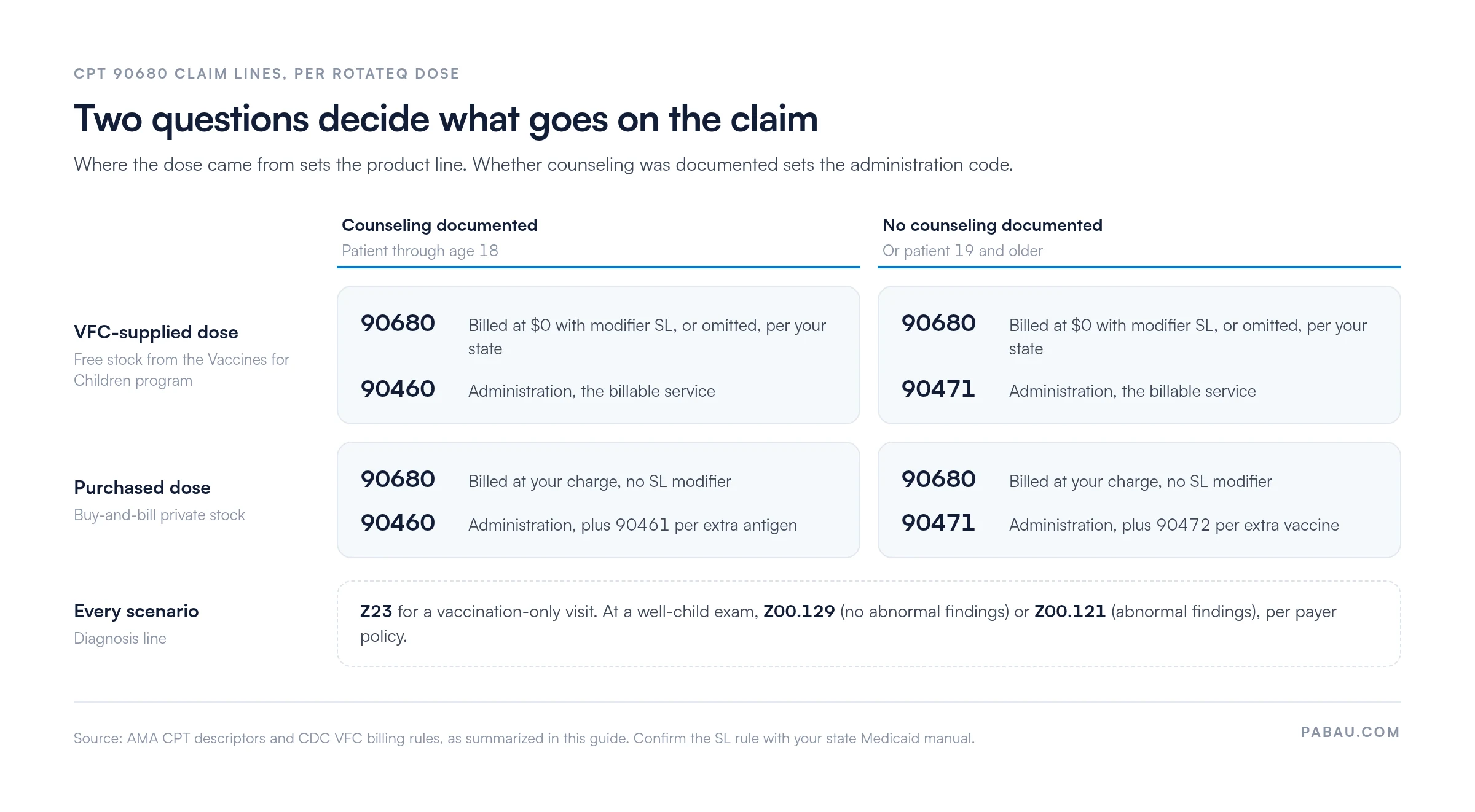
Bill a separate administration code with every 90680 dose: 90460/90461 with counseling for patients through age 18, or 90471/90472 without counseling.
VFC-enrolled providers append modifier SL to a VFC-supplied dose. Billing the product cost for free VFC stock is a compliance violation.
Practice management software like Pabau pre-fills claims from the patient record and holds back incomplete ones before they reach the payer.
CPT Code 90680 covers one dose of RotaTeq, Merck’s pentavalent rotavirus vaccine, given by mouth in a three-dose series. It is a product-only code, so each dose also needs an administration code on the claim. The table below holds the details billers confirm before a claim goes out.
Per the American Medical Association’s CPT code set, 90680 is strictly a product code and does not bundle administration. Every claim needs a separate administration code alongside it, or the payer denies it as incomplete.
Submitting the wrong rotavirus code is a common cause of 90680 denials. RotaTeq and Rotarix are both rotavirus vaccines, but they are different products with different schedules and different codes.
The selection rule is simple. Check the vaccine vial or lot record in the patient’s chart. If the product is RotaTeq, use 90680, and if it is Rotarix, use 90681.
Never assign the code from memory or from the schedule template. Billing 90681 when RotaTeq was given, or the reverse, triggers a code mismatch denial. Fixing it takes a corrected claim and delays payment by weeks.
Because 90680 covers only the vaccine product, every dose is billed alongside an administration code. Which one depends on whether vaccine counseling was provided and on the patient’s age.
RotaTeq is given at two, four, and six months, so most rotavirus encounters bill 90460 alongside 90680. The chart has to support that choice.
If the physician or qualified provider did not counsel the parent or guardian about the vaccine, 90460 can’t be billed. Use 90471 instead, and check current payer guidance on the age threshold before applying the through-age-18 rule.
A missing or incorrect diagnosis code is a frequent reason 90680 claims are denied. The correct ICD-10-CM code depends on the visit type and the clinical context of the encounter.
Check the current ICD-10-CM tabular list, because code assignments can shift between fiscal years. A well-child visit that also bills a preventive E&M code may need both Z23 and the matching Z00.12x code, depending on payer policy. Confirm each payer’s diagnosis requirements for vaccine encounters before finalizing the claim.
Check your payer’s LCD or coverage policy for rotavirus vaccine diagnosis code requirements before claim submission. Some Medicaid plans require the well-child Z00.12x code when the vaccine is administered during a well-child visit, while others accept Z23 alone. A one-time policy check per payer prevents repeated denials across an entire panel.
Reimbursement for CPT Code 90680 varies by payer, by state, and by whether the practice is VFC-enrolled. Medicare is largely irrelevant for this code (see the payer coverage section below), so the rates that matter most are Medicaid and private commercial.
For current RVU values and Medicare reimbursement by locality, the FastRVU 2026 RVU lookup tool pulls directly from CMS data and includes geographic adjustors. Track your reimbursement per dose against your acquisition cost to confirm the code pays for itself outside VFC.
Posting electronic remittances as they arrive keeps that comparison current, so an underpayment is spotted while it can still be appealed.
Payer coverage for 90680 breaks down clearly by program. Checking coverage at scheduling, rather than at claim submission, prevents most coverage-related denials.
The Vaccines for Children program, administered by the CDC, provides rotavirus vaccine at no cost to enrolled providers for eligible patients. VFC eligibility covers Medicaid-enrolled, uninsured, and American Indian or Alaska Native children. Underinsured children qualify for vaccines their private plan doesn’t cover. Billing under VFC changes the claim structure for 90680 in three specific ways.
Put these VFC rules next to the administration rules above, and two questions settle every line on the claim. Where did the dose come from, and was counseling documented?
Review the CDC’s VFC program documentation for full eligibility rules and state-specific billing guidance. The CDC administers the program and updates requirements annually.
Two modifiers come up on 90680 claims more than any others. Using the wrong one, or leaving off a required one, is a frequent cause of denials on this code.
Some Medicaid managed care organizations use a state-specific modifier in place of SL. Confirm with your state’s VFC coordinator and the specific managed care plan before finalizing VFC claims.
Applying SL to a privately purchased dose, or billing SL to commercial payers that do not recognize it, generates denials that require manual resubmission.
Audit risk for vaccine codes centers on documentation. A clean claim for 90680 is only defensible if the medical record contains every required element. Missing any one of these is enough for a payer or an Office of Inspector General (OIG) audit to request recoupment.
These records are what a payer or auditor asks for first on a vaccine claim. A superbill with dedicated NDC and dose-number fields gets both details captured at the visit, before the claim is built.
Most 90680 denials are preventable. The table below maps each denial pattern to its root cause and the fix. Each denied claim also comes back with a reason code, which our list of claim denial codes translates into a corrective action.
A clearinghouse scrub catches most of these errors before the claim reaches the payer. It checks NDC format, modifier presence, and diagnosis code structure against payer edits in real time. For a code with this many pairing rules, that pre-submission check does most of the denial prevention work.
Pull your 90680 denials from the past 90 days and filter for three reason codes. CO-4 flags a missing or inconsistent modifier, CO-97 a service included in another, and CO-119 a benefit maximum reached. Each one points to a modifier, pairing, or dose-count problem covered in this guide.
Prior authorization (PA) is not routinely required for CPT Code 90680. Routine ACIP-recommended childhood vaccines are generally exempt from PA requirements under most Medicaid programs and commercial plans. Covering them without barriers is an ACA preventive services requirement for non-grandfathered plans.
That said, some commercial plans do require PA for rotavirus vaccine in specific cases. Examples include a dose outside the standard age window or a patient flagged as high-risk. Aetna, for example, publishes a clinical policy bulletin covering rotavirus vaccine coverage criteria.
Verify PA requirements with each payer before giving the dose, especially when a patient’s situation departs from the standard ACIP schedule. Most payers confirm PA status within minutes through a phone or portal check. Build that check into scheduling rather than billing, so PA questions are settled before the patient arrives.
Each rule for CPT Code 90680 is simple on its own, but they add up across a busy pediatric day. A practice seeing 40 well-child visits a week, each with three or four vaccines, builds hundreds of code pairings a month. Entering those by hand is where the errors in the denial table come from.
Practice management software like Pabau takes the retyping out of that work. When an invoice is ready, Pabau’s claims management for practices builds a pre-filled claim from the patient, treatment, and insurer details already in the record. The Send button stays disabled until required details are complete, so a half-finished claim never leaves the practice.
In the US, Pabau sends claims through Claim.MD to thousands of payers. The same dashboard runs real-time eligibility checks, tracks claim status, and posts electronic remittance advice (ERA). A VFC patient’s Medicaid enrollment is confirmed before the visit, and each 90680 payment is matched to its claim without a spreadsheet.
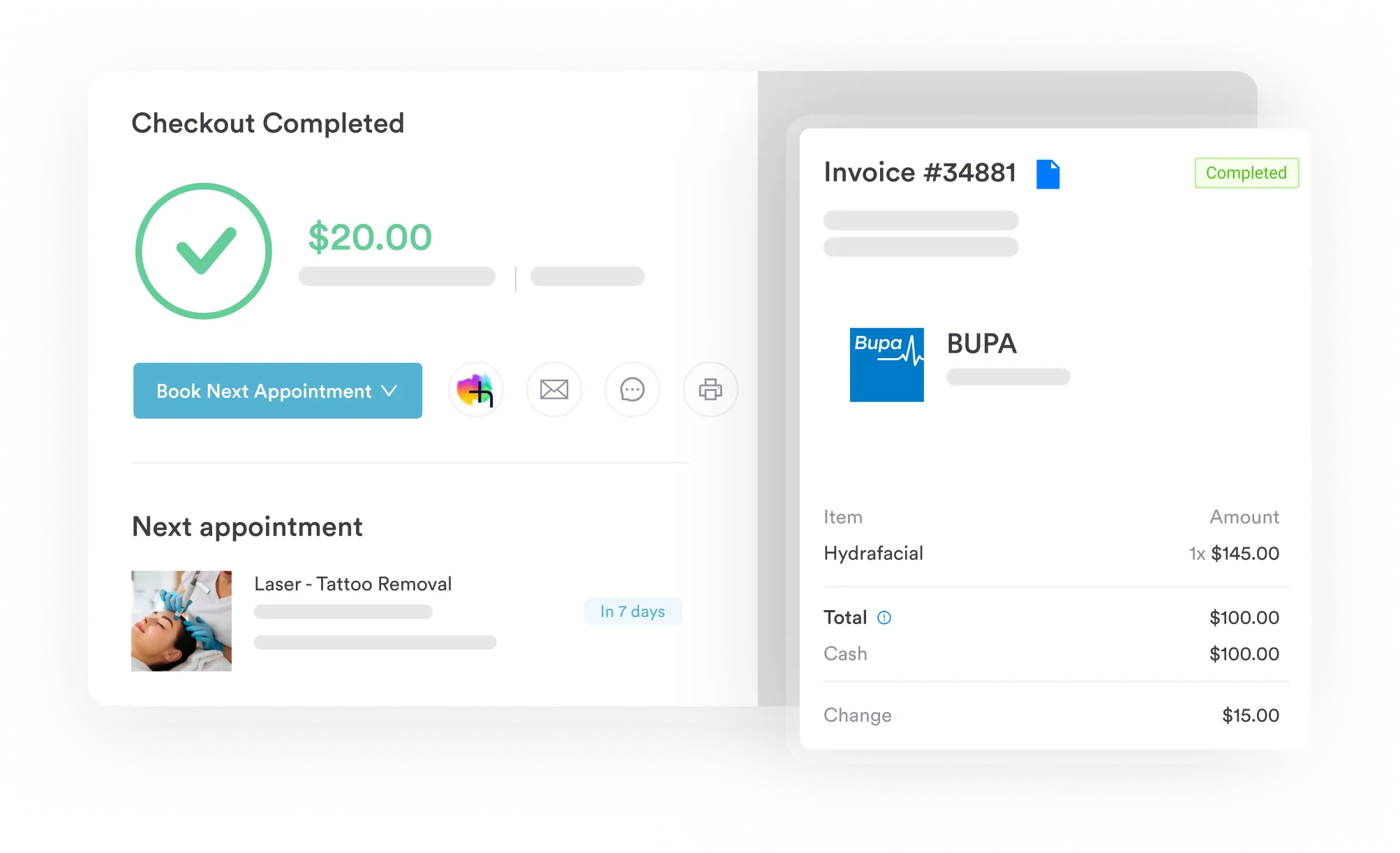
The payoff shows up in first-pass acceptance. With complete claims and verified coverage, fewer immunization claims come back for rework, and your billing team spends its time on the exceptions.

Pabau pre-fills vaccine claims from the patient record, checks eligibility through Claim.MD, and holds back incomplete claims before they reach the payer. See how it works for pediatric immunization billing.

CPT Code 90680 rewards the practice that settles its claim rules once. Decide how your state handles the SL modifier, which administration code your counseling notes support, and which Z code each payer expects. Then build those answers into your intake and charting.
Do that and most 90680 denials stop at the source, because the claim is right before anyone submits it. The trade-off is setup time: each payer and state program needs a one-time check, and the rules shift from year to year.
Book a demo to see how Pabau keeps pediatric vaccine claims complete from the chart to the payer.

Need to understand how claims move through the clearinghouse? 837 EDI file guide explains the electronic claim format payers use to process 90680 and other vaccine codes.
Want to see how credentialing affects vaccine claim acceptance? Getting credentialed with insurance companies covers payer enrollment steps that directly affect whether 90680 claims are accepted.
Billing a vaccine without counseling? CPT code 90471 covers the administration rules for the first vaccine when no counseling is documented.
Counseling a parent at the visit? CPT code 90460 explains when counseling-based administration can be billed for patients through age 18.
CPT Code 90680 covers one dose of the RotaTeq pentavalent rotavirus vaccine (RV5), a live oral vaccine given as a 3-dose series to infants. It is a product code only and must be billed alongside a separate administration code (90460 or 90471) on every claim.
CPT 90680 covers RotaTeq (RV5, pentavalent, 3-dose schedule) and CPT 90681 covers Rotarix (RV1, monovalent, 2-dose schedule). The code is determined by which vaccine product was administered, not by patient age or payer. Billing 90681 when RotaTeq was given, or vice versa, triggers a product mismatch denial.
Z23 (encounter for immunization) is the standard pairing for a vaccination-only visit. For well-child visits where the vaccine is administered as part of a routine health exam, Z00.129 or Z00.121 (with abnormal findings) is the appropriate code. Verify requirements with each payer, as some Medicaid plans specify which Z00.12x variant they accept.
No, Medicare Part B generally does not cover rotavirus vaccine. Rotavirus is a pediatric vaccine and is outside Medicare’s preventive vaccine coverage list, which focuses on adult immunizations. Billing 90680 to Medicare Part B will typically result in a non-covered service denial.
Yes, RotaTeq is an ACIP-recommended vaccine included in the VFC program. VFC-enrolled providers receive the vaccine at no cost for eligible patients and bill administration only. When submitting to Medicaid, they append modifier SL (or the state equivalent) to the vaccine line.
Use 90460 (with counseling, for patients through age 18) or 90471 (without counseling or for adults) as the administration code. When multiple vaccines are given at the same visit, add 90461 for each additional antigen (with counseling) or 90472 for each additional vaccine (without counseling). Verify current CMS age guidance for 90460 before applying the age threshold.
Each dose is billed as one unit of 90680. The RotaTeq schedule allows a maximum of 3 doses, so 90680 may be billed up to 3 times per patient. A 4th unit triggers a denial. If a 4th dose was given outside the standard schedule, the claim needs clinical documentation and a medical necessity appeal.