



HCPCS code E0198: Water pressure pad billing guide
HCPCS code E0198 is a water pad for a standard mattress HCPCS code E0198 is the ...

Last Updated: Oct 13, 2026

CPT Code 90460 covers immunization administration for patients through 18 years of age when a physician or qualified health professional provides face-to-face vaccine counseling.
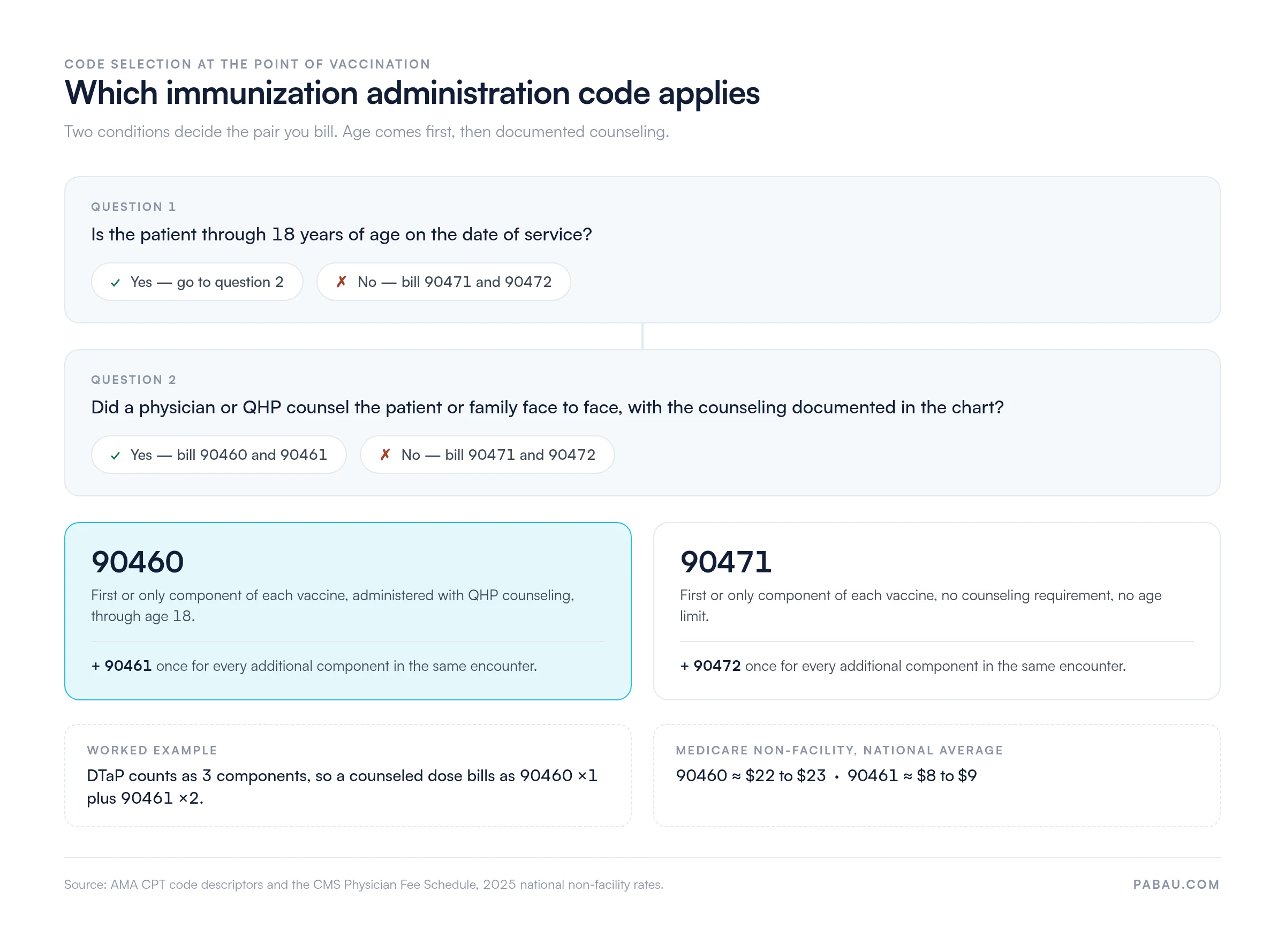
Counseling is the deciding factor. Without a documented face-to-face counseling note, bill 90471 instead of 90460.
Add-on code 90461 covers each additional vaccine component beyond the first, and 90460 can never be billed alongside 90471 for the same vaccine.
Practice management software like Pabau captures counseling documentation at the point of care and submits 90460 claims electronically.
CPT Code 90460 is the billable code for immunization administration through 18 years of age. It applies when a physician or qualified health care professional provides face-to-face vaccine counseling.
The code covers the first or only component of each vaccine administered. Without a documented counseling note, 90471 is the correct code instead.
This reference covers the official descriptor, the add-on rules for 90461, and how 90460 differs from 90471. It also covers documentation requirements, current reimbursement rates, Medicare and Medicaid coverage, and the denials that come up most often.
The American Medical Association (AMA) descriptor for CPT Code 90460 reads as follows:
Three eligibility conditions must all be true at the time of service for CPT Code 90460 to apply:
If any one of these three conditions is not met, 90460 is not the right code. A nurse administering a vaccine without physician-level counseling, or an adult patient receiving an immunization, defaults to 90471 instead.
Four codes cover vaccine administration, and they split into two pairs by age and counseling. The vaccine product itself is billed on a separate CPT code, which you can look up in our CPT code reference.
COVID-19 vaccine administration sits outside this family of four codes. Report CPT 90480 for the dose at any age, because counseling is included in that code.
Code 90461 is an add-on code used alongside CPT Code 90460 when more than one vaccine component is administered in the same encounter with counseling. It is billed once for each additional component beyond the first.
The pattern is consistent. Each vaccine’s first component is 90460, and every additional component of that same vaccine is 90461.
A child who receives a hepatitis B dose and a varicella dose gets 90460 x2, because each of those vaccines has one component. A single DTaP dose carries three components, so it bills as 90460 x1 plus 90461 x2.
Component counting is where many practices undercharge. Billing 90460 x1 alone for a three-component DTaP dose leaves two billable 90461 units unclaimed. Counting components at the point of administration prevents that loss.
The counseling requirement is the single deciding factor between these two codes. The choice runs through two questions, and age is the first one.
Practices sometimes bill 90471 out of habit, or to avoid the documentation overhead of 90460. That habit leaves money unclaimed on every counseled pediatric dose. Where the physician or QHP genuinely counsels at the point of vaccination, 90460 is the correct code, and the documentation is what makes it defensible.
The AMA and CMS both define “qualified health care professional” specifically for this code. Not all clinical staff who administer vaccines meet the standard for billing CPT Code 90460.
The counseling must be face-to-face and must address the vaccine being administered. A general wellness discussion does not satisfy the requirement.
The QHP should record what was discussed. That means the vaccine name, its benefits and risks, any contraindications, and the questions the family raised. The chart should also make clear which provider did the counseling.
Documentation failures are the primary reason CPT Code 90460 claims are denied. Payers audit these claims specifically because the counseling requirement is easy to miss and hard to retroactively prove without contemporaneous notes.
Every 90460 claim should be supported by a chart entry carrying all of the elements below. The checklist belongs in the clinical workflow, not in the billing step at the end of the day.
One missing element is enough for a payer to downcode the claim from 90460 to 90471. The counseling note and the counseling provider’s identity are the two that get caught most often. Structured documentation templates prevent that at the point of care rather than at the appeals stage.
Audit five to ten recent 90460 claims by pulling the corresponding chart notes. Check each one for a distinct counseling entry signed by a QHP. If the note says ‘vaccine administered’ without a separate counseling documentation line, those claims are vulnerable. Flag them before a payer does.
Reimbursement for CPT Code 90460 under Medicare is set through the CMS Physician Fee Schedule. Rates update every January 1 and vary by geographic adjustment factors (GPCI).
The figures below are national non-facility rates. Check the current year for your locality with the CMS lookup tool or a live RVU lookup tool.
Commercial payers typically reimburse above Medicare. Many peg their fee schedules to a percentage of the Medicare Physician Fee Schedule, often 110 to 150% for pediatric vaccines. That multiplier varies by contract, so check your own payer agreements for 90460 rather than working from a national average.
Compare the paid amount on each remittance against the expected rate for 90460 and 90461. A payer that consistently pays the 90471 rate on a 90460 line is downcoding. That pattern shows up on the remittance long before it reaches the month-end report.
Medicare Part B covers vaccine administration, but CPT Code 90460 is primarily a pediatric code. Most beneficiaries are 65 or older, so they fall outside the through-18 age restriction. In practice, 90460 is rarely billed to Medicare.
It can still apply to a younger beneficiary who receives a vaccine with physician counseling. Coverage in that case follows Part B preventive services rules.
Medicaid is where CPT Code 90460 sees its highest volume. State programs generally cover the pediatric vaccine administration codes, but rates vary widely by state.
The CDC’s Vaccines for Children (VFC) program supplies vaccines at no cost to eligible children. The administration code is therefore the billable line item, so confirm your state’s current fee schedule and its counseling documentation rules.
Commercial payers with pediatric populations are the largest source of 90460 revenue for family and pediatric practices. Prior authorization is rarely required for routine immunizations. Checking eligibility before the encounter still matters, because a vaccine given on inactive coverage is unbillable to anyone but the family.
The errors below account for the majority of 90460 denials and audits in pediatric and family medicine practices. Most are preventable at the coding and documentation stage, well before a claim reaches a payer.
Review denial reason codes monthly against your 90460 and 90461 lines. The pattern tells you whether documentation or code selection is driving the rejections for your payer mix.
Submitting a clean claim the first time is always faster than working an appeal. That means documenting every counseling element and billing the correct number of add-on units.
Most 90460 denials trace back to the distance between the clinical encounter and the billing step. The physician counsels, the nurse administers the vaccine, and the encounter moves on.
By the time it reaches the billing team, the counseling note is missing, generic, or credited to the wrong provider.
Pabau is practice management software with claims software for practices built in. Clinical notes capture the counseling encounter, with provider attribution attached to the entry. Vaccine components are logged against the administration code, so add-on units are counted rather than tallied by hand at checkout.
Claims go out electronically through the Claim.MD clearinghouse, Pabau’s US claims partner. Built-in CPT and ICD-10 catalogs validate the code combination before the claim leaves the practice. An NCCI conflict between 90460 and 90471 is caught in the building, not by the payer.
The coding decision belongs in the same workflow as the clinical record. When the two sit in separate systems, someone has to reconstruct the counseling after the fact, and that is where 90460 claims fall apart.
Run a quarterly report on your 90460 and 90461 claim volume alongside your 90471 volume. If 90471 consistently outpaces 90460 where physicians routinely vaccinate pediatric patients, look at the documentation workflow first. The counseling is usually happening. The note is what goes missing.

Pabau captures counseling documentation at the point of care and submits 90460 claims electronically through Claim.MD. See how it works for your pediatric or family practice.

CPT Code 90460 is the right code when a physician or QHP counsels a patient through age 18 about a vaccine. The counseling has to be documented at the time it happens. Without that note, the higher-paying code is indefensible in an audit.
The practices with the strongest 90460 clean-claim rates capture the counseling inside the clinical workflow, rather than leaving the billing team to reconstruct it later. That is a workflow decision more than a coding one.
Book a demo to see how Pabau captures counseling evidence and files 90460 claims for your pediatric or family practice.

Need to understand how clearinghouse submissions work? Our Claim.MD clearinghouse guide explains how electronic 837P claims are validated and submitted to payers.
Getting hit with vaccine billing denials? Denial codes in medical billing maps the most common CARC denial reasons and the corrective actions for each.
Want a cleaner revenue cycle? Best medical billing software in the US reviews the tools practices use to reduce claim errors and improve reimbursement timelines.
Need every administered component on the bill? What a superbill contains shows how to capture each vaccine line before the claim is built.
Billing to coverage that lapsed? Insurance eligibility verification walks through the checks that belong before the vaccine is given.
CPT Code 90460 is used to bill immunization administration for patients through 18 years of age. It applies when a physician or qualified health care professional (QHP) provides face-to-face counseling about the vaccine during the same encounter. It covers the first or only vaccine component administered and requires documented counseling to be billable.
CPT 90460 requires face-to-face counseling by a physician or QHP and is restricted to patients through age 18. CPT 90471 has no counseling requirement and no age restriction. They cannot be billed together for the same vaccine on the same date of service.
Use 90461 once for each additional vaccine component beyond the first when billing 90460 as the base code. For example, a DTaP shot administered with counseling bills as 90460 x1 plus 90461 x2 (three components total). Code 90461 cannot be billed without 90460 as the primary code in the same claim.
Yes. Face-to-face counseling by a physician or QHP is a mandatory requirement for CPT 90460. The counseling must specifically address the vaccine being administered and must be documented in the chart with the counseling provider’s identity. Without this documentation, the claim should use 90471 instead.
Medicare Part B coverage for CPT Code 90460 is limited in practice. Most Medicare beneficiaries are over 18 and do not meet the age restriction. When a younger Medicare beneficiary qualifies, Part B preventive services rules apply. Verify current-year Medicare coverage through the CMS fee schedule lookup before billing.
No. Billing 90460 and 90471 for the same vaccine on the same date of service is prohibited by National Correct Coding Initiative (NCCI) edits. These codes are mutually exclusive per vaccine per encounter. Submitting both can result in claim denial and may raise fraud and abuse concerns during a payer audit.



