CCSD code H1542: Closure of colostomy billing guide
CCSD code H1542 covers closing a colostomy CCSD code H1542 is the schedule entry...

Last Updated: Oct 21, 2026
87635 is the CPT code for detecting severe acute respiratory syndrome coronavirus 2 (SARS-CoV-2), the virus behind COVID-19, by nucleic acid amplified probe technique.
The AMA released it in March 2020, outside the normal CPT cycle. It covers single-target SARS-CoV-2 NAAT and PCR tests on standard-throughput platforms. Rapid antigen tests use 87811, and Medicare high-throughput tests use HCPCS U0003 or U0004. Lab-based tests need a moderate- or high-complexity CLIA certificate, while waived point-of-care tests bill as 87635QW.
Let Pabau's smart automation suggest the right codes, reduce claim denials, and keep your practice compliant—effortlessly.
Automate repetitive tasks and focus on what matters most—your patients.
Reduce coding errors and ensure compliance with the latest regulations.
Clean claims, fewer denials, and faster reimbursements.
Powerful insights and reporting to help your practice thrive.
HIPAA compliant SOC 2 certified GDPR-compliant Trusted by 4,000+ clinics worldwide

CPT Code 87635 covers SARS-CoV-2 detection by amplified probe (NAAT or PCR) only, not antigen-based rapid tests.
Lab-based 87635 tests need a moderate- or high-complexity CLIA certificate, while FDA-authorized point-of-care NAATs run under a certificate of waiver bill as 87635QW.
Do not bill 87635 and HCPCS U0004 on the same claim for the same test, because they describe alternative throughput levels.
Since the PHE ended on May 11, 2023, many commercial plans apply cost-sharing, while Medicare still covers ordered lab tests with no deductible or coinsurance.
Practice management software like Pabau runs validation checks in the background before you send a claim, so missing claim details are caught before submission.
CPT Code 87635 covers SARS-CoV-2 detection by an amplified probe technique, the nucleic acid amplification test (NAAT) family. The full AMA descriptor reads:
Infectious agent detection by nucleic acid (DNA or RNA); severe acute respiratory syndrome coronavirus 2 (SARS-CoV-2) (coronavirus disease [COVID-19]), amplified probe technique.
The code belongs to the 87471-87801 infectious agent detection family, specifically the nucleic acid subsection. The key operative word is amplified probe technique, which means the lab must perform a NAAT-based method: RT-PCR, TMA, or a comparable amplification chemistry. Any test relying solely on antigen-antibody binding does not qualify, regardless of how the result is reported.
Acceptable specimens include nasopharyngeal, anterior nasal and oropharyngeal swabs, plus saliva. Each qualifies only where the test’s FDA Emergency Use Authorization (EUA) or clearance names that specimen type. Billing 87635 for a specimen not listed in the test’s EUA is a documentation risk during post-PHE audits. Verify the performing laboratory’s EUA authorization before submitting.
The ICD-10-CM code you attach tells the payer whether the claim is a diagnostic test or a screening test. That distinction affects patient cost-sharing and coverage eligibility. Verify the patient’s insurance eligibility before submitting any 87635 claim.
Individual payer coverage policies vary. Z11.52 does not guarantee coverage for a diagnostic-intent test under all payers post-PHE. Document the clinical rationale in the ordering note: symptoms, exposure history, or pre-procedure screening requirement. Payers running medical necessity edits will look for that documentation on audit.
CPT Code 87635 is reimbursed under the Clinical Laboratory Fee Schedule (CLFS), not the Physician Fee Schedule. CMS sets one national CLFS rate each year, with no adjustment by locality. Billing software that runs validation checks before a claim is sent, as Pabau does, catches missing claim details before the payer sees them.
Confirm the 2026 national limitation amount for 87635 in the CMS Clinical Laboratory Fee Schedule before billing, because rates update each January 1. As of 2025, the national limitation amount was in the $50-75 range.
The PHE-era figure that still circulates is misleading for this code. CMS paid a temporary $100.00 rate for high-throughput HCPCS codes U0003 and U0004, not for 87635. Standard-throughput 87635 was paid about $51.31 during the PHE, and it now follows the standard CLFS methodology.
Run an eligibility check before ordering a COVID-19 NAAT. Post-PHE, many commercial plans moved COVID testing from first-dollar coverage back into the standard deductible. A patient who expects a free test and receives a balance bill is a patient relations problem the billing team inherits. Check the benefit tier for CPT 87635 at the time of service, not retroactively.
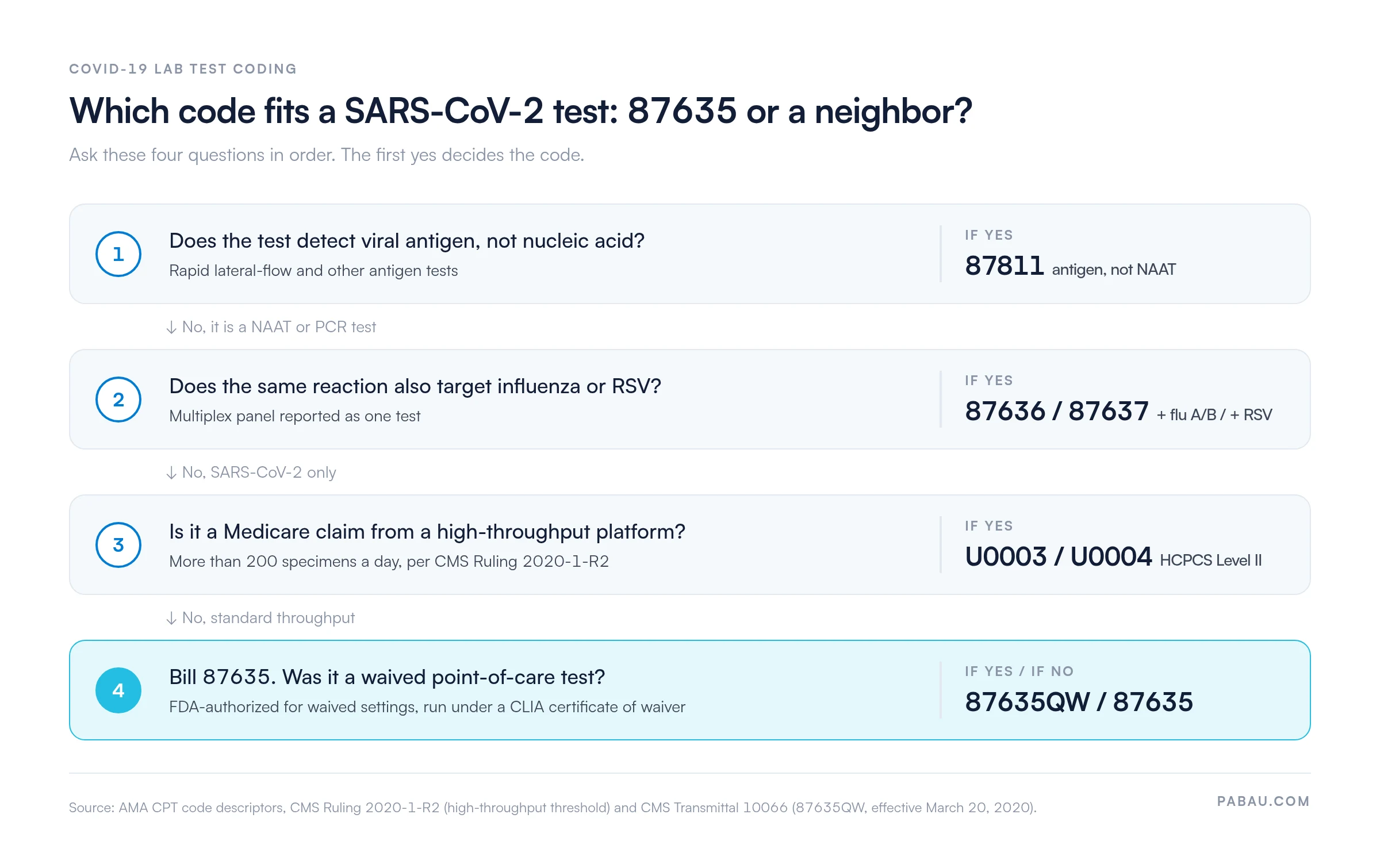
The most common coding error on COVID-19 NAAT claims is choosing between 87635 and the HCPCS Level II codes U0003 and U0004. Per CMS guidance, the distinction comes down to throughput capacity, not the underlying PCR chemistry.
Never bill 87635 and U0004 on the same claim for the same SARS-CoV-2 test encounter. They describe mutually exclusive levels of throughput for the same analyte, and CMS bundling edits will deny the lower-value code. CMS Ruling 2020-1-R2 defines high throughput as automated processing of more than 200 specimens a day. Check current CMS transmittals for the billing status of U0003 and U0004 before using them post-PHE.
When a physician orders a respiratory panel rather than a single-analyte COVID-19 test, the code selection shifts. Getting this wrong is one of the most common downcoding errors in lab billing. Verify code selection against the AAPC CPT code lookup if the test report lists multiple target analytes.
A NAAT run that reports influenza A and influenza B alongside SARS-CoV-2 belongs under 87636, not 87635. Billing both codes from a single specimen unbundles the panel and triggers an NCCI edit.
A broader multiplex panel covering three to five respiratory targets bills as 87631 instead. Billing 87635 as well is then duplicate testing, unless that panel leaves SARS-CoV-2 out.
When a lab runs a multiplexed panel covering SARS-CoV-2, influenza A/B, and RSV on a single reaction, bill 87637, not 87635 plus individual codes. Unbundling a multiplex panel into its component single-analyte codes is an NCCI edit violation. The test report’s list of analytes is the deciding document, and the four checks below put the code choice in order.
Correct place of service (POS) coding for 87635 depends on where the specimen is collected and who performs the test. Using the wrong POS is a top denial trigger for reference lab claims. Send each one as a clean claim, with the correct POS and the performing lab’s CLIA number in Box 23 of the CMS-1500. Submitting 87635 claims electronically on an 837 file reduces the POS transcription errors common on paper claims.
The collecting provider, not the reference lab, can bill specimen collection in addition to 87635. That means 99000 for a transported specimen, or 36415 for venipuncture where applicable. Payer policies on collection add-on codes vary, so check the payer’s rules before the claim leaves your system.
Denial rates on CPT Code 87635 claims rose after the PHE ended, as payers tightened medical necessity edits relaxed during the emergency. Knowing the specific denial codes lets your team route each denial to the right corrective action rather than resubmitting blindly.
Read the electronic remittance advice on every 87635 denial to confirm the adjustment and remark codes before correcting. Treat each code as a distinct root cause instead of resubmitting the same claim unchanged.
CMS and commercial payers review 87635 claims for documentation adequacy, particularly orders placed without a clear clinical indication. The superbill for every 87635 encounter should capture these elements before the claim is submitted.
Check your team’s documentation audit checklist against the CMS Medicare Claims Processing Manual (Pub. 100-04). The manual defines adequate supporting documentation for each lab claim type.
Each denial pattern above shows up on the claim before it leaves the practice. A blank Box 23, a POS 11 on a reference lab claim, or a U0004 line next to 87635 can all be caught at submission.
Pabau runs validation checks in the background every time you go to send a claim, so missing claim details get flagged before submission. In the US, its claims management software connects to Claim.MD to submit claims electronically, run real-time eligibility checks, and track claim status.
ERA remittances post back to the same dashboard. Your team sees a denied 87635 claim next to its adjustment code without logging in to each payer portal. That lets you correct and resend it the same day.
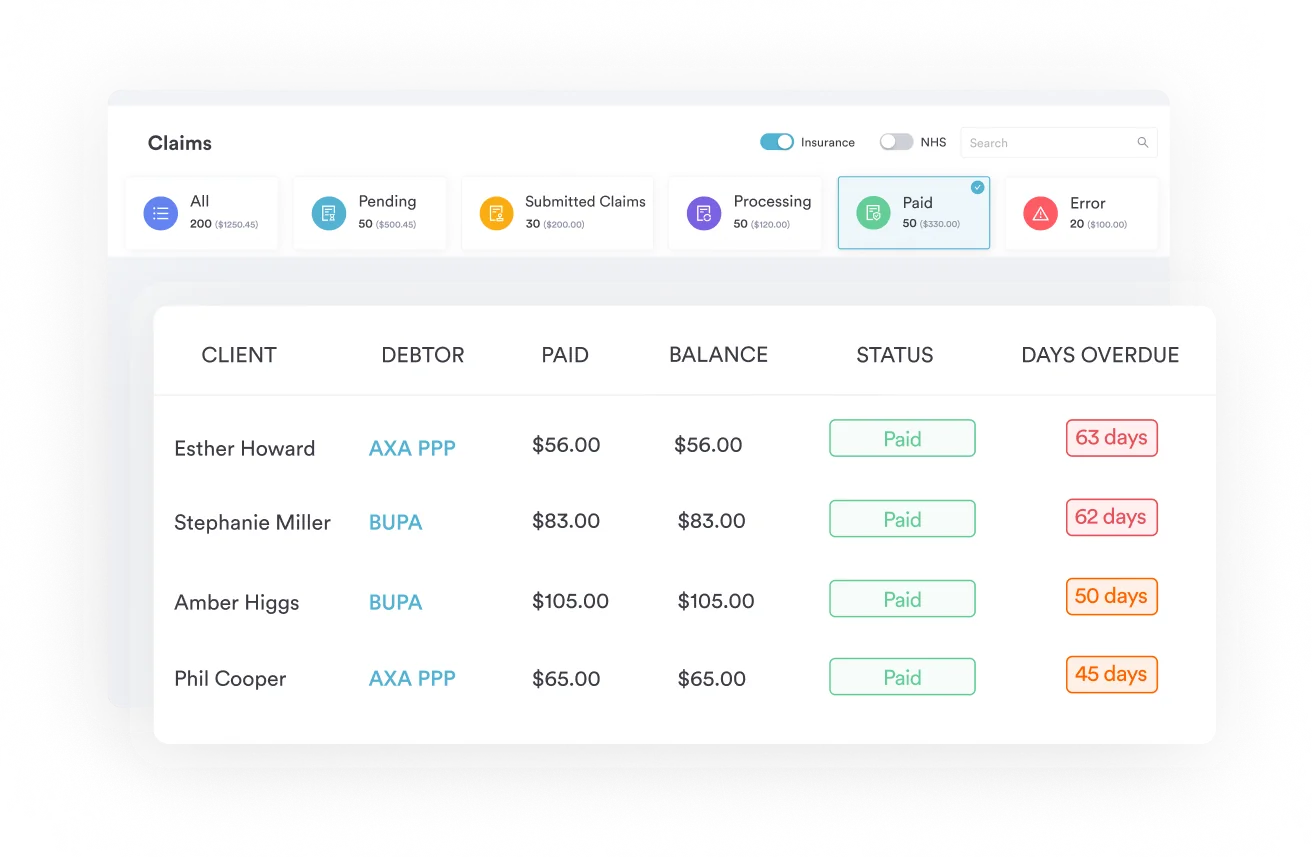

Pabau runs validation checks in the background before you send a claim, then submits and tracks it through Claim.MD. Book a demo to see the billing workflow in action.

Treat 87635 as the code you reach once the alternatives are ruled out. Antigen tests, multiplex panels and Medicare high-throughput runs each have their own code, and the lab report tells you which one applies.
The waiver question deserves a check on every claim. A waived point-of-care NAAT needs QW, and a lab-based RT-PCR must not carry it. With commercial cost-sharing back, a wrong call now lands on the patient’s bill as well as your denial queue.
Pabau checks each claim before it goes out and tracks its status through Claim.MD afterward. Book a demo to see how that fits your lab billing workflow.

Seeing repeated denials on COVID-related lab claims? Denial management in healthcare covers systematic approaches to tracking, categorizing, and resolving claim denials by root cause.
Want to understand the clearinghouse behind your 87635 submissions? Claim.MD clearinghouse explains how the integration connects Pabau to payers for eligibility checks and electronic claims.
Billing a flu antigen test alongside COVID-19 testing? CPT code 87804 covers the rapid influenza antigen code and when it applies instead of a NAAT.
Checking coverage before a COVID-19 test is ordered? Insurance eligibility verification walks through confirming benefits before the visit so cost-sharing does not surprise the patient.
Need a broader overview of the claim submission process? What is medical billing walks through the end-to-end revenue cycle from charge capture to payment posting.
CPT Code 87635 is the billing code for SARS-CoV-2 detection by nucleic acid (DNA or RNA) using an amplified probe technique. It covers standard-throughput NAAT and PCR-based COVID-19 tests. Rapid antigen tests use 87811, and Medicare high-throughput tests use HCPCS U0003 or U0004.
CPT 87635 covers standard-throughput NAAT testing. HCPCS U0004 covers high-throughput testing with non-CDC tests on platforms that process more than 200 specimens a day. They are alternatives, so billing both for the same test encounter triggers a bundling denial of the lower-value code.
87635 counts as waived only when the specific test is authorized for waived settings. CMS has allowed 87635QW since March 20, 2020, for point-of-care NAATs run under a CLIA certificate of waiver. Lab-based RT-PCR needs a moderate- or high-complexity certificate and never takes QW.
Generally no. Billing 87635 and rapid antigen code 87811 for the same COVID-19 test encounter on one date of service usually triggers a duplicate or bundling denial. If both tests were ordered for separate clinical reasons on separate specimens, use modifier 59 and document the medical necessity for each. Then verify against current NCCI edit tables before submitting.
Use POS 81 (Reference Laboratory) when the specimen is sent to an outside lab. Use POS 11 (Office) only when an in-house lab with the appropriate CLIA certification performs the NAAT on-site. Mismatching POS to the actual performing location is one of the top denial reasons for 87635 claims.
Check the CMS Clinical Laboratory Fee Schedule published each January for the 2026 national limitation amount. During the PHE, 87635 was paid about $51.31, while the temporary $100.00 rate applied to high-throughput codes U0003 and U0004. Historical 2024-2025 rates were in the $50-75 range. Medicare applies no deductible or coinsurance to ordered lab tests paid under the CLFS.