CPT Code 31653: EBUS With 3+ Mediastinal Stations
CPT code 31653: Official descriptor and clinical scope CPT code 31653 is the pro...

Last Updated: Oct 20, 2026
A throat swab reported as "Group A Strep: not detected" is a classic CPT code 87081 claim. The code covers culture, presumptive, pathogenic organisms, screening only. The lab checks a specimen for a target pathogen and reports whether it's there, without isolating or fully identifying organisms.
The fact that matters most is isolation. Once the lab isolates organisms and identifies each isolate, the service moves to 87070, with add-on 87077 or 87076 for definitive identification. Payers check the code against the lab report, so the wrong choice means upcoding or lost revenue. Below are the ICD-10 pairings, the Medicare rate and the denials to watch for.
Let Pabau's smart automation suggest the right codes, reduce claim denials, and keep your practice compliant—effortlessly.
Automate repetitive tasks and focus on what matters most—your patients.
Reduce coding errors and ensure compliance with the latest regulations.
Clean claims, fewer denials, and faster reimbursements.
Powerful insights and reporting to help your practice thrive.
HIPAA compliant SOC 2 certified GDPR-compliant Trusted by 4,000+ clinics worldwide

CPT code 87081 covers a screening-only culture for a target pathogen, with no isolation of organisms, no definitive identification and no susceptibility testing.
If the lab isolates organisms and presumptively identifies each isolate, bill 87070 instead, or 87088 for urine. Definitive identification adds 87077 or 87076 per isolate on top of that code.
Group A Strep throat cultures, third-trimester GBS screens and preliminary urine screens are the most common 87081 scenarios.
Medicare pays 87081 under the Clinical Laboratory Fee Schedule at a national rate of about $6.63, which CMS updates each January.
Practice management software like Pabau pre-fills lab claims from the patient record and checks required claim fields before submission, cutting avoidable denials.
The American Medical Association defines CPT code 87081 as “culture, presumptive, pathogenic organisms, screening only.”
In plain terms, the lab checks a specimen for a target pathogen and reports whether it’s present. Nobody isolates organisms, identifies them definitively or runs sensitivities. The code is active, billable and paid by Medicare under the Clinical Laboratory Fee Schedule.
Here’s the code at a glance before we get into when it applies.
Use 87081 when the order and the lab report both describe a screen. The lab looks for a named pathogen and reports it present or absent. It doesn’t work up individual organisms, run minimum inhibitory concentration (MIC) testing or add a susceptibility panel.
Take a common case. A family physician swabs a sore throat to rule out Group A Streptococcus before prescribing. The lab reports “beta-hemolytic group A Streptococcus: not detected.” That report supports 87081 and no other culture code.
You’ll see 87081 most often in these four scenarios:
A positive screen often triggers more lab work, and none of it belongs on the 87081 line.
CPT 87081 covers the screening step only. Once the lab goes further, each extra service carries its own code:
Among those susceptibility codes, CPT 87186 covers microdilution and agar dilution panels that report an MIC. It is billed per plate, not per antibiotic on the plate.
Bundling rules can change the picture on a busy date of service. National Correct Coding Initiative (NCCI) edits update quarterly, so check the current tables before you combine microbiology codes. Last quarter’s answer may not hold.
CPT 87081 and 87070 both stop at presumptive identification, so identification level can’t tell them apart. Isolation does. 87081 screens for a target pathogen, while 87070 isolates organisms and identifies each isolate. Billing 87070 when the lab only ran a screen is upcoding, and it draws audit attention.
The quickest test is to read the lab report the way an auditor would. The guide below runs through that decision one step at a time.
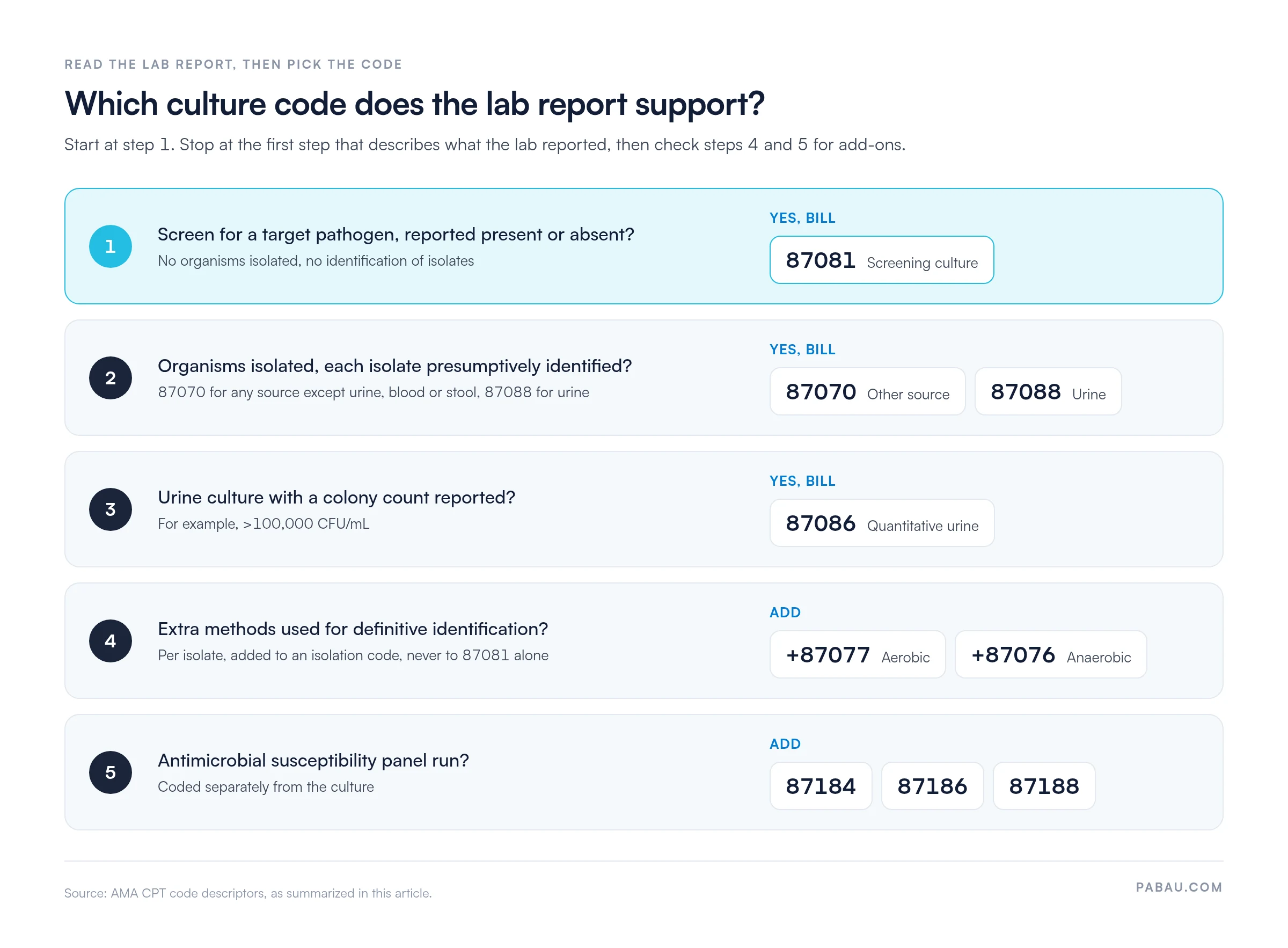
In practice, a report of “Group A Strep screen: negative” supports 87081. A report listing isolated organisms, each with a presumptive identification, supports 87070. Extra biochemical or molecular methods for a definitive answer add 87077 or 87076 per isolate, alongside 87070 rather than in place of it.
Several nearby codes show up on the same claim as 87081, and a few get confused with it. The table shows which can sit alongside it and which replace it. For any pairing not marked as compatible, check the current NCCI tables first.
A clinician may order a rapid Strep A antigen test (87880) and a backup throat culture (87081) at the same visit. Both codes are generally billable when both tests are performed and reported. Document each order and result in the record. Check the current quarter’s NCCI edits before you submit, since payer local coverage determinations can add restrictions.
Pair 87081 with the ICD-10-CM code that explains why the screen was ordered. A diagnosis that doesn’t match the screening rationale is one of the most common reasons these claims deny. Pick the code from the documented clinical scenario, never after the result comes back.
For a urine screen ordered for a suspected urinary tract infection, N39.0 is the usual pairing. Payer local coverage determinations (LCDs) can also narrow the list of accepted diagnoses. Check the relevant LCD before you submit, especially for Medicare Advantage plans and state Medicaid programs.
The current national Medicare rate for CPT code 87081 is about $6.63 per test, paid under the Clinical Laboratory Fee Schedule (CLFS). CMS updates that figure each January, so confirm it before you set fees.
The CLFS sits apart from the Medicare Physician Fee Schedule (MPFS). Lab codes are excluded from the MPFS by statute, so RVUs play no part in the rate. Under the Protecting Access to Medicare Act (PAMA), CMS sets CLFS rates from the weighted median of private payer rates that labs report.
Medicaid works differently. Rates vary by state, and Medi-Cal, for example, doesn’t match the Medicare national rate. To check the current Medicare amount, use the CMS Clinical Laboratory Fee Schedule files.
Auditors reviewing 87081 claims want proof that the clinician ordered a preliminary screen, not a culture with isolation. A superbill that lists 87081 without supporting documentation is exposed to retroactive denial.
The record needs five elements:
The GBS screen shows how the pieces fit together. The prenatal record notes gestational age (36-37 weeks), the GBS screen order and the lab’s presumptive result. The claim pairs Z36.85 with 87081. A third-trimester supervision code such as Z34.03 or Z34.83 can follow as a secondary code where relevant.
Now add a quantitative urine culture at the same visit. That’s 87086, billed separately with N39.0 or R82.79. Each code needs its own specimen documentation, or the second line looks like a duplicate.
Most 87081 errors are set in place before anyone opens the claim form. Follow the claim through its six stops and you can see where each one enters:
Coding errors start at steps 3 and 4, while missing fields at step 5 cause rejections. Here’s what those errors look like once they come back as denials.
Denials on 87081 fall into a predictable set, and front-end documentation prevents most of them. Before you resubmit, find the root cause and fix the workflow behind it. Our guide to medical billing denial codes helps billing staff sort rework by reason code.
Modifiers come last, and on 87081 they’re rarely needed. When one does apply, the wrong choice can trigger a denial or let a bundling edit stand.
CPT 87081 generally isn’t subject to the multiple procedure payment reduction that applies to some physician services. Some payers still apply their own edits to multiple lab codes on one date. Check each payer’s lab policy, particularly Medicare Advantage and commercial plans with lab carve-outs.
Before you use modifier 59 to override an NCCI edit on 87081, confirm in the CCI table that the code pair allows it. Some pairs call for XE (separate encounter), XS (separate structure) or XP (separate practitioner) instead. The wrong modifier makes the override fail and the claim deny. The pathology and laboratory chapter of the CMS NCCI Policy Manual has current guidance.
Every stop in that claim walkthrough involves retyping data. Someone copies the culture code from the lab report, the diagnosis from the chart and the NPI from a list.
Practice management software like Pabau removes most of that retyping. Its claims management software pre-fills the claim form from the patient record.
The CPT code attached to the service lands on the charge line, and ICD-10 slots are seeded from the recorded problem list. Built-in CPT and ICD-10-CM lookup libraries let billing staff confirm 87081, 87070 or Z36.85 without leaving the claim. Pabau also checks that required claim fields are complete before the claim can be sent.
In the US, claims go out through Claim.MD, our clearinghouse partner, as CMS-1500 and 837P submissions. The same connection runs real-time eligibility checks and posts electronic remittance advice (ERA) back to the account.
Your team can confirm coverage before the specimen is collected, then track the claim through to payment. The coding judgment stays with your coder, and the data around it stays accurate.
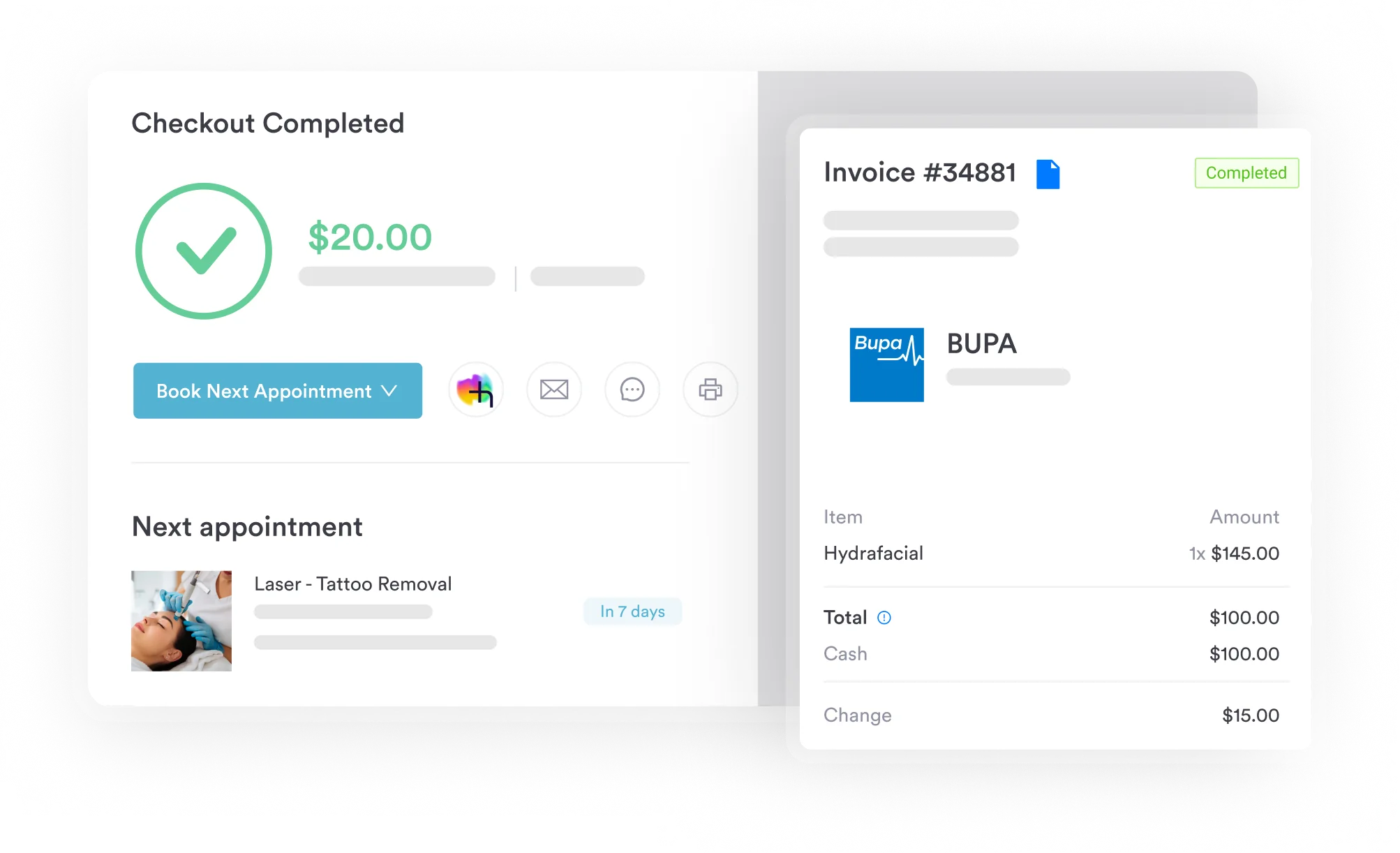

Pabau pre-fills lab claims like CPT 87081 from the patient record and sends them through Claim.MD. Eligibility checks and ERA posting run on the same connection, so fewer claims come back.

The decision on 87081 happens at the lab report, not at the claim form. If the report says present or absent, bill 87081 and stop there. If it lists isolates, the claim belongs to 87070 or 87088, and any definitive work adds 87077 or 87076.
Build that check into your workflow and the rest follows. Coders stop guessing from the order, auditors find a record that matches the claim, and each screen gets paid the first time. The trade-off is a minute spent reading each report, which costs far less than an appeal.
If your team still keys lab codes by hand, book a demo to see how Pabau pre-fills and checks lab claims before they go out.

Coding the isolation step? CPT code 87070 covers culture with isolation and presumptive identification from sources other than urine, blood or stool.
Need a framework for managing claim rejections? Denial management in healthcare walks through root-cause categorization and resubmission workflows for common lab claim denials.
Want lab claims to pay on the first pass? Clean claim guide breaks down the fields and checks payers look for before they pay.
Want to understand how clearinghouse submission works? 837 file billing explains the electronic claim format labs use to submit CPT codes to Medicare and commercial payers.
Brushing up on laboratory billing rules? What is medical billing covers the end-to-end claims lifecycle from lab order through payment posting.
Both are screening-only cultures for presumptive pathogenic organisms. CPT 87084 adds colony estimation from a density chart, so use it only when the lab reports that estimate. A plain present-or-absent screen stays on 87081.
Yes, when the MRSA screen is culture-based and reports MRSA present or absent. A molecular MRSA test using an amplified probe technique is coded 87641 instead, so check which method the lab used.
A molecular Group B Strep test is coded 87653, the amplified probe code for group B Streptococcus. Use 87081 only when the lab runs a culture-based GBS screen.
The national Medicare rate is about $6.63 per test under the Clinical Laboratory Fee Schedule. CMS updates it each January, and the lab must be CLIA-certified to bill it.
Yes, in most cases. If a rapid Strep A antigen test and a backup throat culture are both performed and reported, both codes are billable. Document each order and result, and check current NCCI edits for your payer.
Usually not. Modifier 59 or an X modifier may be needed when an NCCI edit applies and separate specimens are documented. QW applies only to FDA CLIA-waived test systems, which most cultures aren’t.