CPT code 52648: Laser ablation of the prostate billing guide
What CPT code 52648 covers, and what it bundles in CPT code 52648 is the code fo...

Last Updated: Oct 21, 2026

CPT code 72195 covers magnetic resonance imaging of the pelvis performed without contrast material.
Append modifier 26 to bill the radiologist’s interpretation alone, or modifier TC to bill the scanner, supplies and technologist time.
The national average Medicare payment is roughly $227.46 for the global service, splitting about 22% professional and 78% technical.
Sibling codes 72196 and 72197 cover contrast studies, and none of the three may be billed together for the same pelvis on one date.
Pabau’s claims management software connects to the Claim.MD clearinghouse, so US practices can route 72195 claims and track every remittance in one system.
CPT code 72195 is the billing code for an MRI of the pelvis performed without contrast material. If gadolinium went into the patient, 72195 is the wrong code, and one line in the radiology report is what settles it.
That contrast line, plus the modifier saying whether you billed the read or the scanner, explains most of the denials this code attracts. Payers match the report against the code before they release payment.
The sections below cover the descriptor, the modifier math, current RVUs and Medicare rates, and the ICD-10 pairings. Prior authorization and a full claim walkthrough follow.
Quote the long descriptor rather than paraphrase it. Payer systems match claim data against the AMA’s published language. A chart note that says “pelvic MRI” with no contrast statement is the first thing a reviewer flags.
“Without contrast material(s)” is the defining clinical element. The scan reads the patient’s native tissue signal, relying on the magnetic properties of hydrogen protons rather than a gadolinium-based agent.
Clinicians order it when contrast is contraindicated, such as renal impairment or a documented allergy. They also order it when unenhanced sequences answer the question on their own, as with uterine fibroid sizing or pelvic floor assessment.
One detail trips people up in conversation with payers. Per the American Medical Association’s CPT code set overview, 70010-79999 is the whole Radiology section. It holds seven subsections, including ultrasound, nuclear medicine and radiation oncology.
Diagnostic Radiology is only the first of them, running 70010 through 76499. That is where 72195 sits, next to its siblings 72196 and 72197.
The pelvis MRI family has three codes, and picking the wrong one is the most common billing error for this region. The distinction is entirely about what the radiologist administered, not about what the ordering physician expected.
Two rules follow from that table. A payer will deny 72195 outright if the report documents contrast administration, so the report and the code have to agree. And 72195 never goes on the same claim line set as 72196 or 72197 for the same pelvis on the same date of service.
Use 72195 when the order requests an unenhanced pelvis MRI and the finished report confirms that no contrast was given. Three documents have to agree on that point: the imaging order, the radiology report, and the code you bill.
Indications that commonly support medical necessity include the following:
Every 72195 claim needs at least one ICD-10-CM diagnosis code establishing why the scan was ordered. The table below lists the pairings that come up most often.
Check each one against the payer’s Local Coverage Determination before you submit, because covered diagnosis lists differ by MAC and by commercial plan.
Our ICD-10-CM code reference is a faster place to confirm a full code than the payer portal.
Note the fifth row. N83.20 is a parent header, not a billable code, so a claim carrying it rejects at the clearinghouse before a payer ever sees it.
Use N83.201 for a right ovarian cyst, N83.202 for the left, and N83.209 only when the report genuinely does not state a side.
The same discipline applies to the rest of the list. Code from the ordering physician’s documentation, and reach for the most specific option the record supports. Unspecified codes invite a medical necessity review when a precise one was available.
Before you submit, pull the payer’s LCD for 72195 and check your diagnosis code against its covered list. If the code is not on it, ask the ordering physician for a medical necessity letter now rather than after the denial. A five-minute call before submission beats a 30-day appeal afterwards.
Radiology splits the global service into a professional component and a technical component, so the modifier is where the money is decided.
No modifier bills the global service, which means one entity performed the scan and the read. Most hospital-based groups and independent imaging centers split the two.
Modifier 59 deserves a separate warning. Append it only when the documentation clearly supports a distinct service, and never as a routine way to clear an NCCI edit. Its overuse has been an audit target for the HHS Office of Inspector General for years, and radiology sits high on that list.
The total RVU for 72195 is 6.81, and practice expense supplies nearly all of it. That single fact explains the payment split you are about to see: the scanner, not the radiologist, drives the value of this code.
One caveat on the practice expense line. Find-A-Code publishes a single PE value for 72195, not a facility and non-facility pair. So do not build a two-column fee schedule off the figure above.
Confirm the values you contract on through the CMS Physician Fee Schedule lookup tool, which publishes locality-adjusted numbers and updates every January.
Those RVU proportions are what produce the component split below.
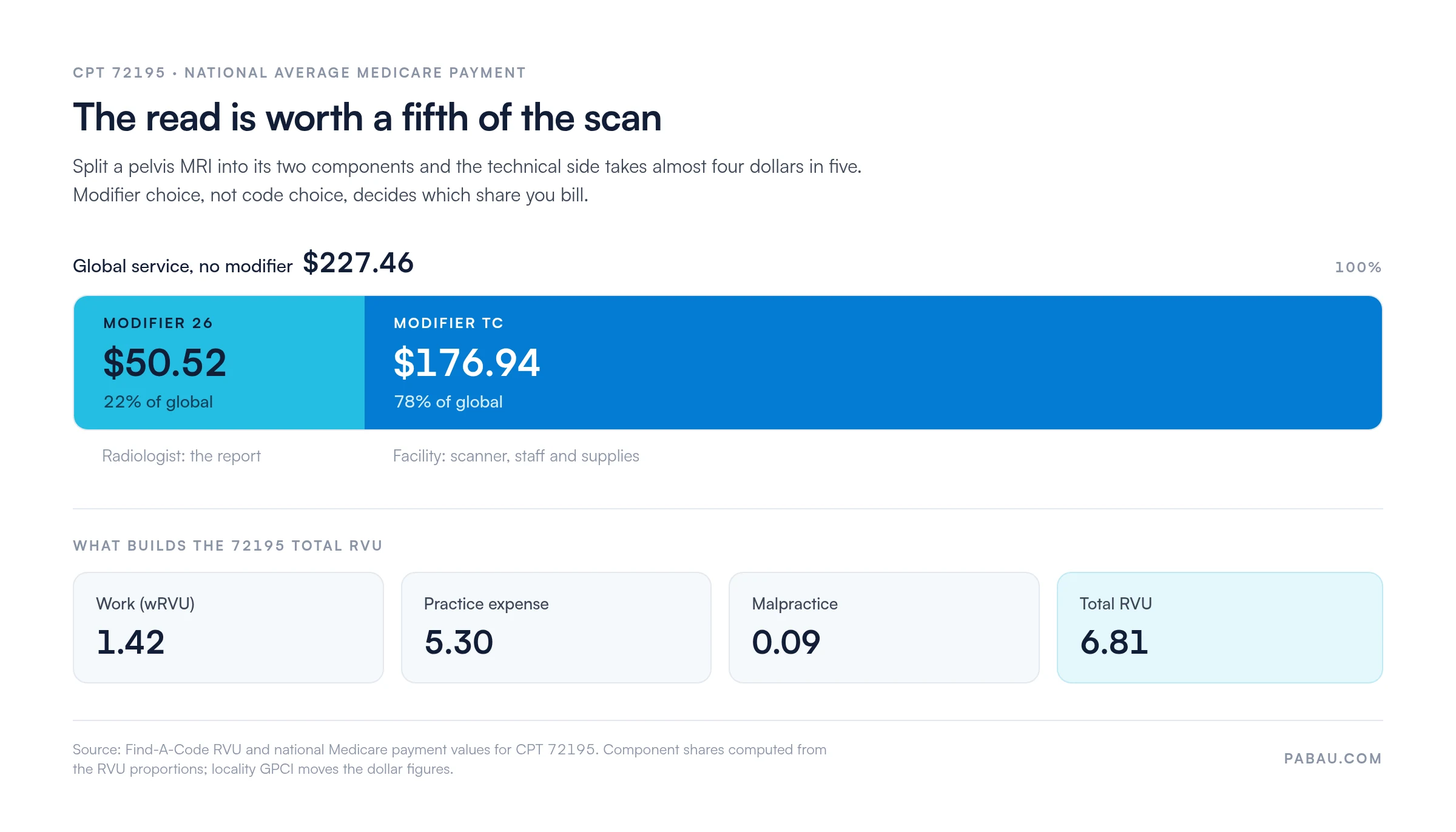
The national average payment for the global service is roughly $227.46. Split it, and the professional component lands near $50.52 while the technical component takes about $176.94.
Those two figures are derived from the RVU proportions rather than published separately, so treat them as close estimates.
Every figure here is a national average. Geographic Practice Cost Indices adjust the amount your MAC pays. That swing matters when you negotiate a commercial fee schedule off Medicare rates. Pull your own locality’s number before you quote one to a payer.
Prior authorization is now standard for pelvis MRI across most commercial plans and nearly all Medicare Advantage plans. It is also the step billing teams inherit late, because scheduling usually owns it. A perfectly coded claim still dies without an authorization number on file.
Traditional Medicare is the exception worth knowing. CMS paused its Appropriate Use Criteria program for advanced diagnostic imaging and rescinded the regulations effective January 1, 2024.
The program has not restarted, so no AUC consultation requirement currently applies to a pelvis MRI under fee-for-service Medicare.
What still applies, plan by plan:
One habit prevents a recurring loss. Authorization is code-specific and setting-specific, so an approval for a different imaging study never covers a pelvis MRI.
Follow the claim rather than the code and the failure points become obvious. Here is the path a clean 72195 takes, with the checkpoint that belongs at each stage.
A worked example makes the modifier step concrete. An independent imaging center owns the scanner and contracts a teleradiology group for the read. The center bills 72195-TC and expects roughly $176.94. The teleradiology group bills 72195-26 under its own NPI and expects roughly $50.52.
If either party bills globally by mistake, the second claim denies as a duplicate, and both sides spend a month untangling it.
Five items catch nearly every avoidable 72195 denial. Work through them on the claim itself, not from memory.
Four mistakes account for most of the rework, and each has a specific fix.
Build a 72195-specific denial view in your billing system, filtered by modifier, diagnosis pairing and payer. After 30 days the pattern names its own fix. Modifier-heavy denials mean a billing workflow problem, diagnosis mismatches mean an ordering documentation problem, and payer-clustered denials mean you need a coverage determination letter.
Pelvis MRI rarely arrives alone on a claim. Knowing which codes sit next to 72195 prevents accidental bundling when several studies happen in one encounter.
When 72195 and 74183 land on the same date, NCCI edits may apply. Modifier 59 belongs there only if the two studies were separately ordered for different clinical questions, and the documentation says so in plain terms.
Most imaging teams lose time after transmission rather than before it. The claim leaves the practice management system and drops out of sight. Tracking it means a clearinghouse portal, remittances matched to patients by hand, and the picture rebuilt every morning.
Practice management software like Pabau closes that loop. Our claims management software connects to the Claim.MD clearinghouse for US practices. A 72195 claim routes to the payer, then reports its status back against the patient record it came from. Remittances land in the same place, with the reason codes attached.
The coding judgment stays with your team, where it belongs. What changes is the follow-up. You see which 72195 claims paid, which sat, and which came back with a CARC 50 or a CO-4. All of it sits in the system that already holds the appointment.

Pabau connects to the Claim.MD clearinghouse, so your team can route 72195 claims to the payer and follow every remittance against the patient record. See how it fits the way your practice already bills.

Almost every 72195 denial traces back to a document nobody read closely enough. An order skips the contrast status. A diagnosis gets pulled from the findings instead of the indication. A modifier goes on that the other party never agreed to. None of that is a coding puzzle, and none of it gets solved in the appeal.
So the work sits upstream. Fix the order template. Agree the modifier split with your reading group in writing. Check diagnosis codes against the LCD before submission rather than after. Do that and 72195 stops being a denial-prone code, because the three documents finally agree before the claim leaves the building.
The part you cannot fix upstream is the follow-up, and that is where a system helps. Book a demo to see how Pabau routes radiology claims and tracks every remittance code against the patient record.

Want fewer rejections before the payer even looks? What makes a clean claim sets out the data checks that stop a claim failing at the clearinghouse.
Stuck decoding a remittance? Electronic remittance advice explains how to read CARC and RARC codes and reconcile payments line by line.
Choosing how claims reach the payer? Medical claims clearinghouse covers what a clearinghouse validates and where it sits between your system and the payer.
Worried about modifier and documentation audits? Medical billing compliance walks through the records that hold up when a payer asks for them.
Need the wider picture around imaging revenue? Revenue cycle management maps the full lifecycle from patient registration through to posted payment.
No. Magnetic resonance angiography of the pelvis is CPT 72198, a separate study of the vessels. If the radiologist runs a standard pelvis MRI and an angiographic sequence, check the order and the report before reporting either code.
No national frequency edit applies to 72195. Repeat scans are judged on medical necessity, and individual MACs may query short intervals through local coverage policy. Document the clinical change that prompted the repeat in the ordering note.
The treating physician or qualified non-physician practitioner managing the patient’s care must order the study. A radiologist cannot self-order a diagnostic MRI. Keep the signed order on file, because it is the first document a reviewer asks for.
Issue an Advance Beneficiary Notice before the scan whenever you expect Medicare to deny 72195 as not medically necessary. Append modifier GA to the claim line to show the notice was signed. Without it, you cannot bill the patient.