

CPT Code 98981: RTM Treatment Management Billing Guide
CPT code 98981: Definition and official descriptor CPT code 98981 is an add-on c...

Last Updated: Nov 9, 2026
69424 is the CPT code for ventilating tube removal requiring general anesthesia. It covers surgical removal of a retained tympanostomy tube when the patient can't safely have it taken out awake in the office.
The code reports removal only, so tube insertion goes to 69433 or 69436. It is unilateral, and the operative note has to state why general anesthesia was needed.
Let Pabau's smart automation suggest the right codes, reduce claim denials, and keep your practice compliant—effortlessly.
Automate repetitive tasks and focus on what matters most—your patients.
Reduce coding errors and ensure compliance with the latest regulations.
Clean claims, fewer denials, and faster reimbursements.
Powerful insights and reporting to help your practice thrive.
HIPAA compliant SOC 2 certified GDPR-compliant Trusted by 4,000+ clinics worldwide

CPT code 69424 reports removal of a ventilating tube when general anesthesia is required, not in-office removal or tube insertion.
The operative note must state why general anesthesia was needed instead of removal in the office.
The code is unilateral, so bill both ears with modifier 50 or with RT and LT lines, per payer preference.
69424 has a 0-day global period, while the insertion codes 69433 and 69436 each carry 10 days.
Claims management software such as Pabau scrubs each 69424 claim for missing or invalid details before it reaches the payer.
CPT code 69424 reports the removal of a ventilating tube, also called a tympanostomy or ear tube, when the removal requires general anesthesia. Check these attributes against the operative note before you submit the claim.
CPT code 69424 covers surgical removal of a previously placed tympanostomy tube from the middle ear when the removal requires general anesthesia. The tube may also be called a pressure equalization (PE) tube, ventilation tube, or ear tube.
The code applies when a tube is retained past its expected lifespan, fails to extrude, or sits embedded in the eardrum. In those cases, in-office extraction is unsafe or impossible for the patient.
Three scenarios most often drive the need for general anesthesia:
The procedure includes tube retrieval, microscopic inspection of the TM after removal, and care of any small perforation created during extraction. It does not include myringoplasty or formal tympanoplasty, which take separate codes if performed in the same session.
The operative sequence helps coders confirm that the note supports 69424 rather than another middle ear code. The clinical steps are:
If the operative note describes a tube that had already extruded on its own, CPT code 69424 does not apply. Spontaneous extrusion is not billable as a surgical procedure.
The operative report must show two things: that a tympanostomy tube was removed, and that general anesthesia was clinically necessary rather than a convenience. Missing either one is the fastest route to a denial.
Required documentation elements:
Payer auditors look for the sentence that explains why general anesthesia was required. A note that says only “tube removed under general anesthesia” counts as incomplete documentation of medical necessity. A note that covers every element above is the starting point of a clean claim.
Run a four-point check before each claim goes out. Confirm the reason for general anesthesia is documented and the laterality in the note matches the modifier. Check that tube status and the post-removal TM condition are recorded. Those four fields take two minutes and remove the most common 69424 denial triggers.
Payers check the ICD-10 code against the procedure to confirm medical necessity. These diagnosis codes are the ones most often accepted alongside 69424.
Z96.22 (presence of tympanostomy tube) is the strongest primary diagnosis for a planned removal. T85.698A adds complication context when the retained tube is causing otorrhea, granuloma, or pain.
When the otitis media affects both ears, report H66.93 rather than the unspecified H66.90. No diagnosis code guarantees coverage, because a payer’s local coverage determination (LCD) may ask for more documentation.
The four codes below are the ones ENT billers most often confuse with 69424. The core distinctions are insertion versus removal and the type of anesthesia.
The highest-risk confusion is between 69424 and 69436. Both involve general anesthesia and an ear procedure, so the deciding factor is direction. 69436 places a tube, and 69424 removes one. When one session removes an old tube and inserts a new one, check current NCCI edits before billing both codes together.
The chart below lays the decision out, including when impacted cerumen removal adds 69210 to the claim.
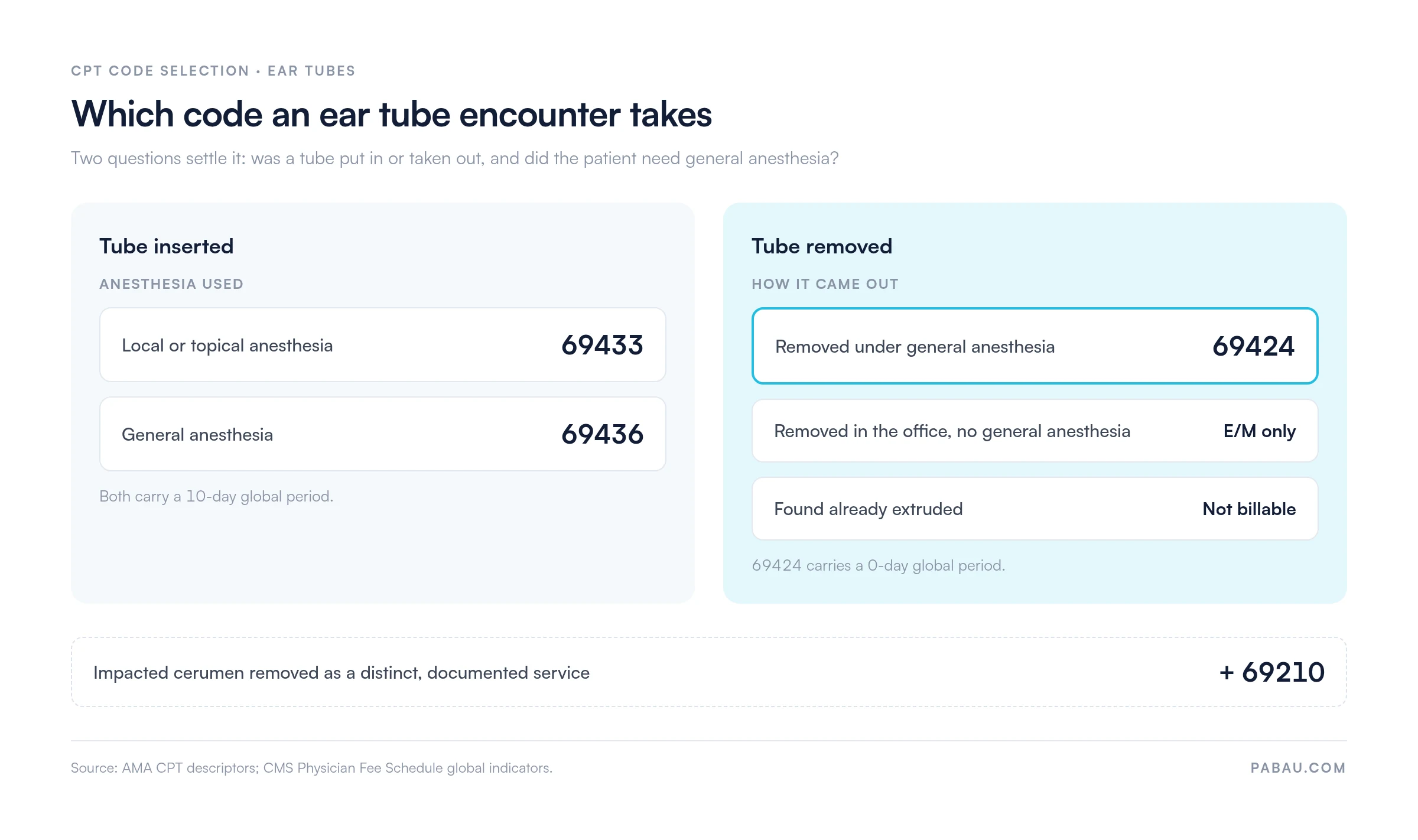
Several scenarios look similar to 69424 but don’t support the code.
CPT code 69424 is unilateral by default, describing removal of a tube from one ear. When both ears are treated in one operative session, bilateral billing rules apply.
Two methods are accepted, and payer preference varies:
Under CMS bilateral surgery payment policy, Medicare pays 150% of the single-procedure rate when the primary surgeon performs a bilateral procedure in one session. Check the payer’s provider manual for its preferred modifier format before submitting. Sending modifier 50 to a payer that wants RT and LT may not cause a payment error, but it delays adjudication.
The operative note must confirm that both ears were involved and describe the work on each ear separately.
Medicare pays CPT code 69424 from the Physician Fee Schedule, using relative value units (RVUs). The CMS Physician Fee Schedule lookup tool shows current facility and non-facility rates by geographic locality. Rates change with each annual update, so confirm the current year’s figures before quoting a patient or setting reimbursement benchmarks.
Key reimbursement facts for 69424:
Most 69424 denials trace back to one of seven issues, and matching each denial code to its root cause cuts appeal prep time. Our guide to medical billing denial codes explains the codes payers send back.
A denied 69424 claim is usually recoverable when the documentation is complete. Work through these steps within the payer’s appeal window, typically 60 to 180 days from the denial date.
Read the denial from the electronic remittance advice rather than a paper EOB, since the ERA carries the CARC and RARC codes line by line. A written denial management process then tracks each appeal deadline so none lapses.
Flag any 69424 claim that follows a 69433 or 69436 claim for the same patient within 10 days. That pairing is the usual cause of a global-period denial on tube removal. Catching it before submission takes seconds, while recovering it after a denial takes hours.
Most 69424 denials start with a detail that never reached the claim: the reason for general anesthesia, a laterality modifier, or an authorization number. When the operative note and the claim sit in separate systems, someone re-keys those details by hand, and that is where they slip.
Pabau, the practice management platform we build, includes claims software for specialists that keeps the note and the claim on one patient record.
Its claim validation scrubs every claim for missing or invalid details before it leaves Pabau. Prior authorizations are stored as cases that follow the appointment through to the claim, and a claim still missing its code is flagged “Assign case”.
In the US, Pabau submits CMS-1500 claims through Claim.MD to thousands of payers. Eligibility checks run before the procedure date, and payments settle straight from ERA files. A rejected claim is flagged “Needs action” with a link to the field that needs correcting, so each fix takes seconds.

Pabau checks each 69424 claim for missing details and authorization codes before it reaches the payer, and verifies eligibility before the visit. See how ENT practices use it to protect reimbursement.

CPT code 69424 rises or falls on one sentence in the operative note: the reason this patient needed general anesthesia. Write it on the day of the procedure, in plain clinical terms, and most medical-necessity denials never happen.
The other trap is timing. With a 0-day global period, 69424 bundles no follow-up visits. A removal within 10 days of a new insertion, though, falls inside that insertion’s global package, so check the patient’s recent claims before you submit.
Book a demo to see how Pabau checks each ENT claim for missing details before it reaches the payer.

Want to understand the clearinghouse behind your ENT claims? Claim.MD clearinghouse overview covers how claims are validated, submitted, and tracked through ERA responses.
Looking to benchmark your overall billing workflow? Revenue cycle management guide maps the process from eligibility verification through payment posting.
CPT code 69424 is the procedure code for removing a tympanostomy tube, also called a ventilating, PE, or ear tube, when general anesthesia is required. It covers tube retrieval, microscopic inspection of the eardrum after removal, and care of any small perforation. It does not include myringoplasty or formal tympanoplasty performed in the same session.
CPT 69424 covers removal of a tympanostomy tube under general anesthesia, while CPT 69436 covers insertion of one under general anesthesia. Both are done in an OR or ASC, but the procedures run in opposite directions. Billing 69436 for a removal misreports the service and is a common audit trigger in ENT practices.
Z96.22 (presence of tympanostomy tube) is the strongest primary diagnosis for a planned removal. H66.90 (otitis media, unspecified) and H69.90 (unspecified Eustachian tube disorder) are common secondary codes. T85.698A applies when the retained tube is causing complications. Confirm accepted pairings against your payer’s LCD for tympanostomy procedures.
Yes, Medicare covers CPT code 69424 when medical necessity is documented and the claim carries an appropriate ICD-10 code. Payment comes from the Physician Fee Schedule, at the facility rate when the procedure is done in an ASC or hospital OR. The CMS lookup tool gives the current rate for your locality.
Yes, when both ears are treated in one operative session. Bill modifier 50 on one line, or RT and LT on two lines, depending on payer preference. Medicare pays 150% of the single-code rate for a bilateral procedure in one session. Confirm the modifier format in the payer’s provider manual before submitting.
The most common reasons are missing prior authorization and an operative note that doesn’t explain why general anesthesia was needed. NCCI bundling is another, when 69424 goes in with 69436 on the same date without a modifier. Claims also fail when they fall inside the 10-day global period of a recent tube insertion.
Usually not. 69424 is a minor procedure with a 0-day global period, so a same-day E/M visit is bundled into its payment. The exception is a significant, separately identifiable E/M service. Bill that with modifier 25 and document the separate decision-making, though payer acceptance varies.




